Booked, Measured, Never Enough

A close look at metric-driven work pressure, related tarot cards, and tarot reading insights shaped by billable-hour strain.

Utilization Pressure
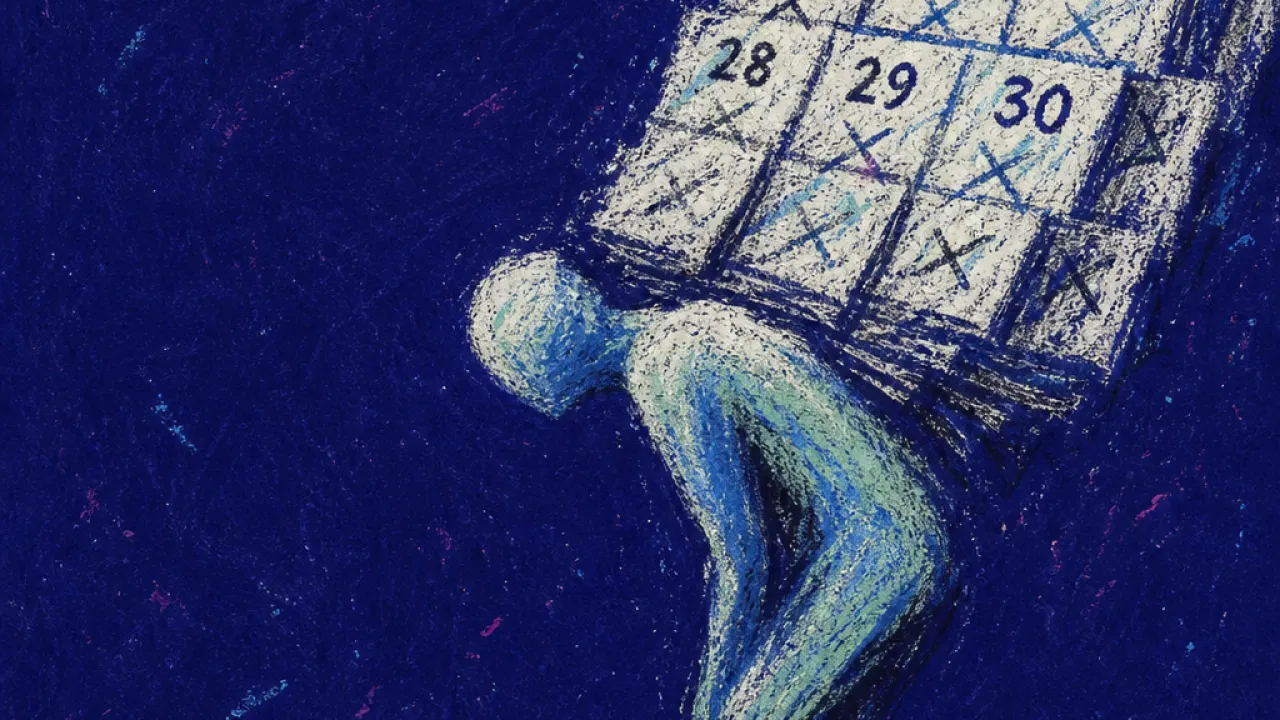
A solitary figure bent toward a glowing time sheet as unseen hands fill calendar blocks and press weight into the shoulders

What is this situation?

Utilization Pressure — you open your laptop on Monday morning and your calendar is already being treated like a public scoreboard. Before you have even answered your first message, there is a staffing sheet, a time-tracking tool, or a manager asking what you are booked to and whether your hours are "covered." The work itself may be demanding, but the heavier part is the constant requirement to prove that every hour has a destination: client work, internal work that still needs explaining, meetings that count only if someone agrees they count. A quiet afternoon does not feel like breathing room; it feels like a gap someone might notice. You start accepting calls you do not need to be on, stretching tasks so they look properly allocated, refreshing dashboards, and doing the second job of making your work appear usable to the system. People above you talk about capacity, targets, billable percentages, and resourcing as if they are neutral numbers, while you are the one rearranging your day around them, eating lunch near your keyboard, and feeling your shoulders tighten before you open the time sheet. By the end of the week, the exhaustion is not only from what you produced; it is from being converted into a metric that must stay full, much like the figure on the Eight of Pentacles, fixed at the bench while one coin after another demands the same exacting attention.

Why it's not you?

The problem is not that you are lazy, inefficient, or failing to manage your time well enough. Utilization Pressure is built into systems that treat unassigned hours as a problem to be explained, even when the workload, staffing pipeline, and approval process are outside your control. When every gap has to be defended, the pressure belongs to the structure around you, not to a personal flaw.

Utilization Pressure in Tarot Cards

Utilization Pressure turns your workday into a quota-driven environment where every quiet hour starts to look like evidence against you. The tight shoulders that show up before opening the time sheet are a body-level response to an environmental, structural dynamic built around constant allocation and visibility. The cards below are not instructions about how hard to work or whether to push back; they reflect the shape of a system that keeps measuring your worth through billable time. Here are the Tarot Cards that tend to mirror this kind of pressure.

The Devil
Upright
Two figures stand beneath a larger authority figure, joined by chains that sit visibly loose around their necks. In a utilisation-driven workplace, the scene maps to a metric that has expanded beyond capacity planning and begun to organise identity: a full calendar reads as legitimacy, while an unassigned hour reads as a personal shortfall. The chains are important because they show constraint without claiming total inevitability. Client demand, staffing access, and managerial scorecards create material stakes, but the added belief that every quiet period proves inadequacy is a separate layer produced by repeated measurement. The image names that fusion so it can be examined precisely. It reveals the system's incentive structure and the internal rule it can teach, allowing professional standards to be assessed without handing a billable percentage the authority to define the whole person.
Two of Pentacles
Reversed
The juggler keeps two pentacles moving within a continuous loop while ships rise and fall on active water behind them. Reversed, the movement reflects a planning cycle in which the calendar never quite settles: one week requires a justification for a gap, and the next requires an abrupt reshuffle to absorb new demand. This is not merely a busy period. The visual instability maps to the mismatch between a recurring utilisation clock and the less predictable clock of client work, approvals, and staffing supply. The image gives the timing pressure a concrete boundary. It distinguishes a moment when work genuinely needs rapid reprioritisation from a metric cycle that manufactures urgency simply because available capacity is visible.
Three of Pentacles
Reversed
Inside the cathedral worksite, a craftsperson faces two figures who hold plans and stand in an evaluative position. Reversed, the scene reflects collaboration that has become overly mediated by staffing sheets, time categories, and external judgments about who is sufficiently used. A utilisation dashboard can alter the social ecology of a team. Access to desirable work becomes tied to status and security, while colleagues may feel pressure to protect assignments, add themselves to calls, or compare whose time is considered billable. The disrupted worksite names the group-level cost without assuming bad intent from any individual. It shows how a measurement system can weaken coordination by making visible allocation compete with the quieter work of sharing knowledge, giving credit, and building trust.
Six of Pentacles
Reversed
A wealthy figure holds a balance scale above two people receiving coins, making the allocation of resources visibly unequal. Reversed, that exchange maps onto a workplace where managers and staffing systems decide who receives work while the person below must explain the consequences of not receiving enough of it. Utilization pressure becomes sharper when the scorecard treats access to billable work as though it were individually controllable. The scale reveals the structural mismatch between being measured on a result and having limited influence over the pipeline, client demand, or approvals that generate that result. The image makes the power distribution inspectable. It distinguishes a genuine development question, such as how work is positioned or communicated, from a resourcing problem that needs to be named at the level where assignments and targets are actually set.
Seven of Pentacles
Reversed
A worker pauses on a tool beside a vine carrying seven pentacles, positioned between labour already invested and a harvest not yet complete. Reversed, that pause can be denied by a workplace that requires each week to show an immediately billable return, regardless of how work, clients, and professional relationships actually develop over time. The card exposes a conflict between cultivation time and reporting time. Internal work, business development, preparation, and recovery may support future output, yet a narrow utilisation target can classify them as a suspicious gap unless someone authorises them. The field makes the missing time horizon visible. It helps distinguish a genuine need to review priorities from an institutional impatience that treats any value not visible this week as though it has no value at all.
Eight of Pentacles
Upright
Seated at a workbench with a tool in hand, the craftsperson faces a vertical run of finished pentacles while another waits to be completed. The repeated unit of output mirrors a utilization model in which a calendar is not simply a planning tool but a ledger of whether your labour can be counted, allocated, and defended. Upright, the bench makes your actual competence visible, but it also shows how sustained craft can be narrowed into throughput. You may be producing useful work while also carrying the hidden labour of coding time, attending unnecessary calls, and making activity legible to people who only see the allocation field. The card separates disciplined work from the system that measures it. That distinction gives you a clearer audit point: a gap in the staffing sheet is evidence about pipeline design and resource control, not automatic evidence that your professional value has diminished.
Reversed
At the same narrow bench, the craftsperson is surrounded by pentacles that invite counting as much as making. Reversed, the repeated task can become detached from its practical purpose: hours are stretched, meetings are added, and internal work requires a justification trail before it is allowed to register as legitimate. The obstruction is not that the worker has stopped caring about standards. It is that a metric-first environment redirects effort from building, solving, or learning toward maintaining a convincing pattern of occupied time. This image names productivity theatre without reducing it to personal dishonesty. When the system gives an unassigned hour the status of a problem, it creates predictable incentives to optimise for dashboard visibility rather than for the substance of the work.
Eight of Swords
Upright
Blindfolded and loosely bound, the figure stands within eight upright swords while an exposed castle sits beyond the muddy ground. The surrounding barriers mirror the mental compression that can occur when a staffing sheet or time-tracking dashboard makes every unallocated hour feel like visible evidence against you. The bindings are real enough to restrict movement, but they are not the entire environment. In this context, the card distinguishes the actual limits of managerial targets, pipeline uncertainty, and approval rules from the additional conclusion that you alone must repair every gap. That distinction creates room for a more accurate internal audit. The scene names hypervigilant self-monitoring as a predictable response to external scorekeeping, while keeping the structural source of the pressure in view.
Ten of Wands
Upright
The figure carries ten long wands so tightly bundled that the load blocks the path ahead, even as a settlement is close by. That physical compression mirrors the compound burden of client delivery, administrative coding, staffing updates, and the constant need to make each hour appear covered. The load is made of separate demands that have been bundled into one role. A meeting invitation, a dashboard refresh, a lunch taken beside the keyboard, and an extra explanation for internal work can each look minor, yet together they consume the margin that would normally support judgment, recovery, and career development. The visible burden locates the pressure in job design rather than character. It lets you examine which parts of the load are actual commitments and which exist because the utilisation system has shifted its coordination cost downward onto the individual worker.

Utilization Pressure in Tarot Card Reading Insights

When Utilization Pressure makes every gap in your calendar feel like something that has to be defended, other people bring that same metric-driven strain into readings. The focus shifts from the cards themselves to what came up when this kind of work pressure was placed on the table. Tarot Reading Insights from sessions shaped by utilization targets, billable hours, and constant visibility.


Psychological Contexts Related to Utilization Pressure