One Chapter, 25 Minutes: From Sunk-Cost Study Delay to Recall Evidence

The 9:07 p.m. Loop: Sunk-Cost Procrastination After Months of Investment
If your 9 p.m. study block begins with a new retrieval-practice template and ends with renamed folders, two tutorial videos, and no completed trial, I know how convincingly that routine can disguise itself as responsible preparation.
At 9:07 on a Tuesday evening, Alex (name changed for privacy) joined my video call from the narrow kitchen table in their Toronto rental. A retrieval-practice template glowed on one side of their laptop screen; months of linked notes filled the other. The radiator clicked behind them, the laptop fan whirred, and a mug of tea had gone cold beside their wrist. While we spoke, their cursor hovered over Rename on a Week 6 folder.
Alex was 24, non-binary, and working through a demanding postgraduate programme in which weekly readings never seemed to respect the limits of an actual human week. They had spent months building a polished digital note system. Now they wanted to test active recall, but every planned start dissolved into the same sequence: I’m preparing responsibly. I need one more comparison. There isn’t enough time to start properly now. Next week will be cleaner.
“I want evidence before I begin,” Alex told me, pressing both palms against the edge of the table, “but I can’t get evidence without beginning. And if the new method works better, what does that say about all the time I spent?”
There it was: the desire to try a more effective study method pulling in one direction, and the fear that changing course would make the existing investment feel wasted pulling in the other. I recognised sunk-cost procrastination when testing a new study method after months of investment, but I did not hear laziness or a lack of discipline. I heard someone trying to protect their sense of competence while assessment pressure, tuition, rent, and a crowded archive made every experiment feel financially and emotionally charged.
The frustration sat across Alex’s shoulders like a rain-soaked backpack they had forgotten they were still wearing. Each time they prepared to begin, the straps seemed to tighten: jaw set, breath shallow, upper body braced for a decision that should have been no larger than one study session.
“We’re not going to ask the cards to declare one method the winner,” I said. “That would only build another authority outside you. I’d rather use them to tidy the problem: what you do, what triggers it, what you’re protecting, what resource you already have, and what small test could produce real information. Let’s make a map of this fog, then you decide what deserves your next hour.”

Choosing the Compass: The Five-Card Shadow Spread
I asked Alex to put both feet on the floor, take one unforced breath, and hold a single question in mind: Why do I keep delaying a new study method after investing so much? I shuffled slowly, not as a performance of mystery, but as a clean psychological transition from looping thoughts to focused observation.
I chose The Shadow Spread · Context Edition, a five-card contextual Shadow Spread. I use this compact layout when a problem is narrow but self-reinforcing. A larger spread can generate more material than the question needs; this one follows a precise chain from visible behaviour to trigger, hidden fear, constructive resource, and practical action.
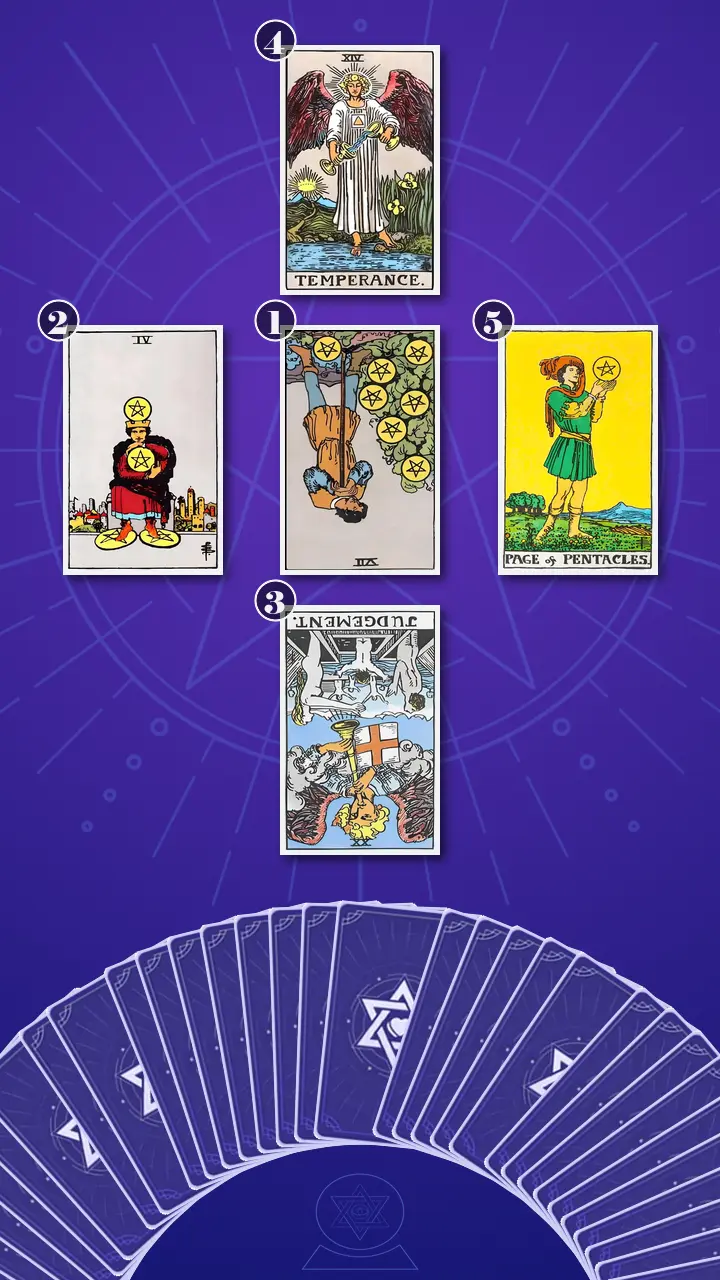
I placed the first card at the centre for the repeated preparation and rescheduling that had replaced a real trial. The second went to its left for the previous investment that activated the protective response. The third sat below the centre for the deeper fear about judgement and control. Above them, the fourth would show the resource capable of turning an all-or-nothing decision into a measured experiment. The fifth went on the right for one bounded action that could generate present-day learning evidence.
From my side of the table, the cross looked like a small compass. I told Alex that it would offer direction rather than a fixed destination. Tarot can organise perceptions, expose assumptions, and help card meanings land in context; it cannot make a study decision on someone’s behalf. That distinction mattered here because Alex already felt crowded by productivity advice from classmates, YouTube explainers, Reddit threads, and polished StudyTok setups.
Reading the Weight Stored in the Archive
Position One: When Evaluation Replaces Studying
I turned the card representing the diagnosis-level behaviour: repeatedly preparing, rescheduling, and evaluating instead of completing a trial session. It was the Seven of Pentacles, reversed.
I pointed to the figure leaning on the hoe, attention fixed on the accumulated pentacles while the next useful movement remained suspended. “This is your 9:07 p.m. routine in one image,” I said. “You open months of organised notes, check progress records, rename two folders, and recalculate the setup cost of switching. When the archive has been sufficiently reviewed, only twelve minutes remain, so the trial moves to next week.”
I read the reversal as a blockage in practical Earth energy, intensified by an excess of evaluation. Assessment is supposed to guide work, but here it has quietly occupied the place where the work should happen. The question Is this worth changing? cannot be answered because every attempt to evaluate the method prevents the test that could supply an answer.
Alex did not nod. They gave one short, bitter laugh and looked at the cold tea. “That’s painfully accurate. Like, almost rude.”
“It would be rude if I used the card to blame you,” I said. “I’m using it to separate the pattern from your character. You’re not failing to work. A protective setup ritual is consuming the time assigned to learning. That is a mechanical problem we can observe.”
Their fingers stopped tapping the trackpad. After a moment, I asked, “During the last trial you planned, what happened between opening the material and deciding there wasn’t enough time left?”
“I watched an active-recall-versus-note-taking video,” they said. “Then I changed my folder structure so it would be compatible with the method I still hadn’t tried.”
I watched their shoulders move down by perhaps half an inch. Recognition had arrived without shame, which gave us room to continue.
Position Two: The Archive That Pins Down the Next Move
I turned the card for the sunk-cost trigger and the concrete behaviour used to protect the previous investment. The Four of Pentacles, upright, appeared.
I traced the pentacle clasped against the figure’s chest, then the two beneath the feet. “What the figure protects also prevents the figure from moving,” I said. “For you, those pentacles can be folders, paid resources, colour-coded notes, saved templates, or the months spent learning how to maintain the system.”
I connected it to the moment a classmate recommends a different method and Alex immediately opens the old dashboard, subscription history, and note archive. Deleting nothing feels prudent. Yet even changing one step begins to feel like forfeiting the effort stored inside it, so Alex returns to the familiar workflow before a new result can enter the decision.
This was an excess of preservation: practical Earth contracted so tightly around security that it became immobility. The old materials were not inherently bad, and I had no interest in telling Alex to delete them. The problem was the untested assumption that preserving their value required preserving the entire workflow unchanged.
“Past effort is data, not a debt collector,” I said. “It can teach you what you value and what you have learned. It does not get to demand another inefficient week merely because it already received several months.”
Alex’s jaw tightened first. Their eyes travelled from the card to the second laptop window, as though they were seeing the archive as an object rather than an extension of themselves. Then their hand relaxed against the mug.
“If I loosen my grip, the value might disappear,” they said quietly.
“What if the value is portable?” I asked. “Which part would you genuinely keep if the system had cost nothing and you had built it yesterday?”
Alex answered almost immediately. “The topic headings. They help me see how the seminar material connects. I don’t think I need the dashboard, though. I mostly maintain it because it took forever to make.”
That distinction was our first usable opening: a helpful structure could travel forward without requiring the entire system to come with it.
Position Three: When Feedback Sounds Like a Verdict
I turned the card representing the hidden fear that changing methods could expose poor judgement and weaken Alex’s sense of control. It was Judgement, reversed.
I showed Alex the trumpet and the figures answering its call. Upright, I often read the image as an invitation to review and respond. Reversed here, the signal was still audible, but it had been filtered through self-criticism. Which method supports recall? had become How could you have chosen so badly?
I described the comparison document Alex had begun and then closed when a possible result started to feel like a performance review of their intelligence. In their mind, a better outcome from the new method would not merely update a workflow. It would turn the previous choice into evidence against the person who made it.
Judgement’s reviewing energy was in blockage. Useful self-assessment had become self-prosecution. The spreadsheet was functioning like a private episode of The Good Place, with every practical variable converted into a score about whether Alex had been competent enough all along.
For a moment, I remembered other conversations held over coffee during my twenty years of reading: small course corrections presented like confessions, as if changing a tool required someone to put their former self on trial. I knew the look that followed. People often find it easier to tolerate ongoing friction than to face an imagined indictment of who they were when they made the original choice.
“You are evaluating a tool, not cross-examining your intelligence,” I said. “A method can be less useful for your current needs without your past self becoming the mistake.”
Alex’s breathing paused. Their gaze slipped out of focus, and I could see them replaying something behind their eyes. When they looked back at the card, the muscles around their mouth had softened, but their eyes were wet.
“I think I’ve been trying to prove I was right,” they said, “because admitting the system isn’t helping enough feels like admitting I should have known better.”
“Knowing better is often the result of testing,” I replied. “It is not an entry requirement.”
When Temperance Moved Water Between Two Cups
Position Four: The Resource Hidden Inside the Standoff
The radiator clicked once and fell silent. In the sudden quiet, the two panes on Alex’s screen reflected faintly in the surface of their cold tea, like a pair of competing windows waiting for a verdict.
I turned the card representing the integrative resource that could transform an all-or-nothing choice into a measured learning experiment. We had reached the key card: Temperance, upright.
I asked Alex to picture the setup loop once more. It was 9 p.m.; the retrieval-practice template sat beside months of polished notes. One more folder was renamed, one more comparison played, their shoulders braced, and the study block disappeared into preparation.
Then I drew their attention to the water flowing between the two cups and the angel standing with one foot on land and one in water. Temperance was not asking Alex to acquit one system and convict the other. Its energy was in balance: patient transfer, proportion, and adjustment through experience.
This was where I used a lens I call Syllabus Deconstruction. When a massive deadline becomes emotionally fused with identity, I strip it into mechanical tasks that do not need to carry a verdict. I applied the same process to “changing study methods.” That phrase sounded permanent and enormous. Its actual components were much smaller: keep the useful topic headings, test three closed-book prompts, and measure one recall result after ten minutes.
I framed it as a controlled software rollout rather than a total migration. Alex did not need to delete the stable features, defend every old setting, or announce a new identity as an “active-recall person.” They only needed to let one new function complete one real task.
The old investment does not need to be condemned; test a blended approach in measured doses, as Temperance moves water between two cups.
I let the sentence remain between us. Then I made it even plainer: “Past effort does not have to win the argument to remain useful. Keep what still helps, test what might work better, and let present evidence decide the next step.”
Alex froze with one hand still touching the trackpad. Their breath stopped high in their chest, their pupils widened, and a flush moved across their cheeks before they pulled their hand back. For several seconds, their eyes moved between the two cups as though old scenes were replaying there: the Sunday planning block at Robarts Library, the folders renamed under fluorescent light, the three awkward minutes of retrieval abandoned for highlighting. Then resistance arrived before relief.
“But doesn’t that mean I was wrong before?” they asked, the words sharper than anything they had said so far.
“It means you made a choice with the information and needs you had then,” I replied. “Now you are allowed to collect new information. Calibration is not a confession.”
Their fingers curled once into their palm, then slowly opened. Their gaze lost focus again, but this time their shoulders lowered with a long breath that trembled at the end. Their eyes reddened. A small, almost incredulous “Oh” escaped them, followed by a quieter admission: “Then I don’t have to make the old method lose. But I do have to run the test.”
I heard both release and new vulnerability in that sentence. The burden of proving the past had loosened, but clarity had left Alex holding the ordinary responsibility of choosing a next action. They looked briefly unsteady, like someone who had set down a heavy bag and needed a moment to remember their own balance.
“Now, using this new perspective, can you think of a moment last week when this insight might have made you feel different?” I asked.
“Sunday at Robarts,” they said. “I could have kept the headings and put retrieval questions underneath. I thought the choice was rebuild everything or change nothing.”
I named the crossing we had just made: from frustrated, guilt-laden setup paralysis toward curious experimentation and grounded, evidence-based self-trust. It was not a completed transformation or a promise that the new method would win. It was the first shift from protecting an old investment to allowing current learning evidence into the room.
Position Five: The Page’s One-Chapter Beta
I turned the final card for the bounded practical action that could produce evidence without demanding permanent commitment. It was the Page of Pentacles, upright.
I pointed to the Page holding one pentacle at eye level. Across the spread, seven pentacles had been accumulated and assessed, four had been gripped so tightly that movement stopped, and now one was being studied with steady attention. The quantity had decreased while genuine engagement had increased.
In Alex’s life, the image became one seminar chapter, one 25-minute timer, three closed-book prompts, and one recall result checked after a ten-minute break. The comparison tabs would remain closed. The wider system would not be redesigned. Any awkwardness would count as beginner-level data rather than proof that the experiment had failed.
The Page brought practical Earth back into balance. The spread contained no Wands, so I did not advise Alex to wait for a dramatic burst of motivation. A calendar appointment and a timer could supply the missing initiation more reliably than inspiration. The Page’s message was modest: My job tonight is not to choose my forever system; it is to learn one thing about one method.
“Evidence cannot arrive before the experiment,” I said. “And a fair trial is not a permanent subscription.”
Alex reached for their phone, opened the calendar, and chose a block before the end of the week. Their thumb hovered over the event title. This time they did not type Start new method. They wrote One-chapter beta.
Keep, Test, Measure: From Tarot Insight to Actionable Advice
The Blind Spot Beneath the Perfect Setup
I gathered the five cards into one story. The Seven of Pentacles reversed showed Alex reviewing stored effort until evaluation replaced studying. The Four of Pentacles revealed why the archive became difficult to alter: holding it unchanged preserved a temporary sense of security. Judgement reversed exposed the fear beneath that grip, where feedback about a workflow became a verdict on intelligence. Temperance restored movement by carrying useful material between old and new. The Page of Pentacles grounded that integration in one observable task.
The core metaphor I gave Alex was a delayed transit route. They had been standing at the entrance to an alternate route while guarding the fare already paid for the old one. The fare did not need to be recovered by remaining delayed. Useful knowledge from the journey could come with them, and one stop on another route could be tested without deciding every future commute.
The cognitive blind spot was mistaking protection of the previous investment for responsible evaluation. Renaming folders, expanding comparison criteria, and waiting for a clean Monday felt careful, but those actions prevented the only evidence capable of informing the decision. The transformation direction was therefore specific: move from defending past effort to observing present learning, while keeping the experiment optional, reversible, and small.
The Next Study Block: A Carry-Forward Experiment
I combined Temperance’s Keep-Test-Measure structure with two low-pressure actions. Before the trial, I also introduced my Study Environment Auditing lens: every open dashboard, tutorial tab, and visible archive was asking for a small piece of Alex’s attention. The solution was not a more aesthetic workspace. It was a temporary reduction in competing decisions.
- The Desktop Reset RitualAt the kitchen table or Alex’s usual library seat, set a 15-minute timer before opening the chapter. Clear the physical surface and close every digital window except the chapter, a blank page, and a timer. Write three lines on a sticky note or phone note: Keep, Test, Measure. Under Keep, name one useful part of the old system. Under Test, write one retrieval step. Under Measure, choose one result, such as recall after ten minutes.This reset is physical and finite: no renaming folders, changing settings, or watching setup videos. On a depleted day, use a five-minute version and stop after writing one prompt.
- The One-Chapter, 25-Minute Evidence LoopChoose one seminar chapter by name and place a start and stop time in the calendar before the end of the week. Keep the old topic headings, close the material, and answer three retrieval prompts for 25 minutes. After a ten-minute break, privately record the topic, the method used, and what was recalled without looking. Finish with only two questions: What helped current recall? What created unnecessary friction?Use one prompt and a ten-minute attempt if the full version feels too exposed. Add no new comparison criteria during the trial, and make no permanent system decision until a separate study block.
I told Alex that both actions were options, not instructions they had to obey. They could stop after one prompt, modify the trial, or close the file entirely. Their old archive would remain intact. Tarot had helped us expose the mechanism and design a fairer question, but the decision, the boundary, and the next move belonged to Alex.
A Week Later: Evidence, Not a Verdict
Six days later, I received a message from Alex. They had completed the Desktop Reset Ritual, although they admitted that resisting the folder menu felt “weirdly physical.” They kept the old topic headings, tested three closed-book prompts for one chapter, and checked their recall after ten minutes.
The result was not a cinematic breakthrough. Two prompts brought back more detail than Alex expected; the third was too broad and left them staring at the page. Instead of redesigning the whole system, they wrote: Narrow the third prompt next time. Then they scheduled a second trial.
Nothing had been deleted. The old notes were still there, and active recall had not been crowned the forever method. What changed was the source of authority: Alex now had one piece of direct evidence that belonged to them, not to a classmate’s productivity post, a YouTube comparison, a tarot card, or the frightened voice insisting that certainty had to come first.
That night, they slept through until morning. Their first thought was still, What if I’m wrong? They told me they smiled, opened the recall note, and answered, Then I’ll have one more data point.
I think of that message as the quiet proof of our Journey to Clarity. The cards did not solve Alex’s study system or predict which method would prevail. They helped us turn a heavy, identity-charged decision into a structure Alex could inspect, test, and revise. Alex supplied the courage to begin imperfectly and the judgement to decide what the result meant.
If your shoulders also brace when an old archive opens beside a new method, I hope you remember what I watched Alex discover: noticing the tug between wanting to learn differently and needing past effort to prove you were in control means you are already beginning to loosen it.
If your past effort could travel in Temperance’s first cup instead of standing trial, what is one tiny part of a new method you feel curious enough to pour into the second cup and test this week?