An Untouched Google Doc, Then One Rough Heading Before Urgency

The 9:30 p.m. Blank-Document Spiral
If you are a capable Toronto undergrad who can spend the first hour of a protected study night reorganising Notion while the assignment document stays blank, you probably know productive procrastination from the inside. Maya (name changed for privacy), a 21-year-old undergraduate carrying a full course load, brought that exact pattern into our consultation.
She took me back to 9:30 on a Tuesday night in her Toronto bedroom. The assignment brief sat open beside an untouched Google Doc while she colour-coded her calendar, replied to course messages, and calculated how late she could begin tomorrow without technically falling behind. The radiator clicked. Her laptop fan pushed warm air across her wrist. Her shoulders kept creeping towards her ears.
“I work better under pressure,” she told me, rubbing the heel of one hand against her chest, “but I hate what pressure does to me. I want enough time to write something thoughtful. Then I open the prompt, realise I do not have one clear idea, and suddenly email feels urgent.”
A WhatsApp notification had arrived during that study night: “Just submitted, good luck everyone.” Maya had put her phone face down, checked her own deadline again, and decided tomorrow still looked spacious. The decision gave her a few clean minutes of relief. Underneath it, shame moved like heat beneath a closed door.
The dread she described was not a vague cloud. It was more like standing barefoot at the edge of an icy pool, every muscle recoiling before the first contact, while a clock behind her quietly counted down to the moment someone would push her in. She wanted a calm, thoughtful week, but the discomfort of one uncertain sentence kept making the opposite inevitable.
I said, “I do not hear a student who does not care. I hear someone who cares so much about the quality of the work that beginning badly has started to feel like a verdict. Busy is not the same as begun, but the busyness is doing something important: it is protecting you from that verdict for another ten minutes.”
I explained that I would not use tarot to predict her grade, diagnose her, or declare a fixed trait. I use it as an objective reflective structure, a way to place visible behaviour, hidden assumptions, available resources, and practical next steps where we can examine them together. “Let us make a map of the fog,” I told her. “You will decide what on that map is true and what you want to do with it.”

Choosing the Four-Layer Insight Ladder
I invited Maya to take one unforced breath and hold a single question in mind: “Why does starting before the deadline feel harder than surviving the deadline?” I shuffled slowly, not as a supernatural performance, but as a deliberate transition from reacting to the problem toward observing it.
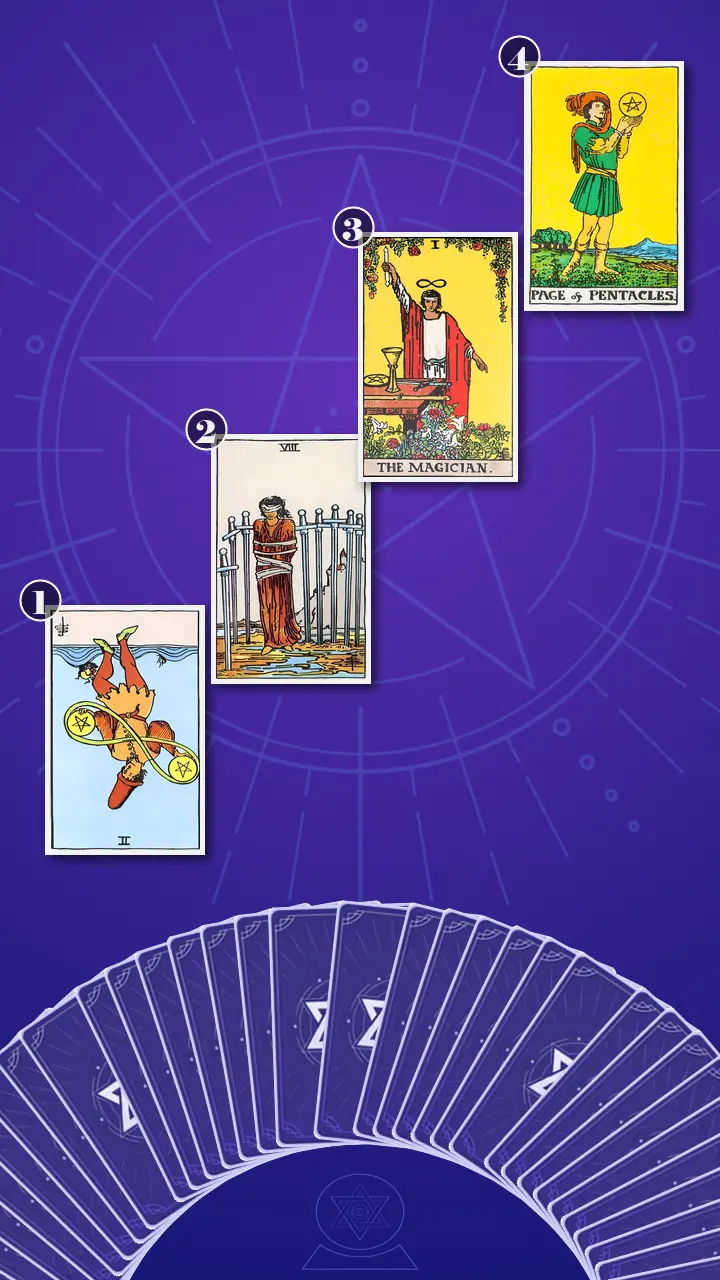
I chose the Four-Layer Insight Ladder, a focused four-card tarot spread for academic procrastination and deadline anxiety. A larger spread could have introduced more context, but Maya was not choosing between two assignments or asking what outcome fate had prepared. She was tracing one repeated protection strategy from the surface down to its root, then looking for the smallest point where she could interrupt it.
For anyone wondering how tarot works in a reading like this, I treat card meanings in context as structured prompts. The first position shows the observable pattern. The second reveals the fear or readiness rule maintaining it. The third identifies the inner resource that can change the pattern. The fourth grounds that resource in a repeatable practice. The cards do not outrank Maya's lived experience; they give us four angles from which to question it.
I placed the cards in an ascending diagonal from the lower left to the upper right. The first two formed the problem-analysis pair. The third marked the threshold, where waiting for pressure could become deliberate initiation. The fourth held the practical integration. On the table, the layout looked like a short staircase built out of the very cycle that had been keeping her in place.
Reading the Loop Beneath the Colour-Coded Calendar
Position 1: Motion Without Contact
Now I turned over the card representing the surface diagnosis: Maya's observable pattern of juggling tasks, repeatedly checking deadlines, and allowing assignments to become urgent before beginning. It was the Two of Pentacles, reversed.
I pointed to the two coins caught in an infinity-shaped ribbon and the ships rising and falling on steep waves behind the figure. In Maya's life, the image was almost literal. At 9:30 p.m., she moved from Brightspace to a colour-coded calendar, from the calendar to WhatsApp, from WhatsApp to several assignment tabs, and then back to the due dates. Every switch lowered the discomfort briefly. Meanwhile, the deferred assignments rose together like the ships in the background.
The reversed Earth energy showed an excess of practical motion and a deficiency of stable contact. Maya was not inactive. She was using considerable attention, but it was scattered across activities that felt finishable and emotionally safer. Reformatting a tracker produced a neat result. Answering a message closed a loop. A first paragraph could expose uncertainty, so the blank document remained untouched.
I asked, “During the first forty minutes of that study night, which actions actually moved an idea into the assignment?”
Maya let out a short laugh with no amusement in it. Her fingers stopped circling the edge of her mug, her eyes flicked towards the cards, and one shoulder lifted as if she had been caught. “That is too accurate,” she said. “Almost cruel. I was doing a lot, so I kept telling myself it counted.”
“I can see why this lands sharply,” I said. “But the card is not calling you lazy or disorganised. It is helping us separate motion from contact. The calendar, the messages, and the dashboard are real tasks. The question is whether they move this draft or reduce the discomfort of seeing it blank.”
I traced the infinity ribbon with one finger. “The loop is not simply delay, then panic. It is uncertainty, productive avoidance, temporary relief, compressed time, frantic competence, and then relief again when you submit. Because you usually pull it off, the loop can look both unbearable and dependable.”
Position 2: The Readiness Rule Around the Blank Page
Now I turned over the card representing the psychological mechanism beneath the delay, especially the belief that uncertainty or a weak first attempt would expose inadequate ability. It was the Eight of Swords, upright.
I drew Maya's attention to the blindfold, the loose bindings, and the incomplete enclosure of swords. I did not describe the figure as helpless. The discomfort was real, but the prison was not sealed.
In Maya's modern study scene, the document was open. The rubric was accessible. Her notes existed. Time was still available, and she could have asked a teaching assistant for clarification. Yet three rules made those resources feel unavailable: “I need the whole argument first.” “The first page cannot be bad.” “If I struggle early, I may not be as capable as people think.”
This was overdominant Air becoming a blockage. Thought, which could have helped her test an idea, had been recruited to prevent the test. It was like treating an anxious pop-up saying “You need the whole argument first” as a system requirement instead of a notification she could question. Each time a deadline check brought relief, her personal algorithm learned to recommend another check.
I told her that I use what I call Research Bottleneck Analysis when a student or writer appears unable to move. On archaeological digs, packed soil is not a moral failure by the person holding the trowel. It is information about where pressure, material, or method has changed. In academic work, a bottleneck often marks the exact place where an untested assumption is carrying too much weight.
“So let us excavate the rule rather than judge the delay,” I said. “The last time you deleted a first sentence, what did that sentence seem to prove about you?”
Maya's jaw tightened. Her fingertips pressed into the mug, then loosened. She looked past me for several seconds before answering. “That maybe I do not understand the course as well as everyone thinks. If I start early and still struggle, what does that say about me? At least when I start late, there is a reason it is messy.”
That distinction mattered. The approaching deadline gave her imperfect work an alibi. It also made revision nearly impossible, strained her chest and shoulders, and sometimes pushed food, sleep, or a shower outside the narrow tunnel of concentration.
“A rough first page is evidence of contact, not evidence of ability,” I said. “You are allowed to discover that an idea does not work. That is not the assignment exposing your worth. That is the assignment becoming learnable.”
When the Magician Put the First Sentence on the Table
Position 3: Focused Agency Before Readiness
The room became unusually still before I turned the third card. A radiator pipe clicked once in the wall, echoing the sound from Maya's Tuesday-night description, and then even the traffic beyond the window seemed to recede.
Now I turned over the card representing the key transformation from waiting for pressure to using available resources for one deliberate first action. It was The Magician, upright.
The Magician raised one hand while directing the other towards the ground. A wand, cup, sword, and pentacle rested on the prepared table. In Maya's life, those tools became the assignment prompt, her current notes, a plain draft document, and a fifteen-minute timer. She did not need the final argument on that table. She needed one available idea she could turn into visible material.
The card's energy was balanced rather than excessive or deficient. Fire supplied the willingness to initiate. Water allowed discomfort to be present without making it the decision-maker. Air shaped one provisional thought. Earth gave that thought a heading, a bullet, or a sentence. The Magician did not wait for all uncertainty to disappear; the figure directed what was already available into form.
Maya had been caught inside the demand to make the correct beginning, as though the first paragraph had to contain a miniature version of the finished essay. Tomorrow looked spacious until the red countdown made any sentence safer than no sentence. Pressure did not add knowledge. It simply removed her permission to hesitate.
Looking at the prepared table, I reached for my Academic Stratigraphy framework. On a dig, I never expected the first pass of a trowel to reveal an entire civilisation. The first trench created a readable section. Fragment by fragment, layer by layer, the structure emerged because contact had begun.
“Your prompt is the boundary of the site,” I told her. “Your notes are the finds already on the surface. The blank document is not a stage where you must perform expertise. It is the first trench. Your bottleneck comes from demanding that the first movement of the trowel explain the whole city.”
I gave her the central message of the card without softening it:
Urgency is not your source of power; one deliberate first move is, and the Magician's prepared table shows that you can begin with what is already available.
I let the words remain between us for a moment. Then I stripped away the archaeological language and said it once more:
Urgency is not the source of your ability. It is the moment fear loses its veto; one deliberate, imperfect move can take that veto away earlier.
For one beat, Maya's breath stopped. Her fingers hovered above the mug as if another task had been interrupted mid-command. Then her gaze lost focus, and I watched her face move through what looked like a replay of several late-night library sessions: fluorescent light, cold coffee, a red submission countdown, and the sudden speed she had always credited to pressure. Her pupils widened. Her mouth opened, but no sound came out.
Next came resistance. Her brows drew together, and colour rose into her cheeks. “But does that mean I have been doing it wrong this whole time?” she asked, the words sharper than anything she had said before. “I have wasted so many evenings.” The anger held for a second; then her hands opened on the table. Her shoulders dropped in stages, and she released a long, uneven breath. Relief arrived with a slight physical blankness, the unsteady feeling of setting down a weight and realising she would now have to choose what to do with her free hands.
“It means deadline panic was a strategy,” I replied. “It helped you submit, and it charged you in sleep, revision time, and physical strain. You do not need to prosecute your past self for using the exit she could see. Now, with this new perspective, think back to last week. Was there a moment when this insight could have made the experience feel different?”
Maya looked down at The Magician. “Wednesday afternoon in the library,” she said. “I had the prompt, two articles, and half a sentence. I deleted the sentence because it sounded basic, then searched for more sources for an hour. I thought research would give me the right angle. Maybe the sentence was the angle I needed to test.”
“Exactly,” I said. “Clarity can be an output of action, not its entry requirement. The heading or first sentence is not a declaration that you are right. It is a small experiment that produces information.”
I offered her an eight-minute version while we were still sitting together. I asked her to open one current assignment, use only the brief and notes already available, and type one rough heading plus one deliberately messy bullet. I made the boundary explicit: she could stop when the timer ended, even in the middle of a thought. If the contact felt stronger than she wanted to engage with, the minimum version was one question raised by the prompt, followed by closing the document.
She typed a heading, grimaced, and said, “That is definitely not the title.”
“Good,” I replied. “It is not applying for the job of final title. It has done the job of making the site visible.”
This was the pivotal movement in the reading: not from dread to permanent calm, and not from procrastinator to perfectly organised student. It was one step from deadline-dependent panic and self-evaluative dread towards steadier confidence built through early, revisable contact. Maya still felt the exposure of beginning. The difference was that the discomfort no longer had an automatic veto.
Position 4: The Apprentice Who Returns Tomorrow
Now I turned over the card representing the small, learning-oriented routine that would carry the insight into daily life: an early, time-limited, imperfect start repeated across assignments. It was the Page of Pentacles, upright.
The Page held one pentacle at eye level. Behind the figure lay a cultivated field and a distant mountain. I placed this image beside the reversed Two of Pentacles in my mind: the reading had moved from two unstable demands being juggled in rough weather to one practical object receiving sustained attention.
In Maya's daily life, the card looked like scheduling a ten-minute return before closing the first rough-contact session. The return would name one exact task, such as “expand bullet two with one example.” She would measure whether she came back before the work became urgent, not whether the early draft looked impressive.
The Page brought balanced Earth energy. This was not the Magician's first spark stretched into an all-night session. It was patient contact, a boundary, a pause, and a return. Google Docs version history became part of the symbolism: version one creates material; later versions make that material useful.
“You are allowed to meet the assignment as a student, not perform as its finished expert,” I told her. “Revision is not evidence that the first attempt failed. Revision is the learning process becoming visible.”
Maya tilted her head. “I can imagine doing the first fifteen minutes,” she said, “but I already ignore calendar blocks. What stops this from becoming another nice system I abandon?”
I appreciated the practical objection. “Nothing guarantees that you will use it every time,” I said. “So we do not build a streak, a perfect tracker, or a new identity around it. Before you close the draft, book one return and name one object inside the document. If you miss it, you reschedule or let it go. The Page is practising contact, not collecting proof of flawless discipline.”
I saw Maya nod once, slowly. The movement was smaller than the release at The Magician, but more grounded. “One assignment, one thing to return to,” she said. “Not a rescue plan for my whole semester.”
The Thesis Beneath the Deadline Panic
When I read the four cards as one sequence, the pattern became coherent. Repeated last-minute submissions had taught Maya that panic produced competence, even though the competence had been present before the panic. The reversed Two of Pentacles showed the surface layer: many moving tasks and very little sustained contact. The Eight of Swords exposed the layer beneath it: an imperfect beginning felt like evidence against her ability. The Magician recovered the buried resource, focused agency with tools already available. The Page of Pentacles turned that agency into a bounded practice she could revisit.
The central cognitive blind spot was not simply poor time estimation. Maya had mistaken the removal of hesitation for the creation of ability. She had also treated planning, research, and minor administrative work as neutral preparation, without noticing when those actions were serving temporary relief instead of the draft.
I returned to the image of a fire alarm. Waiting until a deadline becomes urgent can force movement, just as an alarm can make an exit impossible to ignore. But the alarm does not create the door, the legs, or the knowledge of how to leave. Maya's transformation direction was to stop borrowing focus from emergency and begin practising deliberate initiation while uncertainty was still in the room.
To make that shift usable, I adapted my Thesis Stratigraphy Framework into a deliberately small first-contact tool. I asked Maya to treat the prompt as bedrock, a provisional response as the first interpretive layer, and one example or source as the first recoverable artefact. She did not have to excavate the whole essay. She only needed to open a section where the argument could begin showing its layers.
- The 15-Minute Imperfect StartWithin 24 hours of reading the next assignment brief, put one calendar block titled “rough contact” on your phone. At the start, leave only the brief, current notes, and draft document on screen, switch the phone to Focus mode, and close the course dashboard. Complete the sentence “For the next 15 minutes, this assignment seems to be asking me to...” Then type one provisional heading and three imperfect bullets: the core question, one possible response, and one example or source you might test.Stop when the timer ends. The five-minute minimum is one ugly heading and one bullet; the gentlest version is one question raised by the prompt. This session is for contact, not completion or proof of ability.
- The Scheduled ReturnBefore closing the first session, book a separate 10-minute return for the following day. Name the exact item you will revisit, such as “expand bullet two with one example.” During that return, highlight one usable phrase and turn it into 75 to 100 words without editing the opening sentence first.Keep this smaller than a productivity system. Use no streak and no penalty for a missed day. You may stop at 10 minutes; the minimum version is reopening the draft and adding one sentence to any bullet.
I told Maya that neither action was a command from the cards. They were experiments generated from the pattern we had observed. She could shorten the timers, change the tools, ask for academic support, or reject the framework if her direct experience showed that something else worked better. Tarot had helped us arrange the evidence. The authority to interpret and act on it remained hers.

A Week Later: One Line Before the Alarm
Five days later, I received a message from Maya. She had opened a sociology prompt three days before its deadline, completed twelve minutes of rough contact, and booked a return labelled “find an example for bullet two.” The heading was still clumsy, she told me, but the document was no longer blank.
That night she slept through. In the morning, her first thought was, “What if it is still bad?” She told me she laughed, opened the existing draft, and added one sentence. The doubt had not vanished; it simply no longer had the room to itself.
I did not read her message as proof that procrastination had been solved or that every future assignment would begin early. I read it as a small, credible piece of evidence: she had acted before urgency, returned to material that already existed, and experienced revision as learning rather than exposure.
That was the quiet result of our Journey to Clarity. The cards did not write the heading, silence the group chat, or place the return block in her calendar. Maya did. Tarot gave us a staircase through the pattern, but she was the person who chose to climb one step while her legs still felt uncertain.
If tonight your blank document tightens your chest because you want time to do thoughtful work, while beginning badly feels so exposing that you wait for panic to become louder than self-evaluation, I hope you remember the first trench on The Magician's table. Simply noticing the pull between care and self-protection means you are no longer standing at an untouched site.
If one rough line were allowed to count as a real beginning, what might you be curious to place in that first trench before urgency arrives?