Moving the Study-Reset Date, Then Returning With One Small Block

Finding Clarity at the 8:47 P.M. Study Reset
If you are a Toronto undergrad preparing for an academic comeback, I may already know the Sunday-night move: rebuilding a Notion timetable after seeing a classmate's library Story, then shifting Monday's first block before Monday has even arrived.
Jordan, a 22-year-old non-binary student, joined my video call at 8:47 on a Tuesday evening. Behind them, the radiator hissed in their small apartment near campus. Their laptop fan pushed warm air across one wrist while their other hand held a phone that had become hot from study-reset videos. On-screen, they renamed two course folders, dragged a calendar block from Wednesday to Monday, and left the Quercus portal unopened in the next tab.
They wanted the reset, so they kept preparing for it. They feared what beginning might reveal, so preparation kept the start safely in the future. Their apprehension sat across their chest like a TTC train door that might close the second they tried to step through; their arms looked weighted down by wet winter sleeves, yet their fingers kept darting toward the phone.
“I keep calling it preparation, but I am still not starting,” Jordan said. “What if the reset proves I can't keep going?”
I let that question settle without trying to cover it with motivation. “I don't hear laziness in what you've described,” I said. “I hear someone trying to protect themselves from turning one difficult study session into a judgment about their whole academic direction. Let's give that pattern a shape. We can make a map of the fog without pretending the map gets to choose your route.”

Choosing a Map for the Moved Start Date
I invited Jordan to place both feet on the floor, take one slower breath, and hold a single question in mind: “Why do I keep delaying the study reset I say I want?” I shuffled slowly. The pause was not a mystical performance; it was a practical transition from rehearsing the problem to observing it.
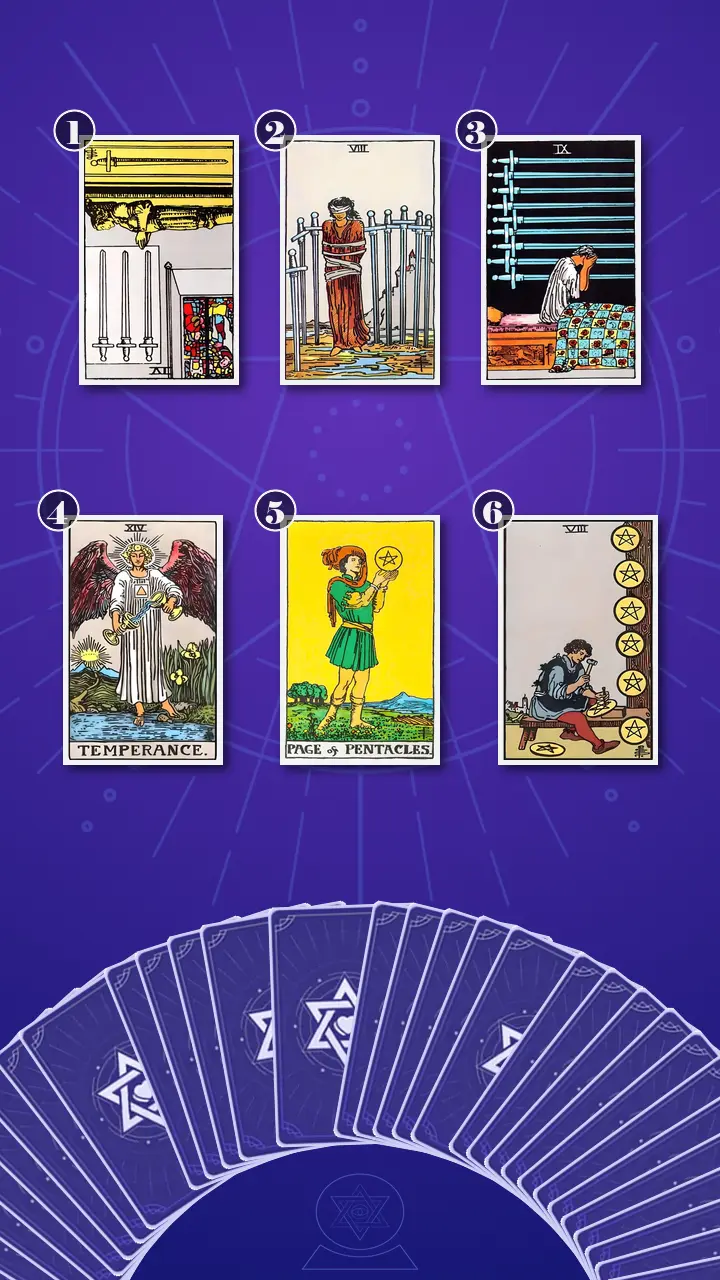
I chose the Transformation Path Grid (6) · Context Edition. For anyone curious about how tarot works in a grounded consultation, I use this six-card spread when a problem behaves like a self-reinforcing loop. It does not predict Jordan's grades or announce whether an academic comeback will succeed. It separates the moving parts so that card meanings can be read in context and tested against real life.
The top row would show the current expression of the delay, the immediate readiness rule blocking movement, and the fear underneath that rule. The lower row would reveal the balancing insight, one actionable next step, and the repeatable rhythm that might follow. That structure mattered because Jordan did not need a forecast. They needed to see how short-term relief from moving the date made the next start feel even more consequential.
I arranged the six cards in a two-by-three grid. The upper row looked compressed beneath my hands; I left more space around the lower three cards, a small visual reminder that understanding the loop could create room for choice.
Where Rest Became Another Form of Waiting
Position 1: Four of Swords Reversed and the Restless Pause
The first card I turned over occupied the position representing the current expression of the delay: rebuilding the plan, moving the start date, and avoiding the first study block. It was the Four of Swords, in reversed position.
I pointed to the figure lying beneath three suspended swords. “This image is meant to contain rest,” I said, “but the reversal suggests a Blockage in that restorative energy. The body has paused, while the mind is still running background processes.”
At 8:47 that evening, Jordan had a clean notebook, a revised calendar, and three productivity tabs open, but the first course reading remained untouched. Their supposed recovery time had been filled with checking the portal, sorting folders, evaluating readiness, and anticipating the restart. They were neither fully resting nor making contact with the work. Moving the block gave them a brief drop in pressure, but the relief taught the loop to repeat itself.
“It's like leaving a laptop permanently in sleep mode,” I said. “Nothing is fully running, but the background processes keep draining the battery. The inner sentence becomes: ‘I need rest before I start, but I can't rest because I'm thinking about starting.'”
I used my Study Environment Auditing lens to distinguish visible order from usable order. Jordan's desk was not especially cluttered. The larger drain came from procedural clutter: five possible start rituals, several open planning systems, an oversized first task, and no clear boundary between resting and preparing. A spotless desk could not solve a workflow that kept reopening the decision.
I asked, “During the last hour you called preparation, what did you physically do, and which task stayed untouched?”
Jordan gave a short, bitter laugh. Their fingertips stopped on the edge of the phone, then curled inward. “That's so accurate it's almost rude. I colour-coded last term's notes for forty-five minutes. I didn't read the first page of the new material.”
“The accuracy can sting,” I said. “But this card is describing a protective pattern, not assigning a character flaw. Preparation stops being preparation when its job is to protect the start date. Once we can see that job, you get to decide whether the ritual is still helping you.”
Position 2: Eight of Swords and the Permission Filter
The next card represented the immediate blockage: the all-or-nothing rule saying that the reset must wait until recovery and preparation feel complete. I turned over the Eight of Swords, upright.
The blindfolded figure stood among swords with open ground still visible between them. In this position, the card showed an Excess of protective mental filtering. Jordan's options had not vanished, but their internal definition of a legitimate start had become so strict that every realistic option was screened out.
I asked Jordan to describe the last time they opened a long reading in the campus library. They remembered the fluorescent light, a nearby printer rattling, and the sharp smell of someone else's coffee. The article was twenty-eight pages. Their shoulders rose, one hand reached for the phone, and four available choices appeared: read two pages, review for fifteen minutes, make five flashcards, or attempt one problem.
“And I rejected all of them,” Jordan said. “They didn't feel like a real reset.”
“That is the blindfold in modern life,” I said. “It's like a Notion filter set so strictly that every task small enough to do disappears from the dashboard. You can see a smaller move, but the filter labels it ‘too small to count.'”
I also compared it to an algorithm trained on “not ready yet.” Each time Jordan clicked another academic-comeback video instead of opening the reading, the feed supplied more preparation content. Their attention learned the same preference. Planning felt active, the first task remained untested, and the lack of evidence made certainty seem even more necessary.
“So which limit is factual?” I asked. “And which one was created by the reset plan?”
Jordan's hand hovered above the phone before they placed it face down. Their eyes moved away from the spread as though they were replaying the library scene. “Being tired was factual,” they said. “The rule that fifteen minutes was pointless was mine.”
I nodded. “Both facts and assumptions deserve respect, but they require different responses. A real limit may call for rest, access support, a deadline conversation, or a smaller workload. An assumed readiness rule can be examined. The card does not ask you to pretend every barrier is in your head.”
Position 3: Nine of Swords and the Midnight Verdict
The third card occupied the position of the underlying root: the fear that beginning without certainty would expose limited control or an inability to sustain academic effort. I revealed the Nine of Swords, upright.
The card showed a figure sitting upright in darkness, face covered, with nine swords aligned behind them. Its energy was an Excess of private mental pressure. The practical task had ended, but the interpretation of the task kept expanding.
Jordan told me about 11:41 on the previous Friday. They had tried to compensate for a week of delay with a three-hour catch-up session. Cold laptop light filled the bedroom; an untouched mug of tea had gone bitter. After seventeen minutes, their eyes stung and their jaw ached, so they closed the reading. Then they saw a classmate's progress post.
I traced the escalation with them: “I stopped after seventeen minutes” became “I can't sustain a routine,” which became “I'm losing control of where my degree is going.” The first statement described an event. The last two converted that event into an identity-level forecast.
In twenty years of listening to stories over the aroma of coffee, I have heard many versions of that internal courtroom. The case may concern study, work, money, or love, but the mechanism is familiar: one piece of incomplete evidence is placed on the witness stand, while the most frightening conclusion acts as both prosecutor and judge. Looking at the row of swords, I thought how tidy a harsh conclusion can appear when it is lined up in the dark.
“Complete this once,” I said. “If I start and cannot sustain it, that would mean...”
Jordan inhaled, held the breath, and pressed their thumb against the side of their index finger. Their gaze lost focus for a moment. Then their hand loosened. “It would mean I can't trust myself with my academic future.”
“That is the feared verdict,” I said. “The known fact is smaller: one oversized late-night session stopped after seventeen minutes. Delay protects you from testing the larger fear, but it also lets that fear grow without new evidence.”
When Temperance Poured Between Two Cups
Position 4: The Bridge Between Recovery and Study
The radiator behind Jordan fell quiet as I moved to the lower row. This position represented the key trigger for transformation: the balancing principle that could combine recovery with a realistic return to coursework. I turned over the reading's central card, Temperance, upright.
I showed Jordan the liquid moving between two cups, the figure with one foot in water and one on land, and the path continuing toward distant light. This was Balance, not as perfect equilibrium but as patient, ongoing adjustment. Temperance did not demand that Jordan choose between legitimate recovery and meaningful study. It suggested that each could help regulate the other.
In ordinary calendar terms, the image became a twenty-minute reading block placed beside a deliberate ten-minute break. Both belonged to the same appointment. Jordan would not ask the study block to prove total readiness or require the break to be earned. They could observe attention, tension, and energy, then decide what to change.
I brought us back to 8:47. The timetable looked finished, the desk was clear, and the first reading was still closed. Jordan's phone was warm, their chest was tight, and dragging the start date offered relief before guilt rushed back in. Their mind was treating the doorway to a fresh start as an entrance exam.
This was where I introduced Syllabus Deconstruction, one of the most practical tools in my work. I asked Jordan to stop carrying the semester as a single emotional object. A twenty-eight-page reading became pages one through three and one highlighted claim. A backlog became one named file. The syllabus stopped acting like a verdict and returned to what it materially was: a sequence of mechanical tasks that could be attempted, shortened, rescheduled, or left for later.
“Temperance gives that deconstruction a rhythm,” I said. “One cup holds a bounded piece of coursework. The other holds an actual recovery action. The point is not to empty one cup before touching the other. It is to adjust the pour using information from your real capacity.”
I said, “The reset is not a test of whether you are fully recovered. Let one small study-and-recovery rhythm show you what your current capacity can support.”
You do not need an all-or-nothing reset to prove that you are ready; you can build readiness through a measured study-and-recovery rhythm, like Temperance pouring between two cups.
Jordan's breath stopped. Their fingers remained suspended above the phone, and their pupils widened slightly as if the sentence had interrupted a familiar script mid-line. For several seconds they stared beyond the card, replaying the moved calendar blocks and abandoned catch-up sessions. Then their eyebrows drew together. “But doesn't that mean all the planning was wrong?” they asked, with a brief edge of anger beneath the words. “I've wasted so much time trying to do this properly.” I did not rush them toward relief. “It means the planning had a protective job,” I said. “Protection is not the same as failure. You can appreciate why it appeared and still renegotiate its role.” Their jaw unclenched first. Then their shoulders lowered, and their closed hand opened against the desk. They exhaled with a slight tremor, but the release left a moment of exposed quiet behind it. Clarity had made the choice more visible, and therefore more genuinely theirs.
I waited until their breathing settled. “Now, using this new perspective, think back to last week. Was there a moment when this insight could have made you feel different?”
“Friday,” Jordan said. “If I'd planned fifteen minutes and a break, stopping after seventeen minutes wouldn't have proved anything. It would have been the block I actually planned.”
“Exactly. Your first study block is data, not a verdict. Recovery does not have to end before re-entry can begin.”
I named the shift carefully. This was not a leap from procrastination to effortless productivity. It was one step from guilt-laden delay and constant readiness monitoring toward curiosity about a sustainable pace. Grounded confidence, if it came, would be built through repeated and adjustable practice, not granted by a card or secured by one impressive day.
Holding One Task Instead of the Whole Semester
Position 5: Page of Pentacles and the Bounded Experiment
The fifth position represented the actionable next step: one concrete, low-stakes practice that could translate the new perspective into behavior. I revealed the Page of Pentacles, upright.
The Page held one pentacle at eye level. In this position, its Earth energy was available in Balance: focused enough to make contact with something real, but modest enough to remain teachable. I told Jordan that this card did not hold the whole semester, repair the past, or guarantee consistency. It held one object.
For Jordan, that object could be pages one through three of a reading, one worked example, five flashcards, or one paragraph of notes. They could set a ten- or fifteen-minute timer, place the phone on Do Not Disturb and out of reach, and work only on that object. The useful result would include what they learned about attention and energy, whether or not they finished the amount they expected.
“Hold one task, not the whole semester,” I said. “What could you name in a single line right now?”
Jordan looked toward the still-unopened portal. Their shoulders rose by habit, paused, and lowered a fraction. “Read pages one to three and highlight one claim,” they said. The sentence sounded almost suspiciously ordinary to them.
“Ordinary is useful here,” I replied. “The Page is an apprentice, not a comeback montage. A small beta gives you information that another private redesign cannot.”
Position 6: Eight of Pentacles and the Return Rhythm
The final card represented integration: the repeatable rhythm Jordan could build after treating study as practice rather than a test. I turned over the Eight of Pentacles, upright.
The craftsperson worked on one pentacle at a time while completed pieces accumulated nearby. Its Earth energy expressed Balance through repetition. Across one week, Jordan might complete several modest study blocks and record each separately. A missed block would remain blank rather than creating a debt. The next session would keep its original size instead of becoming a punishing double session.
“This is the opposite of one dramatic academic comeback,” I said. “One block does not secure the semester. Three blocks do not guarantee a future. They show you how task size, time of day, location, a planned break, or studying near someone affects your ability to return.”
I pointed to the individually crafted pentacles. “Each one is a separate observation. No streak counter, no productivity grade, no repayment. A reset becomes credible through return, not intensity.”
Jordan studied the row of pentacles. Their fingertips tapped the desk three times, more slowly than before. “So if I miss Wednesday, Saturday doesn't become a three-hour punishment session?”
“Correct,” I said. “Saturday remains Saturday's small block. You are building a relationship with returning, not proving you can maintain an unbroken streak.”
The One-Page Route Back In
I gathered the spread into one story. What had looked like recovery in the past had become suspended anticipation: Jordan rested while monitoring whether the rest was working. In the present, an all-or-nothing permission filter rejected every small beginning. Beneath it, the Nine of Swords revealed why that filter felt protective: a difficult start might be misread as proof that Jordan could not trust themselves with their academic direction.
Temperance changed the logic at the hinge of the grid. Recovery and study did not need to be consecutive phases, with one completed perfectly before the other could begin. They could become two adjustable inputs. The Page of Pentacles reduced the emotional scale to one visible task; the Eight of Pentacles turned that task into practice, observation, adjustment, and return.
The cognitive blind spot was not simply that Jordan's plan was too ambitious. It was that the plan had acquired a hidden second job: providing immediate relief from the moment when reality could test it. That relief reinforced the delay. The transformation direction was therefore not “make a better schedule.” It was to pair recovery with one small, time-boxed study action and review what the pairing taught without converting the result into a statement about worth.
I also made the boundary explicit. This spread did not imply that every delayed start is self-imposed. Exhaustion, disability, work, caregiving, inaccessible teaching, financial pressure, and institutional barriers can impose factual constraints. Jordan retained the right to reduce a block, prioritize rest, seek academic or accessibility support, or decide that an experiment was not workable. Tarot was functioning as an organized mirror, not an authority over their body or future.
I wrote two optional experiments for Jordan. They were designed to create information, not another ideal routine they had to follow perfectly.
- The Desktop Reset Ritual and Two-Cup Pairing. On one weekday, at your usual desk or a campus library, use my Desktop Reset Ritual only if visible clutter is interfering: set a strict 15-minute timer, clear one laptop-sized work area, and do not open Notion, rename files, or revise the timetable. When the timer ends, open one preselected task, such as pages 1-3 and one highlighted claim. Study for up to 20 minutes, then take a scheduled 10-minute break for tea, a shower, a short walk, or lying down. Treat the study and recovery blocks as one appointment. If 45 total minutes feels too large, clear only enough room for the laptop, read one paragraph for two minutes, and still take the planned break. The break is part of the rhythm, not a reward. Stop if the exercise becomes physically or emotionally unmanageable.
- The One-Pentacle Data Check. After each short block, use a paper index card or a plain phone note to record three neutral observations: what you touched or completed, what your body or attention did, and one adjustment for next time. Before closing the file, leave one visible continuation note, such as “resume at heading 2.” Try up to three modest contacts across seven days, each between 15 and 25 minutes. Do not add grades, streaks, or productivity scores. If a block is missed, leave it blank and return at the next scheduled time without doubling the session. The minimum version is one named task, one paragraph or worked example, and one next-step note.

A Week Later, Three Ordinary Marks
Seven days later, I received a photo of Jordan's index card in pale morning light: Monday, eighteen minutes; Wednesday, blank; Saturday, fifteen minutes. They had not repaid Wednesday with a catch-up marathon. “I still thought, What if this falls apart?” they wrote. “Then I made tea and kept Saturday small.”
The bittersweet part mattered. Jordan had not solved the semester, erased the backlog, or stopped hearing the old question. They had simply answered it differently once. The blank space had remained a blank space instead of becoming evidence for the prosecution.
I saw the quiet proof of our Journey to Clarity in those three marks. The cards had not produced the change. They had helped us separate the holding pattern, permission filter, feared verdict, balancing principle, bounded task, and return rhythm. Jordan chose what to test, honored the limit when Wednesday did not happen, and chose to return on Saturday. The agency was theirs.
If tonight the cursor hovers over your course portal and your chest tightens, I hope you remember what I saw at Jordan's desk: you may be avoiding not only the reading, but the fear that one imperfect start could certify a lost future. Simply noticing that hidden exam means you are no longer standing at the doorway in quite the same way.
If your reset did not have to certify that you are ready, what tiny pairing would you place in Temperance's two cups for one experiment: one bounded piece of study, and one form of recovery that does not need to be earned?