At the Archive Button, She Kept the File and Changed One Variable

Finding Clarity at the Archive Button
If you are a late-twenties city professional who turns one missed Sunday work block into a brand-new ninety-day plan, I know your Sunday Scaries may look less like doing nothing and more like rebuilding everything.
Maya appeared on my screen from her small New York apartment at 11:40 on a Sunday night. Three productivity videos sat open beside an unfinished portfolio case study. I could hear the laptop fan humming through her microphone; when she lifted her coffee, she tasted it, grimaced at the cold bitterness, and set it beside a phone still warm from scrolling.
Her fingers moved between Notion and Figma while her cursor hovered over Archive. After missing two planned work sessions, she had already changed the board colours and typed a title for a new ninety-day reset. I watched her upper chest remain rigid even as her hands kept moving. Her restlessness looked like a cursor trapped beneath her skin, darting through her fingers while the rest of her body waited for a page to finish loading.
“I know the current system could work,” she told me, “but it doesn’t feel like me anymore. I keep thinking the next setup will be the one I actually stick to. Then I reach the boring part, miss something, or see someone announce a sharper career pivot on LinkedIn, and I start over again.”
I asked her to put the surface question into one sentence. She looked at the Archive button rather than at me and said, “Why do I keep starting over instead of letting change take root?”
I heard the contradiction clearly. Maya wanted lasting change, but when change became repetitive, uncertain, or visually unimpressive, a fresh identity felt safer than allowing an imperfect practice to produce evidence. She was not short on ambition. She had so much beginning energy that it kept crowding out continuation.
I told her, “I’m not going to decide whether this project deserves to stay or tell you that persistence is always the right answer. I want us to locate the precise moment when discomfort becomes a command to erase everything. Then we can separate useful information from the temporary relief of a clean slate. Let’s draw a map through the fog and leave the final decision in your hands.”
Maya closed two of the videos. The fan quieted a little. I reminded her that a clean slate can relieve uncertainty without resolving it, and I saw her cursor move away from Archive for the first time that night.

Choosing the Switchback Map
I invited Maya to place both feet on the floor, take one unforced breath, and hold the question in mind while I shuffled. I use this pause as a focusing transition, not as a performance of mystery. It gives the nervous system a moment to stop solving the problem before the evidence is on the table.
I chose the six-card Four-Layer Insight Ladder · Context Edition. This reset-cycle tarot spread was the right tool because Maya’s problem was not a single decision with a simple yes-or-no answer. It was a feedback loop: discomfort triggered a restart, the restart supplied immediate relief, lost continuity created fresh self-doubt, and that self-doubt made another restart look necessary.
For readers wondering how tarot works in a situation like this, I do not use the cards as predictions. I use the spread as a structured way to externalise a pattern that is difficult to inspect while living inside it. The card meanings in context help me separate observable behaviour, activation, protective belief, corrective perspective, practical action, and integration. Tarot becomes a cognitive map; the person reading the map still chooses the route.
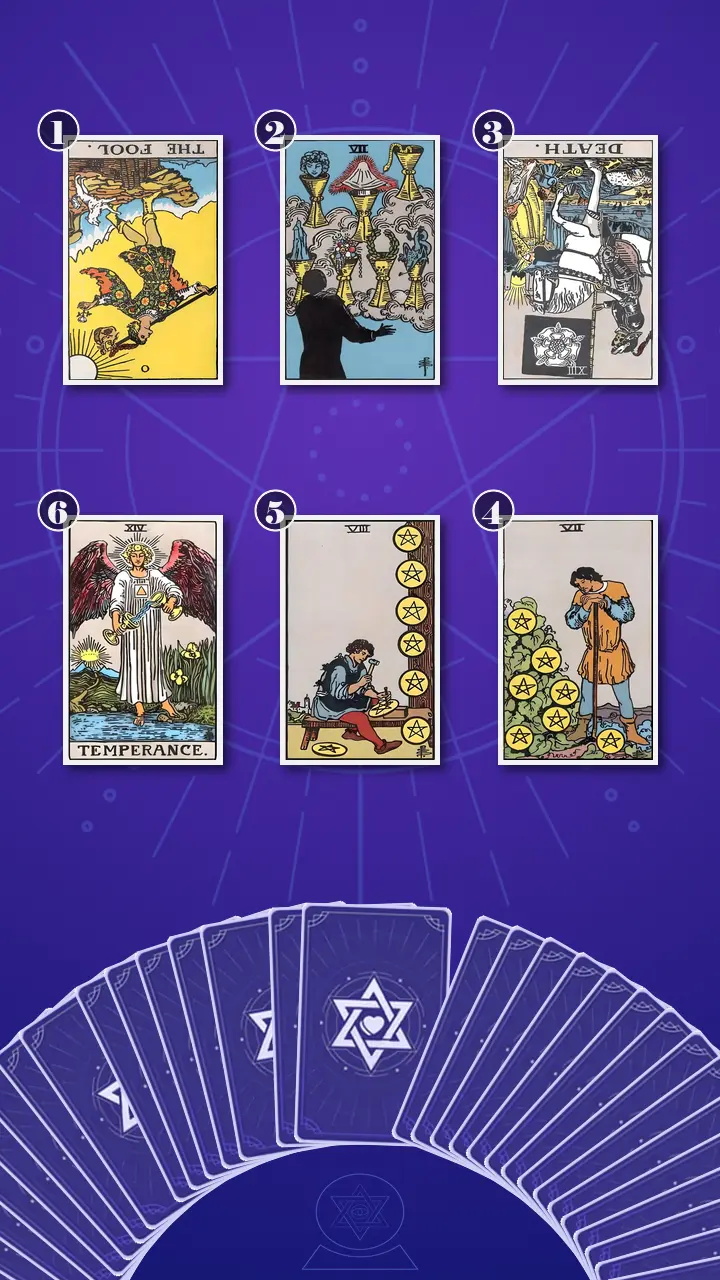
I arranged the cards in two rows of three. The upper row would move from Maya’s visible reset behaviour to its immediate trigger and then to the protective bargain beneath it. Directly below the third card, the fourth position would act as a hinge, revealing the corrective energy capable of interrupting the cycle. The final two positions would show one repeatable action and the integrated relationship with change that action could support.
The layout formed a switchback rather than a straight escape route. I liked that. A switchback changes direction without denying the ground already travelled, which was exactly the distinction Maya needed to explore.
The Upper Row of the Fresh-Start Cycle
I turned the first three cards across the upper row. Together, they would show why rebuilding everything could feel like movement even while it kept Maya suspended at the same threshold.
Position One: The Fool at the Archive Button
I began with the card representing the observable reset behaviour: replacing a routine, project structure, or identity before enough evidence has accumulated. The card was The Fool, reversed.
I pointed to the traveller’s raised foot at the cliff edge. In the reversed orientation, I read the Fool’s beginning energy as blocked and misdirected. Maya was producing an excess of initiation without allowing initiation to develop into experience. The apparent leap into a new chapter was keeping her suspended at the threshold.
I brought the card directly back to the scene in front of us. After missing two Sunday portfolio sessions, Maya still had a usable case study open. Yet her cursor hovered over Archive while she named a new ninety-day reset, changed the colours, and considered buying another template. The beginning felt active, but it prevented her from completing the next research slide or learning what the current system could survive.
“The private script sounds something like this,” I said. “I could do the next ordinary step, but if I rebuild everything tonight, tomorrow can still belong to the ideal version of me.”
I compared it to replaying a game’s character-creation screen because the first imperfect level might challenge the fantasy of the ideal build. Maya was selecting skills, costumes, and identities with care, but she was not remaining in the game long enough to gain experience.
She gave one short laugh, then pressed her lips together. “That is so accurate it feels a little brutal,” she said. Her hand stopped above the trackpad, but her shoulders stayed lifted.
I answered, “Accurate does not have to mean condemning. The restart gave you something real: relief, possibility, and a temporary sense of control. We’re simply asking what that relief costs when it repeatedly replaces the next step. This card is not calling you unreliable. It is showing us where your movement gets redirected.”
Position Two: Seven Cups in an Endless Feed
I turned over the card representing the immediate activation layer: reinvention culture, proliferating possible selves, and the moment ordinary progress begins to look inadequate. It was the Seven of Cups, upright.
The seven cups float in clouds before a motionless figure. I read the upright card here as an excess of imaginative possibility. Imagination itself was not the problem. The problem was that too many vivid options were being presented at once, while their costs, timelines, and compatibility with Maya’s actual life remained outside the frame.
I described the cups as tiles in an algorithmic feed. On the train home, Maya might see a former coworker’s promotion, a creator’s UX-to-strategy pivot, an optimised morning routine, a portfolio cohort, and a new productivity app. She would open several tabs and begin questioning the project she had already chosen. None of the options had to be wrong for all of them together to turn comparison into counterfeit evidence.
“Maybe that version would finally feel like me,” I said, giving language to the first half of the loop. “Then your actual life suddenly looks dull, even though nothing about its value has changed in the last five minutes.”
Maya glanced at the remaining productivity tabs and closed another one. I watched the corners of her mouth tighten before she said, “I do that on the subway. By my stop, I’ve mentally quit three things I liked when I boarded.”
I nodded. “That tightening is useful information. An attractive option can provide emotional relief before it provides any practical information. Inspiration expands what you can imagine. Option overload makes every existing commitment look like a failure of imagination.”
Sometimes the system has not failed; it has simply stopped feeling new. I let that distinction sit between us before moving to the third card.
Position Three: The Ending Hidden Beneath the Rebrand
I turned over the card representing the root protective bargain: what Maya avoided releasing, testing, or grieving each time she started over. The card was Death, reversed.
I explained that Death is not a threat and was not predicting a literal event. In contextual tarot reading, it often describes transition through release. Reversed in this position, I read its energy as a blockage: Maya was creating external endings while preventing one internal rule from ending.
She could change the planner, course, project title, colour palette, and public explanation. Yet she carried the same rule into every new version: if she missed a day or produced ordinary results, the attempt no longer counted. A complete visual rebrand concealed an unchanged standard. It was like deleting and reinstalling an app, then restoring the exact settings that had created the friction.
“The hidden sentence may be, I can delete the plan more easily than I can test what happens if I stay imperfect,” I said. “The container changes, but missed days still mean failure, ordinary results still feel humiliating, and visible progress still carries too much authority over your worth.”
Maya’s thumb rubbed slowly along the edge of her mug. Her eyes left the cards and settled on the rough research slides. When I asked what she feared the same practice might reveal after two more weeks, she stayed quiet long enough for the refrigerator’s buzz to become noticeable through the call.
“That I can work hard and still make something average,” she finally said. Her voice was lower. “Or that I’m the problem, not the system.”
I answered carefully. “Uneven evidence would not prove that you are the problem. It might show that the work needs more time, that one constraint needs changing, that the project is genuinely misaligned, or simply that learning looks less polished from inside it. The card is asking which conclusion you keep protecting from examination. It is not telling you what the evidence must say.”
Her fingers tightened once around the mug and then loosened. I saw recognition arrive with grief attached to it. Each fresh start had offered Maya a new future, but it had also allowed the old perfection rule to survive without ever having to defend itself.
When the Living Vine Refused a New Field
I reached the hinge of the spread, directly beneath Death reversed. A distant siren faded outside Maya’s window, and the laptop fan finally stopped. In the sudden quiet, the amber light from my table lamp caught the green vine on the next card.
Position Four: Seven of Pentacles and the Evidence Already Growing
I turned over the card representing the key transformation that interrupts the cycle: evaluating what has taken root before treating discomfort as a command to reset. It was the Seven of Pentacles, upright, the central card of the reading.
The figure rests on a tool and looks directly at pentacles growing on an established vine. I read this as patient energy in balance. The pause is not abandonment, passivity, or forced loyalty to a failing plan. It is a deliberate review of accumulated evidence before choosing whether to continue, prune, or redirect effort.
I used a lens I call Hero’s Journey Alignment. In a familiar heroic story, the Refusal of the Call can look like staying safely at home. In Maya’s story, refusal wore the costume of constant departure. Every new dashboard looked like a brave threshold crossing, but it returned her to the trailer for another round of character creation. The real call was quieter: enter the ordinary middle, tolerate an unflattering rough cut, and let repeated experience develop the character.
As an artist, I flashed to an editing room where a film remains rough long after the first beautiful concept art has lost its shine. I know how tempting it is to mistake a new title sequence for a repaired story. Yet the next act becomes visible only when I stay with the existing footage long enough to see what the scene is actually doing.
I brought Maya back to 11:40 p.m. The unfinished case study was still open, her cursor had hovered over Archive, and a redesigned dashboard had already begun to sound relieving. Staying with the next ordinary step felt more exposing than announcing another reset because the existing record could answer back.
“Starting over gives you a clean story about who you could become; staying with one imperfect practice gives you evidence of who you are already becoming.”
Starting over is not proof of transformation; tending what already exists creates real change, just as the figure in Seven of Pentacles pauses beside a living vine instead of planting a new field.
I stopped speaking. Maya’s breath paused first. Her right hand froze halfway between the mug and the trackpad, and her pupils widened as though she were replaying several Sunday nights at once. Then her brow pulled inward. Colour rose along her cheeks, and the recognition sharpened into resistance rather than immediate relief.
“But doesn’t that mean all those resets were wrong?” she asked. The words came quickly, with a flash of anger protecting something more tender. “I spent money on courses. I told people I was moving in a new direction. I thought I was being brave.”
I kept my voice steady. “No. It means the resets were trying to protect you from a conclusion you feared. Some may also have contained useful choices. We do not need to shame the version of you who reached for possibility, and we do not need to preserve every commitment to prove a point. We only need to stop confusing relief with evidence.” Her jaw unclenched. Her fingers opened against the desk. A long breath left her with a slight tremor, and her shoulders lowered, but the new clarity also left her briefly exposed, almost dizzy with the responsibility of choosing without a dramatic new identity to hide behind.
I asked, “Now, with this new perspective, think back to last week. Was there a moment when this insight could have changed how the situation felt?”
Maya looked toward the two rough slides. “Monday night,” she said. “I duplicated the Figma file because the research section still looked basic. I could have noticed that I was exhausted after nine and shortened the session. Instead, I treated the feeling as a design verdict.”
“That is the turn,” I said. “What if discomfort is data, not a command to erase everything?”
Before archiving the board, Maya could keep one current practice unchanged for fourteen more days and review observable evidence: what she actually repeated, what created friction, what had grown, and what genuinely produced no value. If fourteen days felt loaded, she could use seven. If the project crossed a safety, financial, ethical, or wellbeing boundary, she retained full permission to stop. Staying was an experiment, not a moral obligation.
I named the emotional crossing I had just witnessed. This was not simply a choice about a portfolio. It was one step from restless, comparison-driven self-reinvention toward grounded self-trust built through evidence. Maya did not yet feel certain. She had become curious enough to let the existing record speak before replacing it.
Position Five: One Pentacle in the Existing File
I turned over the card representing the repeatable action that redirects repetition from identity resets into one bounded unit of practice. It was the Eight of Pentacles, upright.
I showed Maya the craftsperson carving one pentacle while a visible row of completed pieces accumulated nearby. I read the upright earth energy as balanced and available. Maya did not need less capacity for repetition. She needed to redirect repetition away from rebuilding the workshop and toward making one more piece.
In her daily life, this meant opening the existing Figma case study, defining one visible endpoint, and spending twenty-five minutes finishing a single research slide before watching a tutorial, redesigning the template, or reconsidering her professional identity. One simple mark in the current document could record the unit. Like small commits in the same repository, no single unit had to be the launch for the sequence to become trustworthy evidence.
“The inner line here is, I do not need to know whether this is the final version of me to complete this one unit,” I said. “You do not need to settle your identity before completing the next unit.”
Maya moved the Archive dialog to one side and clicked into the rough slide. She did not edit it yet, but I saw her eyes scan the actual content rather than the template around it.
“One decision caption,” she said. “I could finish that without solving my entire portfolio.”
“Exactly,” I replied. “Craftsmanship makes the next action smaller than the identity debate surrounding it.”
Position Six: Temperance and the Update That Keeps the History
I turned over the final card, representing the integrated relationship with change: preserving continuity while making proportionate adjustments instead of demanding total reinvention. It was Temperance, upright.
Water moves continuously between two cups while one foot rests on land and the other in water. I read Temperance as balance in motion, not a perfect static midpoint. Aspiration and actual capacity could inform the same plan. Consistency and flexibility did not have to compete for control.
For Maya, the card looked like keeping the current project, file, and overall goal while reducing weeknight sessions from ninety minutes to thirty. If she missed Tuesday, she could move the next session to Thursday without deleting the record or renaming the plan. The adjustment would count as continuity. It was a software update rather than a factory reset: preserve the working history, patch one problem, and continue using the system while it evolves.
“I can change the ratio without erasing the recipe,” I said.
Maya’s shoulders softened again, this time without the dramatic release of the key-card moment. She nodded slowly. “I’ve been treating revision like an admission that the plan failed.”
“Revision can preserve continuity; it does not have to erase it,” I told her. “Temperance does not ask you to become rigid. It gives you permission to adjust one variable while keeping enough history to learn from the result.”
The Plot Was Not Asking for a Recast
I looked across the whole spread and gave Maya the short version of the story it told. The Fool reversed showed startup energy repeatedly stopping at the threshold. Seven of Cups showed comparison and option overload making ordinary progress look inadequate. Death reversed revealed the hidden bargain: every cosmetic ending protected the belief that real change should be polished, uninterrupted, and immediately identity-confirming.
Then the earth cards changed the pace. Seven of Pentacles asked for evidence before replacement. Eight of Pentacles converted that evidence into one bounded act of craft. Temperance allowed the plan to evolve without deleting its history. I also noticed that no Sword card appeared. Maya did not need a sharper argument with herself or another perfectly reasoned framework. She needed material evidence gathered through a small, repeatable rhythm.
I described the cycle as repeatedly repotting a seed to check whether it had roots. Each new pot looked purposeful, but the seed lost the uninterrupted time needed to reveal what it could become. In the film language that comes naturally to me, Maya had been redesigning the set, changing the wardrobe, and announcing a new title whenever the middle act became difficult. The plot was not asking for a recast. It was asking for one more honest scene.
I named the cognitive blind spot directly: Maya had been treating novelty as information and mood as a verdict. She counted finished launches and perfect streaks while overlooking partial work, improved judgment, and useful friction. She also assumed that continuing meant rigidity and revising meant failure. The cards offered a different direction: preserve one workable thread, gather evidence, and let that evidence support continuing, adjusting, or ending by choice.
The Root Check and the Next Scene
I wanted the insight to survive beyond the reading, so I gave Maya two small experiments. I also introduced my Character Bible Directive, a future-self visualisation adapted from the character notes I use in creative work. I told her not to write another polished identity statement. A useful character bible describes how the protagonist behaves when the scene becomes inconvenient, repetitive, or unflattering.
- Run an Eight-Minute Root Check. Choose the existing portfolio case study and open a plain phone note titled Root Check. Set an eight-minute timer and write three lines: what I actually repeated, what created friction, and the smallest next unit I can complete without changing the system. For the next fourteen days, keep the same file and record only minutes spent, the unit completed, and the friction point. Schedule one fifteen-minute review to ask what grew, what needs one adjustment, and what produced no value. Start with a seven-day window if fourteen feels punitive. Keep the notes private, stop if the exercise feels overly exposing, and end the experiment early for a clear safety, financial, ethical, or wellbeing boundary.
- Write the Character Spec, Then Play One Scene. In the same note, write three behavioural specifications for the Maya who can sustain change: when she misses a session, she moves it and keeps the record; when comparison spikes, she closes the feed before changing direction; when the reset urge appears, she completes or schedules one visible unit in the existing file. On one weeknight, open that file before any tutorial and spend twenty-five minutes on one research slide or decision caption. Define completion on screen before starting. Reduce the unit to ten minutes or one paragraph when energy is limited, stop when the timer ends, and never use the exercise to justify skipped sleep, meals, or unpaid overwork.
“This is Vision Actualization without the rebrand,” I explained. “You are not waiting to feel like the future character. You are giving her one observable behaviour in today’s scene. Your future self is not a flawless identity you have to launch. She is a pattern of choices you can test, revise, and keep only when they serve you.”
Maya renamed nothing. Before we ended the call, she typed one line into the existing file: Tonight’s unit is complete when the decision caption explains why the research changed the design. It was not a life overhaul. It was specific enough to begin.

A Week Later, One Unbroken Thread
Seven days later, Maya messaged me: “I kept the same Figma file, cut the session to thirty minutes, and finished one research slide. I slept through the night. I woke up thinking, What if this still fails? Then I laughed and kept the record.”
I noticed what the message did not claim. Maya had not solved her career, completed the entire case study, or eliminated the urge to reinvent herself. She had noticed the urge, revised one unrealistic variable, and preserved enough continuity to collect a new piece of evidence. The doubt returned in the morning, but it was no longer holding the Archive button.
I did not see tarot change Maya’s life for her. I saw the cards make an invisible loop visible, and I saw Maya choose where to interrupt it. That distinction matters to me. The spread offered a map; her small act of authorship moved the story.
When the middle stops looking impressive, I know how quickly the chest can tighten and the clean slate can begin glowing like an exit sign. If that happens to you, remember the living vine beside the Seven of Pentacles: noticing the urge to pull it up is already a way of placing your hands back on your own story.
If you allowed one imperfect thread of your current life to remain unbroken this week, what small pentacle of growth might you become curious enough to notice before you rename the file?