Too Behind to Start: One 25-Minute Task Made Progress Visible

The 10:40 p.m. Loop: Too Behind to Start Studying
I know the academic avoidance loop that begins after an evening shift: the course portal opens, three overdue labels appear, and the energy that was supposed to fuel an academic comeback disappears before one task is chosen.
At 10:40 p.m. in a shared Toronto apartment, Maya (name changed for privacy), a 22-year-old third-year student and part-time cafe worker, sat across from me on a video call. Her laptop fan hummed beside a mug of cold coffee. The overhead light cast a hard white square across her desk, and her phone, still warm from the class group chat, rested in her palm.
She had an overdue lecture open on one side of the screen and a freshly highlighted catch-up calendar on the other. A second study-routine video waited in another tab. Her shoulders had dropped so far that they seemed to carry the entire semester like a wet winter coat.
“Why do I avoid studying when I’m already behind?” she asked. “Every time I check the portal, I lose whatever energy I had. Then I make a new plan, check what everyone else has finished, and somehow close the laptop without doing anything.”
I could hear the contradiction clearly. Maya wanted studying to restore her momentum, but she was asking herself to feel caught up before any study session was allowed to count. The backlog was practical; the dread came from treating it as a measurement of her ability.
“I’m not going to tell you that you need more discipline,” I said. “You already care, and you’re already spending energy. I want us to find out where that energy is being diverted. Let’s make a map of the loop, then identify one place where you can interrupt it without pretending the workload isn’t real.”

Choosing the Transformation Path Grid
I asked Maya to put both feet on the floor, release the phone, and take one slower breath while holding a single question in mind: what happens between seeing the backlog and abandoning the first task? I shuffled slowly. I use this brief pause as a transition into focused observation, not as a supernatural test.
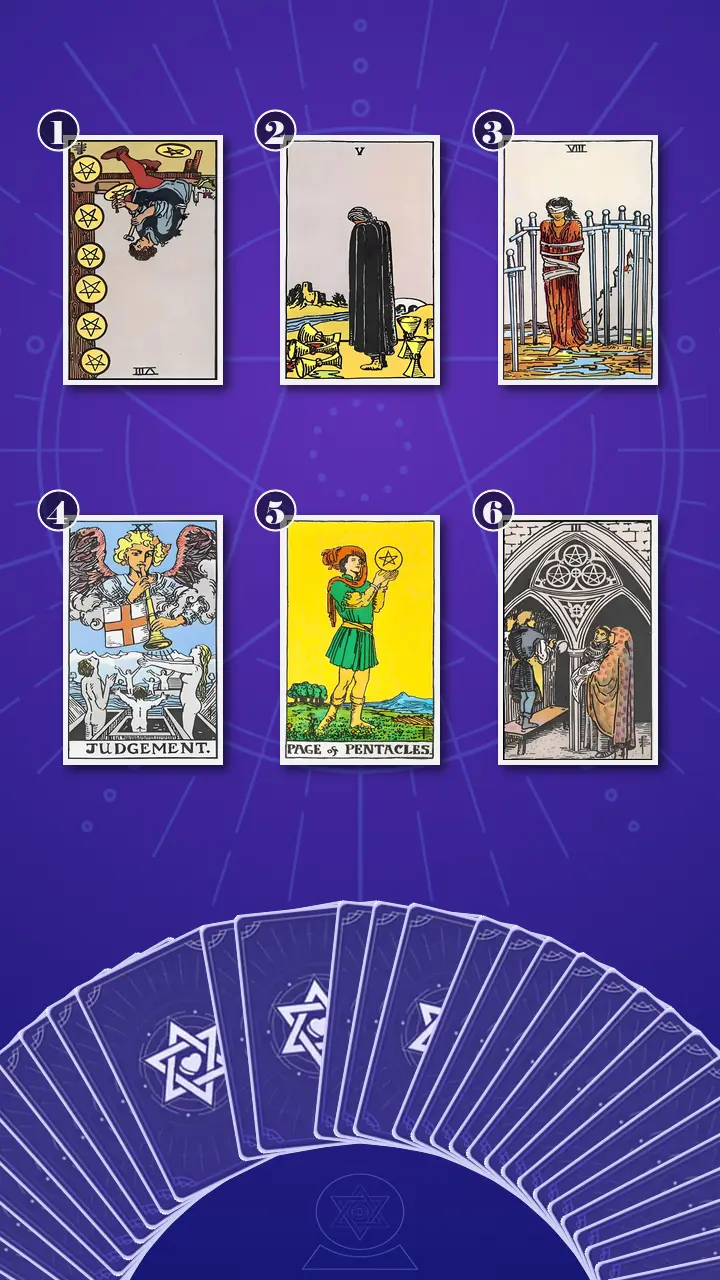
I chose the Transformation Path Grid · Context Edition, a six-card tarot spread arranged in two rows of three. This is how tarot works in my practice: the cards provide an external structure for examining a pattern. They do not predict Maya’s grade, diagnose her, or decide what she must do.
I chose this spread because the problem was a feedback loop. A simpler past-present-future reading might have compressed the visible avoidance, the discouragement beneath it, and the deeper fear into one vague message. A larger spread would have introduced future and external-influence questions that Maya did not need. This grid was the smallest map that could separate the symptom, blockage, root belief, catalyst, action, and integration.
I placed the first three cards across the top. The first would show what Maya visibly did when the portal loaded. The second would identify how lost time drained the value from the time still available. The third would expose the belief that made a short session seem pointless. Beneath them, the next three positions would show the leverage point, a bounded response, and the structure that could support repeated progress.
I told Maya that I would read the card meanings in context and treat each one as a hypothesis she could test against her real evenings. Her experience, not my authority, would determine whether an interpretation was useful.
Practice and Prison: How the Avoidance Loop Tightened
Position 1: The Workbench Buried Under Preparation
I turned the card in the position representing Maya’s observable study behavior: opening the work, confronting the backlog, and diverting into planning or tab switching before completing a task. It was the Eight of Pentacles, reversed.
Upright, the artisan gives one pentacle the full attention of his hands. He does not stare at every object he will ever need to make. He works on the piece in front of him, and the completed row grows through repetition. Reversed, that single-object focus was blocked.
I brought Maya back to 10:40 p.m. The overdue lecture was open, but so were three course tabs, a new catch-up calendar, the class chat, and a study-routine video. She was expending effort, yet none of it stayed with one piece of material long enough to become practice. The online academic-comeback montage looked organized; the ordinary first repetition remained untouched.
“You’re doing study-adjacent things,” I said. “They reduce uncertainty for a few minutes, but they don’t complete the practice question. Productive procrastination still leaves the practice question blank.”
The reversed Earth energy showed both blockage and overcorrection. There was too little contact with one task and too much pressure to design a flawless rescue plan. A six-hour catch-up schedule might appear ambitious, but it also made one interruption capable of invalidating the entire day.
Maya gave a short laugh with a bitter edge. “That’s too accurate. Kind of brutal.”
I watched her thumb stop rubbing the side of her phone. “It’s accurate, but it isn’t an accusation,” I said. “The card isn’t calling you lazy. It’s showing that your ability to organize has been recruited by avoidance. That means the same ability can be given a smaller, more useful job.”
Position 2: The Hour That Disappeared Beside the Spilled Cups
I turned the card in the position identifying how discouragement about lost time drained drive and narrowed Maya’s attention to what had not been completed. It was the Five of Cups, upright.
The cloaked figure stared at three spilled cups while two upright cups remained behind. I read the three spills as the three missed study blocks Maya totaled on Sunday night. I read the standing cups as the hour still available, the lecture notes she already had, and one question she could still answer.
“The disappointment is real,” I said. “I’m not going to ask you to pretend the missed time doesn’t matter. But your line of sight is making the loss feel more complete than it is.”
I invited her to finish a sentence: “Because I lost three study blocks, I’m treating...”
She looked away from the cards. “I’m treating tonight as if it no longer counts.”
That was the maintaining force. The Water energy of the Five of Cups had pooled around regret until the remaining resources became emotionally invisible. The imbalance was not that Maya cared too much. It was that every usable hour was being compared with the total number of hours already lost.
“When you saw those overdue labels this week, what did your attention notice first?” I asked.
“The total hours,” she said. “Then someone posted a library photo in the group chat, and I thought, cool, they’re moving and I’m still restarting.”
Her hand moved to the centre of her chest, pressed there for a moment, and then dropped. I could see recognition arrive before relief did. The card had named both the shame beneath the loss of drive and the practical blind spot beside it: lost time was receiving attention; usable time was not.
Position 3: When Heavy Traffic Became a Closed Road
I turned the card in the position revealing the limiting belief and worth-based fear beneath the blockage: that one small session could not matter, and that an incomplete attempt might expose personal inadequacy. It was the Eight of Swords, upright.
I pointed to the blindfold, the loose bindings, and the incomplete enclosure of swords. The card did not deny the real constraints around Maya. She had unfinished coursework, evening shifts, limited energy, and deadlines. The distortion appeared when “I cannot complete all of this now” became “nothing I do now can matter.”
“This is like a navigation app reporting heavy traffic,” I said, “and your mind translating that into ‘there is nowhere I can go.’ The delay is factual. The conclusion that every route is closed is a forecast.”
The Air energy had moved into excess. Backlog arithmetic no longer helped Maya choose. It generated an all-or-nothing enclosure: total recovery or failure, complete understanding or evidence of inadequacy. The open ground in the image represented smaller entry points that the full-portal view obscured.
I asked her for the exact sentence that appeared when a 25-minute study block felt pointless.
Her breathing paused. Her eyes shifted to the untouched lecture on her screen as if she were replaying several nights at once. Then she said quietly, “If I try properly and I still can’t catch up, maybe I’ll find out I’m not actually capable.”
I let the sentence sit without rushing to correct it. “That fear makes sense of the loop,” I said. “Planning lets you remain near the work without risking contact with what you don’t yet understand. Scrolling gives temporary relief. But neither one can provide evidence that the forecast might be incomplete.”
Maya nodded once, slowly. Her jaw remained tight, but her fingers opened on the desk. I could see the first distinction taking shape: the backlog was real, while the belief that no small move had value was an interpretation maintaining the trap.
“A short session does not have to erase lost time to change what happens next,” I said.
When Judgement Turned the Verdict into Data
Position 4: The Call to Review Without Condemning
I turned the card in the position locating the leverage point between an accurate backlog review and a condemning judgment about Maya’s identity. This was the catalyst of the spread: Judgement, upright.
The refrigerator compressor in Maya’s apartment clicked off. Through her half-open window, a distant streetcar bell sounded once, cleanly, while the room on my screen seemed to settle around the card. The trumpet in Judgement did not feel like a threat. It felt like a clear signal finally audible beneath the class-chat notifications.
I explained that Judgement is often misunderstood as punishment. In this position, it represented honest reckoning, release from an outdated verdict, and a concrete response. Maya could acknowledge every unfinished item without turning any of those items into a definition of the person reviewing them.
The modern scene was simple. She would open one course once, list each outstanding item, record its due date and grade weight, identify the next physical action, and remove phrases such as “disaster,” “proof I’m failing,” or “I should have done this already.” Those phrases were emotionally understandable, but they were not task statuses.
I used my Syllabus Deconstruction lens here. I have spent twenty years listening to people describe deadlines as if each one were a single enormous object hanging over their lives. I mentally pictured the closing checklists I had seen beside so many coffee counters: wipe one surface, count one drawer, lock one door. Dread loses some of its authority when a massive demand is reduced to mechanical, observable actions.
“For this card,” I said, “the syllabus stops being a courtroom document. It becomes a work order. ‘Unit 4 is proof I’ve ruined the semester’ cannot be acted on. ‘Open Unit 4, read the assignment requirements, and answer question one’ can.”
At 10:40 p.m., the overdue lecture was open, the new catch-up plan held three highlighted dates, and the class chat was still moving. Yet the page where that night’s actual learning could happen remained untouched.
You are not the sentence written by missed sessions; make an honest reset and answer Judgement's trumpet with one chosen task.
I left a few seconds of quiet around the words. Then I made the distinction even plainer.
Your backlog can tell you where to restart, but it does not get to decide what kind of learner you are.
For one beat, Maya seemed to freeze. Her breath stopped halfway in, and two fingers hovered above the laptop trackpad. Then her focus drifted beyond the screen; I could almost see her replaying the red overdue labels, the discarded timetables, and every night she had called a short session useless. Her pupils widened, and her brows pulled together.
“But doesn’t that mean I’ve been doing this wrong for weeks?” she asked, sharper than before.
The anger arrived first. Then her mouth softened, her hand flattened against the desk, and a long breath left her chest. Her shoulders lowered, but the release was not simple. Her eyes grew damp, and a small, unguarded blankness crossed her face, the kind that can appear when a familiar burden drops and responsibility becomes visible underneath it.
“No,” I said. “It means the strategy that protected you from feeling inadequate also kept you from gathering new evidence. You weren’t foolish for reaching for relief. Now you can choose a different response.”
I invited her back into a real memory. “Now, with this new perspective, think back to last week. Was there a moment when this insight could have made you feel different?”
“Tuesday after work,” she said. “I had about forty minutes. I spent most of it fixing the calendar because forty minutes couldn’t catch me up. If I’d treated the backlog as information, I could’ve done one section. I’d still have been behind, but I wouldn’t have ended the night at zero.”
That was the key crossing in the reading. Maya had not moved from uncertainty to perfect confidence. She had moved from shame-heavy, discouraged stagnation toward cautious relief and renewed curiosity. For the first time that evening, she could imagine self-trust being built through observable progress instead of granted only after complete recovery.
I gave her a deliberately small test. “Set an eight-minute timer and open only one course page. On paper, complete this sentence: ‘For the next 25 minutes, I am only working on ___, and the visible result will be ___.’ Choose five answered questions, one annotated page, or three lecture-note headings. Begin the first two minutes immediately. Do not redesign the semester tonight. If the full portal feels too intense, use a screenshot or the syllabus. You can stop after defining the task, and continuing remains your choice.”
The Page’s One Open Tab
Position 5: A Bounded Study Experiment
I turned the card in the position translating the key shift into one bounded study experiment that could be completed without waiting for full motivation. It was the Page of Pentacles, upright.
The Page held one pentacle at eye level. The wider landscape and distant mountain remained visible, but neither was the current unit of work. I read that pentacle as one learning target written on a sticky note: “complete questions 1-5,” “annotate one page,” or “create three lecture-note headings.”
In Maya’s actual evening, the card looked like putting her phone in the kitchen, opening one required course tab, and running one 25-minute timer. At the end, she would record what moved and what remained unclear. The session would be contact with the material, not a test of whether she could rescue the semester overnight.
The Earth energy had returned in a balanced, modest form. It did not ask for excitement. In fact, no Wands card appeared anywhere in the spread. I took that absence seriously: Maya could not build her plan around spontaneous Fire arriving first.
“Motivation does not have to clock in before you do,” I told her. “The Page begins with one object and lets interest develop through contact.”
Maya reached for a sticky note and wrote while I watched. “Questions one to five,” she read aloud. “Visible result: five attempts, even if some are wrong.”
Her voice still carried caution, but the caution now had an object. She was no longer trying to feel ready for the entire semester. She was defining one experiment that reality could answer.
Position 6: Competence With Comments Enabled
I turned the final card in the position describing the sustainable pattern Maya could cultivate through realistic structure, visible progress, feedback, and appropriate academic support. It was the Three of Pentacles, upright.
I drew her attention to the craftsperson on the raised bench and the two people consulting a plan. Skill was being constructed in public enough to receive feedback. No one in the image was required to arrive fully formed.
For Maya, this meant building a modest weekly plan around her two cafe shifts, tracking completed tasks rather than ideal study hours, and bringing one prepared question to a teaching assistant, tutor, instructor, or consenting study partner. The card did not promise a particular grade. It showed a process she could choose to build and revise.
The Earth energy expanded from one Page-like task into supported structure. The competence Maya feared she had lost was not something she needed to prove through solitary recovery. It could be constructed through practice, feedback, and repetition, much like a shared document with comments enabled.
I asked what question she could realistically bring to another person after the 25-minute session.
She glanced at the course tab. “I could write, ‘I tried question four, I got stuck when the formula changed, and I’m unsure why that step is allowed.’ That sounds less dramatic than telling the TA I’m lost in the whole unit.”
“Exactly,” I said. “A bounded question gives support a workable edge. You can draft it without sending it tonight, and you still decide which channel feels appropriate.”
Maya’s expression held both relief and embarrassment, but her shoulders stayed lower. I could see the final card changing recovery from a private verdict into a visible learning process. Competence is built through visible reps, not proved in one comeback night.
The Backlog-Without-the-Verdict Plan
I read the whole grid back to Maya as one causal story. Interrupted practice in the Eight of Pentacles reversed had left visible work unfinished. The Five of Cups fixed attention on the time already lost. The Eight of Swords converted that disappointment into a closed forecast: because total recovery was impossible tonight, no action tonight could matter. Judgement interrupted the circuit by separating facts from identity. The Page of Pentacles restored one concrete repetition, and the Three of Pentacles placed that repetition inside a realistic system of tracking and feedback.
I compared the backlog to a Toronto transit map showing several delays. The delays were real information. They might require a different route, a shorter trip, or an honest change of timing. They did not mean every route was closed, and they were not a character reference attached to the traveller’s name.
The cognitive blind spot was now clear: Maya had been evaluating the entire backlog before allowing any individual action to count. She believed motivation had to precede study, when the spread showed that cautious motivation could follow one visible piece of movement. The transformation direction was not “catch up perfectly.” It was “review accurately, choose narrowly, record movement, and seek specific feedback.”
I also used my Study Environment Auditing lens. The cold mug, warm phone, open chat, multiple tabs, and fresh timetable were not neutral background objects. Together they consumed the limited psychological bandwidth Maya had left after work. I folded that observation into my Desktop Reset Ritual, giving her two practical next steps rather than another elaborate productivity system.
Two Small Actions That Can Begin This Week
- The Desktop Reset and One-Course Audit On one evening at your desk, spend 15 minutes removing the cold mug, stacking unrelated papers, closing every nonessential tab, and placing one sheet of paper beside the laptop. Then set a 10-minute timer and review only one course. Make four columns: item, due date, grade weight, and next physical action. Circle one item by relevance and available time, not shame. Keep every status neutral: “not started,” “partly complete,” “needs clarification,” or “submit by Friday.” If the portal feels too intense, use the syllabus or list only the next three items.
- The One-Pentacle Sprint and Question-Ready Loop During the next available study block, write one target and one visible result on a sticky note, put the phone in the kitchen, a bag, or Focus mode, and work for 25 minutes with one course tab open. Finish by adding one line to a plain note titled “Moved.” If something remains unclear, draft: “I tried ___, I got stuck at ___, and I am unsure how ___ works,” then take or send it to one appropriate support person this week. After a late shift, use 10 minutes and one question instead. Stopping when the timer ends is allowed. The purpose is to create one visible rep and one useful feedback point, not to manufacture a perfect study night.
I reminded Maya that these were experiments, not obligations handed down by the cards. If a step proved too large, she could reduce it. If a support channel felt dismissive, she could choose another appropriate person. The measure of success was not instant motivation or a transformed grade. It was whether the next action became observable and recoverable.

A Week Later: The Quiet Proof in the “Moved” Log
Six days later, I received a message from Maya. She had attached a screenshot of a plain note with no colour coding and no elaborate dashboard. It read: “Five questions attempted. Three complete. Two marked for review. Sent one question to the TA.”
She told me that the first eight minutes had felt almost insultingly small. Then she noticed that her stomach loosened after the first answer existed on the page. The next night was not magically easy, and she still checked the group chat once. But she caught herself before rebuilding the calendar and returned to the same course tab.
The next morning, her first thought was still, “I’m behind.” This time she added, “That’s a status, not a sentence,” smiled at the awkwardness of saying it aloud, and opened her notes.
I did not see the reading as a moment when tarot rescued Maya. I saw the cards help her place observable behavior, emotion, belief, and choice in separate positions long enough for her own judgment to become clearer. She supplied the honesty, chose the task, completed the work, and asked the question.
When the portal loads and your shoulders drop, the distance between where you are and where you meant to be can feel as though it is measuring your intelligence instead of your workload. I hope Maya’s reading leaves one distinction within reach: the unread count may need your attention, but it does not get to write your character reference.
If tonight did not have to prove that you can rescue the whole semester, which one pentacle-sized piece of learning might you be willing to let count?