The Question That Followed Jordan Home
At 11:40 p.m., I found Jordan (name changed for privacy) sitting at the edge of her Toronto bed with her phone warm in both hands. Three versions of an answer glowed in her Notes app. The apartment vent clicked on and off behind her; blue light caught on her knuckles while she deleted a sentence, restored it, then typed it a third way.
Earlier, at a King Street West work drink, a coworker had asked, "Where are you from?" Jordan had given the short answer. Then she had seen the slightest movement in their eyebrows and added context, a joke, and a disclaimer she had not planned. The actual exchange lasted less than a minute. By the time she got home, it had expanded until it occupied the whole room.
"I can answer the question," she told me, pressing her thumbnail into the side of her index finger, "but I cannot predict the version they are actually asking."
I could see the cost in the way her jaw held itself shut and her breaths stopped high in her chest, as though every sentence had to squeeze through a doorway that was getting narrower. Her self-consciousness was not an abstract worry; it was like a phone battery draining in the background while no single app appeared responsible. She wanted to stay connected on her own terms, yet feared that a bounded answer would make her seem difficult, evasive, or somehow outside the room.
"One question should not become an unpaid night shift," I said. "I do not think we need to find the perfect answer tonight. I think we can find out why this one moment keeps asking for more of you than it deserves, then make a map back to your own choice."

Choosing a Map Instead of a Verdict
I asked Jordan to put both feet on the floor, take one ordinary breath, and hold the question in mind without trying to solve it. I shuffled slowly, not as a performance of mystery, but as a way of giving her attention a clear transition: the event was over; the replay could pause; we were looking at the pattern now.
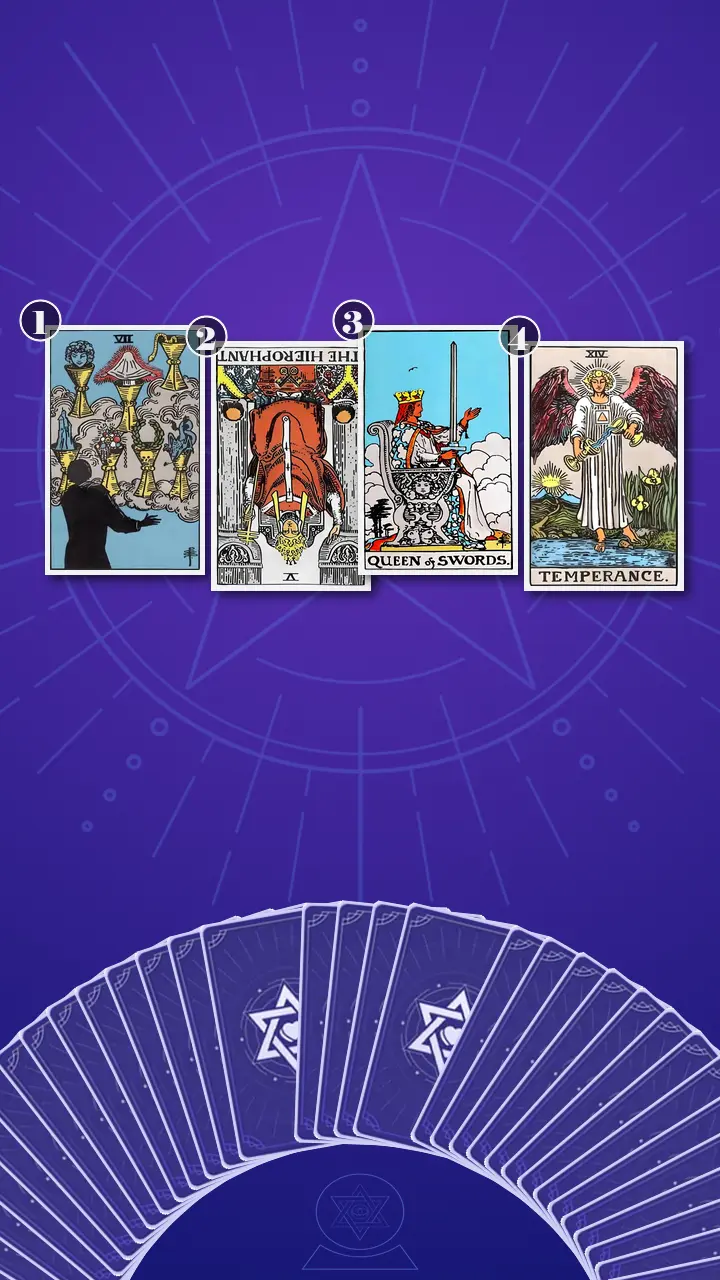
I chose The Shadow Spread, a four-card linear tarot spread. I use it for an inward-looking question like this because it does not pretend to judge the person asking the question or predict every future interaction. It traces the inner cycle: the visible habit, the hidden rule that powers it, the insight that interrupts it, and the practical way to carry that insight into ordinary life.
The first card would show the concrete shadow pattern after the origin question lands: the drafting, face-scanning, and late-night replay. The second would reveal the belonging rule underneath it. The third, positioned as the hinge of the spread, would show the reframe Jordan could use in a real conversation. The fourth would turn that reframe into a sustainable social rhythm.
For me, this is how tarot works at its most useful: the cards do not issue a verdict on anyone's identity. They give an image to a pattern that has been hard to see while living inside it.
Seven Tabs and One Invisible Rule
The Visible Shadow: Seven of Cups Upright
I turned over the first card. "Now turned, this is the card representing the visible shadow pattern: what happens in your attention after someone asks where you are from." It was the Seven of Cups, upright.
Seven cups floated in cloud, each holding a different possibility. I told Jordan that I saw seven reply windows: the short version, the detailed version, the funny version, the version that sounded less defensive, the version that might prevent a follow-up, and two more she had not even written yet. In a Toronto coworking space or at a networking drink, one ordinary prompt could become seven browser tabs open for the same reply.
The upright card showed an excess of possibility rather than a lack of intelligence. Jordan was trying to protect connection by preparing for every imagined interpretation. But the more options she managed, the more her attention turned away from the actual person in front of her. The cloaked figure on the card faces the cups, not the room behind them. That was the social energy drain: her evening kept being spent on reactions no one had actually voiced.
"Maybe I should have said the other version," I heard her say, almost automatically. Then she exhaled a dry, brief laugh. "What if they thought I was hiding something? This is so accurate it is almost rude."
I let the laugh stand. "It is not rude to notice a pattern," I said. "It is also not a character flaw. You are trying to prevent every possible misunderstanding before it happens. The card is simply showing the price of that job." Her fingers loosened from the phone, though her gaze remained fixed on the seven cups.
The Hidden Driver: The Hierophant Reversed
I turned the second card. "Now turned, this is the card representing the hidden driver: the fear of being judged insufficient and the social rule that makes one answer feel like proof that you belong." It was The Hierophant, reversed.
In its traditional imagery, gray pillars frame an authority figure. Crossed keys rest at the feet, and a raised triple cross signals an established framework. Reversed, I read the image as an approved script losing its unquestioned power. Jordan was hearing a casual question and searching for the official biography format, as though an invisible onboarding handbook had appeared in the air and required her to submit the correct version of herself.
"I am not only answering them," I said. "I am trying to pass a belonging test they may never have created."
The line made Jordan look away toward the rain tracing the studio window. Her mouth tightened first, then her shoulders lifted, then gradually settled. "That is exactly it," she said. "Sometimes they are clearly being nice. But my brain is already acting like there is a panel of reviewers."
I was careful not to turn that into a judgment of the other person. Genuine curiosity exists. So does a real history of being made to feel like an explanation is owed. The reversed Hierophant did not tell Jordan to shut down every follow-up or defend every label in advance. It showed the difference between a social convention and a personal obligation. There is no official version of Jordan that she must submit in order to remain in a conversation.
When the Queen of Swords Made Room to Breathe
The Hinge: Queen of Swords Upright
The room seemed to quiet as I reached for the third card. "Now turned, this is the card representing the key reframe: the discernment and self-trust that can replace scattered explanations with one clear answer and a deliberate boundary." It was the Queen of Swords, upright.
Her sword rose in one clean vertical line. Her gaze met the world directly. Her open left hand did not grab or push away; it made space for a choice. At a first date or networking coffee, this is the card of giving one truthful, bounded answer, letting one breath pass, and then deciding what is relevant, mutual, and available today.
I have spent fifteen years blending perfume, and I call the lens I use here an Aura Permeability Diagnosis. I mean it as a perfumer's metaphor, not a claim that Jordan was responsible for anyone else's behaviour. A good fragrance has a perimeter: it can be present without filling every room, and it does not have to disclose every note in its formula to be real. Jordan's boundary had become too porous at the instant she mistook another person's possible confusion for a demand to hand over the whole bottle.
Before I said more, I named the exact scene the card was interrupting: 11:40 p.m., three drafts open in Notes, the vent clicking, her jaw tight. Jordan was still trying to solve a question that had taken less than a minute because she believed that the right wording might finally make her fully legible.
You are not required to satisfy every imagined version of the question; offer one clear, self-chosen answer and hold the Queen of Swords' upright blade as a boundary between honest sharing and compulsory explanation.
I let the sentence rest between us. Then I gave it its plainest form: "You do not owe every imagined version of the question an answer. One truthful boundary can keep you in the conversation without turning your identity into a full-time explanation."
Jordan went still. First, her breathing paused and her fingertips hovered above the edge of the table. Then her eyes lost their focus for a moment, as if she were replaying the King West bar and seeing the point at which she began answering questions that had never been asked. Her face hardened before it softened. "But does that mean I got it wrong before?" she asked, and there was a small flash of anger under the question. "Like I gave away all that energy for nothing?"
"No," I said. "It means you used the strategy you had when the room felt unsafe to leave unfinished. You do not have to make that past version of you the villain in order to choose a better boundary now." Her eyes reddened slightly. Her fist opened against her knee. A breath came out of her with a faint tremor, and her shoulders dropped as if she had been carrying a tote bag she had forgotten was there. The relief did not make her instantly certain; for a few seconds, the clear path seemed to leave her almost dizzy with responsibility.
I asked, "Now, using this new perspective, can you think of a moment last week when one answer and one pause might have changed how the rest of the evening felt?"
"The streetcar," she said. "I could have said, 'I grew up between a couple of places, and Toronto is home now,' then just... stopped." She looked at the Queen again. "I answered what was asked. I do not have to answer every version I imagined."
That was the breakthrough. It was not about becoming colder or more guarded. It was a first move from scattered social vigilance and identity-management exhaustion toward self-trust, bounded sharing, and steadier participation. One answer is information, not an audition. Jordan could be truthful without becoming fully legible.
The Landing: Temperance Upright
I turned the final card. "Now turned, this is the card representing grounded integration: a small practice for protecting your social energy while staying open to connection." It was Temperance, upright.
The angel pours steadily between two cups, with one foot on land and one in water. I read that as balance, not compromise for its own sake. One cup is what Jordan chooses to share. The other is what remains private for now. Neither cup is false. Temperance does not ask her to choose between total disclosure and total withdrawal.
I thought of my old workbench, where one extra drop can overwhelm a composition and too little air can flatten it. The point of balance is not to make every formula identical; it is to keep enough room for each note to breathe. In a friends' gathering, Jordan might answer once, feel her own capacity, then let the conversation move naturally toward music, work, food, or whatever shared interest is actually alive in the room.
"Both truths can exist," I told her. "I am open, and I am not fully available for this topic."
The card showed balance rather than blockage. The Queen's clear boundary was not a wall. Temperance gave it a rhythm: one answer, one pause, one choice about whether more sharing feels mutual and wanted. A boundary can leave the conversation open without leaving Jordan exposed.
Clarity Without Autobiography
I laid the four cards out as one story. The Seven of Cups showed Jordan's attention scattering across imagined replies. The Hierophant reversed showed the invisible approved-identity script underneath: the belief that a single imperfect answer might prove she did not belong. The Queen of Swords created the hinge, returning authorship to her own language. Temperance turned that insight into a measured disclosure rhythm that protected the rest of her evening.
The cognitive blind spot was not that Jordan cared too much about connection. It was that she had been treating the possibility of being misunderstood as a requirement to manage every interpretation. Her shift was simple in structure, though not always easy in practice: replace "I must provide the perfect origin answer" with "I can offer one chosen answer, pause, and decide whether I want to continue."
I gave her three small next steps. I wanted each one to be a choice, not another performance standard.
- Build a two-line origin menu.Before the next team coffee, date, or gathering, spend ten minutes in Notes writing one truthful answer to "Where are you from?" and one optional closing line, such as "That is the short version; I am happy to talk about something else." Read both aloud once at home.Keep the language ordinary and private. Do not send it to anyone, and do not promise yourself that you must use it. One sentence is enough.
- Use the Scent Bubble Protocol.Before entering a draining social space, I asked Jordan to anchor herself for one breath by noticing a familiar, comforting scent on a scarf, hand cream, tea, or even an imagined clean-air bubble around her. When the personal question arrives, she gives the chosen answer once, notices her jaw or shoulders, and takes one comfortable breath before adding anything.The pause is not a dramatic silence. It is a small personal perimeter in which Jordan decides whether the conversation has earned more context.
- Contain the after-event replay.After one social event this week, Jordan can set a seven-minute timer and write only three labels: what I said, what I wanted to protect, and what I may choose next time. When the timer ends, she closes the app and makes tea, showers, or listens to one song.The goal is not to produce a better biography. It is to return ownership of the evening. If writing makes the spiral louder, she can skip it or use a brief voice note instead.
These were not rules for becoming invulnerable. They were ways to check genuine interest against personal capacity. The fuller story can remain Jordan's until she chooses the room for it.

A Week Later, the Evening Was Hers Again
A week later, Jordan sent me a message after a team coffee. A colleague had asked the familiar question. Jordan used her chosen sentence: "I grew up between a couple of places, and Toronto is home now." She felt the urge to add the director's cut. Instead, she took one breath and waited.
The colleague smiled, asked what part of Toronto she liked most, and the conversation moved to neighbourhood restaurants. Jordan had not needed a confrontation, a perfect script, or proof that the question would never feel loaded again. She had used discernment at the point where she normally surrendered it.
On the streetcar home, she replayed the raised eyebrow for half a stop. Then she noticed the vibration beneath the seat, kept her headphones on, and let the draft stay unwritten. At home, she made tea. The question had not disappeared; it had stopped owning the whole night.
I thought back to the line of cards: clouded cups, gray pillars, one upright blade, two measured streams. Jordan had not received certainty from tarot. She had recognized a choice that was already hers, then gathered enough evidence to trust it. That was her Journey to Clarity: not a complete answer, but a safe boundary around what she was willing to share.
When a simple question makes your jaw lock and your mind start drafting explanations, I know the tug-of-war can feel private and exhausting: part of you wants to be met as a whole person, while another part fears that one imperfect answer will leave you outside the conversation. Noticing that pull is already a way of stepping out of the old script.
What part of the conversation could you stay present for if you offered one truthful answer, held the Queen's clear blade for one breath, and let the next second belong to you?
Every reading at AceTarot is a journey to connect with inner wisdom and empower the path ahead. This reading shared here is a psychological mirror, not a private record—crafted to reflect universal emotional loops and help restore personal clarity. Please note that these insights do not replace professional psychological, medical, legal, or financial advice, and should not serve as the sole basis for major life decisions.
Learn more about our Journey to Clarity.
How did this insight land for you?
🫂 This Resonates Deeply
🌀 Living This Story
✨ Now I See Clearly
🌱 Seeing New Possibilities
🧰 Useful Framework
🔮 The Confirmation I Needed
💪 Feeling Empowered
🚀 Ready for My Next Step
Author Profile
 AI
AI Luca Moreau
835 readings | 512 reviews
“As a perfumer for fifteen years, I’ve learned to perceive human boundaries through the delicate metaphor of scent. Relationships need the right amount of space to breathe, and I've seen too many kind souls exhaust themselves trying to please everyone. I’m here with warmth and understanding—not to teach you to be guarded, but to help you gently clear the air and rediscover the comforting, safe boundaries that are rightfully yours.”
In this Social Tarot Reading :
Core Expertise
- Aura Permeability Diagnosis: Using scent as a metaphor to identify environments where your personal boundaries are too porous, allowing toxic group vibes to permeate.
- Sensory Overload Management: Diagnosing the physical and emotional exhaustion caused by absorbing the chaotic energy of crowds.
Service Features
- The Scent Bubble Protocol: A visualization and somatic anchoring technique to establish an impenetrable energetic perimeter before entering draining social ecosystems.
Also specializes in :
Explore Related Patterns:
Boundary DiffusionAfter the short answer, you add context, a joke, and a disclaimer, then continue the exchange internally long after the coworker has stopped asking. You are allowing another person's possible confusion to blur the line between what they asked and what you owe, so disclosure expands before you have chosen it. The story does not show that the coworker demanded a full account; the pressure operates through an imagined obligation that follows you home. You can keep the conversation open while retaining private material, using one breath to decide whether more sharing is mutual, relevant, and available to you.
Performance-Based BelongingAt the drink, you fear that a bounded answer could make you seem difficult, evasive, or outside the room, and you search for an official biography format as though an invisible onboarding handbook were waiting for the correct version of you. You are turning ordinary self-disclosure into a performance whose quality appears to determine whether you belong. The imagined panel explains why one answer keeps demanding revisions after the coworker has moved on. You can let belonging be a relationship you participate in rather than a status you earn by becoming fully legible, so one truthful sentence can be enough without making the past strategy a personal failure.
Option HoardingAt 11:40 p.m., you have three answer versions in Notes, and the Seven of Cups image expands that scene into seven possible reply windows. When you delete, restore, and rewrite, you are not simply looking for better wording; you are keeping several social outcomes alive so no single version has to carry the risk of being misunderstood. At the later coffee, the urge to add the "director's cut" shows the same protective strategy returning after you have already answered. You can notice that generating more options feels like control while it quietly moves your attention away from the person in front of you and turns one question into a job with no finish line.
Post-Event RuminationAlthough the exchange lasts less than a minute, you carry it home until it occupies the room, then delete, restore, and retype the answer at 11:40 p.m. The replay is an attempt to gain certainty from a moment that contains no new data, so each review briefly feels useful while extending the unfinished task. When you later replay the raised eyebrow for half a streetcar stop but leave the draft unwritten, the loop has a visible interruption. You can treat the end of the conversation as real information and give the rest of the evening back to yourself instead of asking memory to produce a perfect verdict.
Defensive OverexplainingAt the King Street West drink, you give the short answer, notice a slight eyebrow movement, and add context, a joke, and a disclaimer you did not plan. You are using extra explanation as a defensive buffer, trying to close every imagined gap before another person can decide that your answer is difficult or evasive. At home, the same buffer becomes three rewritten versions because a sentence that feels bounded seems unsafe to leave alone. You can separate honest context from compulsory repair and let one clear answer stand without making your identity responsible for every interpretation.
Mind ReadingAt the drink, you use the slightest movement in a coworker's eyebrows to infer what they may really be asking, and you ask yourself whether they thought you were hiding something. The observable cue is small, but the imagined judgment becomes a working fact, so you start answering an unspoken question. When your brain creates a panel of reviewers even while the other person is clearly being nice, possible evaluation outruns the words that were actually exchanged. You can hold the cue as ambiguous information rather than a verdict and choose your response from what was said, not from every mind you imagine behind it.
Explore Related Struggles:
Identity Verdict LockAt 11:40 p.m., you are still holding your phone over three versions of an answer to a question that lasted less than a minute. After the coworker's slight eyebrow movement, you add context, a joke, and a disclaimer, then keep revising what you might have said. The exchange has become a private review panel. A short answer is no longer just information; it carries the possible verdict that you are difficult, evasive, or outside the room. You spend the night trying to make one origin story fully legible to every imagined reader, locking the need to belong and the right to author your own identity into the same sentence. More wording cannot settle a verdict that was never actually issued. One chosen answer lets you separate being understood from being approved, leaving your identity larger than any response a coworker may or may not have expected.
Privacy-Belonging SplitAt the King Street West drink, you give the short answer and then add context, a joke, and a disclaimer after noticing a slight movement in the coworker's eyebrows. You want to remain in the conversation, but the amount you share keeps expanding beyond what you had chosen to offer. A bounded reply begins to feel like social withdrawal, while fuller disclosure feels like the price of staying inside the room. Privacy and belonging are made to compete at the same moment, even though neither need actually cancels the other. You can be open to connection without making your whole history available on demand. Later, you say that you grew up between a couple of places and Toronto is home now, then pause. The colleague smiles and asks about neighbourhood restaurants. The conversation continues because one truthful answer was enough, showing that participation and privacy can occupy the same social space.
Boundary CollapseAt the King Street West drink, you give the short answer and then add context, a joke, and a disclaimer after a slight movement in the coworker's eyebrows. By 11:40 p.m., the same line is still being reopened across three Notes drafts. Your line around what is yours to share becomes porous at the exact moment you treat possible confusion as a request for the whole bottle. The effort keeps the exchange smooth on the surface, but it leaves you carrying explanations that were never explicitly asked for. A social boundary that could have ended at one truthful sentence keeps extending under pressure from imagined reactions. At the later team coffee, you use one truthful sentence, take one breath, and watch the colleague move to neighbourhood restaurants. A boundary can hold the shape of your participation without shutting the door, so more context becomes a choice made in real time rather than an automatic extension of the answer.
Self-Editing ExhaustionAt 11:40 p.m., you are sitting at the edge of your bed with three versions of the same answer glowing in Notes. You delete a sentence, restore it, and type it a third way, while your jaw stays tight and your breath remains high in your chest. The editing is meant to prevent misunderstanding, but every revision reopens the same less-than-one-minute exchange and directs your attention toward reactions no one has voiced. The answer becomes an unpaid night shift, with effort continuing long after the social event has ended and no new information arriving to justify the cost. At the later team coffee, the urge to add the director's cut appears again, but one comfortable breath gives you enough space to leave the draft unwritten. You do not need a perfect biography to end the work. You can let one sentence stand and return the rest of the evening to yourself.
Explore Related Emotions:
Conditional Belonging FearYour bounded answer feels risky because you fear it could make you seem difficult, evasive, or outside the room. When the colleague is plainly being nice, your mind still supplies a panel of reviewers and an invisible onboarding handbook demanding the approved version. That imagined test turns ordinary curiosity into a condition you must satisfy before you can remain connected. Conditional Belonging Fear names the pressure of treating belonging as something that can be withdrawn when your explanation is not complete enough.
Identity PR FatigueAt King Street West, you give the short answer, then add context, a joke, and a disclaimer after noticing the smallest eyebrow movement. By 11:40 p.m., the exchange has become three drafts in Notes and has expanded to fill the room. You are spending attention on making your identity land correctly for every imagined audience, even though no one asked for a full biography. The background drain described in the story gives Identity PR Fatigue its particular texture, with self-presentation turning into unpaid work that continues after the social moment is over.
Identity Verdict DreadAt home, you keep working on a question that lasted less than a minute because the right wording seems capable of making you fully legible. The eyebrow movement, the unfinished drafts, and the thought that someone might think you are hiding something all give one answer the weight of evidence about your whole identity. That is why the replay feels larger than the exchange itself. Identity Verdict Dread is the fear that a small, imperfect description will be treated as a final judgment, leaving you to defend versions of yourself that no one has actually requested.
Choice Paralysis OverwhelmThree versions of the answer glow in your Notes at 11:40 p.m.; you delete a sentence, restore it, and type it again after a coworker's less-than-one-minute question. Your attention has split into multiple reply windows, each one trying to anticipate a different reading of the same words. That split keeps you facing imagined reactions instead of the person actually in the room, so choosing becomes a demand to eliminate every possible misunderstanding. The felt result is the overwhelm of choice paralysis, with too many plausible answers and too little permission to let one be enough.
Cautious Self-TrustAt the later team coffee, you say, 'I grew up between a couple of places, and Toronto is home now,' then take one breath instead of adding the director's cut. The colleague smiles and the conversation moves to neighbourhood restaurants, giving your own choice a piece of real-world evidence. Your openness is still selective, and your boundary is still available for revision if you genuinely want to share more. Cautious Self-Trust is the steadier feeling that lets you stay in the conversation without handing over authorship of your identity.
Emotional HangoverOn the edge of your Toronto bed, the phone stays warm in both hands while the vent clicks and the question keeps occupying the room. Later, on the streetcar, you replay the raised eyebrow for half a stop even after you leave the draft unwritten. Your body has moved on from King Street West, but the interaction remains active in the background, making a brief social moment feel like the emotional weather of the entire evening. Emotional Hangover captures that lingering residue without claiming that the question itself became more important than it was.
Agency ReliefAfter the cards are laid out, you can see the point where you began answering questions that had never been asked. In the later coffee, you use one sentence, wait, and allow the next second to belong to you. At home, the draft stays unwritten and you make tea while the question stops owning the whole night. Agency Relief comes from no longer treating other people's possible interpretations as tasks you must complete, so the evening returns to your choice.
Clarity ReliefYour chosen line separates what was actually asked from the versions your mind invented, and the conversation moves toward Toronto restaurants without a confrontation or a perfect script. The distinction is concrete enough to guide the next breath. Clarity Relief is not a flawless biography or certainty that the question will never feel loaded. It is the clean recognition that one truthful answer is information, not an audition, and that more context remains a choice.
Explore Related Contexts:
Conditional Belonging PressureJordan gives a short answer at the work drink, notices a small movement in the coworker's eyebrows, and immediately adds context she had not planned to offer. Later she describes an invisible panel of reviewers, as though the conversation requires an approved biography before she can remain uncomplicatedly inside it. The structure is a social condition that has not been spoken aloud. A bounded answer is made to carry the risk of being read as difficult or evasive, so belonging appears to depend on supplying more personal history than the moment actually requested. You can locate the pressure in that implied test, where ordinary participation is made contingent on proving that your background is legible to the room.
Origin Questioning PressureAt 11:40 p.m., Jordan is still editing three versions of an answer to a question that lasted less than a minute at a King Street West work drink. She had already added context, a joke, and a disclaimer after noticing a coworker's slight eyebrow movement, so the social exchange continues as unpaid explanatory labor after everyone else has moved on. The external pressure is the expectation that a simple origin question should receive the version of Jordan's biography most likely to prevent misunderstanding. You can see why the evening keeps getting consumed when the task is no longer answering what was asked, but managing every possible interpretation of the answer. That makes Origin Questioning Pressure a precise description of the social situation rather than a judgment about Jordan's character.
Unspoken Social RulesJordan says she can answer the question but cannot predict which version is actually being asked. At the work drink, that uncertainty produces extra context, a joke, and a disclaimer, while later the same exchange remains open in her Notes app because no one has supplied a clear stopping point. The social rule is powerful precisely because it is undefined. You are left trying to infer how much explanation will count as normal, direct, or sufficiently reassuring, even though no formal requirement has been stated. Seeing the rule as a convention rather than a compulsory submission creates room to decide what is relevant and what remains yours.