Off-Script Drift: Naming Grief Before Testing One Career Choice

When an Off-Script Life Became a Blank Calendar
On Sunday night, I watched Jordan open their Notes app to redesign their entire life philosophy, then hover over closing the laptop without putting one 20-minute action on Monday's calendar. It was 9:12 p.m. in their small Toronto apartment kitchen. The kettle clicked itself cold beside them, the radiator tapped behind the chair, and the white light from a document titled A More Authentic Life sharpened the tiredness around their eyes.
At twenty-nine, Jordan moved between short-term content design contracts. They could explain nonlinear careers, independence, and why conventional milestones were not a useful measure of a life. What they could not explain, even to themselves, was why every practical next step remained in draft form.
“I can explain what this season means,” they told me, rubbing the heel of one hand against the hollow place below their collarbone, “but I can't say what I'm doing next. Maybe the fact that my life is off-script means I'm freer than everyone else. Or maybe I'm protecting my potential by never making it concrete.”
Their ambivalence sat in the body like one foot inside a TTC train and one foot on the platform while the warning chime sounded: heavy shoulders, restless fingers, and a chest braced for doors that would eventually have to close or reopen. Behind the language of freedom, I could hear grief, shame, and longing pressing against one another.
Jordan finally gave me the question without polishing it: “What am I avoiding by calling my drift an off-script life?”
“An off-script life can still contain choices,” I said. “I am not here to put you back inside somebody else's script, and the cards will not issue a verdict about your future. I want us to separate reflection from refuge, grief from failure, and a small experiment from a permanent identity. Let us make a map of this fog and see where your agency is already waiting.”

Choosing the Shadow Spread as an Excavation Map
I invited Jordan to place both feet on the floor, take one unforced breath, and hold the consultation question in mind while I shuffled. I treat this preparation as a change of attention, not a supernatural performance. It gives the mind a clean threshold between repeating its usual explanation and examining that explanation.
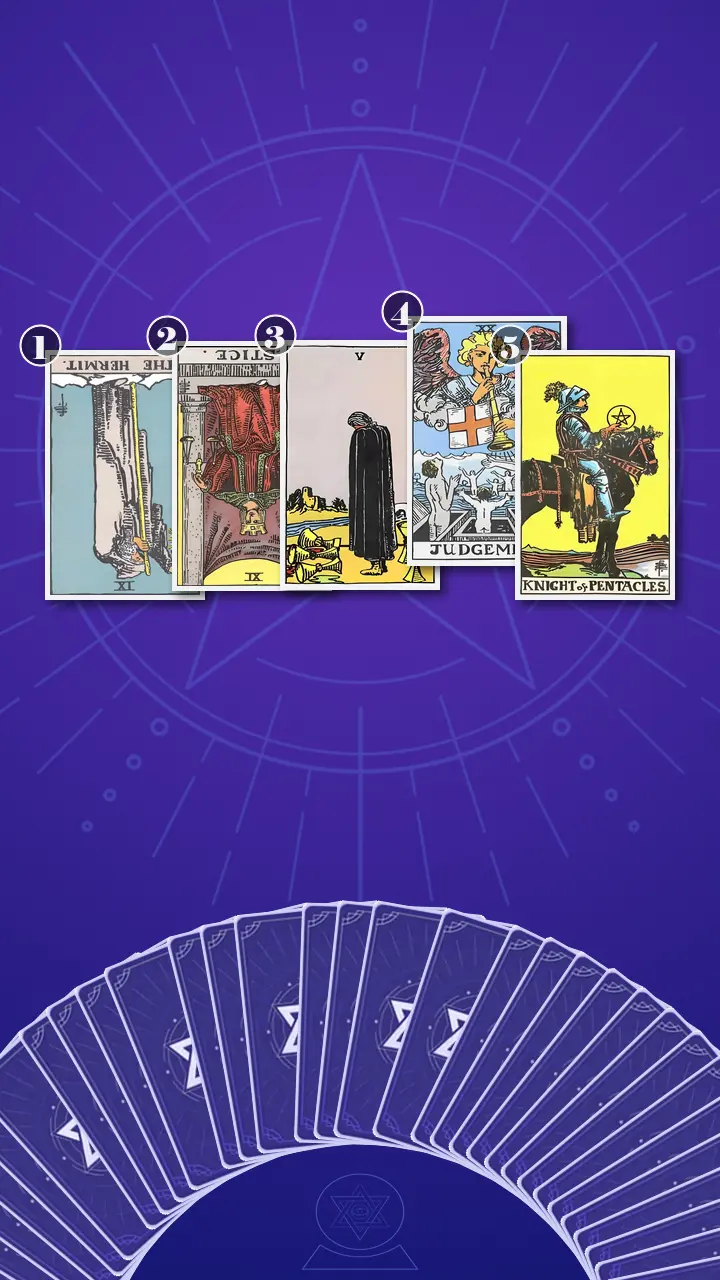
I chose The Shadow Spread, a five-card linear tarot spread. For anyone wondering how tarot works in a reading about career indecision, this spread does not predict which job Jordan will take. It provides a structured sequence through which card meanings in context can reveal a visible pattern, the story permitting that pattern, the feeling underneath it, an awakening, and a practical form of integration.
The method suited Jordan's question because this was an inner excavation, not a request for a predetermined outcome. A larger spread would have introduced external possibilities before we understood the identity story protecting the drift. These five positions were economical: the first would show the observable symptom, the second the rationalization beneath it, the third the grief being protected, the fourth the honest reckoning, and the fifth the grounded next step.
I arranged the cards in a shallow staircase from left to right. In my mind, the eye path moved from a dim private room toward a workbench: a lantern, scales, spilled cups, a trumpet, and finally a cultivated field. Tarot would supply the visual evidence. Jordan would retain the authority to decide what, if anything, to do with it.
The Lantern That Never Reached the Road
Position 1: The Visible Shadow Pattern
“The card I am turning now represents the visible shadow pattern,” I said. “It shows the observable form of your existential drift, including how the off-script story appears in ordinary life while one grounded choice is delayed.”
I revealed The Hermit, in reversed position. The cloaked figure held a raised lantern close to the body while standing apart from the surrounding landscape.
I connected the image directly to the scene Jordan had shown me. The Hermit reversed was the Sunday night spent refining a philosophy of the off-script life in Notes while the kettle cooled and a portfolio email remained unsent. The lantern was not fake insight. Jordan had done real reflection. The problem was that the light stayed close to the body instead of reaching the road, the calendar, or another person.
I read the reversal as a blockage in Hermit energy. Solitude and contemplation had stopped functioning as a route toward participation and had become immediate relief from choosing, grieving, or being seen trying. Their inner search resembled a beautifully redesigned Notion dashboard whose actual task remained permanently in the backlog. Insight was present; conversion into lived information was missing.
“Which part of your Sunday ritual genuinely clarifies the next step,” I asked, “and which part gives you the feeling of movement while leaving the same observable action untouched?”
Jordan's inhale caught first. Their eyes shifted from the card to the blank calendar on the screen. Then they released a short, bitter laugh and let their hands fall still. “That's so accurate it feels a little brutal.”
I did not let accuracy become an accusation. “Then we slow down,” I said. “Reflection helped you survive uncertainty and preserve a sense of possibility. We are only checking whether it still performs that job without charging too high a price. You do not have to abandon the lantern. We are asking it to illuminate one metre of road.”
Position 2: The Story That Keeps Changing the Scales
“The next card represents the protective identity story,” I said. “This position identifies the explanation that makes drift feel meaningful while postponing responsibility, uncertainty, and the question of what is actually being avoided.”
I turned over Justice, in reversed position. The paired scales and upright sword were still visible, but the reversal changed their function. A structure intended for discernment had become unstable.
I described a scene Jordan recognized immediately: a friend in a west-end cafe asks what they are working toward, the espresso machine hisses, and Jordan gives a polished explanation about timing, alignment, and nonlinear careers. The answer is thoughtful, but it never reaches a deadline, a tradeoff, or a statement of what they are willing to test. Like scales whose scoring system changes whenever a result gets close, the off-script label makes every outcome philosophically valid and therefore difficult to evaluate.
Justice energy was not absent; it was distorted and blocked. Jordan was skilled at analysis, but their standards dissolved at the exact moment analysis could become accountable. The choice was then protected from failure, but also from evidence. Every open tab for a possible future remained ideal because none had been asked to survive twenty minutes of contact with reality.
I offered the inner script plainly: “I am not avoiding it; I am keeping the options open. If I name a standard, I can fail it.”
Jordan's jaw tightened. One thumb pressed into the rim of their mug, their gaze lost focus as though replaying a recent conversation, and then their grip loosened by a fraction. “A client asked what terms would make me extend my contract,” they said. “I gave them a whole answer about flexibility. I never gave them the terms.”
Years around excavations have taught me that an object without recorded context can support almost any attractive theory. I felt the same professional caution here. A life philosophy without a date, boundary, or test could keep changing shape to defend itself.
“Justice is not asking you to impose a punitive five-year plan,” I said. “It is asking for a standard as clear and humane as the one you would offer a trusted friend: what do you know, what do you value, what are you responsible for, and what reversible action could you take by Friday?”
Position 3: The Cups Beneath the Explanation
“The third card represents the hidden feeling beneath the label,” I said. “This is where we look for the grief, disappointment, or unmet need giving the outer pattern its emotional weight.”
I revealed the Five of Cups, upright. Three cups had spilled in the foreground. Two remained standing behind the cloaked figure, and a bridge led toward a distant structure.
I asked Jordan to remember opening LinkedIn on the TTC and seeing a former classmate announce a promotion, or pausing over a group-chat photo of a friend's new apartment. Jordan could sincerely reject parts of that conventional script and still ache for the stability, recognition, belonging, or legible identity inside the frame. The black cloak held the private sadness that their polished explanation could not comfortably admit.
The card's emotional water was upright and available, but its flow was narrowed by attention fixed on what had spilled. The two standing cups did not promise that everything was fine. They represented resources grief had not erased: Jordan's design experience, their independence, trusted relationships, enough stability for a bounded experiment, and the freedom to revise an option after learning from it.
“Grief is not proof that the old script was right,” I said. “You can mourn the life you expected without choosing it again. But if the mourning is translated immediately into a philosophy about freedom, it never gets to tell you what mattered.”
Jordan's fingers curled once, then opened against the tabletop. Their eyes reddened before they looked away toward the dark kitchen window. “I don't even know if I want the exact life they're posting,” they said quietly. “I just thought that by twenty-nine I'd be able to answer a basic question without giving a TED Talk about it.”
“That is specific enough to honour,” I replied. “You may be grieving ease, recognition, and the expectation that adulthood would feel more legible. None of that obliges you to imitate your friends. It simply lets the grief stop disguising itself as superior detachment.”
When Judgement's Trumpet Broke the Private Loop
Position 4: The Reckoning That Is Not a Verdict
The room seemed to become quieter as I reached the fourth position. A streetcar bell sounded faintly beyond Jordan's window, brief and clean, and for a moment the city itself appeared to echo the card waiting beneath my hand.
“This position represents the honest reckoning that can turn the question What am I avoiding? into self-authored clarity and a chosen next step,” I said. I turned over Judgement, upright: the angel's trumpet sounded outward while figures rose from enclosed spaces with open arms.
Judgement energy arrived in balance, not as punishment, but as honest self-assessment, self-forgiveness, and conscious response. Its modern-life meaning was precise: Jordan could hear their own question without turning it into a verdict about who they were. They could acknowledge grief, accept responsibility for one current choice, and answer with a reversible experiment rather than a final identity.
I asked Jordan to picture the Sunday scene again: elegant theories filling the Notes app, the kettle gone cold, and the calendar still blank. The reflection brought real relief, yet Monday returned with the same hollow chest because nothing had been allowed to answer back through experience.
At that point I used the lens I call Cognitive Paradigm Excavation. On a dig, a collapsed wall is not evidence that an entire settlement lacked value. It tells me that an old structure can no longer carry the life pressing against it. Jordan's bottleneck was not a defective character. It was the collapse of an obsolete intellectual era governed by one brittle law: I must discover a completely authentic direction before I act, because the result will measure my worth.
I then applied Core Philosophy Stratigraphy, separating beliefs by layer instead of demolishing everything at once. Jordan could carry forward the durable foundations: independence, curiosity, reflective depth, and the right to live unconventionally. They could leave behind the later defensive layer that treated every small commitment as a permanent identity claim. The new governing law was simpler: A bounded choice can gather evidence without defining me.
“The off-script story may be protecting you from grieving the life you expected and from choosing a responsibility that could feel like a verdict on your worth,” I said. “Clarity does not arrive by explaining the path perfectly. It begins when one honest, reversible experiment lets the path answer back.”
Do not use the off-script label to keep drift unexamined; answer Judgement's trumpet by naming the grief and taking one reversible, accountable step.
For one long beat, Jordan's breathing stopped. Their fingers hovered above the laptop as if an old reflex had been interrupted before it could open another note. Their pupils widened; then their brows drew together and heat rose into their face. “But doesn't that mean I've been wrong this whole time?” they asked, the words sharper than anything they had said so far. I let the resistance have space. “No,” I answered. “It means the story protected something real until its cost became visible. A structure can become obsolete without making the person who built it foolish.” Their gaze drifted away, replaying some private sequence of postponed emails and moved calendar blocks. Then the tension travelled downward: their shoulders dropped, their fist opened, and a trembling exhale escaped. Relief appeared, followed by the slight disorientation that comes when a familiar defence is no longer required. “So I don't have to prove what my life is,” they said, almost under their breath. “I only have to answer it.”
“Now, with this new perspective, think back to last week,” I invited. “Was there a moment when this insight might have changed how you felt?”
Jordan named the contract-extension email. “I thought replying would trap me in that career. But I could have stated my conditions and learned from their response. It wasn't a life sentence. It was an email.”
I named the shift I had just witnessed. This was not certainty replacing uncertainty. It was a first movement from spiritualized drift and fear of a wrong choice toward grief-aware agency and grounded self-trust through reversible action. Jordan still felt exposed, but the exposure now belonged to participation rather than shame.
“I do not need to know whether this is my forever direction,” Jordan said, testing the sentence aloud. “I only need to learn what happens when I participate for one honest week.”
The Knight and One Cultivated Row
Position 5: The Practice That Lets the Path Answer
“The final position represents practical integration,” I said. “It shows how the insight can become a small, repeatable action that moves you from existential drift into grounded participation without prescribing your entire life.”
I revealed the Knight of Pentacles, upright. The horse stood still. The knight held a single pentacle at eye level, and the plowed field behind the figure showed deliberate work rather than dramatic reinvention.
In Jordan's life, this card looked like one focused portfolio hour, one application, or one conversation with a trusted professional, followed by a short review of what the action revealed. The task did not have to prove a new identity. It only had to be small enough to repeat and real enough to produce information.
Knight of Pentacles energy was in balance: patient, embodied, and reliable. The stillness of the horse was different from the stagnation in the opening cards. The Hermit reversed stayed still to preserve an untested possibility; the Knight stayed still long enough to tend one chosen row. Consistency, not intensity, would allow Jordan to rebuild trust in their own decisions.
“My problem is that I can turn a twenty-minute block into a whole productivity system,” Jordan said. Their smile was more open now, but I heard a real practical obstacle beneath it. “I'll make a tracker, redesign the tracker, and then decide the experiment is badly designed.”
“Then the minimum version is part of the reading,” I said. “One plain note. One calendar block. No new dashboard. If twenty minutes feels too exposed, open the case study and revise one sentence. The experiment may remain unfinished. Your task is to generate contact, not perform certainty.”
The Paradigm Shift Manifesto in Twenty Minutes
I drew the five cards into one continuous account. The Hermit's private lantern showed how reflection had separated from participation. Justice reversed revealed the moving standards that protected every option from evaluation. The Five of Cups located the grief beneath the philosophy. Judgement called Jordan out of a sealed self-story, and the Knight of Pentacles placed one measurable task in their hands.
The cognitive blind spot was not simply a lack of direction. Jordan had been treating action as an identity verdict and inaction as neutral openness, even though delay was already shaping income, confidence, and available choices. The transformation was therefore not from an unconventional life to a conventional one. It was from using “off-script” as an exemption from choice to using freedom as the capacity to run humane, reversible experiments.
I framed the next steps through my Paradigm Shift Manifesto. This was not another elaborate declaration to file inside Notes. It was a compact operating agreement for Jordan's next life chapter, designed to replace one obsolete governing law and test the new law in ordinary time.
- Write the Four-Line Paradigm Shift ManifestoFor one current decision about work, open a plain note and spend no more than ten minutes writing: “What I know,” “What I value,” “What I am responsible for,” and “One reversible action by Friday.” Add one sentence above the list: “A choice can give me information without defining my worth.” Read the result as if a trusted friend had written it.Keep the standard clear and humane. Review it on Friday rather than turning it into a five-year plan, and revise it only after collecting real evidence.
- Run One Reversible Career ExperimentChoose one direction already on the list, such as a longer-term content design role. Before Friday, place one 20-minute block in Google Calendar to revise a single portfolio case study, review one relevant job description, or message one trusted professional. When the timer ends, record only three observations: what felt energizing, what felt heavy, and what became clearer through doing.Give the experiment a one-week exit date. If resistance says the test is too small to matter, reduce it to opening the document or drafting the first sentence. The result creates information, not an obligation.
“These are not instructions from fate,” I told Jordan. “They are instruments for observation. You choose the direction, the pace, the boundaries, and the criteria. The cards have helped us expose the old structure; only your participation can show what deserves to be built next.”

Five Days Later, One Mark on the Calendar
Five days later, I received a screenshot from Jordan. A Thursday calendar block read Portfolio test, 20 minutes. They had revised one case-study opening, reviewed a role they had been avoiding, and written three observations without applying or declaring a new career identity.
Their message said, “It didn't solve my career. It did show me that I miss working with a consistent product team. That feels like evidence, not a personality test.”
That night, they slept through until morning. Their first thought was still, “What if this is wrong?” The question no longer landed like a verdict. Jordan smiled, made coffee, and kept the Friday review block.
I thought back to the spread's movement from lantern to scales, from water to earth. The five-card Shadow Spread had not rescued Jordan, predicted an outcome, or selected a respectable path on their behalf. It had made the hidden structure visible. Jordan created the first proof by acting within boundaries they had chosen.
That was our Journey to Clarity: not the discovery of a perfect script, but the recovery of authorship. Self-trust did not arrive as confidence before action. It began as Jordan's willingness to feel grief, answer one practical question, and remain kind to themselves while the evidence was still incomplete.
I know how a hollow chest can return when another LinkedIn milestone appears, and how much safer it can feel to call the blank space freedom than to grieve the life once expected or risk a choice that seems to measure personal worth. I also know that noticing this protection, without condemning it, is already a loosening of the old structure.
If one calendar block could become your answer to Judgement's trumpet rather than a verdict on your worth, what reversible 20-minute experiment would you be curious to place there this week?