From Self-Doubt and Course Hoarding to Practice-Based Self-Trust

Course Hoarding at 9:40 p.m.
I met Alex (name changed for privacy), a 27-year-old early-career digital marketing coordinator in Toronto who could follow a manager’s brief with ease and still open another course whenever their own blank portfolio project asked them to choose a direction. That is how productive procrastination through learning had begun to look in their life: responsible from the outside, quietly painful from within.
At 9:40 p.m. on a Tuesday, I watched Alex open the blank campaign concept, stare at the blinking cursor beneath the title, and switch to two course-comparison tabs. The laptop fan hummed against the harsh overhead light. Their phone felt warm in their hand, and the white project page seemed almost bright enough to interrogate them.
Alex gave a small, embarrassed laugh. “I keep thinking the next course will make me ready. I can explain the process better than I can show my own work.”
I could see the self-doubt physically: a tight jaw, shallow breaths, shoulders lifted as if they were bracing for a question they could not answer. It was like building a launchpad entirely out of instruction manuals, then standing beside it with a full library and nowhere to take off.
“You want to trust yourself enough to start,” I said, “but starting without another framework feels as if it might expose every gap in what you know. I’m not here to shame the courses or force a public performance. Let’s look closely at the pattern and draw a map through it. Our Journey to Clarity begins with finding the difference between learning that serves your work and preparation that keeps the work safely unopened.”

The Compass for a Career Crossroads
I asked Alex to place both feet on the floor, take one ordinary breath, and name the question without trying to solve it. Then I shuffled slowly. The small ritual was a psychological threshold, a way to move attention from the glowing marketplace of courses back into the room, the body, and the decision in front of us.
I chose a Four-Layer Insight Ladder tarot spread. When I explain how tarot works in a consultation, I describe the cards as structured mirrors rather than verdicts. This spread was precise for Alex because course hoarding was not one isolated habit; it was a self-reinforcing sequence. Collecting produced relief, relief delayed practice, and delayed practice seemed to prove that more collecting was necessary.
A Celtic Cross would have added more context than this question needed, while a simple three-card line would have compressed the visible behaviour and the maintaining fear into one layer. The Four-Layer Insight Ladder gave us four distinct places to look: the observable blockage, the root that kept it repeating, the transformation key, and the practice that could make the insight real.
I told Alex that the line would rise from the storage room of accumulated resources toward a working studio. The first card would show what happened in the first two minutes after the blank file became visible. The second would ask what the preparation ritual protected them from feeling. The third would identify the agency that could return to them. The fourth would turn that agency into repeatable, practice-based next steps.
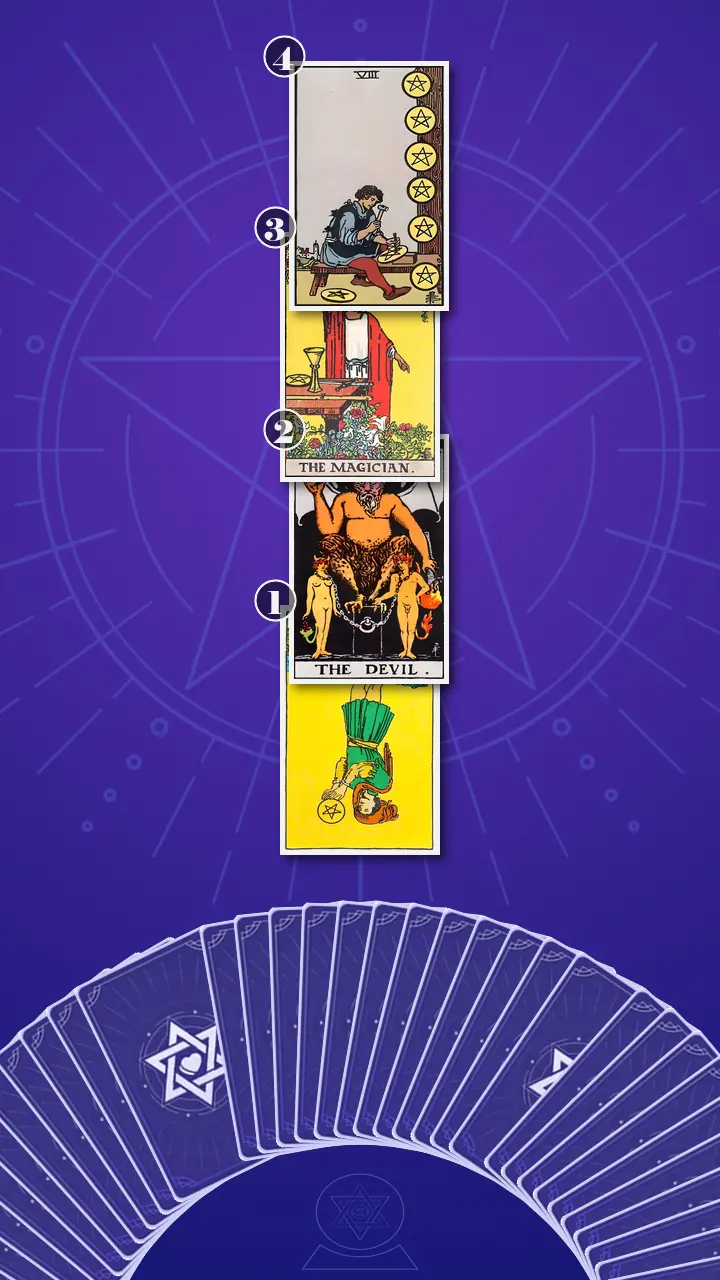
Reading the Map of a Safer Click
The Pentacle Beside the Empty Project
Now I turned over the card representing the observable blockage: how the Resource Hoarding Loop appears when Alex collects, sorts, or compares courses instead of starting a first draft.
The full card was the Page of Pentacles, in reversed position.
The Page of Pentacles reversed was the exact moment Alex opened the blank campaign concept, saw the cursor blinking under the title, and switched to a course marketplace before writing one line. The newly purchased course could be held as evidence of seriousness. The project folder could remain empty without having to offer any evidence at all.
I pointed to the Page’s careful grip on the pentacle. Upright, that attention can become practical curiosity, the willingness to learn through contact with the real world. Reversed, the Earth energy had become blocked and over-contained. Alex was studying the promise of competence so intensely that they never entered the field where competence was developed.
“This is not a sign that you do not care about learning,” I said. “It shows learning energy held still. A full learning dashboard is not the same as a finished piece. The resource has become something to possess instead of something to use.”
I brought the scene back to 9:40 p.m. “I am only checking one more thing,” I said, naming the sentence Alex’s hand had already rehearsed. Then I added the quieter line beneath it: “If I start now, someone might see the gap in what I know.”
Alex let out a short laugh with a bitter edge. “Damn, this is exactly what I do: my learning dashboard is full, my project folder is empty, and I keep calling the delay responsible.”
I did not treat the recognition as a confession or a failure. “That sentence is useful data,” I replied. “We can notice the switch without turning it into a character judgment. The question is not how to become a different person overnight. It is whether you can stay with the blank file for a few minutes longer and learn what the discomfort is trying to prevent.”
Alex’s eyes moved from the card to the laptop, then to the carefully labelled course folder. Their thumb stopped scrolling. For the first time that evening, the delay looked less like a moral problem and more like a protective move that had become too expensive.
The Relief Hidden in the Chain
Now I turned over the card representing the maintaining root: how Shadow Possession and the fear of being exposed as unready drive Repetition Compulsion beneath the respectable appearance of preparation.
The full card was The Devil, in upright position.
I began with the loose chains around the two figures, not the horned figure on the black pedestal. The chain was real, rehearsed, and powerful, but it was not an absolute verdict. It showed the small connection between a limited-time course banner, an almost-automatic purchase or bookmark, the temporary calm that followed, and another postponed draft.
“The Devil is not telling me that courses are bad,” I said. “It is showing me the attachment to the feeling a course gives you at a very specific moment. When the work could be evaluated, the next course offers a way to postpone evaluation.”
I asked Alex to imagine the discount notification arriving just after rent and utilities had left their Toronto account. One purchase seemed manageable. The growing total beside the untouched Google Drive folder was harder to look at, but the new course still gave them a pulse of control.
Alex whispered, “I know this probably will not solve it, but buying it means I do not have to find out yet.”
“Exactly,” I said. “Readiness is being treated like a product you can add to cart. The purchase removes the discomfort of being seen trying, at least for tonight. That relief is not proof that you are weak. It is the reward that keeps the loop alive.”
The black pedestal became, in our conversation, the authority of the ideal method: the perfect syllabus, the expert framework, the credential that would make judgment impossible. The downward-pointing torch turned attention away from constructive creation and toward comparison, reviews, and the private scoreboard of other people’s LinkedIn certificates.
Alex’s shoulders dropped a fraction. Their expression did not brighten, but their defensiveness loosened. They rubbed a thumb along the edge of the card and said, “So I’m not really buying information. I’m buying a few hours where I don’t have to know whether I can do it.”
“That is the root we can work with,” I said. “Not shame. Not a dramatic promise to stop learning. Just an honest pause before the ritual takes the steering wheel.”
When the Magician Closed the Course Tabs
The Table Was Already Set
I paused before turning the third card. The room seemed to narrow around the table. Outside, a streetcar bell moved faintly through the Toronto evening, and the sound disappeared into a silence that felt unusually attentive.
Now I turned over the card representing the transformation key: the specific capacity that can return authority to Alex and interrupt the repeated movement from blank project to another course.
The full card was The Magician, in upright position.
The Magician’s table held the Wand, Cup, Sword, and Pentacle, a complete working set. I translated them into Alex’s existing creative direction, emotional tolerance for imperfect work, judgment, and practical digital tools. Their audience knowledge, copy instincts, Figma access, notes, and ability to make a marketing decision were not waiting for a final credential. They were already arranged within reach.
“The Magician does not promise a flawless campaign,” I said. “The card shows focused agency. One skill, one familiar tool, and one concrete outcome can do more for self-trust than another broad curriculum chosen from fear.”
I use a lens I call Hero’s Journey Alignment at moments like this. Alex was not failing the journey; they were standing in the classic Refusal of the Call, the scene before a major character evolution where the known identity feels safer than the next role. They knew how to be the conscientious student. Becoming the maker meant accepting that no manager, rubric, or certificate would pre-approve the first move.
I then used Vision Actualization to examine the limiting narrative underneath the behaviour. Alex had been rehearsing the story, “I am not ready for the next stage of my life’s plotline.” I invited them to rewrite it more accurately: “I am ready for a private first experiment, and the experiment will show me what to learn next.”
I put the core moment into words. “At 9:40 p.m. in Toronto, the blank campaign file is open, the phone is warm in your hand, and Notion is already colour-coded. You tell yourself you are being responsible while another course tab quietly takes the place of the first draft you wanted to make.”
Self-trust is not a prerequisite you can buy; it is evidence you create by using what is already on the table.
I let the sentence settle, then gave the card’s more personal instruction.
You are not missing the final credential; begin with the tools already on the Magician’s table and let one finished attempt become evidence of self-trust.
Alex did not nod. First, their fingers froze above the phone and their breath stopped halfway in. Then their eyes lost focus, moving beyond the card as if they were replaying every saved course, every colour-coded plan, and every Sunday evening spent comparing a private blank file with someone else’s polished portfolio launch. Their jaw tightened as though the insight had accused them.
“But then doesn’t that mean I was wrong all this time?” they asked, with a sudden flash of anger.
I let the anger have a sentence. “It means the strategy protected you from exposure. It does not mean your past effort was worthless or that you have to punish yourself for needing safety.” The flush in Alex’s face softened. Their closed fist opened one finger at a time. Their shoulders lowered, not all at once but with the reluctant release of a held weight.
Then a long breath came out of their chest. “Oh,” they said, almost too quietly to hear. “I can use what I have and let the attempt tell me what I’m missing.” A streetcar bell sounded again outside, clear and brief. The room seemed to widen. “Now,” I asked, “use this new perspective to think back: was there a moment last week when this insight could have made you feel differently?”
That was the first crossing from self-doubt and preparation-based avoidance toward grounded self-trust built through observable practice. I did not expect certainty to appear. I wanted Alex to feel the small opening where choice had returned.
The Workbench Instead of the Trophy Shelf
Now I turned over the card representing the grounded integration: a practice-first way to build self-trust through completed attempts and use future learning only in response to a demonstrated skill gap.
The full card was the Eight of Pentacles, in upright position.
The craftsperson on the card was carving one pentacle while completed examples were displayed nearby. I connected that image to a portfolio workflow: Draft 01, review, Draft 02, and one visible record of what changed. The workbench was not a trophy shelf for flawless outcomes. It was a place where skill could become observable through repetition with attention.
“This is the difference between deliberate skill-building and compulsive resource collection,” I said. “You finish one small component, review the friction, and study only the gap the attempt reveals. Your next lesson should answer a question your last attempt actually revealed.”
I gave Alex the sentence I wanted them to carry into the next blank file: “I can learn from this version instead of learning forever before making one.”
Alex’s hand moved toward the notebook. They wrote down one possible component: a single audience insight slide for the campaign concept. Their breathing was still careful, but it no longer seemed trapped high in their chest. The choice was modest. That was precisely why it was believable.
The Page had held the resource. The Devil had shown the relief loop. The Magician had coordinated the tools. The Eight of Pentacles gave those tools somewhere to go.
The Draft That Became a Compass
I placed the four cards in their rising line and told Alex the story I could now see. The reversed Page had turned learning into a stationary identity, a careful student holding a pentacle while the fertile field of practice went unused. The Devil revealed the emotional payoff beneath that identity: another course created a temporary shelter from evaluation. The Magician returned authority to Alex’s hands. The Eight of Pentacles showed how that authority could become evidence through ordinary, repeated making.
The core metaphor was no longer a launchpad built from instruction manuals. It was a storage room being converted into a studio. The problem was not too few resources. It was that resources had shifted from tools into borrowed permission. Self-trust could begin when a course stopped functioning as proof that Alex was allowed to start and became a targeted instrument for a real question.
I named the cognitive blind spot carefully: Alex had been treating uncertainty as evidence of inadequacy and preparation as a morally safer choice. They were also comparing an unedited private draft with other people’s public highlight reels, then using the difference as proof that they were behind. The more honest transformation direction was from external permission to internal evidence, from broad course collection to targeted skill-gap learning, and from readiness checking to practice before another course.
“I want to make the next identity concrete,” I said. “This is where I use my Character Bible Directive. It is a creative visualization protocol, not a performance. We write the exact psychological and behavioural specifications of the future self you want to begin embodying today.”
We drafted a short character entry for Alex’s future self: this person notices the jaw tightening when the blank file opens; takes one ordinary breath; closes the marketplace tab; chooses one audience, one message, and one rough asset; lets the first version remain private if needed; and asks the work what question deserves a lesson. The future self was not magically fearless. They simply had a different response available.
“These are your actionable next steps,” I said. “Keep them small enough to test and specific enough to teach you something.”
- Run the One Skill, One Tool, One Outcome resetOn one weekday evening this week, open the existing portfolio project in Google Drive or Figma before opening Coursera, Udemy, Skillshare, or another course platform. Spend three minutes writing your Character Bible response, then choose one audience, one problem, and one rough campaign concept. Set a 45-minute timer and finish one visible version using only the skills and tools already available. Keep the file private if public sharing feels too exposing.Define the deliverable before starting. If 45 minutes feels too large, use the ten-minute version: one headline, one audience insight, or one campaign angle still counts.
- Make Draft 01 teach you what Draft 02 needsWithin seven days, choose one small portfolio component, such as a campaign brief, three-email sequence, audience insight slide, landing-page critique, or content calendar. Label the first version Draft 01. Before revising, write only three notes: what is clear, what is confusing, and what single change would improve it. Record the exact skill gap that appeared.Do not turn the review into a new curriculum. An unlisted link, a private file, or observations sent to one trusted peer are all valid forms of evidence.
- Use a 24-hour course gateWhen a course discount appears this week, screenshot the offer without purchasing and place it in a 24-hour holding note. Before revisiting it, spend at least ten minutes on the portfolio project and write one question that emerged from the work. After the pause, decide whether the course answers that specific question, fits the budget, and supports an existing project rather than serving as proof that you are allowed to begin.The point is not to reject education. It is to let the gap come from the work. If the discount disappears, the decision still belonged to you.
I reminded Alex that this was an experiment, not a vow to become endlessly productive. They could stop when the timer ended. They could keep the first version private. They could still buy a course later. The new rule was simply that learning would follow contact with the work often enough for real evidence to enter the conversation.

The Quiet Proof of Draft 01
Five days later, I received a message from Alex while I was waiting for the kettle to boil. “I opened the Figma file before Coursera,” they wrote. “I spent 45 minutes on one audience insight and a rough campaign angle. It’s not impressive yet, but it exists. I wrote down the gap instead of buying the course.”
Alex had kept the file unlisted and created Draft 02 after noticing that the audience problem was too broad. The new question was specific: how could they sharpen the message for one segment without making the campaign sound generic? That was a real learning need, not a general request for permission.
That night, Alex slept through until morning, but woke with the familiar thought, “What if I’m wrong?” They smiled, opened Draft 01, and read the question they had earned.
I did not call that a solved life. I called it a quiet proof. The cards had not made the decision for Alex; they had helped separate a repeated protective ritual from a choice. The Journey to Clarity had moved from self-doubt and preparation-based avoidance toward grounded self-trust built through observable practice, one imperfect file at a time.
When a blank file makes your jaw lock and your breathing go shallow, it can feel safer to keep collecting proof than to risk discovering what your current skills can actually make. If you let one existing skill be enough for a private Draft 01, what small piece of work would you be curious to see from yourself before reaching for another course?