Intense Chemistry Made the Red Flag Look Smaller, Then the Note Stayed

The 12:40 a.m. Spotlight on Dismissing Red Flags
I recognized the pattern the moment I met Maya (name changed for privacy): she was a Toronto product designer who could evaluate evidence all day in Figma, then delete the evidence from her own dating life as soon as an affectionate text lit up her phone.
At 12:40 a.m. in her small apartment, I watched Maya hold her warm phone under the blue screen light while the fridge hummed behind her. She had typed two behaviours that unsettled her after a Hinge date into her Notes app, switched to an intensely flirtatious iMessage thread, and erased the second line with her thumb.
“Why do I keep dismissing red flags when the chemistry feels intense?” she asked. “I know what I would tell a friend, but it feels different when I am inside it. The red flag looks smaller every time they make me feel wanted.”
I heard the contradiction clearly: Maya wanted to follow the chemistry into connection, but feared that taking the warning seriously would require her to step back from something rare. The feeling moved through her like trying to read a warning label through a nightclub spotlight: the letters were there, but the brightest part of the room kept winning her attention.
“You keep treating chemistry like evidence,” I said gently. “That does not make you foolish, and it does not make the attraction false. Let us give the attraction a place at the table without letting it speak for every other fact. We can draw a map before you decide where to go.”
The Compass Around the Magnetic Center
I asked Maya to put her phone face down, take one slower breath, and name the question she wanted the cards to examine. I shuffled while she focused on the observable pattern rather than trying to guess what the other person secretly felt. For me, the preparation was a psychological transition: a small pause in which her attention could stop chasing the latest message.
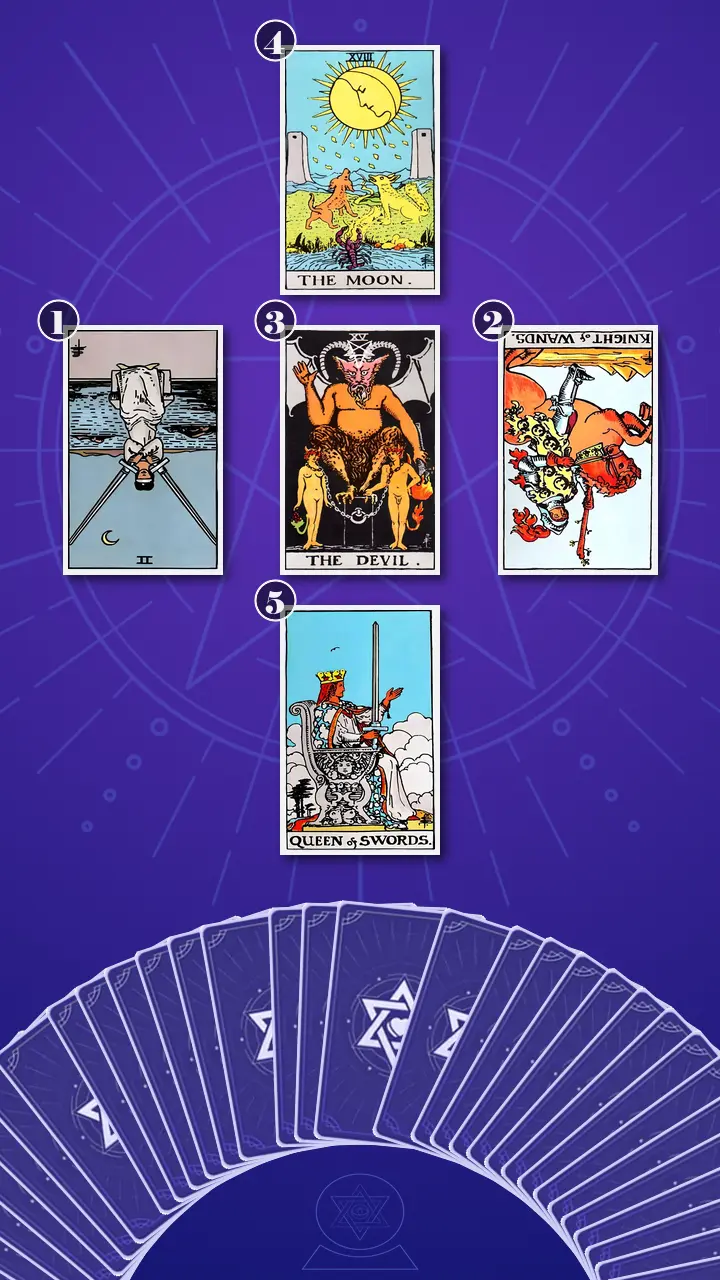
I used a five-card Relationship Spread - Context Edition. This is how a focused relationship tarot spread can clarify red flags and chemistry without pretending to provide access to another person’s private motives. The first position examines Maya’s current stance and the moment she disqualifies her own concern. The second looks at observable pacing, consistency, and follow-through from the other side. The central card reveals the reward that makes the pattern feel difficult to interrupt. The fourth clarifies the fog around facts, stories, and bodily unease. The fifth offers a self-led integration practice rather than a prediction.
I explained that a Celtic Cross would add background and forecasting layers that were unnecessary for this focused question. This spread gave us just enough structure to move from the visible behaviour, through the magnetic attachment, toward direct communication and evidence-based self-trust. The cards could not make the decision for Maya. They could help her see which information had been receiving too little authority.
Reading the Map Beneath the Chemistry
The Deleted Line: Two of Swords Reversed
Now I turned over the card that reveals the presenting behaviour and blocked decision process through which Maya recognizes a red flag, reopens the question, and dismisses her own observation. It was the Two of Swords, in reversed position.
The blindfold and crossed swords became Maya’s deleted phone note. The perception was already present; the problem was that it was not being allowed to become a stable conclusion. The reversed position showed blocked Air becoming increasingly difficult to contain. This was not a total lack of information. It was information being repeatedly softened whenever a clear response might threaten the connection.
I brought the image into her actual life. Maya leaves a date with one clear concern, opens Notes to record it, and then reopens the entire debate when an affectionate message arrives. The crossed swords become competing explanations. The blindfold becomes the decision to avoid the evidence that might require her to slow down. The red flag does not become smaller because the text is affectionate.
I recreated the scene with her: the blue light, the fridge hum, the warm phone, and the sentence waiting to be erased. The private logic sounded like this: “If I leave this written, I have to take it seriously; if I delete it, I get to keep the possibility.”
Maya did not nod. First, her breath caught and her thumb hovered over the phone as if the old message thread might rescue her. Then her eyes lost focus, replaying the date and the moment she had typed the concern. Finally, she gave a short, bitter laugh and said, “That is too accurate. I do this every time I am afraid of what the answer would require.”
“You do not have to turn the concern into a verdict tonight,” I told her. “Let us keep it visible long enough for it to become a question. That is different from spiralling, and it is different from accusing anyone.”
Heat Without a Schedule: Knight of Wands Reversed
Now I turned over the card that identifies observable pacing, consistency, and follow-through from the other side of the interaction, without claiming access to private motives. It was the Knight of Wands, in reversed position.
The rearing horse and forward-driving wand looked like the rush that arrives after distance: several invitations, late-night voice notes, intense compliments, and sudden plans. The connection surges quickly enough to make Maya react to the latest burst instead of observing the whole pattern. Reversed Fire creates excess heat and insufficient direction. Enthusiasm may be genuine, but vivid pursuit is not the same as steady follow-through.
I asked Maya to compare emotional speed with observable behaviour. Had plans been kept? Had a stated boundary received a respectful response? Had the warm words continued after closeness resumed, or had the renewed attention simply reset the evaluation? I did not need to label the other person as careless or manipulative. I needed Maya to notice what happened next.
“When the messages spike, I rearrange everything,” Maya said. “I answer immediately. I tell myself that the acceleration proves the connection is going somewhere.”
I watched her turn her phone over and look at the calendar on the wall. “Your pace is data too,” I said. “If the chemistry can only survive when you abandon your sleep, plans, or normal reply speed, that is useful information about the rhythm, whatever the other person intends.”
The Autoplay Loop: The Devil Upright
Now I turned over the card that exposes the deeper force connecting Maya to the pattern, especially the reward that makes intense chemistry feel more authoritative than her boundaries. At the centre of the spread lay The Devil, upright.
I did not read it as a sentence about the relationship, and I did not use it to predict that the connection was doomed. I focused on the visibly loose chains around the two figures. Desire can feel compulsory while agency is still present. The question was not whether Maya wanted closeness. The question was what short-term reward made slowing down feel almost impossible.
The modern image was an autoplay loop. Maya decides to take space, a flirtatious message arrives at exactly that moment, and the sudden relief makes the unresolved issue feel temporarily irrelevant. Her private thought becomes, “I was going to slow down, but now I feel wanted again, so maybe the concern was not that serious.” The chemistry is not false. It has simply been promoted into an instruction.
The radiator clicked off in the quiet room. Maya pressed her palms against her knees, then released them. “I keep treating chemistry like evidence,” she said, this time without trying to defend the sentence.
“The pull can be enjoyed while its authority is examined,” I replied. “You can notice the relief, name what it gives you, and still pause before letting it decide the next date, the next reply, or the meaning of the entire connection.”
The Moonlit Route: The Moon Upright
Now I turned over the card that clarifies the primary relational challenge and perceptual blind spot that allow attraction, uncertainty, and projection to blur the meaning of red flags. It was The Moon, upright.
The long path between the two towers gave me the clearest translation. A path can be real without every turn being visible at once. The Moon showed Maya having a few concrete observations, several emotionally persuasive explanations, and a physical sense that something was off, then blending all three into one story she could neither prove nor dismiss.
I asked her to separate three categories: what happened, what story she was adding, and what remained unknown. A delayed reply was an observation. “They are losing interest because I asked for too much” was an interpretation. Whether the person could respond directly and follow through over time was still unknown. Her tight chest was important information about her experience, but it was not by itself a complete account of another person’s intentions.
I compared it to reviewing a dimly lit TTC route at night. I could move carefully without pretending to see the whole journey in one glance. The goal was not to treat every shadow as proof. It was to stop calling every shadow nothing simply because I could not photograph it clearly.
Maya traced the edge of the card with one finger. Her shoulders rose when she listed the facts, then lowered slightly when she gave herself permission to label the unknowns. “I think I keep asking whether I am intuitive or afraid,” she said. “Maybe I am expecting one feeling to solve the whole case.”
“That expectation is part of the fog,” I said. “You can move with partial visibility. You only need enough clarity for the next honest question.”
When the Queen’s Sword Cleared the Spotlight
The Clean Research Note: Queen of Swords Upright
The room seemed to become quieter around the final card. Now I turned over the position that defines Maya’s self-led integration practice: holding chemistry and discernment together through direct questions, preselected boundaries, and repeated observation. It was the Queen of Swords, upright.
The single upright sword and the Queen’s open hand gave me the balance Maya needed. The sword was clear language, not punishment. The open hand was receptivity without self-abandonment. This Queen did not ask Maya to become cold, suspicious, or certain about the entire future. She asked Maya to give repeated behaviour, direct communication, and personal standards equal authority with attraction.
My signature lens here is Daily Friction Deconstruction. I strip away dramatic accusations and locate the mundane, mechanical breakdown underneath. In Maya’s dating life, that means replacing a sweeping question like “Is this person bad for me?” with a precise one: “What happened after I stated that boundary, and was the response respectful and consistent?” The ordinary details are not too small to matter. They are where compatibility becomes observable.
I also used my second lens, Emotional Clutter Sorting. I separated the actual relational question from the pressure around it: the rarity of exciting dates in an expensive city, the polished anniversaries in Instagram Stories, the fatigue of a hybrid work schedule, and the fear that being easygoing was the price of being chosen. Those pressures could make a concern feel heavier or lighter, but they could not answer it.
I flashed back to the kind of product research Maya trusted at work. A vivid user reaction was a signal, not the entire evidence set. No designer would declare a product healthy because one person loved the launch screen while ignoring repeated friction in the flow. The same principle could serve her without reducing romance to a spreadsheet.
I said, “Intensity is not evidence of compatibility; let the Queen’s upright sword separate what feels electric from what is consistent, respectful, and real.”
Maya had been caught inside an old bargain: if she named the concern, she might have to slow down; if she slowed down, the connection might cool; if it cooled, the rare feeling might disappear. The phone was quiet, but the fear was still asking her to choose the spark over herself.
Chemistry can be completely real without being sufficient evidence of compatibility. The spark gets to be felt, but repeated behaviour and direct communication get an equal vote.
I let the silence hold. I watched Maya’s breath stop for a beat, her fingers suspended above the Notes app. Then her gaze went unfocused as if she were replaying the comment that had brushed against her boundary, the affectionate text that followed, and the instant relief she had mistaken for an answer. Her eyes grew bright, and her jaw tightened before slowly releasing. Her shoulders dropped in stages, not dramatically but enough for the chair to take some of her weight. One closed hand opened against her thigh. When she finally spoke, her voice was low and unsteady: “I can like the chemistry and still ask a clear question.” She opened a new note and wrote three headings: observed, added story, still unknown. Underneath, she began three personal standards. I could see relief arrive alongside a small, unfamiliar vulnerability. Clearer vision meant she had choices again, and choices carried responsibility. “I am not deciding the whole future,” she read aloud. “I am checking whether this specific behaviour matches what I need.”
“Now use this new perspective to revisit last week,” I invited. “Was there a moment when separating the electric feeling from the repeated behaviour would have let you feel different, even if the answer stayed complicated?”
That was the crossing I wanted her to notice: not from attraction to rejection, but from adrenalized longing and uneasy self-doubt toward calm, evidence-based self-trust. The spark could remain. Maya was beginning to decide how much authority it deserved.
Finding Clarity Without Killing the Spark
When I placed the five cards together, I could see a coherent story. The reversed Two of Swords showed Maya’s available information being reopened and disqualified. The reversed Knight of Wands showed how bursts of attention created heat and urgency before consistency could be evaluated. The Devil revealed the short-term reward beneath the loop: feeling wanted, chosen, and temporarily protected from loss. The Moon showed why facts, interpretations, and body signals kept merging into one exhausting story. The Queen of Swords supplied the missing structure, while the absence of Pentacles reminded me that insight alone would not ground the next decision. Maya needed observable records, slower pacing, and repeated behaviour.
The blind spot was not that Maya could not see a red flag. It was that she believed a pull this strong must mean the connection was special enough to receive more chances, even when the pattern had not earned them. Her deeper fear made the chemistry carry a job it could not perform: proving that she was worth choosing. The direction of change was practical. She would move from rating the connection by its peak moments to recording whether repeated behaviour stayed consistent with three preselected boundaries across several interactions.
I told Maya that this five-card Relationship Spread - Context Edition had separated five things that usually arrived in one emotional rush: her own stance, observable pacing, the attachment reward, the ambiguity around the facts, and a self-led integration practice. Tarot had not declared an outcome. It had given her a cleaner way to ask the next question and return authority to her own recorded observations.
“I want the next steps to be small enough that the spark does not become another emergency,” Maya said.
- Keep one concern visibleWithin 30 minutes after the next concerning interaction, open the Notes app you normally use and write one sentence beginning, “I observed...” Keep that sentence visible for 24 hours. Afterward, rewrite it as one neutral question, such as, “What happened there, and how do you see it?” Decide for yourself whether to send it, save it for a conversation, or use it only to clarify your own standard.Tip: Keep it to one behaviour and one sentence. If the exercise makes you more activated, pause, do something ordinary and grounding, and return only when the note feels useful rather than compulsive.
- Build a three-boundary evidence logBefore the next interaction, write three personal boundaries in observable language, such as clear plans, a respectful response to a no, and follow-through on commitments. For the next two or three interactions, add the date and one factual line under each boundary when relevant. At the end of the week, ask only, “What has repeated?”Tip: Track behaviour, not imagined motives. The list is flexible and personal, not a universal rulebook or a demand to monitor every message.
- Use the 24-Hour Micro-Boundary ResetFor the next 24 hours, choose one non-negotiable block of your own time. When a sudden burst of attention arrives, keep the plan already on your calendar, silence notifications for 30 minutes while you finish the meal, commute, class, or evening with friends, and reply afterward at your normal pace. Record what was promised separately from what was completed.Tip: This is a pacing experiment, not a test of the other person’s character. You are protecting enough space to notice whether intensity can coexist with your life.
I reminded Maya that none of these actions required her to end the connection, send a confrontation text at midnight, or decide whether the other person was good or bad. They simply gave her perception a place to survive long enough to become useful.

The Quiet Proof of Self-Trust
Four days later, I received a message from Maya. She had kept the note, asked one concise question, and left one existing Wednesday plan intact when a burst of invitations arrived. The response she received was clear in parts but did not fully match the later follow-through. Maya did not rush to explain it away, and she did not force herself to make a final decision before she was ready.
“I am not deciding the whole future,” she wrote. “I am watching whether the answer holds.”
Maya told me that evening, she slept through until morning. At breakfast, the old thought arrived - what if I am wrong? - but she kept eating, left the message unanswered until lunch, and smiled at the small blank space where panic used to make the decision.
That was the first evidence of the shift: not a solved relationship, not perfect certainty, but a woman allowing attraction and discernment to occupy the same room. The cards had offered images. Maya had chosen the pace, the question, and the boundary. That is what finding clarity looked like in practice.
When a connection feels rare, I know how tightly the chest can close around the note that almost gets deleted. The desire to stay open can sit right beside the fear that naming what hurts will make you less easy to choose. Even noticing that conflict is already a form of self-trust beginning to return.
If you could let one small piece of evidence sit beside the spark without deciding the whole future tonight, what would you want to keep visible?