Three News Feeds Cooled Dinner; Ten Phone-Free Minutes Made Room

The Sunday-Night Feed That Ate Dinner
If you work a hybrid communications job in Toronto and check breaking-news alerts before your feet touch the floor, the Sunday Scaries may be about more than Monday morning. They may carry the fear that your own day cannot begin until the world stops changing.
That was how Alex (name changed for privacy), a 28-year-old communications coordinator, arrived for our video consultation. It was 7:42 on a Sunday evening. Behind them, pasta sat cooling beside the stove while the kettle clicked off and the refrigerator kept up its low electrical hum. Their phone was warm in one hand. Three news feeds were open, and their jaw tightened whenever another vibration crossed the kitchen.
“I know the main update,” Alex said, glancing down at the screen again. “That is the ridiculous part. I already know it. But I keep checking different versions because closing everything feels irresponsible.”
A Notion page for their portfolio waited untouched on the laptop. A group chat held an unanswered dinner invitation. Alex worked in an environment where CBC links, Slack messages, social posts, and breaking-news alerts could all look equally relevant, so the boundary between professional awareness and doomscrolling had become almost invisible.
“I cannot tell whether I am engaged with the world,” they said, “or simply postponing my own life.”
I watched one of their hands curl around the phone while the other rested beside the cold plate. Their unease had the physical quality of a radio locked to emergency frequencies: plenty of signals, no silence, and no bandwidth left for their own voice. A tight jaw, shallow breathing, and restless fingers were doing the work of readiness even though no immediate response had been asked of them.
“Nothing about caring for the world makes you foolish,” I told them. “And we are not going to use tarot to tell you that you should ignore the news. We are going to make the loop visible, separate awareness from permanent readiness, and find out where your choices can re-enter the day. Let us draw a map through this fog.”
Choosing a Staircase Out of the Signal Field
I asked Alex to place the phone face down, still within reach, and take one slow breath before I shuffled. I do not treat this as a mystical performance. The pause gives the mind a threshold: for a few minutes, incoming information stops leading, and the actual question gets the room.
I chose the Four-Layer Insight Ladder · Context Edition. For anyone wondering how tarot works in a situation like compulsive news checking, I use the cards as a structured external mirror. Their images help us place a habit, its underlying rule, an alternative perspective, and a testable next step where we can examine them more objectively.
I chose this four-card tarot spread because Alex did not face two competing external options. A decision spread would have falsely reduced the issue to “news or no news,” while a ten-card Celtic Cross would have added more layers than the question required. The actual problem was a self-reinforcing attention loop, so I wanted the smallest map capable of showing the entire mechanism.
I explained the staircase arrangement. The first card would reveal the visible checking pattern and the personal space it consumed. The second would uncover the survival rule keeping the pattern active. The third would offer the transformative resource, and the fourth would turn that insight into a small information boundary Alex could test without surrendering the decision to the cards.
“The reading is not a prediction,” I said. “It is a way to see the system clearly enough that you can choose what happens next.”
Reading the Crowded Left-Hand Column
Position 1: The Blindfold Made of Open Tabs
“The card I am turning now represents the visible symptom and present condition,” I said, “including the concrete checking behavior, the narrowed attention, and the lack of room left for your personal life.”
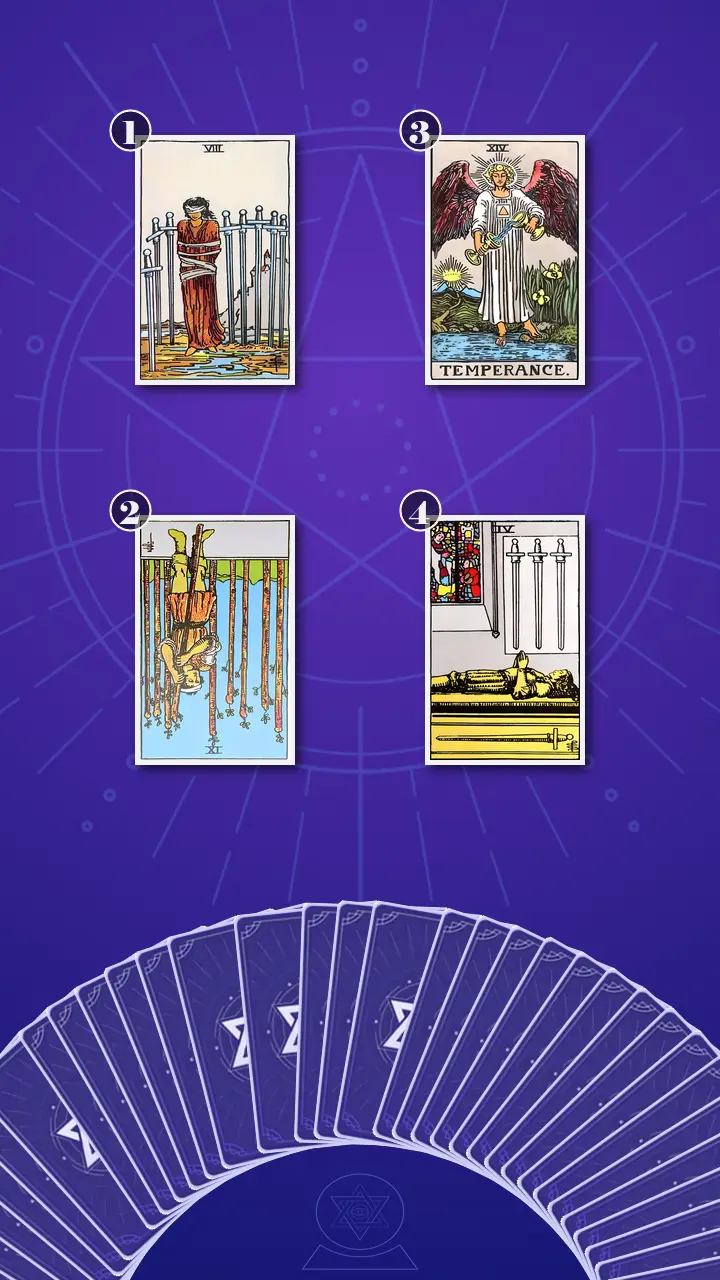
I turned over the Eight of Swords, upright.
I pointed to the blindfolded figure, the crossed arms, the loose bindings, and the enclosing swords. In Alex’s life, this was the moment when a personal task remained open on the laptop while the phone stayed within reach. One more headline promised orientation, but dinner, conversation, work, and personal direction had to wait while the same update appeared in slightly different language.
“The inner script sounds reasonable,” I said. “It says, ‘I only need one more update, then I can get back to my life.’ But the observable fact is that the personal moment has already been postponed.”
The card’s Air energy was in excess: too many signals, comparisons, and unfinished lines of thought. That excess had become a blockage. Alex was not physically prevented from closing the feed, just as the figure’s bindings were not as fixed as they first appeared. Repeated checking had narrowed the visible field until “keep reading” felt like the only responsible choice.
I asked, “When did a headline last interrupt something ordinary that you genuinely wanted to be doing?”
Alex gave a short laugh that carried no amusement. Their eyes stayed on the card while their thumb rubbed the darkened phone screen. “That is so accurate it is almost cruel.”
I let the reaction land before answering. “Cruel would be telling you that the cage is permanent. I do not see that here. The card is showing us how the restriction is assembled, including the loose binding. That means we can identify which part belongs to circumstance and which part can be adjusted.”
I tapped the space between the swords. “Your attention is not a public emergency channel. Which information is genuinely actionable for you today, and which information is only keeping the loop active?”
Position 2: The Guard Whose Shift Never Ends
“The card I am turning now represents the underlying mechanism and root,” I said, “the place where survival mode and the 24/7 news cycle convert staying informed into depleted vigilance.”
I revealed the Nine of Wands, reversed.
The bandaged figure still held the staff, but reversed, the card showed Fire in deficiency and blockage. The guard had spent so much energy maintaining readiness that the boundary no longer protected recovery. I connected it to Alex checking an alert during a colleague’s sentence, following two links beside a half-eaten lunch, and returning to the conversation with only half of it remembered.
“I want to put the phone away,” I said, giving one side of the conflict a voice.
“I cannot afford to be unprepared,” I added, voicing the other.
Alex’s shoulders rose slightly. “Yes. If I relax, I feel like that will be the exact moment I miss the thing that proves I should have stayed ready.”
“Being informed is not the same as being permanently on call,” I said. “The guard is still standing, but the life they meant to protect is not being lived.”
I used what I call an Energy Extraction Audit. Instead of treating the news app as one large problem, I asked Alex to identify the tiny habits drawing from their baseline energy: leaving the phone face up, opening alerts between Slack messages, filling every TTC pause with a live feed, and checking what friends had shared to confirm that continued attention was still necessary.
Each habit offered a few seconds of relief from not knowing, then charged interest later through a tighter jaw, a fragmented task, or the sense that personal motivation had gone missing. I call that delayed-return anxiety: attention keeps paying into the promise that the next update will finally produce enough orientation, but the return is delayed again every time a new alert resets the calculation.
Over twenty years of listening to people talk over coffee, I have learned to notice how small arrangements reveal private rules. I thought of phones placed face up between two cups, chairs angled toward an exit, and conversations repeatedly interrupted by a screen. The physical detail often speaks before the person has language for the pattern. Alex’s phone beside the cold pasta was saying, “Readiness gets a permanent place here. Your appetite can wait.”
Alex’s fingers stopped moving. Their gaze shifted from the reversed guard to the cooling pan behind them, as if the card had returned the kitchen to their awareness. Then their shoulders lowered by less than an inch, the kind of movement that does not announce relief but makes room for it.
When Temperance Opened a Second Channel
Position 3: Two Cups for One Livable Day
The room changed as I reached for the third card. Through Alex’s microphone, the refrigerator hum seemed to recede, and a streetcar bell sounded once beyond the apartment window, clean and distinct against the digital static.
“The card I am turning now represents the transformative insight and resource,” I said, “the perspective that can interrupt the checking loop without forcing you to choose between awareness of the world and participation in your own life.”
I turned over Temperance, upright.
I showed Alex the water passing between two cups, one foot on land and one in water, and the path continuing toward distant light. Temperance carried balanced energy: not the elimination of information, but its proportion. One cup could hold public awareness. The other could hold dinner, friendship, work, rest, a portfolio, or an unstructured hour in which a personal preference had enough quiet to become audible.
I asked Alex to picture Sunday at 7:42 p.m. again: pasta cooling, the phone warm in their palm, three feeds open, and the thought, “Closing this would be irresponsible.” The evening was being spent preparing for a headline instead of inhabiting the life already in the room.
This was where I applied my Daily Clutter Deconstruction. I named the physical inventory without judgment: a phone occupying the cooking hand, three feeds competing on one screen, a cold plate, an unanswered friend, and a personal project pushed behind the browser. Those objects formed a map of psychological traffic. The issue was not that Alex cared too much. It was that public urgency had containers everywhere, while their own life had none.
Temperance’s cups gave us a new design. News could have a receiving container: a chosen time, one or two reliable sources, and a clear question about action. Personal presence could have another: a protected meal, conversation, work block, or creative task. The goal was not perfect balance. It was to stop letting every incoming signal label itself “now.”
“Being informed can be a deliberate practice, not a permanent state of readiness,” I said. “Awareness is meant to support a life with direction, not become the place where your life waits outside. You can receive the world without letting it occupy every room in your day.”
You do not have to keep your attention on every update to escape Existential Drift; follow Temperance's measured flow by setting a news container and using the reclaimed time for one personally chosen activity.
I stopped speaking. The streetcar sound faded, and for a beat the consultation held only the small kitchen noises that had been there all along.
First, Alex’s breath paused. Their fingers froze above the face-down phone, and their eyes widened as if they had heard permission and accusation in the same sentence. Then their gaze moved away from me and lost focus on something beyond the screen, replaying, I suspected, meals and conversations interrupted in the name of being prepared. Their mouth tightened.
“But does that not mean I have been doing it wrong this whole time?” they asked. The words came out sharper than anything they had said before.
“It means a protection strategy has outlived the conditions in which it felt useful,” I replied. “I am not asking you to shame the part that wanted safety. I am asking whether that part still deserves complete control of the schedule.”
Their jaw unclenched first. Then their shoulders sank, and the hand beside the phone opened from a fist into a flat palm. Their eyes shone, but the relief did not arrive neatly. I saw a moment of almost weightless uncertainty, the slight dizziness that can follow putting down a burden and realizing that free attention also carries responsibility. Alex released a long breath and said, more quietly, “I can receive this without remaining available to it.”
I asked, “Now, with this new view, think back to last week. Was there a moment when this insight could have made the experience feel different?”
Alex mentioned a friend telling a story over lunch while an alert sat between them on the table. “I could have read it later,” they said. “There was nothing I could act on. I think I knew that, but I did not trust knowing it.”
I offered a low-pressure experiment: set a ten-minute timer, place the phone face down in another room, and choose one ordinary activity such as eating, showering, stretching, or opening the portfolio. I asked Alex only to notice what their attention reached for. When the timer ended, they could freely return to the feed. If ten minutes felt too activating, they could stop or shorten the interval. This was data, not a rule or a test of character.
I named the shift I was witnessing carefully. It was not a leap from distress to perfect calm. It was the first movement from hypervigilant, guilt-driven news monitoring toward bounded awareness, steadier attention, and deliberate participation in daily life. Alex had begun replacing “I must know everything before I can live” with “I can choose when and how I receive information.”
Position 4: The Quiet That Is Still a Life
“The card I am turning now represents grounded integration and the next step,” I said, “a small, self-chosen information boundary that can be tested in daily life without turning the cards into an authority over your decisions.”
I revealed the Four of Swords, upright.
The resting figure, the horizontal sword, and the quiet sanctuary translated directly into Alex placing the phone in another room for the first ten minutes of dinner or the beginning of a personal project. The pause was temporary and deliberate. News remained accessible later, but it did not enter every minute automatically.
In the opening Eight of Swords, Air had become an enclosing field of signals. Here, Air returned to balance through suspension. The mind was not being denied information; it was being allowed to stop receiving commentary long enough to recover perspective.
“A pause is not a disappearance,” I told Alex. “It is a place to hear what is yours. The feed may be quiet for ten minutes, but your life is still here.”
I asked them to name one bodily or environmental detail they could observe during the experiment. Alex listened for a moment. “The refrigerator,” they said, almost laughing. “And my jaw does feel different now.”
I watched them put the phone into a kitchen drawer for the remainder of the reading. The gesture was small and visibly imperfect; they looked toward the drawer twice. That was precisely why it mattered. The boundary was already becoming something they could observe and revise, rather than a dramatic promise to disconnect forever.
Turning Four Cards Into a Livable News Boundary
I gathered the cards into one coherent story. The Eight of Swords showed the visible result: a field of choice crowded by alerts, tabs, and repeated versions of the same update. The reversed Nine of Wands revealed why the loop persisted: checking had become a survival rule, offering brief relief while spending the energy needed for work, relationships, rest, and direction. Temperance introduced the unused resource, the capacity to proportion attention. The Four of Swords gave that capacity a physical form through a bounded pause.
The core contradiction was not care versus selfishness. It was continuous monitoring versus having room for a lived day. Alex’s attention had become a radio fixed on emergency frequencies, and the solution was not to smash the radio. It was to add a tuning schedule and restore a channel for their own voice.
I named the cognitive blind spot plainly: Alex had been treating continuous availability as proof of care and preparedness, while requiring personal time to justify itself through productivity, certainty, or moral permission. Yet another headline could not provide lasting control over safety. It could only postpone the discomfort of not knowing while also postponing the next personally chosen action.
The transformation direction was equally concrete: choose when to receive news, separate actionable information from reflexive checking, and protect one daily block for something self-directed. Tarot had not decided the correct amount of news for Alex. It had made the attention architecture visible. Alex remained the person with the authority to build, test, and revise the boundary.
Three Small Experiments for the Next Seven Days
- The Two-Window News RhythmFor seven days, schedule two ten-minute news windows at times that already exist, such as 12:30 p.m. and 6:30 p.m. Use one or two reliable sources, note anything that requires an action from you today, and close the feed when the timer ends.Begin with one five-minute window if two ten-minute appointments feel abrupt. The timing belongs to you and can be revised around genuine safety, work, or caregiving needs.
- The One-Breath Actionability CheckThe next time your hand reaches for a refresh during work, dinner, or a conversation, take one breath and ask, “Is there an action I need to take today, or am I trying to reduce the feeling of not knowing?” If there is no action, save the link and give five minutes back to the interrupted task or person.Do not debate whether the headline matters in theory. Ask only whether it requires your response today; make reasonable exceptions for information you have personally chosen to monitor.
- The 15-Minute Physical Anchor ExperimentWithin the next 48 hours, clear one minimal physical corner where the news usually enters your life: one end of the kitchen table, a square of the desk, or the space beside the sofa. Give the phone a specific resting place outside that corner, then spend fifteen minutes there on a meal, personal project, stretch, or message to a friend.Make the corner almost comically small. If fifteen minutes feels like a character test, use three. Record one neutral observation afterward, such as a slower breath, warmer food, or one personal preference that became easier to hear.
I reminded Alex that these were experiments, not commandments. A difficult day would not mean failure, and returning to the feed would not erase the information gathered during a pause. The purpose was to create evidence that awareness and personal presence could coexist, then let Alex decide which rhythm deserved to continue.

A Week Later, the Pasta Was Still Warm
Five days later, I received a message from Alex. They had cleared one end of the kitchen table, placed the phone in the bedroom, and set a ten-minute timer before dinner. “I reached for it at minute two,” they wrote. “At minute seven, I remembered the pasta was actually good.”
After eating, they opened the neglected portfolio and worked for fifteen minutes. They did not finish it or suddenly solve their future. They changed one paragraph, replied to their friend’s invitation, and stopped when the chosen block ended.
Alex had slept through that night, but their first morning thought was still, “What if I missed something?” This time, they told me, they noticed the thought, smiled without mocking it, and waited for the news window they had selected.
I did not call that certainty. I called it authorship. Our Journey to Clarity had not made the world quieter; it had helped Alex distinguish the world’s volume from their obligation to remain permanently available to it. The cards revealed the structure, but Alex changed the placement of the phone, chose the timer, opened the portfolio, and gave their own evening a turn.
The feed stayed updated while Alex’s life got a turn to happen.
If your phone stays face up beside the laptop and your jaw tightens at every buzz, I hope you remember that one part of you may be trying to protect your safety while another is still waiting for permission to have a life of its own. Simply noticing those two streams means you are no longer standing at the very beginning.
If one chosen news window could be enough for today, what small part of your evening would you pour into Temperance’s second cup, without first requiring yourself to prove that stepping away is safe?