The 11:40 p.m. Attention-Driven Boundary Collapse
You're a late-twenties city professional who can defend a product decision in a room full of stakeholders, yet five days into an intense Hinge match, you are answering every notification as if the connection has a response-time SLA.
Maya (name changed for privacy) sat on the edge of her Toronto bed at 11:40 p.m., her work laptop still open on the duvet. Cold blue light washed over a mug of tea; the radiator clicked, the notification chime cut through the room, and two messages from a close friend remained unread while her thumb rewrote a vulnerable reply to someone she had met five days earlier.
She wanted to enjoy being chosen, but a slower reply felt like a trapdoor. I recognised the pattern as attention-driven boundary collapse during intense early-dating communication: concentrated affection was making her reply immediately, share private details, move existing plans, and call the feeling chemistry before she knew whether the connection was trustworthy.
The longing in her chest felt like a warm, fizzy current with a thin wire pulled tight beneath it. When the messages arrived, excitement lifted her; when the screen went quiet, her jaw locked and her hand returned to the phone as if another check could keep the whole connection from slipping away.
"I know it is fast," she said, "but it feels rude not to match their energy. And when I do not match it, it feels strangely dangerous."
I nodded. "I am not here to talk you out of attraction or decide what this person means. Let us look at the rhythm you are entering, the evidence you actually have, and the part of your own life that is getting edited out. We can draw a map through the fog and leave the choice with you."

Choosing a Compass for a Moving Conversation
I asked Maya to place her phone face down, take one slower breath, and hold the question in plain language: Why do I keep merging so fast when a date floods me with attention? I shuffled slowly while she listened to the cards move. The small ritual was a psychological transition, a way to bring one scattered question into one room, not a performance of fate.
For this reading, I chose the Relationship Spread · Context Edition. When I explain how tarot works here, I describe it as a structured reflection tool: each position gives a different angle on the same lived pattern, so feelings, assumptions, observable behaviour, and practical choices do not blur into one dramatic conclusion.
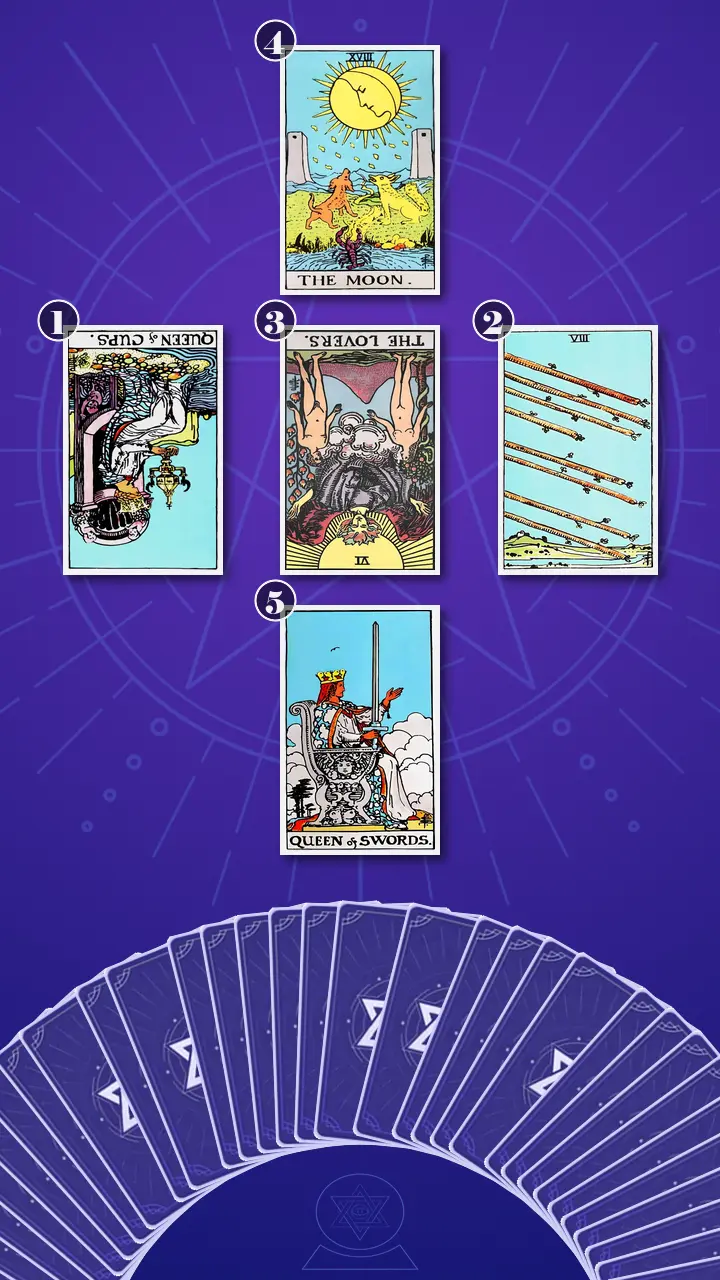
This five-card contextual Relationship Spread for attention-driven boundary loss in early dating is intentionally narrow. A larger spread would add history and atmosphere that Maya did not need in this moment. The first card reveals her observable relational stance; the second examines the flood of attention as she experiences it; the centre shows the merger mechanism; the card above exposes the uncertainty she is being asked to tolerate; and the card below offers a grounded route back to choice.
I placed the five cards in a cross: receptivity on the left, incoming velocity on the right, automatic alignment in the centre, uncertainty above, and discernment below. The shape looked less like a verdict than a bridge intersection with a lookout above and a foundation waiting to be used.
The Map Begins with the Message Thread
The Queen's Closed Cup Beside Figma
Now I turn over the card representing Maya's observable pattern of orienting toward a new date's emotional signals so strongly that her own preferences, routines, and pacing cues become difficult to hear. It is the Queen of Cups, in reversed position.
Upright, I read the Queen of Cups as emotional receptivity, intuition, and compassionate attunement. Reversed, that water is not absent; it has lost its container. I point to the ornate closed cup in the Queen's hands and the throne set at the edge of the sea. Maya is studying the message thread as if it contains the answer while the emotional information rising inside her remains outside the frame.
At position one, I see Maya keeping the Hinge-to-iMessage thread open beside an unfinished Figma file, checking the date's tone before checking whether she wants to stay online, disclose something intimate, or give up her evening. Her sensitivity is real. The blockage is that it is aimed almost entirely at sustaining someone else's emotional experience, so her own privacy and preference become background noise.
"I know what they want from this conversation," she said quietly, "but I have not asked what I want from tonight."
She gave a brief, rueful laugh and rubbed her thumb along the rim of her mug. "That is too accurate. Almost rude."
"I will not use your sensitivity against you," I said. "The problem is not that you feel deeply. The problem is that your care has stopped including you." Her shoulders lowered by a fraction, enough to show that recognition had landed without turning into shame.
Eight Wands Across the Lock Screen
Now I turn over the card representing the flood of messages and affection strictly as Maya experiences it, without claiming knowledge of the date's hidden motives. It is the Eight of Wands, in upright position.
The eight wands fly through a clear sky before anything has visibly landed. I read them as rapid movement, concentrated momentum, and communication arriving in quick succession. In Maya's week, that looks like good-morning texts, voice notes, compliments, memes, and ideas for two future dates arriving before any of them has been tested in ordinary shared life.
She had been telling herself, "This much contact has to mean something." I offered the factual counterline: it tells her the pace is fast; it does not yet tell her how this person handles a boundary, a busy day, a difference, or follow-through. A full inbox is not a shared history. Message frequency is information about velocity, not proof of depth.
Maya glanced at her own notification history and then turned the phone over without opening it. Her face held the small jolt of recognition I often see when excitement is allowed to remain real while certainty becomes more carefully measured.
The Lovers, Before the Word We
Now I return to the centre and turn over the card representing the merger mechanism created when rapid attention meets Maya's fear of losing connection. It is The Lovers, in reversed position.
The Lovers is a card of relationship, values, alignment, and consequential choice. Reversed here, the choice is being bypassed at the exact point where attraction becomes automatic agreement. I show Maya the two separate figures, the angel above them, and the mountain between them. A real meeting requires two distinct people. It does not require one person to quietly edit herself into a ready-made "we."
I brought the card into a Queen West cafe after a second date. The espresso grinder roared while rain gathered on the window, and the date suggested a neighbourhood Maya did not enjoy. I imagined her cheeks warming as she heard herself say, "I love it there," then begin describing what they could do together next month.
Her inner sentence had shifted from "I want this connection" to "I should make myself easy to connect with." She remembered agreeing to a texting rhythm, a weekend plan, and a future conversation before locating her own answers. Compatibility is not the absence of visible difference. It is the ability to remain visible while finding out whether difference can be met with respect.
Maya's mouth tightened. One hand moved toward her phone, then stopped. "I keep calling it chemistry before I actually know them," she said. I let the silence stand long enough for the distinction to belong to her, not just to my interpretation.
The Moonlight Pause: Chemistry Meets Missing Information
The Next TTC Stop, Not the Whole Route
Now I lift the card above the centre, representing the central challenge and blind spot: tolerating uncertainty long enough to distinguish chemistry, projection, and repeated evidence of respect. It is The Moon, in upright position.
The Moon does not tell me that the connection is false or doomed. It shows me what is incomplete. I follow the winding path between the two towers and compare it to taking the TTC home after dark when only the next station is visible. Maya does not need to identify the whole destination from the first burst of attention. She needs to notice what remains unknown and take the next observable step.
At 9:27 p.m. on Sunday, four quiet hours after a week of constant contact, the fridge buzzed beside a cup of cold peppermint tea while Maya refreshed the chat. She could feel the chemistry and still did not know how the date would respond to "not tonight," a genuine difference, a stressful week, or a misunderstanding. The Moon asks her to stop forcing a verdict of completely real or completely disappearing and instead choose one question that another interaction can clarify.
Maya exhaled, slowly enough for the breath to make a small space around her. The tightness did not vanish, but curiosity appeared beside it. That was the beginning of slowing down without pretending she was not excited.
When the Queen's Sword Separated Attention from Trust
The Queen of Swords: A Pace That Can Be Heard
The room grew unusually quiet as I descend to the grounding guidance position. Now I turn over the card representing an actionable route toward maintaining existing commitments, communicating a preferred pace, and assessing consistency without suppressing attraction. It is the Queen of Swords, in upright position.
Her upright sword separates fact from projection, while her open hand still permits contact. I read her as clarity, direct communication, boundaries shaped by experience, and independent judgment. Maya can say, "I am enjoying getting to know you," without adding a paragraph to prove it. She can keep dinner with friends, stay offline during work, and make one date at a time without turning warmth into continuous availability.
In my sound-energy research, I have learned to listen for the rhythm beneath a conversation. I use what I call a Communication Dissonance Audit: I diagnose a difficult exchange not only by the words spoken, but by a mismatch in emotional tempo and frequency. Here, the date's affectionate language may be arriving at a high, bright BPM while Maya's body, calendar, and actual evidence are moving more slowly. That mismatch is not proof of bad intent. It is a useful signal that her own tempo needs to be heard.
The Sentence That Changed the Tempo
At 11:40 p.m., her laptop was still open, two friends' messages were unread, and a five-day-old notification lit the room. I watched the warm rush meet the realisation that her whole evening had started moving at someone else's speed.
You do not have to become easier to absorb to keep someone's interest; keep your own pace, ask direct questions, and let the Queen's upright sword separate attention from earned trust.
Attention can arrive at full speed; trust still has to travel at the speed of evidence. You do not need to match someone's intensity to keep a connection alive.
For a beat, Maya's breath stopped and her fingers hovered above the phone. Then her eyes lost focus as she replayed the friend dinner she had nearly cancelled and the private detail she had shared to keep a conversation bright. Her brow tightened. "But does this mean I got it all wrong?" I did not turn the question into another verdict. Her jaw worked once, her hands slowly opened, and a shaky breath left her chest. The relief carried a slight dizziness, the vulnerable blankness that can follow the realisation that a choice is finally yours. Her shoulders settled, though not completely. I watched her move from freeze, to memory, to release.
"No," I said. "It means you have more information now. If your pace changes their response, that response is data, not a verdict on your worth. You do not have to decide the entire relationship tonight."
"Now, use this new lens to revisit last week," I invited. "Was there a moment when this insight could have made you feel differently?"
Maya looked once more at the Queen's sword. I named the crossing clearly: this was a move from reassurance-seeking merger to self-defined pacing and evidence-based trust. The cards had not chosen a date for her. They had made the decision point easier to see.
From Attention to Evidence: A Small Boundary Map
When I read the five cards as one story, the pattern becomes coherent. The reversed Queen of Cups shows emotional attunement pulled away from self-reference. The Eight of Wands accelerates that outward focus until incoming contact feels like accumulated proof. The Lovers reversed shows the central bypass: Maya matches a pace, preference, and future before consciously choosing them. The Moon reveals the missing facts, and the Queen of Swords supplies the language to gather them without shutting attraction down.
I told Maya that her blind spot was not caring too much. It was treating a boundary as a threat and the other person's response to that boundary as a verdict on her worth. The missing earth in the spread matters here: sleep, work, friendships, meals, routines, and repeated behaviour are the ordinary ground where trust becomes visible. You can enjoy the rush without handing it your calendar.
The transformation direction is practical: move from matching communication intensity in real time to keeping existing routines, preferences, privacy, and commitments visible while consistency develops across several interactions. I offered her three small experiments rather than a universal rule about how quickly intimacy is allowed to grow.
- Run the Attention-vs-Trust SplitWithin ten minutes after an intense message burst, open a note titled "Attention received / Trust demonstrated." Put compliments, message volume, voice notes, and future talk in the first column. Put kept plans, respectful responses to limits, and consistent follow-through in the second.Use the two-minute version if the exercise feels activating: record one item in each column. This checks her experience and the available evidence; it does not assign hidden motives.
- Keep One Life AnchorBefore the next date or texting surge, protect one existing friend dinner, workout, study block, or solo evening. Keep that commitment, and use Focus mode during the first thirty minutes of work or the final twenty minutes before sleep.Keep one plan only. Maintaining a life is not a punishment, a test, or a strategy for appearing unavailable.
- Use the Syncopation PauseWhen the urge to send a second reassurance message rises, put the phone face down for three seconds: one beat to feel your feet, one beat to notice your jaw and breath, and one beat to ask, "Am I answering because I want to, or because silence currently feels dangerous?" Then, if she still wants to reply, she can write: "I am enjoying getting to know you. I am usually offline during work, and I prefer to make plans one date at a time."I call this The Syncopation Pause, a three-second acoustic grounding technique that lowers the emotional BPM before a defensive reaction takes over. The sentence can be drafted without being sent; it is information for her, not a test for the other person.

A Week Later, the Quiet Proof
A week later, Maya texted me from a Queen West cafe: "I kept dinner with my friend, told him my pace, and he was fine. I still wondered this morning if I was wrong, but I went to work before checking my phone." Her coffee was warm, her uncertainty was still present, and the chat no longer held the whole room.
I smiled at the smallness of the evidence. The first proof was not a solved relationship. It was a friend dinner kept, a preference spoken without apology, and a morning that began with Maya's own life before the notification stream.
That was her Journey to Clarity: not certainty handed down by the cards, but a steadier rhythm she could recognise and choose. The Queen's sword had not cut her off from connection; it had given her warmth an edge, a shape, and a way to remain herself while trust earned its time.
When the screen goes quiet and your chest tightens, it can feel as though keeping your own pace might cost you the connection, and that losing the connection might confirm you were never worth staying curious about. But your pace can stay in the room with attraction, and the other person's response can become information rather than a sentence.
If your own pace were allowed to stay in the room with the attraction, what small part of your life or preference would you want to keep visible?
Every reading at AceTarot is a journey to connect with inner wisdom and empower the path ahead. This reading shared here is a psychological mirror, not a private record—crafted to reflect universal emotional loops and help restore personal clarity. Please note that these insights do not replace professional psychological, medical, legal, or financial advice, and should not serve as the sole basis for major life decisions.
Learn more about our Journey to Clarity.
How did this insight land for you?
🫂 This Resonates Deeply
🌀 Living This Story
✨ Now I See Clearly
🌱 Seeing New Possibilities
🧰 Useful Framework
🔮 The Confirmation I Needed
💪 Feeling Empowered
🚀 Ready for My Next Step
Author Profile
 AI
AI Alison Melody
996 readings | 597 reviews
“Through ten years of sound energy research, I’ve found that when we struggle, it's usually just our internal rhythm falling out of sync under pressure. I know firsthand the frustrating helplessness of wanting to move forward but feeling paralyzed. Without overwhelming theories, I want to be the soothing background track that helps you recalibrate, turning your heavy burdens back into a light, effortless, and harmonious melody.”
In this Love Tarot Reading :
Core Expertise
- Communication Dissonance Audit: Diagnosing arguments not by the words spoken, but by the fundamental mismatch in emotional tempo and frequency.
- Reactive De-escalation Mapping: Identifying the specific 'high notes' of defensive anger that shatter the emotional safety of the connection.
Service Features
- The Syncopation Pause: A 3-second acoustic grounding technique to interrupt an escalating argument, lowering the emotional BPM before permanent damage is done.
Also specializes in :
Explore Related Patterns:
Anxious AttachmentWhen the screen goes quiet after hours of contact, your jaw locks and your hand returns to the phone as though another check could keep the connection from slipping away. A slower reply feels like a trapdoor, and the pressure to match the date's energy makes immediate contact feel safer than a pause. The underlying process is a threat-sensitive reading of distance. Silence is no longer just missing information; it becomes a possible signal that the bond is weakening, so you move quickly to restore closeness before you know what the silence means. That is how attention can pull you into a merger before trust has had time to develop. A slower response is not a verdict that the connection is ending or that you are unworthy of interest. Keeping your own pace lets you observe how the other person handles ordinary distance, boundaries, and difference, which provides more useful information than repeatedly trying to remove uncertainty in the moment.
Boundary DiffusionAt 11:40 p.m., you leave your work laptop open, unread messages from a close friend, and your own question about staying online while rewriting a vulnerable reply to someone you have known for five days. You answer every notification, share private details, move existing plans, and call the feeling chemistry before you know whether the connection is trustworthy. When the date's pace starts to feel like a requirement, your attention moves outward to preserving their experience and your own preferences become background noise. That is the mechanism captured by Boundary Diffusion, where the line between enjoying another person's interest and reorganizing yourself around it becomes harder to see. The pattern appears again when you say you love a neighborhood you do not enjoy and begin building a ready-made 'we' before checking your own answer. Keeping one friend dinner, work block, or preferred pace does not cancel attraction. It gives you evidence about whether the connection can include two distinct people, and it turns the other person's response into information rather than a verdict.
Romantic ProjectionGood-morning texts, voice notes, compliments, memes, and future date ideas arrive before the connection has been tested in ordinary shared life. You tell yourself that this much contact has to mean something, then call the feeling chemistry and begin making plans before you know how the person responds to a boundary or a real difference. The mind is filling missing information with a coherent romantic story. Message frequency becomes evidence of depth, while the unknown parts of the person and the relationship fade from view. This does not establish anything about the date's hidden motives; it shows how your own interpretation turns velocity into certainty and makes a ready-made future feel emotionally present. You can keep attraction real without allowing it to complete the story. Let the next interaction answer one concrete question, and allow repeated behavior, follow-through, and respect for your pace to earn the meaning that attention alone cannot provide.
Self-AbandonmentAt the second-date cafe, you hear a neighborhood suggested that you do not enjoy, yet you say you love it and start describing what the two of you could do there next month. You have already agreed to a texting rhythm, a weekend plan, and a future conversation before locating your own answers. The mechanism is not simply being generous. Your care has narrowed around keeping the other person's experience smooth, so your privacy, routines, and preferences become negotiable before the other person has demonstrated that difference can be handled respectfully. You make yourself easier to connect with by becoming less visible inside the connection. Keeping one existing commitment and naming one honest preference restores self-reference without requiring emotional distance. A connection that depends on your disappearance is giving you important information, while a connection that can include your actual pace has room to become more trustworthy.
External ValidationYou want to enjoy being chosen, but not matching the date's energy feels strangely dangerous because the connection has started carrying more than attraction. The possibility that their response might change begins to sound like a judgment on whether you are worth continued interest, so you answer quickly and make yourself easy to connect with. Attention is functioning as an external worth signal. The issue is not that the date's interest is meaningless or that your attraction is false; it is that the response you receive is being asked to settle an internal question about your value. That pressure makes agreement feel protective and makes an ordinary boundary feel unusually costly. When you keep your pace and let the other person's response become data, you separate fit from worth. Their reaction can tell you whether their preferred rhythm is compatible with yours, but it does not have to decide what you deserve or whether your own preferences are legitimate.
Reassurance SeekingYou answer every notification as if the connection has a response-time SLA, and when the screen goes quiet your hand returns to the phone. The urge to send another reassuring message is an attempt to settle the tension quickly, especially when silence currently feels dangerous. The checking and rapid replies provide a brief sense of control, but they also train your attention to wait for the next sign that the connection is still intact. The more the momentary relief becomes the goal, the easier it is to confuse an immediate response with genuine trust. Your behavior is regulating uncertainty before you have gathered enough evidence to make a grounded judgment. The Attention-vs-Trust Split creates a different reference point. Message volume and compliments can be recorded as attention received, while kept plans, respectful responses to limits, and consistent follow-through remain separate evidence. You can reply because you choose to, rather than because silence has temporarily become intolerable.
Explore Related Struggles:
Approval-Safety FusionWhen you say that not matching their energy feels rude and strangely dangerous, the date's approval is doing more than making you feel wanted. It is beginning to function as the condition that lets you relax, answer, disclose, and keep the conversation moving. That is why a quiet screen sends your hand back to the phone even when no new fact has arrived. Immediate availability temporarily protects the sense of being chosen, while a boundary risks exposing whether the connection can tolerate your actual pace. Approval-Safety Fusion captures the point where another person's continued enthusiasm is asked to provide security that has not yet been established. You can let their response become data about compatibility and respect, without handing it the authority to decide whether you are safe enough to remain yourself.
Boundary CollapseAt 11:40 p.m., your work laptop is still open, two close friends' messages are unread, and your thumb is rewriting a vulnerable reply to someone you met five days ago. The new thread has become the place where you check the other person's tone before checking whether you want to stay online, disclose something private, or give up your evening. Immediate replies, moved plans, and early agreement keep the conversation smooth, but each adjustment pushes your own preferences and commitments farther out of frame. The struggle is not that you feel deeply; it is that care has been organized around preserving the other person's experience, leaving your own boundary to appear only after the connection has already claimed the room. Boundary Collapse names the point at which maintaining contact requires your privacy, calendar, and pacing to become negotiable before trust has earned that access. Seeing the structure lets you keep attraction present while making your own life part of the evidence again.
Relational Pacing CollapseFive days of good-morning texts, voice notes, compliments, memes, and future-date ideas make every notification feel like a demand for an equally fast answer. When the screen goes quiet, you refresh the chat and your jaw locks, as though slowing the rhythm could make the connection disappear. The resulting motion is not a deliberate choice of intimacy but a forced synchronization. You match texting, weekend plans, and future conversation before locating your own answers, so the pace of the exchange becomes the pace of your decisions. Relational Pacing Collapse describes how attention turns timing into a pressure system. You can stay interested and still let trust develop at the speed of repeated behavior, allowing a slower reply or a kept commitment to become information rather than a threat.
Attraction-Compatibility SplitAfter the second date, you hear yourself say you love a neighborhood you do not enjoy and begin planning next month before you have located your own answer. You also call the rush chemistry before knowing how this person handles not tonight, a genuine difference, stress, misunderstanding, or follow-through. The attraction is real, but it is being asked to answer a separate question about whether the person is trustworthy and compatible in ordinary life. Attention measures velocity; it does not yet measure how two people meet limits or sustain what they promise. Attraction-Compatibility Split gives the two kinds of information separate places. You do not have to diminish the spark to wait for evidence, and you can remain visible while discovering whether difference can be met with respect.
Availability-Worth FusionAt 11:40 p.m., the notification from a five-day-old match outranks two unread messages from a close friend and the unfinished Figma file in front of you. The decision is organized around staying available, because a slower reply feels like a trapdoor under the connection. By moving plans, sharing private details, and matching a texting rhythm before choosing it, you turn responsiveness into a way to keep being chosen. When the pace changes their response, the event can start to read like a verdict on your worth rather than information about the fit. Availability-Worth Fusion names that binding of access to value. Keeping dinner with a friend, going to work before checking your phone, and stating your pace create a different measure of connection, one in which your worth does not depend on continuous availability.
Explore Related Emotions:
Limerent RushAt 11:40 p.m., Maya is rewriting a vulnerable message to someone she met five days earlier while her work remains open and her friends' messages go unread. The incoming attention gives her a genuine lift, but it also tightens the thread between being chosen and needing to keep the exchange alive. You can feel excited by a new person and still notice when the pace begins to carry your choices for you. The rush becomes especially intense when private disclosure, future plans, and instant availability start arriving before trust has had ordinary time to develop. Naming the rush makes room for a more grounded question: what is actually being shown through repeated behaviour, and what is being supplied by the speed of the feeling? That distinction lets attraction stay real without requiring you to disappear into it.
Relational UrgencyMaya keeps the Hinge-to-iMessage thread open beside an unfinished Figma file, leaves two friends unread, and begins moving existing plans around a new conversation. Her evening is not simply busy; it has started taking its rhythm from someone she barely knows. You may recognise the pressure to respond before you have checked whether the request, plan, or disclosure fits your actual day. When connection feels time-sensitive, every delay can seem like a risk and every other commitment can feel negotiable. Keeping one routine, friend plan, or offline block visible gives your own life a continuing voice in the relationship. The pace then becomes something you participate in setting, not something that happens to you.
Self-Betrayal AcheMaya catches herself agreeing to a texting rhythm, a weekend plan, and future talk before she has located her own answer. The friend dinner she nearly cancels and the private detail she shares to keep the conversation bright make the cost of that automatic agreement visible. You can want closeness while also feeling a quiet sting when your preferences repeatedly become background noise. That ache is not proof that attraction was a mistake; it is information that your own side of the connection has not been receiving equal attention. Returning to a preference, a routine, or a slower answer restores a practical form of self-reference. It lets you find out whether connection can include the person you already are.
Boundary GuiltMaya says that not matching the date's energy feels rude, and keeping a friend dinner begins to feel like it could endanger the connection. Her boundary is carrying more meaning than the action itself: it starts to resemble withdrawal, rejection, or a test of whether she deserves continued interest. You may feel guilt before you have done anything unkind, simply because your pace differs from someone else's intensity. That feeling can make an ordinary preference seem like a risk you need to explain away. A clear boundary does not have to settle the entire relationship. It gives both people usable information about whether warmth and respect can coexist with two distinct lives.
Grounded AgencyA week later, Maya keeps dinner with her friend, tells the date her pace, and goes to work before checking her phone. The uncertainty remains, but the chat no longer takes over the whole room. You do not need to become detached to make a choice that includes you. A phone placed face down, a plan kept, or a preference spoken plainly can return your calendar, body, and attention to your own authorship. The other person's response then becomes useful information rather than a sentence about your worth. This makes space for connection that is chosen from within your life, instead of pursued at the expense of it.
Reply AnxietyAfter four quiet hours, Maya refreshes the chat beside cold peppermint tea, with her jaw locked and her hand returning to the phone. The absence of a message becomes louder because the previous week has taught her body to expect constant contact. You may know the screen is quiet without being able to experience that quiet as neutral. A slower reply can begin to feel like a trapdoor, as though preserving the connection depends on checking, answering, or sending something before the gap grows. The physical cue matters here: a clenched jaw, hovering hand, or held breath can show that the urgency is arriving before the evidence. Noticing that sequence gives you a moment to choose whether a reply expresses your wish or tries to silence the fear of waiting.
Cautious TrustMaya is invited to split attention received from trust demonstrated, placing message volume and compliments beside kept plans, respectful limits, and consistent follow-through. The connection no longer has to be judged from one intense week of contact. You can let interest develop through what happens across ordinary days: how a person handles a busy schedule, a difference, a boundary, and a plan they said they would keep. This leaves room for warmth while preventing speed from impersonating depth. Trust becomes less about forcing certainty and more about noticing evidence over time. That gives you a steadier basis for deciding what level of closeness feels earned.
Explore Related Contexts:
Chemistry to Commitment TestMaya calls the five-day rush chemistry while still lacking information about how the date responds to "not tonight," a genuine difference, a stressful week, or a misunderstanding. Future plans and frequent messages are already present, but the ordinary evidence needed for a commitment-level judgment has not yet accumulated. The Chemistry to Commitment Test names this transitional dating stage without dismissing the attraction. You can let chemistry count as real attraction while reserving commitment for a different evidence set: kept plans, respected boundaries, consistent follow-through, and room for visible differences. Making one date at a time gives the connection a clear next step without demanding an immediate verdict. The task is to observe whether early momentum can become reliable participation while your own preferences remain part of the interaction.
Digital Intimacy Boundary ConfusionMaya keeps the Hinge-to-iMessage thread open beside an unfinished Figma file, shares private details, moves existing plans, and agrees to a texting rhythm before identifying what she wants. Digital contact is crossing several life boundaries while the connection itself is only five days old. When access, disclosure, scheduling, and affection arrive through the same screen, constant contact can begin to stand in for established closeness. You encounter Digital Intimacy Boundary Confusion when privacy, availability, and perceived intimacy become bundled into one accelerated exchange before trust has been tested in ordinary shared life. The workable distinction is not constant contact versus total withdrawal. You can decide which parts of your calendar, attention, and personal history remain protected while allowing the connection to develop through repeated evidence.
Love Bombing PaceGood-morning texts, voice notes, compliments, memes, and ideas for two future dates reach Maya within five days, before any of them can be tested through ordinary follow-through. The observable issue is the concentration and speed of attention, not an assumption about the date's hidden intent. Love Bombing Pace describes an external communication tempo in which affection and future orientation accumulate faster than shared history. When that tempo sets the terms of the interaction, you can find yourself matching availability, disclosure, and commitment before the connection has shown how it handles a boundary, difference, or busy day. A full inbox can remain enjoyable without being treated as proof of depth. You can read the attention as evidence of velocity, then let trust depend on consistency, respected limits, and what happens after the first intense burst.
Response Time PressureMaya is answering a five-day-old Hinge match at 11:40 p.m. with her work laptop still open, as though every notification carries a response-time SLA. The thread has expanded from a conversation into an informal availability rule even though no response rhythm has been negotiated. When rapid contact becomes the working standard, your sleep, work, and friendships must compete with the task of maintaining momentum. That pressure is visible in the unread friend messages, unfinished Figma work, immediate replies, and repeated checks after quieter periods. Naming Response Time Pressure separates the speed of incoming messages from any obligation to mirror it. You can establish when you are offline and treat the other person's response as information about whether the connection can accommodate two distinct schedules.