When Research Joined the Procrastination Loop: One Seven-Day Test

Self-Help Choice Paralysis at 10:45 p.m.
If you can explain five habit systems but still open another routine video when your ten-minute walk is due, your productivity paralysis may be wearing a very convincing research costume.
Alex, a 28-year-old junior product designer in Toronto, met me online from a narrow desk in their apartment. Three morning-routine videos talked over one another in separate tabs. Cool screen light flattened the room, the radiator clicked behind an untouched tracker, and their phone sat warm beneath a restless thumb. Their walking shoes were still in the closet while they renamed categories in Notion.
"I have researched this enough to have a system," Alex said, rubbing the tight line between their eyebrows. "But somehow I still do not have a routine." They wanted one stable morning, yet committing to a single direction felt like watching every other route vanish. The restless uncertainty moved through them like a transit app refreshing while the bus they could have taken pulled away.
I told them I did not see laziness or a shortage of intent. I saw research arriving at the precise moment practice was supposed to begin. "Let us map what happens between the cue and the disappearing start window," I said. "We are looking for clarity, not a verdict on your character."

Choosing the Four-Layer Insight Ladder
I invited Alex to take one slow breath and hold the question, "Why do I keep collecting advice instead of starting one routine?" I shuffled while they focused. The small ritual was not about summoning certainty; it marked a transition from scrolling inside the problem to observing it.
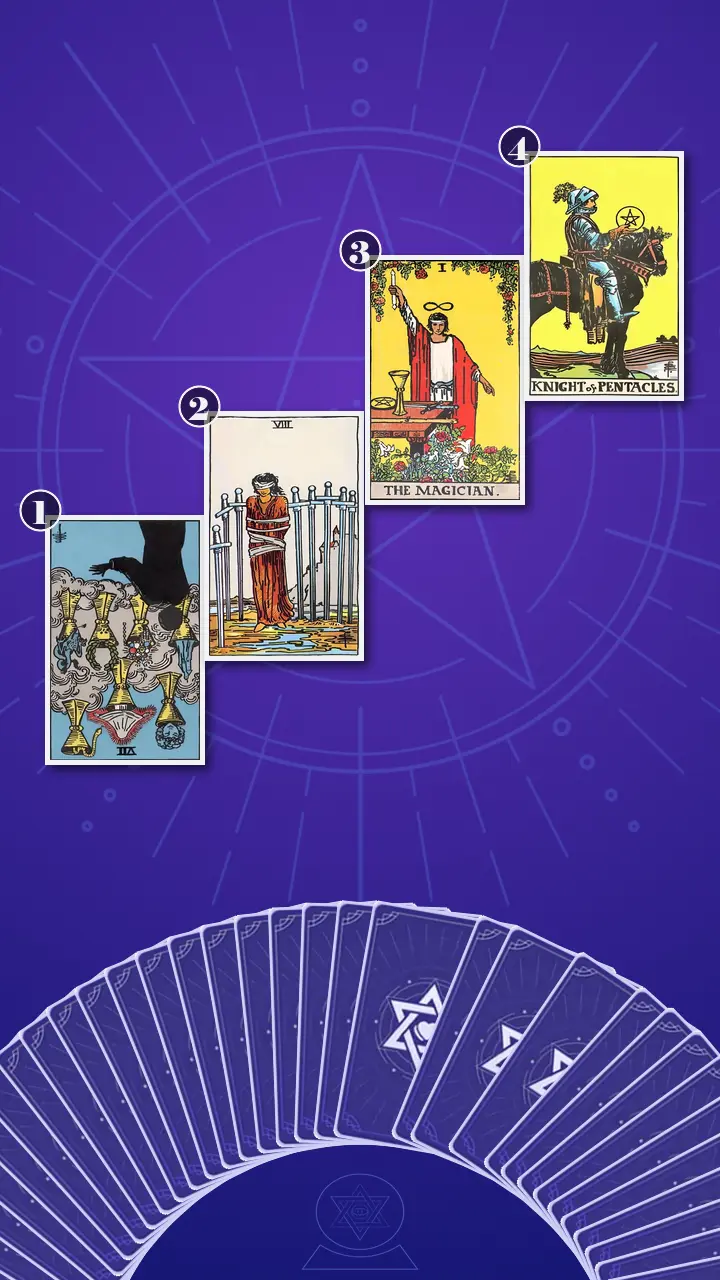
I chose the Four-Layer Insight Ladder · Context Edition. A decision spread would have compared routines and reinforced the idea that finding the best option was the task. This four-card tarot spread for habit paralysis instead traces a causal chain: the visible behavior, the rule maintaining it, the leverage point, and the practice that can ground a new response.
I explained that the first position would show what happens at the routine cue. The second would uncover why waiting feels necessary. The third would identify the interruption, while the fourth would turn insight into a reversible seven-day experiment. This is how tarot works in my practice: the cards make a pattern visible, but Alex remains the person who decides what applies.
Seven Floating Answers in the Sunday Reset Feed
Position 1: Seven of Cups Reversed and the Advice Queue
I turned over the card representing the observable symptom: collecting, comparing, and reorganizing self-help advice when it is time to begin. It was the Seven of Cups, reversed.
I asked Alex to imagine the seven cloud-borne cups as a Sunday-night feed: a 5 a.m. routine, a slow morning, a habit stack, a dopamine reset, and three planning systems. At 8:18 p.m., they might intend to schedule a ten-minute walk, then narrow the list, find one more persuasive creator, and reopen every choice. The inner line is always, "This looks sensible, but what if the next one fits me better?"
The reversed Water energy showed blockage rather than useful exploration. Each option stayed suspended above lived experience, so narrowing the list never produced grounded clarity. "When research always starts at the starting line, research has joined the procrastination loop," I said. "You are not short on methods; you are short on evidence from your own repetitions."
Alex gave a small, bitter laugh. Their fingers tightened around the phone, then released it onto the desk. "That is so accurate it is almost rude."
"Accurate does not have to mean condemning," I replied. "The research has been protecting you from the vulnerable part, which is choosing something imperfect and seeing what happens."
Position 2: Eight of Swords and the Unshippable Routine
I turned over the card representing the psychological rule beneath the loop: the belief that more certainty or expert input is required before a routine can be chosen safely. It was the Eight of Swords, upright.
I translated the surrounding swords into criteria copied into a comparison document. At 8:07 a.m., with twenty-three minutes before stand-up, Alex's walk must apparently include morning light, happen before caffeine, last long enough to count, use the right tracker, follow the correct sequence, and include a fallback. The thought becomes, "I technically could begin, but I am not allowed to begin until I know enough."
Here, Air was in excess. Analysis had hardened into an approval workflow where a minimum viable attempt could never ship. Yet I pointed to the loose bindings and the incomplete enclosure. The card did not show an objective lack of movement; it showed one reversible opening that had not been labelled as permission by an expert.
Alex's jaw set first. Then their gaze drifted past the screen as if replaying several lost mornings. Finally, a long breath left their chest, and their shoulders dropped by a fraction. I asked, "Which single missing fact would materially change a low-risk ten-minute walk today, and which questions only postpone it?"
When The Magician Closed the Tabs
Position 3: The Work Surface That Was Already Full
The room seemed quieter when I reached the leverage position, the card showing how Alex could direct resources already available into one bounded experiment. I turned over The Magician, upright.
I saw the four suit tools arranged on a solid table, with one hand raised and the other pointing toward the material world. "The Magician's table is a work surface, not another shopping list," I said. Alex already had the shoes, phone timer, calendar cue, and ten-minute walking plan. Balanced Magician energy would connect one existing idea to one observable action; it would not prove that action universally optimal.
I brought Alex back to 10:45 p.m.: shoes still in the closet, three tabs glowing, tracker untouched, categories being renamed. They had been hoping the next system would make starting safe, while every added option made their own direction feel less trustworthy.
I used my Micro-Cycle Energy Mapping as the diagnostic lens. A routine did not need identical output every day. Alex could keep one cue and one direction while respecting natural energy tides: up to ten minutes on a higher-energy morning, two minutes during a trough, or a conscious pause when rest or safety required it. The experiment could remain stable without demanding that Alex behave like a machine.
Clarity is not the permission you receive before starting; it is the evidence one small, repeated action gives you afterward.
Do not treat more information as permission; choose one tool from The Magician's table, use it for seven days, and let practice show you what fits.
I let the sentence sit between us. Alex's inhale stopped, and their fingers hovered above the laptop trackpad. Their eyes lost focus for several seconds, as though they were watching each "one more video" moment run backward. Then their mouth tightened.
"But does that mean I have wasted months doing this wrong?" they asked, the words sharper than before.
"No," I said. "It means the strategy that helped you feel in control stopped producing the evidence you needed. Seeing that now does not make your earlier self foolish."
The tension around their eyes softened. Their fist opened against the desk, followed by a shaky exhale and the slight disorientation that can arrive when a familiar burden is removed and choice becomes real again. I asked, "Now, using this new perspective, was there a moment last week when this insight could have changed how you felt?" Alex remembered missing Thursday's walk, opening a notification for a new consistency system, and replacing the plan before Friday arrived.
I named the shift carefully: this was one step from restless advice-seeking and outsourced direction toward evidence-based confidence and steadier self-trust. The Magician offered focused agency and experimental self-trust, not guaranteed success.
Position 4: Knight of Pentacles and One Ordinary Commitment
I turned over the card representing action and integration: the concrete seven-day practice through which consistency could replace repeated optimization. It was the Knight of Pentacles, upright.
The Knight held one pentacle while a cultivated field extended behind him. I connected it to one paper note with seven boxes beside the apartment door. Alex could follow the same short walk after the same cue, mark attempted or not attempted, and add one observation. A missed day would remain visible without triggering a new app, cue, or identity story. New recommendations could wait in an "after the test" note until an eighth-day review.
This was balanced Earth: patient enough to accumulate evidence, but not so rigid that one disruption became failure. "Boring does not mean ineffective," Alex said slowly. "It means I can observe the same thing more than once." I nodded. "Exactly. Do not optimize a routine that has not had the chance to exist."
The Lunar Routine Sync: Evidence Before Optimization
I laid the four cards in their ascending line. The story was simple: browse, restrict, direct, repeat. Conflicting possibilities fed restrictive readiness rules; those rules kept Alex reorganizing maps at the trailhead. The Magician restored the use of existing tools, and the Knight protected one choice long enough for experience to answer questions that comparison could not.
The cognitive blind spot was treating uncertainty as evidence of unreadiness. The transformation was not from imperfect to perfectly disciplined. It was from ranking borrowed advice to gathering personal observations from one stable but revisable test.
"But what if an early design review moves the morning again?" Alex asked. I told them the cue could include an alternate window without redesigning the routine. This was where my Rest Phase Legitimacy principle mattered: a low tide, interruption, or chosen rest belonged to the orbit of a real week. It was information, not a moral score.
A Seven-Day Field Test That Can Bend
- Run the Lunar Routine Sync. For seven days, place the shoes beside the apartment keys and use one reminder: "After breakfast, walk for up to 10 minutes." On early-meeting days, use after lunch. On a low-energy day, try two minutes, rest, or stop if the action feels wrong. Tip: use the phone timer already available. No new app, purchase, or setup is needed.
- Use evidence before optimization. Put seven boxes by the door, mark only A for attempted or N for not attempted, and add an observation of no more than ten words. Send new advice to a parking-lot note and schedule one eighth-day evidence review. Tip: do not redesign after a missed day. Resume at the next cue, and treat stopping, adapting, or deciding the walk does not fit as valid data.
I reminded Alex that a seven-day test was data, not a lifelong identity decision. Tarot had supplied an objective visual map of the loop. The authority to try, revise, or decline the experiment remained entirely theirs.

A Week Later: Four Marks and One Missed Day
Six days later, Alex messaged me a photo of the note by their door: four A marks, one N, and a sixth empty box waiting for the next morning. Thursday's design review had moved early, but they had not rebuilt the plan. They used the same cue on Friday and wrote, "Less rushed by 9:00."
That night, Alex slept through until morning. Their first thought was still, "What if I chose wrong?" This time, they smiled, put on the shoes, and let the question come along for the walk.
I did not see a life solved. I saw the first grounded proof in a Journey to Clarity: Alex had allowed one routine to exist long enough to meet their real life. The cards had not created their agency; they had helped Alex recognize where it was already waiting.
I want to leave you with the same recognition. When the starting window arrives and your hand reaches for one more expert tab, that heaviness may not mean you lack desire. It may be the strain of protecting your sense of control from an imperfect choice while still longing for a life that feels steady.
If your next routine could be a seven-day field test rather than a verdict on who you are, which small tool already waiting on your Magician's table might you feel curious to use once?