A Fair Rule Loosened Decluttering Decision Paralysis in One Drawer

The Closet Floor at 11:20
I met Alex (name changed for privacy) at 11:20 on a Saturday in Toronto, and before I touched the cards I said, “You can map a complicated user flow at work, but one unused lamp can send you into Kijiji, donation, recycling, repair, and storage tabs until your two-hour clear-out becomes an entire weekend project.”
Alex was sitting on the laminate floor beside an open closet, a denim jacket held between both hands for the third time. Four labelled bags leaned against the bed. A laptop fan whirred beside three resale tabs, fresh coffee smelled bitter, and their shoulders had sunk so low that the jacket seemed to be resting on them. They had come to me with a real, practical need: part of the one-bedroom apartment had to work as a home office, the dining table had to become available for meals, and every clear-out kept ending with more piles instead of more room.
“I keep moving the same things without actually clearing anything,” Alex told me. “I need a better system before I start. I do not want to throw away something I will regret losing.” They wanted the space back, yet each attempt to clear it became a test of finding the perfectly responsible destination for every object. You want the space, so you try to choose carefully; the more carefully you try to choose, the less space actually clears.
I saw their overwhelm as a loading spinner with a body: heavy shoulders, held breath, restless fingers, and one ordinary decision circling without ever reaching the next screen. I did not call it laziness or disorganisation. I said, “There is a pattern here, and a pattern can be observed without blaming you for having it. We will not try to transform the entire apartment today. We will map the loop, find the point where it can change, and let this be our Journey to Clarity.”

A Map, Not a Verdict
I invited Alex to place both feet on the floor, take one slow breath, and name the question again without trying to solve it. Then I shuffled slowly. I use that small ritual as a psychological threshold: the laptop closes, the browser tabs stop multiplying, and attention moves from managing every possible outcome to looking honestly at the present pattern.
“I am using the Transformation Path Grid · Context Edition,” I explained. “This is a six-card tarot spread designed for a repeating block. It does not predict whether your apartment will become perfect. It helps us trace how a visible behaviour begins, what keeps feeding it, what belief gives it force, and what kind of practice could interrupt it.”
I chose this spread because the phrase every time points to a system rather than one bad Saturday. The sequence preserves the whole causal chain: visible stationary planning, immediate option overload, the fear beneath it, a catalyst, a repeatable action, and an integrated relationship with the space. That is how tarot works here: the images give us a structured language for card meanings in context, while Alex remains the person who decides what stays, what exits, what needs special handling, and when to stop.
I arranged the cards in a two-row serpentine grid. The first three formed the diagnostic line: what could be seen, what interrupted movement, and what fear made the interruption persuasive. The lower row returned through the hinge card toward practice and grounded care. I told Alex that the fourth card would be especially important because it would show the leverage point, while the fifth and sixth would translate insight into next steps rather than a promised future.
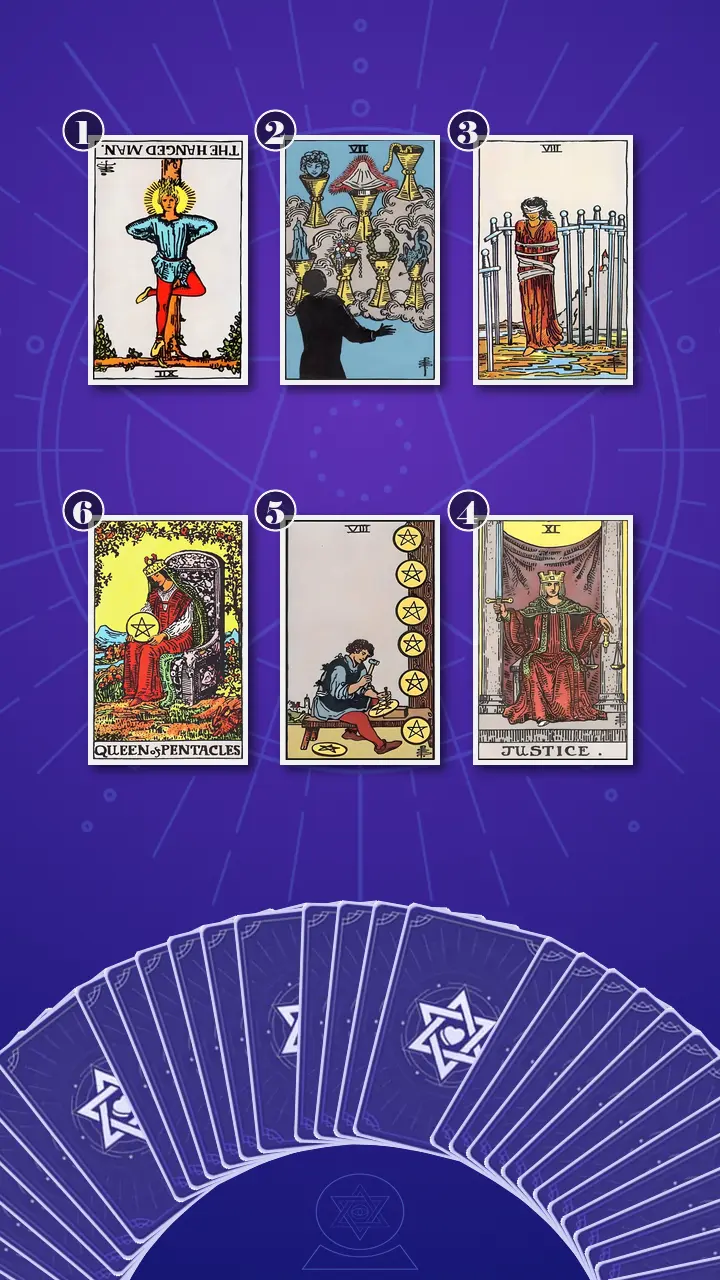
Reading the Loop: Card Meanings in Context
Position 1: The Open Closet That Kept Waiting
Now I turn over the card representing the diagnosis in observable form: the point at which your attempt to clear the space becomes stationary planning, waiting, or repeated postponement. It is The Hanged Man, in reversed position.
The upside-down figure mirrors Alex on the floor beside the closet, visibly working but physically stationary. They had rewritten the labels on four bags, checked another donation route, and waited for a feeling of certainty before allowing one object to leave. The pause had begun as caution, but it had hardened into protection from concluding anything. In reversed energy, reflection has become blockage; preparation creates the sensation of motion while the room remains unchanged.
“I am not avoiding it,” Alex said quietly. “I am getting ready to do it properly.” I returned to the scene I had just witnessed: the laptop glowing, the bags waiting, the same jacket moving from hand to hand. A useful pause makes room for a decision. Protective postponement keeps the decision open because the discomfort of choosing feels more threatening than the cost of leaving the surface unusable.
Alex gave a short laugh, but it carried a bitter edge. Their mouth lifted and stopped; their eyes moved to the neat labels, then to the jacket; their fingers folded the sleeve once more before going still. “That is almost rude,” they said. I did not argue with the reaction. I said, “Let the irritation be information, not a verdict. What were you hoping the next label would finally allow you to feel?” Their shoulders rose, then lowered by a fraction. The question had located the moment when getting ready became delay.
Position 2: The Lamp and the Six Browser Tabs
Now I turn over the card representing the immediate blockage: the multiplication of possible destinations and imagined consequences that turns each object into an overloaded decision. It is Seven of Cups, in upright position.
I translated the seven clouded cups into one unused desk lamp. Alex could keep it, sell it on Kijiji or Facebook Marketplace, donate it, recycle it, repair it, store it for a future apartment, or save it for a hypothetical need. Each route looked responsible in a different way. The water energy was not absent; it was uncontained, spreading attention across possibilities until one small object became six simultaneous projects.
“But what if selling wastes less? And what about recycling? Maybe I should check whether the donation centre takes lamps. Maybe I could repair it. Maybe I will need it later,” Alex said. I watched their fingers move as though switching between invisible tabs. The more routes they kept open, the safer the decision seemed for a moment, but no route could actually be completed.
More options are not always more care. I let the sentence sit beside the card. Alex gave a rueful laugh and glanced at their laptop. “I have tabs open for things that are worth less than the time I have spent researching them,” they said. I asked which route could realistically be completed this week, not which route could theoretically be the most responsible in every possible future. Their eyes stayed on the lamp for a few seconds longer than before.
Position 3: The Charger Behind the Blindfold
Now I turn over the card representing the psychological root: the fear that an imperfect or regretted choice would demonstrate a lack of control and unreliable judgement. It is Eight of Swords, in upright position.
I brought Alex to the Sunday-night image they had described: standing beside the dining table at 9:36, holding an obsolete charger while imagining the one future day it might be needed. Their grip tightened. Their breath caught. The private rule appeared in the exact words they had used with me: “If I choose wrong and regret it, I cannot trust myself.”
The blindfold showed attention narrowed by fear, while the partial ring of swords showed that the enclosure felt complete without actually being complete. In this card, uncertainty has become a restrictive rule: only a regret-proof decision counts as responsible. The practical opening remains, but Alex cannot use it while every ordinary release is treated like a production deployment with no rollback.
“Your home is not a referendum on your judgement,” I said. “The charger can be a charger, not evidence for or against your competence. A workable route can remain available even when you cannot guarantee that you will never wish you had kept it.”
Alex froze first. Their fingers tightened around the imaginary charger, and their breath stopped halfway in. Then their gaze lost focus as the Sunday scene seemed to replay: the table unavailable, the phone in one hand, the object in the other, the future regret doing all the talking. Finally, their jaw loosened and a quiet “Oh” came from somewhere deep in their chest. I asked, “Which part of the decision has been carrying the burden of proving that you are trustworthy?” Alex looked toward the open closet and did not answer immediately.
When Justice Cut Through the Open Tabs
Position 4: Justice at the Hinge
The room became very quiet as I turned to the card that changes the direction of the grid. This is the catalyst position, the visual hinge between the diagnostic row and the practical row. It is Justice, in upright position.
Justice does not ask Alex to become ruthless, inspired, or certain. The balanced scales represent a limited evaluation, and the upright sword represents the moment deliberation closes after a fair criterion has been applied. The question is not whether a rule can predict every future need. The question is whether the rule is reasonable enough to support action now.
I guided Alex back to the closet floor: the jacket in their hands, four bags waiting, three tabs open. Their shoulders had already dropped because every destination seemed to carry a different future regret. The question was no longer what to do, but how to avoid being wrong.
Stagnation does not end when every object receives a perfect answer; apply one fair rule to the next decision, and let Justice's scales turn procrastinated reweighing into completed choice.
Alex froze before they released a breath. Their pupils widened slightly, and the hand holding the jacket stopped in midair. Then their eyes moved away from the card, unfocused, as if they were replaying the lamp, the charger, and the donation bag that had come back from the lift. Their mouth formed a silent objection before their shoulders began to descend. A second later, their fist opened against the fabric. They breathed out with a small tremor, not the bright relief of having solved everything, but the cautious release of someone discovering that responsibility might have a proportionate size. The silence afterward contained a little vulnerability: a clear rule meant Alex would have to choose, and that choice would belong to them. I asked, “Now, use this new perspective to remember whether there was a moment last week when this insight could have made you feel differently.”
Justice also met one of my signature tools, Micro-Cycle Energy Mapping. I use it to track natural daily and weekly energy peaks and troughs so a task is placed where it has a realistic chance of being completed. The fair rule handles the decision; the energy map handles the timing. I suggested that Alex test the rule during a natural ten-minute peak rather than waiting for an imaginary all-day surge. On a low-energy day, Rest Phase Legitimacy mattered just as much: recovery is a legitimate phase of the orbit, not proof that the person has failed. A low tide should not trigger an exhausting purge that creates regret and makes the next session harder.
This was the first movement from overwhelmed stagnation toward grounded ownership. Nothing had left the apartment yet, but the standard had changed. Alex no longer needed to solve every possible future before allowing the next decision to have an ending.
The Workbench, Then the Lived-In Room
Position 5: Eight of Pentacles and the Completed Cycle
Now I turn over the card representing the practical action that embodies the catalyst: practising the same short clearing sequence on one contained zone until a full decision cycle is complete. It is Eight of Pentacles, in upright position.
The craftsperson works on one pentacle at a time, with finished pieces arranged nearby. I translated that image into one top desk drawer or one square foot of the dining table. Alex would close Marketplace and donation-research tabs, set a ten-minute timer, pick up one object, apply the same rule, and place it in KEEP or EXIT. The earth energy is disciplined repetition, not a dramatic apartment-wide transformation.
As I looked at this card beside Eight of Swords, my professional reflex made the contrast clear: the same capacity for repetition can rehearse restriction or build a usable skill. Alex did not need a new personality. They needed to transfer repetition from mental reweighing to completed practice. One object. One rule. One concluded choice.
Alex looked at the top desk drawer and rubbed their thumb across the edge of the table. “Ten minutes feels almost too small,” they said. “That is probably why I want to dismiss it.” I answered, “That is exactly why it can teach completion. Stop when the zone is done, even if another pile catches your eye. The boundary is part of the practice.”
Position 6: Queen of Pentacles and the Room That Supports Life
Now I turn over the card representing cognitive and practical integration: relating to the home as support for ordinary life rather than as a test of worth, control, or perfect self-management. It is Queen of Pentacles, in upright position.
The Queen cradles the pentacle inside a cultivated garden. She is not displaying a sterile room for an audience; she is tending a living environment. I asked Alex to measure the dining table by whether it could support a laptop and coffee during hybrid work, a meal after six, or a place to rest, not by whether it resembled a polished apartment tour.
“A supportive home can look lived-in and still do its job,” I said. This card did not promise that every drawer would stay clear or that regret would disappear. It offered a developmental direction: practical care can become ordinary, repeatable, and responsive to present needs. The absence of Wands in the spread reinforced the point. Alex did not need to wait for inspiration. Criteria, practice, and grounded stewardship could create momentum.
Alex placed both palms flat on the table. Their posture was still tired, and one unopened bag remained near the bed, but their gaze had changed. They could imagine a functional surface without first imagining a flawless apartment. I asked which activity they wanted the table to support tomorrow. “Work in the morning, dinner at night,” they said. That answer was modest, specific, and entirely theirs.
The Rule That Lets the Room Breathe
The six cards told one connected story. The Hanged Man reversed showed a useful pause becoming stationary planning. Seven of Cups multiplied every destination until responsible care looked like endless research. Eight of Swords revealed the deeper rule: if a choice could be regretted, it might expose unreliable judgement. Justice supplied the leverage point by limiting evaluation. Eight of Pentacles turned that criterion into a repeatable physical process, and Queen of Pentacles widened the result into a home that supports work, meals, and rest.
The blind spot was not that Alex lacked information. It was the assumption that more options must mean more care, and that the home had to be completely resolved before it was allowed to be useful. The transformation direction was from finding the perfect destination for every object to applying one precommitted rule, finishing one small zone, and reassessing only after completion. Clarity would not arrive as a sudden flash of certainty. It would become visible through concluded choices.
I offered Alex three pieces of actionable advice. I kept each one deliberately bounded because a strategy that expands into another research project would simply recreate the loop.
The Fair-Enough Criterion
- Write the rule before the tabs openBefore Saturday's session, place one note beside a selected drawer: If I have not used it in 12 months and replacing it would be easy, it exits. At 11:00, put the phone on Do Not Disturb, use only KEEP and EXIT, and give each ordinary object no more than 60 seconds.Test it on five ordinary, replaceable items. Exclude sentimental, shared, hazardous, legally important, or high-value belongings. The minimum version is one written criterion and one concluded choice; no one has to decide an unsafe or deeply personal item today.
- Try the Lunar Routine SyncFor one week, note when your energy naturally rises and falls, then place one ten-minute micro-zone session inside a realistic peak. On a low-energy day, choose three objects, prepare the EXIT container, or write the rule and stop. Adjust the output expectation instead of treating every day as an all-day purge.This is my one-week Lunar Routine Sync experiment. Rest Phase Legitimacy is part of it: recovery is not a failed clearing session. A lower-energy orbit can still protect the next decision from being made under exhaustion.
- Complete one zone and return it to functionChoose one top desk drawer, bathroom shelf, or laptop-sized patch of the dining table that can be finished without leaving the room. Repeat pick up, apply the rule, and place until the timer ends. Return KEEP items, move EXIT beside the door, then name the surface's present job in a phone note.Take one timestamped photo as evidence of completion, not for social-media comparison. Stop at the chosen boundary even if another pile becomes visible. The smallest version is three minutes or three objects followed by 24 hours of keeping one usable patch clear.
“These are experiments, not commandments,” I told Alex. “You remain the person who decides what deserves more care. The cards are not making the choice for you, and neither am I. The point is to make a reasonable endpoint available without pretending uncertainty has vanished.”
Alex chose the top desk drawer for the first test. I watched them write the rule on a sticky note and place two empty containers on the floor. Their hand hovered over the phone, then they turned it face down. That small action was not a purge. It was consent to a smaller scope.

A Laptop-Sized Patch of Light
Five days later, I received a message from Alex while I was making tea. “I finished the top drawer,” they wrote. “I still wanted to open Marketplace, but I used the timer instead. The drawer is not perfect, but I can find my charging cable now.”
When I saw Alex again, the dining table held a laptop, a mug, and enough open surface for a notebook. One donation bag still waited beside the door, and the apartment had not become a social-media reveal. The next morning, Alex slept through the night and woke with the thought, “What if I am wrong?” They looked at the usable table, smiled, and opened the laptop anyway.
I had not cleared the drawer for Alex, and the cards had not done it. Alex had chosen the rule, the scope, the exclusions, and the stopping point. That was the first evidence of the emotional transformation: not a finished apartment, but a completed decision that did not have to become a verdict on their worth. The querent, not the cards, remained the master of the next turn.
For me, this Journey to Clarity began when Alex stopped asking how to guarantee that every object would be handled perfectly and started asking what was fair enough for this one zone. A usable home can be built through small, repeatable decisions, and a low tide can be met with a gentler expectation rather than a punishment.
When you are holding the same object for the third time, shoulders heavy and breath paused, the room can start to feel like a test of whether your judgement deserves trust instead of a place you are allowed to use. The first fair rule does not erase every uncertainty, but it can give the next choice somewhere to land.
If one reasonable rule were allowed to be enough for the next object, what tiny patch of space would you be curious to finish?