The Unsent Apology at 11:40 p.m.
I recognized the scene immediately: Maya, a 27-year-old junior UX researcher in Toronto, had answered a casual dating question at a friends-of-friends dinner with the entire backstory of a painful breakup, then checked the group chat for changes in tone on the TTC ride home. She had come to ask me the question underneath the story: why did she keep oversharing with new friends before she felt safe?
At 11:40 p.m. in her Toronto apartment, she had sat on the edge of her bed, scrolling through the thread with one thumb. Her phone was warm against her palm; the radiator clicked in the corner while traffic hissed below the window. An unsent message beginning with Sorry if that was a lot waited in the text box, and her stomach had dropped so heavily that she kept moving her hand just to avoid feeling it.
She told me, “I can hear myself saying too much, but I don’t know how to stop without making it weird. If I keep things surface-level, I worry they’ll never really know me. Then I get home and wonder who now knows something they didn’t earn.”
I heard the central contradiction clearly. Maya wanted to create closeness quickly in a new friend group, but she was afraid to tolerate the uncertainty that had to come before safety could be established. Her longing for belonging had the texture of a hand pressed against a closing elevator door: every pause felt like the doors were narrowing, so she pushed another private detail through before the opening disappeared.
I told her I did not see a broken social instinct or a character flaw. I saw a warm, perceptive person trying to make uncertainty end before the relationship had enough evidence to answer it. I said, “Let’s make the pattern visible without shaming you for wanting to be known. We’ll use the cards as a map, not a verdict, and see where your choice can return.” That was the beginning of our Journey to Clarity.

Choosing a Compass for New-Friend Boundaries
I asked Maya to put her phone face down, feel both feet on the floor, and take one slower breath than the conversation seemed to require. I shuffled gradually while she held the question in mind. For me, this preparation is a practical transition: it gathers attention from the group chat, the imagined reactions, and the unsent apology, then brings it back to the room.
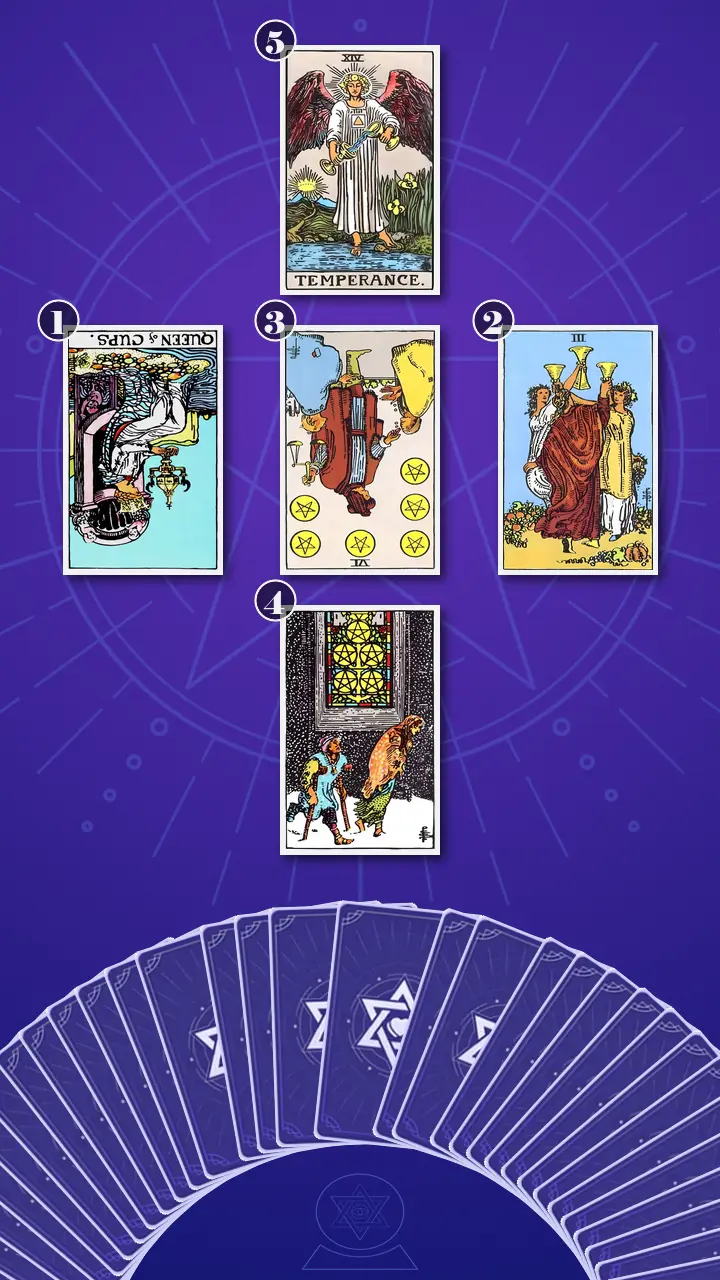
Today I was using the classic five-card Relationship Spread, a focused tarot method for examining friendship boundaries, reciprocity, and belonging. For anyone wondering how tarot works in a reading like this, I use the cards as an external visual structure for patterns that can be difficult to see while social uncertainty is moving quickly. The images do not decide whether a group is safe, and they do not predict a fixed future. They help me separate what happened, what Maya is assuming, what the relationship has demonstrated, and what she can choose next.
This spread suited the question because it is small enough to stay practical while still distinguishing five different layers: Maya’s contribution, the new group’s energy, the exchange pattern between them, the deeper challenge beneath the behaviour, and a constructive direction. A larger spread could add more atmosphere, but it might also blur the focused issue of why emotional openness is moving faster than trust.
I explained the route. “The first card will show how you are currently contributing through the level and timing of your disclosure. The second will show what the group’s warmth can responsibly mean. The centre will reveal the exchange that keeps the cycle going. Beneath it, we’ll look at the fear that makes a pause feel so urgent. Then we’ll rise to the card that offers a workable middle path.”
Reading the Map, One Layer at a Time
The Lidded Cup That Kept Opening
I turned the first card and said, “Now being revealed is the card that shows your current contribution to the pattern: emotionally rich but poorly paced disclosure in the early stages of group connection.”
The card was the Queen of Cups, in reversed position.
I kept my attention on the ornate cup held close to the Queen’s body. Its lid mattered. The water around her throne represented emotional depth and sensitivity, but the closed vessel also represented private material that belonged to her until she deliberately chose to open it. Reversed, that containing energy was blocked. Maya could notice that a story was private and still continue because the group’s attention had briefly felt more important than her internal signal to pause.
I connected the image directly to the restaurant. A question about dating had become a private emotional file: the breakup timeline, the part about what she had tolerated, the family detail she usually reserved for close friends. The card’s modern translation was a Notes app draft. A story could be true, meaningful, and ready to share later without becoming a public link simply because someone had asked a friendly question.
She did not nod in agreement. First, her breath paused and her fingers stopped turning the water glass. Then her gaze slipped away from the card, as if she were replaying the exact moment the conversation had changed. Finally, a short laugh left her chest, dry at the edges. “That’s too accurate,” she said. “It’s almost cruel.”
I let the sentence stand without trying to soften it into a lesson. “I hear how exposed that feels,” I said. “But you are not too much. You may be moving faster than the evidence can support. The work is not to become silent. It is to notice when openness has stopped being a choice and started trying to obtain reassurance.”
The Group Chat with Its Guest Login
I moved to the card on the right. “Now being revealed is the card that examines what new-group warmth can responsibly signify and tests the assumption that immediate sociability is the same as established safety.”
It was the Three of Cups, in upright position.
The three figures formed an open circle, cups raised together, surrounded by the signs of a shared harvest. I read this as genuine social warmth. The group chat after the first dinner had filled with photos, inside jokes, and plans for another meetup. While commuting on the TTC, Maya had seen the notifications and felt the quick lift in her chest that said, I’m in.
The upright energy here was not false or dangerous. It was simply public and communal rather than confidential. A lively first dinner could show that the group enjoyed her company. A fast reply, a group selfie, or an invitation to another event could show welcome. None of those moments could yet establish how each person handled privacy, disagreement, a subject change, or information shared in confidence.
I said, “Warmth is evidence of welcome, not proof of privacy. One good conversation is a welcome, not a background check.” I watched Maya glance at her phone as if it had become a small social thermometer. Then she turned it face down and looked back at the three raised cups. Her shoulders lowered a fraction, and she seemed able to hold two truths together: the welcome could be real, and the trust could still be new.
The Scale That Could Not Settle the Exchange
I placed my hand near the centre card. “Now being revealed is the card that identifies the maintaining relational dynamic: an imbalance between the personal value you give and the reciprocity or trust that has actually been demonstrated.”
The card was the Six of Pentacles, in reversed position.
The merchant’s scales hovered above an uneven distribution of coins. I brought Maya back to 7:42 p.m. in the Queen West restaurant: another person had shared a light anecdote about an awkward first date, and Maya had answered with the detailed story of a painful relationship. Cutlery had clinked. Pendant lights had reflected in the water glasses. When the other person changed the subject, Maya had felt the heavy drop in her stomach and kept explaining.
Reversed, the energy showed excess in one direction and deficiency in another. Maya was giving high-value private information before the relationship had demonstrated equal care, discretion, or responsibility. The disclosure was not a calculated attempt to control anyone. It was more like sending the full amount through a payment app before the other person had confirmed the transaction, then hoping a matching confession would appear and make the exchange feel fair.
I asked her to listen for the internal ledger that came after the conversation. The thought she had given me was, I gave them the valuable part, so why do I feel less secure? Attention had been received, but attention was not the same as reciprocity. Someone listening kindly in one moment had not yet shown how they would hold the information later.
Maya pressed her palm against her stomach. Her eyes stayed on the scales, and then she said, “I think I keep trying to make it fair after the fact. If I ask them something personal too, maybe I won’t be the only one who crossed a line.”
I answered, “You are allowed to notice the imbalance without forcing the other person to disclose more. Reciprocity is not a demand for equal secrets. It is something I would look for across time: respectful questions, discretion, follow-through, and the ability to let a topic end without punishment.”
The Lit Window Beneath the Snow
I turned the card below the centre. “Now being revealed is the card that shows the deeper challenge beneath the oversharing cycle: the fear that ordinary newness means exclusion or a lack of belonging.”
The card was the Five of Pentacles, in upright position.
Two figures moved through falling snow beneath an illuminated window. I recognized the scene Maya had described from the 8:47 p.m. TTC Line 1 ride home after a creative workshop: one hand on the pole, the other checking Instagram Stories and the group chat, the phone screen catching tunnel reflections while the fluorescent lights buzzed overhead. She had seen the new group making plans for drinks and remembered an inside joke she had not understood.
The upright energy was a scarcity-based interpretation of belonging. A quiet moment, a delayed reply, or a reference to a shared memory could become evidence that Maya was still the forgettable new person. Her body could read ordinary distance as exclusion, and a private story could begin to feel like an entry fee.
I pointed to the lit window. “The question is not whether you are ever allowed to feel left out. The question is whether the evidence says rejection, or whether it says that this relationship is still new. What did someone actually do? What are you predicting?”
Her thumb stopped above the group chat. She took a breath, then gave me a small list: no one had told her to leave, no one had criticised her story, and the group had invited her to another event. The evidence did not prove lasting safety, but it also did not prove exclusion. For the first time that evening, the pause had somewhere to sit besides a verdict.
When Temperance Slowed the Pour
The room grew quieter when I lifted the fifth card. The radiator clicked once, and a streetcar bell sounded faintly through the window before the traffic settled again. I said, “This is the key card, the Antidote in the spread. Position five provides the transformation and integration practice: paced vulnerability that balances authenticity with observation, reciprocity, and self-protection.”
The card was Temperance, in upright position.
An angel stood with one foot on land and one in water, moving liquid carefully between two cups. I read the image as a volume knob rather than an on-off switch. Maya did not have to choose between flooding a new group with private history and answering every personal question with a joke. She could offer one layer, remain connected to the pause, and let the other person’s response provide information before she chose another layer.
After fifteen years as a perfumer, I have learned that a room can become difficult to breathe in when one scent crosses the boundary between presence and saturation. I do not call the fragrance bad; I ask where the concentration has moved, whether the air can circulate, and who has chosen the distance. I use the same lens in what I call Boundary Permeability Diagnosis: I identify when another person’s lack of limits, or my own urgency, is bleeding into my space and causing emotional suffocation. For Maya, the useful question was not simply, “Are these people safe?” It was, “What access has this moment actually earned?”
At 11:40 p.m., I brought Maya back to the warm phone, the unsent apology, and the moment a dinner felt welcoming enough to make her keep speaking. I asked her to notice the exact gap between social welcome and earned safety, where the next private detail had begun to feel necessary.
You do not have to pour out everything to earn a place; build closeness by mixing honesty with pacing, like Temperance moving water carefully between two cups.
For a few seconds, Maya did not blink. First, her breath stopped halfway in and her thumb hovered above the unsent apology. Then her gaze lost focus and returned to the dinner table: the fork, the water glass, the half-second of silence, and the extra details she had added. Finally, her fist loosened around the phone, her shoulders dropped, and a shaky breath left her chest. Her eyes grew bright. “But does that mean I was wrong to be open?” she asked, with a brief flash of anger. I let the anger remain. “No,” I said. “It means your openness was trying to solve uncertainty. We can keep the warmth and return the choice to you.” She tested another sentence aloud: “I can let this be enough for now.” Then I asked, “Now, use this new lens to think back to last week: was there a moment when this insight might have made you feel differently?”
She looked down at the two cups in the image. The breakthrough was not a promise that she would never overshare again. It was the first movement from urgent disclosure used to secure belonging toward grounded confidence in gradual, reciprocal friendship-building. Authenticity was not the same as instant access. One honest layer could be real without being the whole archive.
From Insight to Action: The Two-Cup Pause
I gathered the five cards into one story. The Queen of Cups reversed showed a private emotional archive opening before Maya had chosen the timing. The Three of Cups confirmed that the group’s laughter, photos, and invitations were genuine signs of social warmth, but not yet a confidentiality agreement. The reversed Six of Pentacles showed why the cycle continued: Maya gave more personal value in an attempt to make uncertainty disappear. Beneath that exchange, the Five of Pentacles revealed the fear of standing outside the circle. Temperance offered the resource that could hold all of it together: feeling connected to evidence, time, and her own authority.
I could also see why the pattern had become so urgent. Maya’s hybrid-work week was full of scheduled, task-based contact, while established friends had demanding schedules and Toronto rent left few free evenings. A single Meetup, creative workshop, or friends-of-friends dinner could start carrying the weight of an entire social future. That was the hidden pressure: if the evening had to prove that she belonged, a quiet moment became intolerable.
I named the cognitive blind spot plainly. Maya was treating attention as emotional responsibility, warmth as privacy, and one engaging conversation as proof that the relationship had already moved several stages forward. The transformation direction was not toward guardedness. It was toward one-layer-at-a-time sharing, evidence-based relational safety, and trust built through repeated respectful behaviour.
I gave her two small experiments. I described them as experiments she controlled, not rules she owed to any group.
- Choose the medium layerBefore the next friends-of-friends dinner or Meetup, open Apple Notes and write three possible answers to one likely personal question: a light answer, a medium-personal answer, and a private answer. During one conversation, use the medium answer in two or three sentences, take a sip of water, and pause long enough to notice whether the other person asks respectfully, changes the subject, or lets the topic rest.The smallest version counts: one honest sentence and a two-second breath. Maya did not owe a deeper layer because someone laughed, listened, or asked a friendly question. If the topic felt too exposed, she could say, “I’m keeping that one private for now,” and move on without explaining.
- Use the Space Calibration RitualFor one week, create a ten-minute digital blank space after each new-group interaction: put the phone face down, do not reread the chat, and do not draft a message beginning with “Sorry if that was a lot.” Create a physical blank space by taking a five-minute walk or standing by a window before reviewing anything. In the next low-stakes coffee, walk, or workshop, notice three repeated behaviours: whether people respect a subject change, remember details, and follow through on plans.If the pause feels like rejection, do not reach for a verdict. Record only what happened in the room and what you are predicting about it. Trust is built in repeats, not won in one revealing conversation. If a group repeatedly mishandles private information or ignores a clear boundary, stepping back remains Maya’s valid choice.
I reminded Maya that a boundary was not a performance of emotional coldness. It was a breathable space in which she could remain warm and still decide what belonged there. The point of the Space Calibration Ritual was not to make every interaction controlled. It was to stop a single social pause from taking over the whole atmosphere.

A Week Later, the Quiet Proof
Four days later, Maya texted me from a coffee shop. She had used the medium answer when someone asked about dating, stopped after two sentences, and watched the other person respond with care before moving naturally to another subject. The friend remembered the detail at their next coffee, respected the change of topic, and made a plan that they actually kept. It was not a dramatic declaration of trust. It was three small pieces of evidence.
She slept a full night after the coffee, but woke with the old thought, “What if I’m getting it wrong?” This time, she smiled, left the question unanswered, and met the group for a walk anyway.
I told her that was the quiet proof: not that the cards had fixed her social life, but that she had created enough room to observe it. The five-card Relationship Spread had helped us move from the warm pressure of premature emotional disclosure to a more grounded form of belonging. Maya was still open. She was simply no longer making immediate access to her private history the price of connection.
Sometimes the pause after you speak feels like a verdict, so you hand over another piece of yourself before you have learned whether this circle knows how to hold it. If one honest layer could be enough for tonight, what small sign of respectful reciprocity would you feel curious to notice next?
This story is adapted from psychological research, written so that those in a similar struggle can see their own pattern in it — and find their next step clearly.These insights are not a substitute for professional psychological, medical, legal, or financial advice.
Learn more about our Journey to Clarity.
How did this insight land for you?
🫂 This Resonates Deeply
🌀 Living This Story
✨ Now I See Clearly
🌱 Seeing New Possibilities
🧰 Useful Framework
🔮 The Confirmation I Needed
💪 Feeling Empowered
🚀 Ready for My Next Step
Author Profile
 AI
AI“As a perfumer for fifteen years, I’ve learned to perceive human boundaries through the delicate metaphor of scent. Relationships need the right amount of space to breathe, and I've seen too many kind souls exhaust themselves trying to please everyone. I’m here with warmth and understanding—not to teach you to be guarded, but to help you gently clear the air and rediscover the comforting, safe boundaries that are rightfully yours.”
In this Friendship Tarot Reading :
Core Expertise
- Boundary Permeability Diagnosis: Identifying friends whose lack of limits is metaphorically 'bleeding into your space' and causing emotional suffocation.
- Vibe Contamination Auditing: Recognizing when a highly sensitive or negative friend is unconsciously polluting your personal psychological atmosphere.
Service Features
- The Space Calibration Ritual: A behavioral directive to implement specific 'digital and physical blank spaces', preventing enmeshment and restoring breathable boundaries.
Also specializes in :
Explore Related Patterns:
Boundary DiffusionAt dinner, a public question opened the door to private breakup history, and afterward you wondered who now knew something they had not earned. The group was warm, but warmth was allowed to stand in for demonstrated privacy. That blurring makes access feel binary. Either stay surface-level and risk being unknown, or hand over a deeper archive so the relationship can feel real. The result is a boundary recognized after the fact rather than chosen while the interaction is happening. Temperance gave you a more precise measure. You can treat a friendly invitation as welcome, then watch whether people respect a topic change, remember details, and keep plans before granting more access.
Premature VulnerabilityAt the friends-of-friends dinner, you answered a casual dating question with a breakup timeline, what you had tolerated, and a family detail that usually belonged to close friends. You could hear yourself saying too much, yet the wish to be known quickly kept the next detail moving before the group had shown it could hold the first one. The protective logic was not that openness was wrong. Disclosure was being used to accelerate closeness and make the uncertain space feel safer, so authenticity and access became fused in the moment. That is why the regret arrived on the TTC ride home. The story was true, but the timing had outrun the evidence. Your later medium answer shows that the choice can return without making you distant. One honest layer can communicate who you are while leaving the next layer to be earned through respectful questions, discretion, and follow-through.
Reassurance SeekingOn the ride home, you checked the group chat for a change in tone, and at 11:40 p.m. drafted a message beginning with "Sorry if that was a lot." After the other person changed the subject, you kept explaining and later imagined that another personal confession might make the exchange feel fair. Those actions function as attempts to get immediate confirmation that the connection is intact. Attention can briefly soothe uncertainty without proving responsibility, so each check or extra explanation creates another place to search for reassurance. The loop keeps the group's response in charge of your sense of security. When you put the phone face down and waited for repeated evidence, you made room for a different question about what they actually did and what you are asking their reaction to settle. That shift preserves your warmth while stopping disclosure from carrying the job of emotional proof.
Rejection SensitivityOn the TTC ride, an inside joke you did not understand and the group's plans became possible evidence that you were still the forgettable new person. A delayed reply or quiet moment could therefore feel larger than the facts available. This reading narrows attention toward exclusion and away from competing data. No one had told you to leave or criticized your story, and the group had invited you to another event, yet your body treated ordinary newness as a warning that needed to be solved through more visibility. Writing down what happened separately from what you predicted lets uncertainty remain uncertainty. You can notice the alarm without making another private disclosure the price of belonging.
Timing DiscernmentFour days later, you used a medium answer when someone asked about dating, stopped after two sentences, and watched what happened next. The other person respected the change of topic, remembered the detail at the next coffee, and kept the plan they made. That sequence changes the role of openness. You are no longer asking one disclosure to prove that a new group is safe; you are letting respectful behavior accumulate before deciding whether more access makes sense. The pause becomes a source of information rather than a social verdict. You can remain warm, honest, and visible while keeping authority over the next layer. Trust is not won by revealing the whole archive in one night. It becomes clearer through repeated evidence that your boundaries can remain intact in the relationship.
Explore Related Struggles:
Accelerated Intimacy TrapMaya answers a casual dating question with the full backstory of a painful breakup, then checks the group chat on the ride home and drafts an apology at 11:40 p.m. The disclosure creates a burst of closeness, but the relationship has not had time to show whether it can carry what you shared. When a quiet beat appears, you treat it like a closing elevator door and push another detail through before the opening disappears. Uncertainty becomes a demand for immediate intimacy, so access is offered faster than trust can gather evidence and each new connection becomes a test that has to be passed in the same conversation. The struggle is not a lack of warmth or a reason to become silent. It is the trap of trying to make a new friendship feel established before its repeated behavior can establish safety. Pacing lets your openness remain chosen rather than used to force reassurance.
Privacy-Belonging SplitMaya says that keeping things surface-level might mean new friends never really know you, yet later asks who now knows something they did not earn. At the dinner, the same answer has to serve two competing needs: to be recognized as a real person and to keep private history inside a boundary you have not consciously opened. You can offer one honest layer and still reserve the rest, but belonging begins to feel conditional on access. When the group laughs, replies, or invites you back, welcome and confidentiality appear close enough to blur; the social circle is open while your private material still needs time and evidence. The strain lives in deciding how much of yourself connection is allowed to reach. Seeing the split restores a workable middle ground: authenticity without full access, and privacy without disappearing behind surface talk.
Scarcity Compass LockOn the TTC ride, Maya checks Instagram Stories and the group chat after seeing plans and remembering an inside joke she did not understand. A quiet beat becomes possible proof that she is still outside, and one dinner begins carrying the weight of an entire social future, making a private detail feel like an entry fee rather than a choice. That compass points toward avoiding exclusion, but it cannot tell you whether the group has actually mishandled you. It turns delayed replies, ordinary distance, and incomplete shared history into pressure to close the gap immediately, so disclosure becomes a way to move the circle closer before the evidence arrives. Seeing the lock leaves room to separate what happened from what the moment seemed to demand. A group can be genuinely welcoming and still be new; belonging can grow through repeated contact without requiring your private archive as proof.
Reciprocity DeficitMaya answers a light first-date anecdote with the detailed account of a painful relationship, including material she normally reserves for close friends. Attention arrives, but the group has not yet shown discretion, follow-through, or an ability to hold a subject over time. Afterward, you try to make the exchange fair by wondering whether the other person might share something personal too, as though matching disclosure could retroactively confirm the transaction. You are left with a ledger that records what you gave more clearly than what the relationship has demonstrated. Reciprocity is not equal secrets in a single conversation. It is a pattern of respectful questions, remembered details, topic changes without punishment, and plans that are kept. Letting those actions accumulate before another private layer protects the value of your openness without turning it into a test the other person must pass immediately.
Explore Related Emotions:
Cautious TrustAt coffee, the other person receives Maya's two-sentence answer with care, moves naturally to another topic, remembers the detail later, and keeps the next plan. None of these actions is a dramatic promise, but together they provide three separate pieces of relational evidence. You are letting trust emerge as a provisional feeling supported by repeated conduct rather than instant chemistry. Cautious Trust makes room for genuine welcome while preserving your right to wait, observe, and revise how much access the relationship receives.
Cautious VulnerabilityFour days later, Maya answers another dating question with two medium-personal sentences and then stops. She stays in the conversation long enough to see the other person respond with care and move naturally to another subject, without using additional disclosure to secure the connection. You can be genuinely known through one chosen layer while allowing the rest of your private archive to remain yours. Cautious Vulnerability describes openness that is neither a flood nor a shutdown: honesty remains available, but timing, evidence, and your own sense of readiness determine whether another layer is offered.
Conditional Belonging FearOn the TTC, Maya sees plans for drinks and remembers an inside joke she did not understand; at dinner, keeping the answer light seems to risk remaining the forgettable new person. Because one gathering is carrying the weight of an entire social future, a private story begins to feel like an entry fee rather than a freely chosen disclosure. You are not simply seeking attention in this emotional weather. Conditional Belonging Fear is the sense that welcome may expire unless you quickly provide something intimate, valuable, or memorable, which turns your understandable wish to be known into pressure to earn a place before anyone has asked you to.
Grounded BelongingMaya meets the group for a walk even though she still cannot know exactly where every friendship will lead. She remains open, accepts the invitations and kept plans as meaningful evidence, and no longer makes immediate access to her private history the admission price. You can occupy social space without proving your depth all at once. Grounded Belonging is the felt sense that connection can develop while parts of you remain private, allowing your place in the circle to rest on participation and reciprocal behaviour rather than the amount of yourself you hand over.
Mutuality HungerAnother guest offers a light story about an awkward first date, while Maya answers with the detailed history of a painful relationship. Afterward, she wants to ask the others something equally personal so she will not be the only person who crossed into private territory. You are longing for the exchange to become emotionally balanced after your disclosure has already moved beyond the relationship's demonstrated depth. Mutuality Hunger names the wish for someone else to meet you at the same level, not merely by listening in the moment but by showing that openness, discretion, and care can travel in both directions over time.
Relational UrgencyA casual dating question at dinner opens into Maya's breakup timeline, what she tolerated, and a family detail, and she keeps explaining even after the other person changes the subject. The half-second of silence feels like a closing elevator door, making one more private detail seem capable of keeping the social opening alive. You are feeling pressure in the uncertainty between being welcomed and being securely known. Relational Urgency names the internal rush to make closeness arrive before the relationship has produced enough evidence, allowing you to see that the speed is an attempt to settle uncertainty rather than proof that your openness is defective.
Social Exclusion DreadDuring the TTC ride home, an inside joke she missed and plans for drinks become larger than the facts themselves, even though the group has invited her to another event and no one has criticised her. The unfinished nature of a new friendship is translated into the image of standing outside a lit window while everyone else already belongs. You can experience ordinary social distance as if exclusion is already underway, which is the core of Social Exclusion Dread. That inner atmosphere helps explain why disclosure accelerates: offering a deeply personal story can feel like a way to cross the imagined distance before the evidence has shown whether there is a distance to cross.
Verdict DreadWhen the other person changes the subject, Maya feels the heavy drop in her stomach and continues explaining; later, a delayed reply or tiny tonal shift in the chat receives the same close inspection. No one has delivered a judgment, but the pause feels capable of becoming one. You are reacting not only to what happened but to the possibility that an unresolved moment will harden into a final answer about your acceptability. Verdict Dread captures why silence becomes so difficult to tolerate: another detail seems to postpone the imagined ruling, even when continuing to speak takes you further from your own boundary.
Grounded Self-TrustMaya wakes after the coffee with the familiar question about whether she is getting the friendship wrong, leaves it unanswered, and meets the group for a walk anyway. Her earlier sentence that one layer can be enough has returned the decision about access to her rather than placing it in the group's momentary reaction. You can remain connected while trusting yourself to notice, pause, share, or step back as new evidence appears. Grounded Self-Trust is not certainty that every person will handle your openness well; it is confidence that uncertainty does not have to take your choice away.
Privacy AnxietyAfter the dinner, Maya wonders who now knows something they did not earn: the breakup timeline, what she tolerated, and a family detail usually reserved for close friends. The group's attention was warm, but warmth had been treated as if it already guaranteed responsible handling of her private material. You are left preoccupied with an access level that moved faster than your deliberate consent. Privacy Anxiety captures the unease of knowing that truthful information now sits outside your control while the people holding it have not yet demonstrated discretion, follow-through, or respect for a boundary.
Vulnerability HangoverAt 11:40 p.m., Maya sits on the edge of her bed with a warm phone in her palm, rereading the thread while an apology remains unsent. The dinner has ended, but the disclosure continues inside her through the dropped stomach, stalled breath, and repeated search for a change in the group's tone. You are left carrying the delayed exposure that follows openness once the social momentum disappears. Vulnerability Hangover names that heavy aftereffect: the story was meaningful and honestly told, yet its timing no longer feels fully chosen, so your mind returns to the interaction looking for reassurance that cannot make the information private again.
Reciprocal WarmthThe group fills the chat with photos, jokes, and plans for another meeting, and the person at coffee later remembers Maya's medium-personal detail without pressing for the rest of the story. Respect for the subject change and follow-through on a plan add substance to the initial welcome. You are receiving warmth that can remain real without being mistaken for instant confidentiality. Reciprocal Warmth develops when interest is joined by restraint, memory, and consistent action, letting connection feel nourishing without requiring you to increase the emotional concentration to keep another person's attention.
Grounded CuriosityWhen Maya separates what happened from what she is predicting, she can list that no one criticised her, no one asked her to leave, and the group invited her to another event. At the later coffee, she notices how the person handles a medium answer instead of demanding that the interaction immediately prove safety or rejection. You are allowing uncertainty to become observable rather than treating it as an emergency that disclosure must end. Grounded Curiosity is the felt openness to discovering what people consistently do, which gives your attention somewhere concrete to rest while the relationship is still too new to support a final conclusion.
Explore Related Contexts:
Friendship Disclosure Pace MismatchMaya answers a casual dating question at a friends-of-friends dinner with the full history of a painful breakup, including details she normally reserves for close friends. The dinner offers attention and sociability, but it has not yet established how anyone in the group handles private information after the table clears. That creates a mismatch between the level of access being given and the amount of relational evidence available. You can treat warmth as real while still noticing that welcome, confidentiality, and reciprocity develop on different timelines. The useful point of leverage is not becoming less open. It is letting the pace of disclosure track repeated evidence of respect, discretion, and follow-through, so your private history remains something you choose to share rather than something a new room silently acquires.
Social Safety Net GapMaya's hybrid-work week is built around scheduled, task-based contact, her established friends have demanding schedules, and Toronto rent leaves few free evenings. Under those conditions, a Meetup, workshop, or friends-of-friends dinner becomes one of a limited number of available openings for social connection. When access to dependable connection is scarce, a single pleasant evening can start carrying more practical weight than the interaction itself can support. You may then be pushed to make that room feel settled quickly, because there are fewer nearby chances to let a connection develop gradually. Seeing the access gap changes the question from whether you must secure belonging in one conversation to how you can widen your opportunities for repeated contact. That makes it easier to let any one group remain a possible connection rather than the sole container for your social future.