Calling Your Career Path a Dead End Before You Test the Next Door

The Spreadsheet That Called a Career Dead End
“You have 23 saved job postings, four bookmarked certificate programs, and zero sent messages. If that math feels personal, this reading is about you,” I said when Alex (name changed for privacy) sat across from me in my Toronto studio. It was 4:47 p.m. on a gray Tuesday in their apartment, the radiator ticking against the window while a fluorescent desk lamp buzzed over a private spreadsheet titled options v7 FINAL. Their laptop glowed against the dim room; their shoulders had climbed almost to their ears.
Alex highlighted a row, typed probably not a fit, and closed the lid. The action brought a brief, chest-tight relief, the kind that arrives when one more decision has been postponed. Underneath it, their discouragement moved like low-energy restlessness trapped beneath a weighted blanket: nowhere to go, too tired to stand. “If there were a real opportunity here, I would have seen it already,” they said.
I let the silence hold that sentence without arguing with it. Alex was twenty-eight, working as a project coordinator at a nonprofit, with real skills in timelines, communication, and keeping complicated projects alive, yet the lack of a visible promotion path had made those skills feel like evidence of nowhere. “You are asking what you are missing while you keep calling this path a dead end,” I said. “That is a fair question. We can look at it without forcing you to stay, leave, or pretend everything is fine. Our Journey to Clarity today is simply to find out whether this is a genuine lack of fit or a verdict formed before you gathered enough direct evidence.”

Choosing a Map for a Narrow Corridor
I asked Alex to put both feet on the floor, take three unhurried breaths, and hold the question in one clear sentence. I shuffled slowly while they focused, using the movement as a practical transition from browser tabs and private arguments into deliberate attention, not as a promise that the cards could make a decision for them.
For this reading, I chose the Four-Layer Insight Ladder · Context Edition, an original six-position tarot spread for career clarity. I use it when a person is caught in a self-reinforcing interpretive loop rather than choosing between two clearly defined external options. A Celtic Cross would bring in a wider landscape than this question needs, and a Decision Cross would assume that Alex had already established a fixed set of alternatives. This spread lets us examine the verdict, the filter creating it, and the smallest experiment that can produce better information.
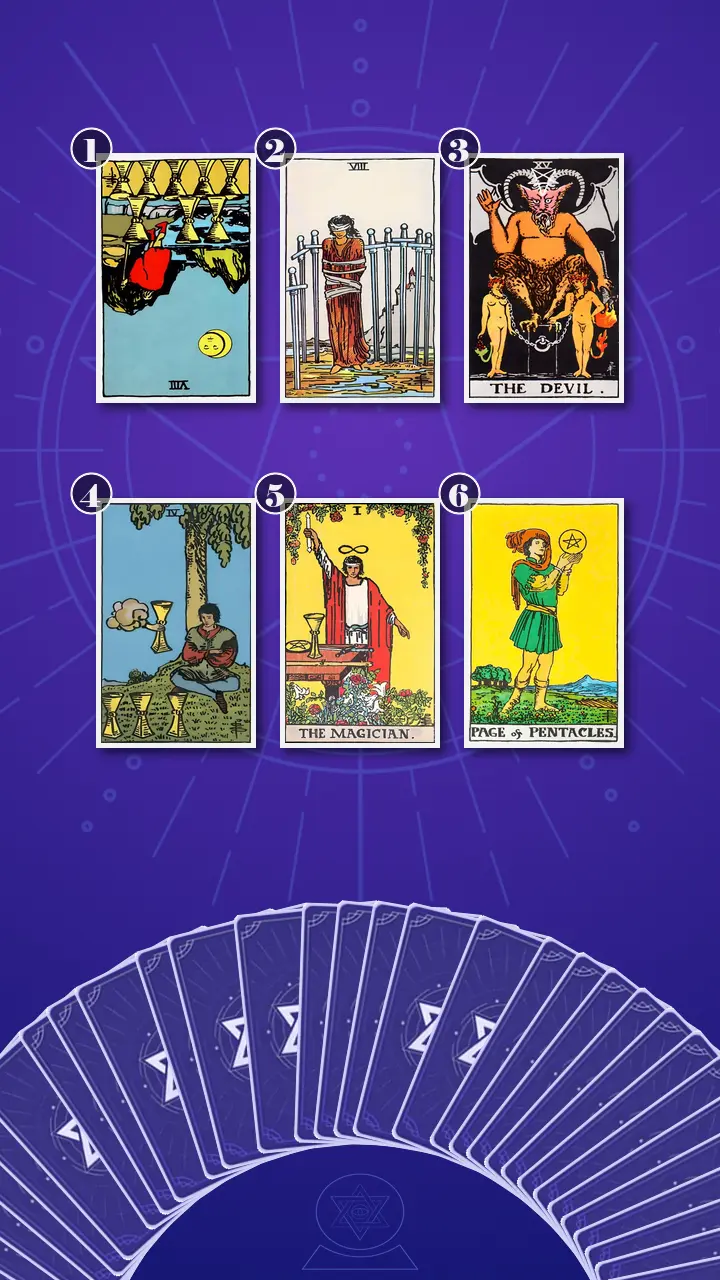
I explained the structure for Alex and for anyone reading along. The upper row would move from the current verdict to the visible blockage and then the underlying belief. From there, we would move diagonally to the overlooked resource, then across the lower row to the transformative lever and grounded integration. The first card would show the lived symptom; the second would show how opportunity blindness becomes observable; the third would touch the worth-based fear beneath it. The fifth card, placed at the visual pivot, would point to the action that returns agency. The sixth would turn that insight into a practical next step.
This is one useful way to understand how tarot works in a career reading: the images give language to patterns that may be difficult to see from inside them. They do not certify that a job is doomed or guarantee that an adjacent field will work. They help us ask sharper questions, notice what attention has filtered out, and hand the decision back to the person living it.
The Corridor Before the Exit
Position 1: The Exit Draft That Never Sends
Now turned over is the card representing the current verdict and lived symptom: the exact story Alex is using to label the path a dead end and the stagnant behavior that follows.
The card is the Eight of Cups, in reversed position.
I saw the small figure walking away from the stacked cups beneath the moon, but I also noticed that the path continued beyond the edge of the image. “This is the loop you described,” I said. “After a flat workday, you open a fresh browser tab, type a new field into the search bar, and imagine the version of you who walked away. Then you picture explaining the gap, feel the flush of being asked why you left, and quietly return everything to the way it was. The resignation draft sits in your notes app, unsent, reread, revised.”
Reversed Water is not flowing toward a clean departure or a renewed commitment. It is blocked between the two. Alex is scanning for deeper meaning while refusing to examine the ground directly beneath them, which keeps the current path emotionally incomplete and practically untested. The card does not tell them to stay or go. It asks a more useful question: what information would a real departure decision need before it became a decision rather than an escape fantasy?
Alex gave a small, bitter laugh and looked toward the window instead of nodding. “That is almost rude,” they said. “I keep saying I want an answer, but I mostly want a reason that cannot be challenged.” I smiled gently. “That makes sense. A reason that cannot be challenged can also prevent you from learning anything new.” Their fingers moved to the edge of the card and rested there, recognition arriving with a little grief.
Position 2: The Blindfolded Requirement
Now turned over is the card representing the visible blockage: how opportunity blindness and limiting beliefs become observable through dismissed options, delayed outreach, and the absence of direct evidence.
The card is the Eight of Swords, in upright position.
I asked Alex to picture an operations role appearing in their feed, one that mapped almost perfectly onto what they already did: coordinating timelines, writing clearly, and keeping messy projects alive. Then came one preferred qualification they lacked. “In the instant you see that line,” I said, “your body performs the decision before your mind finishes reading. There is a micro-flinch, a shoulder drop, the practiced click of the tab closing. One missing requirement equals one sealed door. That equation has never once been checked.”
The blindfolded figure on the card is surrounded by swords, but the blades are not touching them. The ropes are loose enough to slip. That does not mean the restriction feels imaginary; it means the felt enclosure has not yet been confirmed by the room. Fear, incomplete information, and one perceived deficiency have been treated as binding rules. The Eight of Swords is Air in blockage: thought has become so organized around proving that movement is impossible that it no longer gathers the evidence needed to test the claim.
“Slow is data. Stopped is a choice,” I said, keeping the distinction free of blame. A slow work week, an unanswered application, or an unfamiliar qualification may tell us something about timing, fit, or the market. But closing every door before touching the handle creates a silence that can then be mistaken for proof. It is the difference between asking whether a constraint is externally confirmed and repeating it internally until it sounds objective.
For a moment, Alex stopped breathing. Their index finger hovered above the row of cards, their eyes fixed on the qualification they had imagined, as if the memory were playing on a screen only they could see. Then their shoulders dropped, their hand unclenched, and a long breath left them. “I do that before I even ask anyone,” they said. I watched the defense soften without disappearing. The point was not that every door was open; it was that Alex had been conducting the inspection with a blindfold on.
Position 3: The Story That Charges Rent
Now turned over is the card representing the underlying belief: the limiting assumption and worth-based fear that make an uncertain path feel like proof of poor judgment.
The card is The Devil, in upright position.
I read this card carefully, because The Devil is often treated as a threat when it can be a remarkably precise picture of attachment. “This is the sentence you have been living inside,” I said. “I am someone who always chooses the wrong path. Say it once after a disappointing week and it sounds like analysis. Say it for six months and it becomes an operating system.”
The chains around the two figures are loose. I pointed that out before discussing the darkness of the pedestal or the inverted torch. “The story protects you from the risk of being seen trying,” I said, “and it charges rent in the currency of every possibility you explain away before it can challenge the belief. That is not a character flaw. It is a defense strategy that once offered relief and is now costing you contact with reality.”
At the root, the card shows an excess of attachment and a blockage of choice. A temporary lack of visible progress has been fused with identity. The fear underneath is not only wasting another year; it is that a failed experiment would reveal that Alex lacks the judgment to recognize a viable opportunity and is therefore less worthy of respect. That is why researching instead of applying feels so attractive. Research is planning with the risk removed.
I asked, “If you tried one small thing and it did not work, what exactly would you be afraid it proved about you, and to whom?”
Alex looked down at their hands. Their mouth opened, closed, and opened again. “That I cannot read my own life accurately,” they said. “That everyone else can see what I should do, and I keep missing it.” I let the answer stand. The chain was visible now, not as a sentence from the cards but as a belief Alex had the authority to examine.
The Cup Outside the Frame
Position 4: The Offer Hidden in Ordinary Work
Now turned over is the card representing the overlooked resource: the perspective, offer, skill, or small signal Alex is failing to recognize because attention is fixed on disappointment.
The card is the Four of Cups, in upright position.
The image showed a figure with arms crossed and gaze lowered while a hand offered a fourth cup from a cloud. I connected it to a recent scene Alex had almost edited out of their own memory. A teammate had mentioned a cross-team project that could put Alex’s research and coordination skills in front of people who mattered. Alex had heard unpaid extra effort and declined before the sentence finished. Later, while replaying the conversation, they skipped the part where access, learning, and a new kind of visibility had been on the table.
This card names what may be missing: not a miracle opening, but an ordinary offer sitting within reach while disappointment does the filtering. The energy is withdrawn Water. Attention is so busy measuring what has failed that new information does not register as usable. The three cups on the ground are real, but they are not the whole field of possibility. The fourth cup is not a guarantee; it is a data point that deserves to be evaluated on its own terms.
“Have you noticed that the dead end looks most certain right after a disappointing day?” I asked. “What invitation, project, or compliment have you waved off within seconds? What might it have contained if you had looked at it before deciding whether it was enough?”
Alex slowly uncrossed their arms. They remembered that the teammate had asked whether they would help map the project’s research process, not merely take on more admin. The realization did not make the offer perfect. It made the earlier rejection incomplete. Their expression held relief and a faint, bittersweet annoyance at how quickly they had closed the door.
When the Magician Put the Corridor on the Table
Position 5: The Table of Existing Tools
The room changed when I turned to the lower middle card. The radiator clicked off, a streetcar bell sounded once beyond the window, and the blue-gray light made the reading table look like a small stage. We had reached the visual pivot of the spread.
Now turned over is the card representing the transformative lever: the smallest shift from declaring a final answer to using available resources for a direct, testable experiment.
The card is The Magician, in upright position.
The Magician stood with one hand raised and one hand lowered, an infinity symbol above their head and a table holding a cup, pentacle, sword, and wand. I mapped the objects onto Alex’s actual inventory. The cup was the work they still felt called toward. The pentacle was the coordination and writing skill they dismissed as just admin. The sword was their ability to ask sharp questions. The wand was the simple willingness to begin.
“Everything needed for the first real test is already on your desk,” I said. “You know how to coordinate a timeline, write a clear email, summarize findings, and ask a decent question. You do not need a new identity to run one experiment.”
After a decade of guiding people through uncertainty, I use a lens I call Macro-Orbital Projection. I do not use it to tell someone that a planet has sentenced them to wait, or to turn a painful stretch into an excuse. I use it to widen the frame. A slow early-career phase can be part of a longer cycle in which old work no longer supplies enough meaning and the next trajectory has not yet been tested. The apparent stillness is not a verdict on Alex’s worth.
I also named what I saw as a Void Phase: a transitional space in which the old route feels too small while the next route has not acquired enough evidence to feel real. Void Phase Identification helps me locate that gap without treating it as permanent emptiness. It gave Alex a different scale for the discomfort. They were not required to leap across the void; they needed to find one stable surface on which to place a foot.
I asked Alex to return to options v7 FINAL, the highlighted row, and the 4:47 p.m. click. With the Eight of Swords beside the spreadsheet, the scene stopped looking like a mood and started looking like a system: verdict, flinch, closure, no feedback, more certainty.
“Stop treating the path as a sealed verdict; use the tools already on the Magician's table to test one possibility and let self-trust grow through contact with reality.”
For one beat, Alex froze: breath held, fingers hovering above the edge of the card. Their eyes went out of focus, as if the gray apartment and spreadsheet had been replaced by a replay of every tab they had closed. Their jaw tightened before their hands did; the familiar defense arrived as anger. “But doesn’t that mean I was wrong this whole time?” they asked, their voice thin and sharper than before. I kept mine level. “It means the verdict was protecting you from feedback. It does not mean the path is right, and it does not mean you failed. It means you can update the story now.” The sentence reached them slowly. Their shoulders dropped a fraction, then another. The fist in their lap opened finger by finger. Their eyes shone, not with a dramatic answer but with the strain of no longer having to defend one. A long breath moved up from the compressed place behind their sternum. “I could have just asked,” they whispered.
I asked, “Now, using this new perspective, can you recall a moment last week when this insight might have let you feel or act differently?”
Alex remembered the cross-team invitation. Nothing about the project had changed, and it still might have been too much extra work. But the response could have been a question instead of an automatic no: What would I learn, who would I work with, and how much time would it take? That was the movement from discouraged certainty toward curiosity and agency, with grounded clarity still being built rather than claimed.
The Ground Under One Pentacle
Position 6: The Apprentice’s Seven-Day Practice
Now turned over is the card representing grounded integration: a practical next step that lets Alex gather evidence about what this path still contains without asking the cards to decide the future.
The card is the Page of Pentacles, in upright position.
The Page stood in a cultivated green field, looking steadily at one pentacle while distant mountains waited beneath an open sky. I read the image as a correction to Alex’s habit of surveying the entire horizon before taking one step. The Page does not need a guaranteed five-year future to begin learning. They need one tangible task, enough attention to notice the result, and permission to record not for me as a valid finding.
This is Earth grounding the Magician’s Fire. Agency becomes sustainable when it is attached to a small practice: one course module, one shadowing request, one fifteen-minute conversation, or one modest contribution in an adjacent area. The question is no longer whether Alex can prove the entire career path is right. It is whether one week of contact with reality can reveal something true about interest, skill, and fit.
Alex wrote the date at the top of a fresh page. For the first time that afternoon, they did not title it final. Outside, the clouds had begun to thin above the Toronto rooftops. The path in the Page’s landscape remained long, but it was no longer being judged from the far end.
The Verdict-to-Evidence Method
I gathered the six cards into one story. The reversed Eight of Cups showed a departure that had been imagined but not clarified. The Eight of Swords showed how a slow week, an unanswered application, or one missing qualification became a wall through selective attention. The Devil revealed the deeper attachment: if Alex could label the path finished first, no visible experiment could expose poor judgment. The Four of Cups showed the cost of that protection, an ordinary offer filtered out before it could be understood. Then The Magician placed emotional insight, practical skill, clear thinking, and initiative within reach, and the Page of Pentacles gave those resources a patient, measurable form.
The contradiction was not simply stay versus leave. It was seeing what the path still contained while calling the path finished too soon. Alex’s cognitive blind spot was treating a lack of direct evidence as evidence of absence. The transformation direction was therefore specific: replace the global verdict with one testable question, then use a low-stakes career experiment to gather information. A genuine mismatch could emerge from that process. So could an adjacent opportunity. Either result would be more honest than another week of private planning.
To make that process easier to track, I gave Alex my Cosmic Redshift Observation. For one week, they would note one signal that was fading, or shifting red, such as an interest that no longer held their attention, and one signal that was approaching, or shifting blue, such as a task that made them curious or a conversation they wanted to continue. The exercise was not about forcing a cosmic meaning onto ordinary events. It was a way to observe patterns before a tired day turned them into conclusions.
“One door handle. That is the whole assignment,” I said. “You do not need to open the entire corridor. You only need to touch one handle and notice what reality tells you.”
- Touch one handleOn Wednesday at lunch, choose one saved contact working in adjacent operations or research and send a two-sentence informational interview message. Spend no more than ten minutes drafting and sending it; the purpose is one new data point, not a job application or a dramatic career pivot.If the message receives no reply, record that as information about timing or access, never as a verdict about your value. You can pause there.
- Use the 20-minute course module ruleOn Thursday evening, open one bookmarked certificate program at home and complete its first module for twenty minutes. When the timer ends, you are allowed to stop in the middle of a slide and write down what held your attention, what drained it, and what you learned.If twenty minutes feels impossible, begin with two. The point is direct contact with the material, not proving your discipline.
- Run a Cosmic Redshift evidence logFrom Friday through the following Thursday, write one specific reason the path feels finished and name one direct data point that could verify it, such as feedback from a manager, a small adjacent task, or a conversation. Add one fading interest and one approaching signal each day in three brief bullets.Treat the first thought of this is pointless as weather, not instruction. Every entry is reversible, private, and useful even when the honest result is not for me.
These next steps were deliberately small. They did not ask Alex to quit, stay, announce a new identity online, or turn uncertainty into a productivity contest. They created enough movement for evidence to enter the room. The Four-Layer Insight Ladder had brought the question into focus; Alex would remain the person deciding what the evidence meant.

When the Corridor Became a Route
A Week Later: The Quiet Proof
A week later, I received a message from Alex while they were on the streetcar. “I sent the two-sentence note,” they wrote. “They replied and offered fifteen minutes to talk about operations research. It is not a job, but it is more information than I had last week.” I read the message twice and smiled. The reply was not a prophecy. It was the small, ordinary proof that contact with reality could produce a new question.
The plan was clearer but still fragile: Alex slept a full night, woke with the old thought, What if I am wrong?, and smiled before reaching for the phone. The fear stayed; it simply no longer had the whole room.
I told Alex that the cards had not discovered a hidden destiny or declared the current path secretly perfect. They had helped us see the difference between a genuine dead end and a corridor inspected only from one tired angle. The querent remained the author of the next move. Self-trust did not arrive as certainty; it began as the willingness to let one small experiment teach something true.
That is what finding clarity looked like here: not solving an entire career in one sitting, but moving from discouraged certainty and research-based avoidance toward curiosity, agency, and grounded clarity. A slow stretch could still be painful. Leaving could still become the right choice. The difference was that Alex would now make that choice with evidence, not with the silence created by never asking.
We have all stood at the end of a road we declared finished ourselves, mistaking our own stillness for the world running out. Clarity is sometimes the first thin line around a door we had stopped seeing.
If you gave yourself one week of curiosity instead of conclusions, what is the first small question you would place on the Magician’s table and actually want answered about this path?