A LinkedIn Alert Closed Her Photos; Five Exports Tested Career Fit

The Creative Tab She Closed at 9:40 p.m.
If you are a late-twenties tech professional caught in golden handcuffs, you may know how quickly one LinkedIn promotion post can make the work you love feel unserious. I have watched that single notification turn a career crossroads into an unofficial leaderboard before anyone has asked whether the daily work actually fits.
At 9:40 p.m. on a Tuesday, Maya propped her phone against a mug for our video consultation from her Toronto condo. Through the camera, I saw photo thumbnails glowing on the left side of her laptop and a finished promotion deck on the right. Blue screen light washed over cold coffee, the radiator clicked behind her, and a LinkedIn alert vibrated against the desk.
As if following a rehearsed cue, she moved the cursor toward the photographs and closed them. Her jaw locked before she said, “I only need one more promotion before I’ve earned the right to choose differently.”
I asked her to leave the closed tab alone for a moment and tell me why she had booked the reading. She pressed one palm against the centre of her chest. “Why do I keep choosing the admired career over work I love? I know which work gives me energy, but it sounds irresponsible when I say it out loud.”
I could hear the core contradiction clearly: Maya wanted the sustained attention she found in photography, but she also feared losing the admiration attached to a prestigious technology career. She described the pull in a way I could almost feel across the screen, like a camera strap and a corporate lanyard being tightened in opposite directions across the same rib cage.
I told her, “We’re not going to ask the cards whether you should quit, and I’m not going to pretend Toronto rent, benefits, and career capital are imaginary. We’re going to separate practical constraints from the need to remain impressive. Then we’ll look for one honest way to gather evidence.”
I framed our work as a Journey to Clarity, but not toward perfect certainty. I wanted to help her see the pattern without shaming the part of her that valued recognition. Admiration is a normal human need. The trouble begins when it becomes the only navigation system allowed to calculate the route.

Choosing the Compass Beneath the Career Crossroads
I invited Maya to put both feet on the floor, take one slower breath, and hold a single question in mind while I shuffled: “What keeps giving prestige the deciding vote?” I use this brief pause as a focusing transition, not as a performance of mystery. It helps the mind stop opening new comparison tabs long enough to examine the question already present.
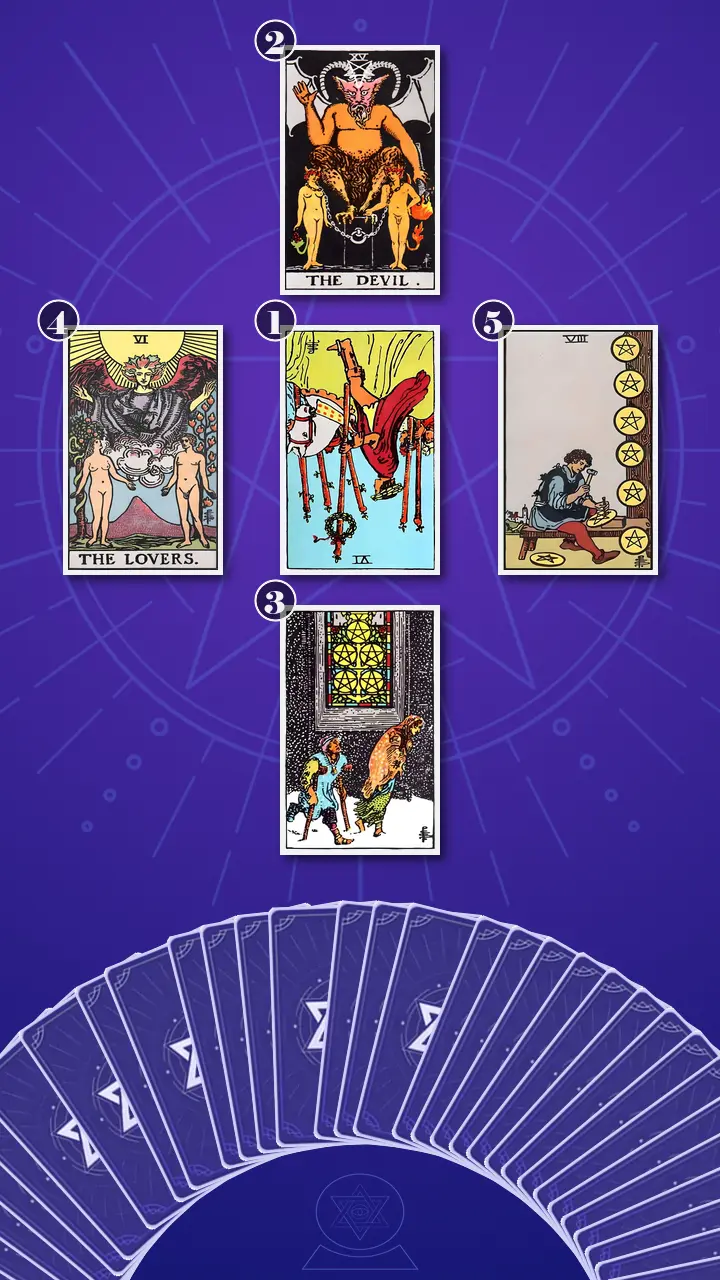
I chose a five-card Rider-Waite-Smith layout called The Shadow Spread. When readers ask me how tarot works in a career reading, I describe it as structured reflection: the images place different parts of a tangled problem where we can inspect them separately. Tarot does not replace financial planning, professional advice, or choice. It gives language and shape to information that may otherwise remain fused together.
I chose this spread because Maya did not lack career information. She had salary reports, promotion criteria, job rankings, and a highly engineered spreadsheet. What she lacked was a way to separate visible behaviour from the hidden agreement underneath it. A decision spread would have compared product management with photography too early, before asking why the admired option kept winning by default.
I arranged the cards like a compass. The centre would show the visible career pattern. The card above it would reveal the attachment linking admiration with worth, while the card below would expose the fear keeping that attachment active. The card to the left would reclaim a truth Maya had been excluding; the card to the right would turn that truth into a practical experiment. The vertical axis would excavate the problem, and the horizontal axis would redirect it.
Reading the Vertical Axis of the Prestige Career Trap
Position One: Applause That Expires by Evening
I turned the card representing Maya’s visible career behaviour and contracted pattern: repeatedly choosing admired opportunities while postponing meaningful work. It was the Six of Wands, reversed.
I showed her the laurel-crowned rider and the crowd holding up their wands. Upright, the image can speak to deserved recognition, confidence, and public success. Reversed in this position, I read an Excess of audience-monitoring and a Blockage in the ability to let achievement become stable inner confidence. The problem was not ambition. The problem was asking applause to keep proving that her life counted.
I brought the card into her actual week. At 4:58 p.m. the previous Friday, a senior colleague had praised her launch in a public Slack channel. She had felt her shoulders lift, sent a screenshot to a friend, and watched three celebratory reactions appear. By evening, she was refreshing LinkedIn, checking whether a former colleague had reached director level, and wondering whether her own next title would look significant enough. The photography folder she had planned to open stayed untouched.
I said, “Your title is proof of recognizability, not proof of fit. The praise can be genuine, and it still cannot tell us whether you want the ordinary hours required to keep earning it.”
Maya gave one brief, bitter laugh instead of nodding. “That’s so accurate it’s almost cruel. I should feel successful, so why am I already looking for the next proof?”
I let the question stand without using it against her. I asked what she had hoped the visible achievement would prove and what happened in her body when she sacrificed the photography block. She rubbed the hinge of her jaw and said the praise offered a quick lift, but moving the creative work made her chest feel as if someone had reduced the room by several inches.
I told her the reversed Six of Wands was not criticizing her success. It was showing that recognition had become a product dashboard dominated by a vanity metric: the number moved, everyone knew how to read it, and it still failed to describe the user experience of an ordinary workday.
Position Two: The Golden Handcuffs with a Loose Clasp
I turned the card representing the hidden attachment linking admiration with worth, credibility, and permission to belong. It was The Devil, upright.
I addressed the image carefully because I never use The Devil to frighten someone. I asked Maya to look past the dramatic figure and notice the loose chains around the two people. In this reading, the card did not describe an external force condemning her to the wrong career. It revealed an agreement she kept renewing: prestige would provide safety and belonging, and in return she would continue giving it time that belonged to other parts of her life.
I read the energy as an Excess of attachment to visible credibility and a Blockage around perceiving reversible choices. Real constraints existed, but “prestige must decide” was not the same thing as a fixed material fact.
I returned to the split screen I had seen at 9:40 p.m. The promotion deck already met the brief. The visual essay was unfinished and waiting. Maya still gave the next hour to polishing the visible assignment because doing more corporate work produced immediate reassurance, while giving photography serious attention raised a question no title could answer for her.
I said, “This is the gap that Severance makes painfully familiar: the polished professional self remains legible to everyone, while the off-hours self knows what feels alive but receives almost no decision-making authority.”
Her fingers tightened around the mug and then loosened. “I say I have no choice,” she said slowly, “but what I mean is that I don’t know how to choose without approval.”
I told her that noticing the difference between “I cannot” and “I keep choosing” was not an invitation to blame herself. It was the first return of agency. A chain can be emotionally powerful even when its clasp can be tested.
Position Three: Outside the Warm Window
I turned the card representing the fear beneath the attachment: that choosing loved work would mean losing admiration and therefore losing worth or belonging. It was the Five of Pentacles, upright.
I pointed to the two figures moving through snow below an illuminated stained-glass window. I told Maya directly that this was not a prediction of poverty, unemployment, or exclusion. In context, it pictured what her mind did before she had run even one serious experiment: it placed her outside the warm, recognizable world of successful peers and treated that imagined position as an accomplished fact.
She told me about standing outside a King West networking event in February, hearing laughter through the glass after someone had asked what she did. “Product manager at a prominent tech company” had come out easily. The words “local documentary photography” had caught in her throat. Later that week, a former colleague’s promotion post sent her into a row of open tabs for rent, salary benchmarks, camera costs, and benefits, even though her housing, salary, and employment had not changed.
I read an Excess of scarcity forecasting and a Deficiency in counted support. I did not ask her to minimize actual risk. I asked her to distinguish what could be verified from what she was predicting other people might think.
“If you gave photography one protected weekly block,” I asked, “what material loss would occur that day?”
“None,” she said after a pause. “What I’m imagining is that respected people would hear about it and quietly downgrade me.”
I saw her shoulders lower by a fraction. She had not solved the financial question, but she had stopped making anticipated judgment impersonate a financial fact. I said, “Practicality asks for evidence; prestige asks for an audience.”
When The Lovers Replaced the Career Leaderboard
Position Four: The Ordinary Tuesday Choice
I let the room become quiet before turning the card representing the truth Maya could reclaim: career choice guided by lived values, enjoyment, and self-authored responsibility rather than audience approval. The card was The Lovers, upright.
I placed it beside The Devil so Maya could see the visual dialogue. Both cards show two human figures beneath a larger winged presence, but The Devil’s figures are chained to a pedestal while The Lovers’ figures stand unchained in an open landscape. I did not read the openness as permission to ignore consequences. I read it as the Balance required to let desire, responsibility, income, attention, and acceptable trade-offs enter the same decision.
I asked Maya to compare two unglamorous Tuesdays instead of two announcement posts. On one side were product meetings, stakeholder feedback, roadmap decisions, administrative work, salary, benefits, and the quality of attention those hours demanded. On the other were shooting, editing, client or editor feedback, file management, uncertain income, skill development, and the kind of concentration she would need to practise repeatedly. The question was not which identity looked more cinematic. It was which trade-offs she could knowingly accept.
At this point, I used a lens from my practice called Decision Timing Calibration. I pictured an orbit observed from one dramatic coordinate and remembered how easily a temporary position can be mistaken for a permanent trajectory. A peer’s promotion post, launch-week praise, or an exhausted Sunday evening was not a structurally clean moment for a high-stakes career verdict.
I paired that with Cyclical Variable Filtering. I filtered out temporary friction such as the LinkedIn spike, the afterglow of public praise, and the fatigue of a late workweek. I kept the variables likely to matter across her longer orbit: her required income floor, benefits, actual weekly tasks, sustained attention, energy after doing the work, desired skills, and willingness to repeat the less glamorous parts. This did not decide for her. It made the decision conditions more honest.
I brought her back to 9:40 p.m.: photo thumbnails glowing on one side of the laptop, a finished promotion deck on the other, and a LinkedIn alert tightening her jaw until the work she loved became the tab she closed.
A title can show that other people recognize your path; it cannot tell you whether you want the daily relationship that path requires. Let one small trial give you the evidence applause cannot.
Then I gave her the reading’s central sentence:
Your title is not proof of fit; choose the work whose daily reality matches your values, as the unchained figures in The Lovers stand openly before their choice.
I stopped speaking.
First, Maya’s breath caught, and her index finger remained suspended above the trackpad. Her eyes lost focus as though she were replaying every time “one more promotion” had moved further away. Then her jaw tightened again. “But doesn’t that mean I’ve been wrong all these years?” she asked, with a flash of anger under the words.
I kept my voice level. “No. Your career has given you real skill, income, relationships, and choices. This means the rule that helped you build stability may no longer deserve unlimited authority. Updating a rule is not declaring your past a mistake.”
Her hand opened against the desk. A long breath left her chest, her shoulders dropped, and her eyes reddened without spilling into tears. For a moment she stared at the cards with the slight blankness that can follow putting down a heavy bag. I could see relief, but also the vulnerability of realizing that clearer information would return responsibility to her.
I asked, “Now, with this new view, can you think of a moment last week when this insight might have changed how you felt?”
She remembered spending an hour photographing storefronts along Dundas West, then editing one frame until she forgot to check her phone. The following morning, a promotion post had made her label the entire afternoon unserious. “If I’d treated my attention as evidence,” she said, “I wouldn’t have had to call photography a career. I just wouldn’t have dismissed what happened.”
I asked her to open a private note and set a seven-minute timer. She made two headings: Evidence from doing the work and Evidence from imagining the audience. Under each, she recorded what happened to her attention, energy, jaw, and chest when she pictured an ordinary hour of product work and an ordinary hour of photography. She did not need to show anyone the note.
I named the shift I was witnessing: from using public admiration as a career compass toward values-based self-trust grounded in lived work, conscious trade-offs, and repeatable evidence. It was not a complete transformation. It was the first clean step from contracted conflict into curiosity.
The Workbench Beyond the Announcement Post
Position Five: Five Images Before a New Identity
I turned the card representing the practical act of integration: a small experiment that could give loved work consistent space without demanding an immediate, all-or-nothing career decision. It was the Eight of Pentacles, upright.
I showed Maya the artisan concentrating on one pentacle while completed pieces formed a visible row nearby. No crowd surrounded the workbench. The craftsperson did not need applause at every stage to keep carving. I read this as a Balance of earth energy: practicality expressed through repetition, skill, feedback, and finished evidence rather than through imagined catastrophe.
I translated the image into a Saturday library session. Maya could bring five photographs she already had, choose one editing objective, set a 45-minute timer, and export the images in sequence with working captions. Before and after, she could record her energy, attention, one skill practised, and whether she would voluntarily return for another session. That information would not prove photography was destined to become viable. It would tell her more than another evening of salary rankings could.
I said, “The work you love stays ‘unrealistic’ when it never receives calendar time. You do not need a new identity yet. You need one honest trial.”
Maya looked down at her calendar rather than at the promotion deck. I saw her reserve Saturday from 3:30 to 4:15 p.m. and label it simply, “Five-image story.” She did not add “career pivot,” “portfolio launch,” or anything that would turn a small experiment into a public referendum.
Finding Clarity with Two Tuesdays and One Workbench
I drew the five cards together into one coherent story. The Six of Wands reversed showed a history of public success that produced only short-lived security. The Devil revealed the hidden subscription renewing beneath it: Maya exchanged creative time for reassurance that she remained impressive. The Five of Pentacles explained why the exchange felt necessary, because a less recognizable path had become fused with anticipated exclusion and material loss. The Lovers restored conscious choice, and the Eight of Pentacles supplied the resource that comparison could not: direct evidence from practice.
I described the pattern as a recommendation algorithm trained almost entirely on prestige signals. Every click on a promotion post, every late-night acceptance of visible work, and every career matrix weighted toward brand recognition taught the system to serve more comparison. Enjoyment disappeared from the feed, not because it lacked value, but because it received almost no behavioural data.
I named Maya’s cognitive blind spot plainly: she was treating the lack of sustained photography evidence as proof that photography was less credible, without counting how often she had removed the calendar time that could create that evidence. The transformation direction was not “choose photography immediately.” It was to let admiration become information rather than authority, preserve verified stability, and give values-aligned work enough room to become observable.
For actionable next steps, I offered three bounded practices:
- Use the 72-Hour Orbital Pause.When the next non-urgent, high-visibility assignment or career opportunity arrives, tell the requester when you will confirm, then wait up to 72 hours. In a private note, label the benefits as skill, income, interest, and image. Check the real role expectations before deciding, and notice whether the urge changes after the initial recognition spike passes.If the request genuinely needs a faster answer, use a 10-minute version. The pause is for returning to baseline, not avoiding a necessary response.
- Run the Ordinary-Tuesday Fit Test.On one evening this week, spend 10 minutes sketching an ordinary Tuesday in product management and an ordinary Tuesday doing photography. Include meetings, editing, admin, feedback, commute, income needs, and trade-offs. Rate each day from 1 to 5 for quality of attention, energy one hour afterward, and alignment with values Maya wants to practise repeatedly.Keep salary and long-term risk visible, but score them separately from daily fit so neither category erases the other.
- Complete the Five-Image Apprentice Sprint.During the protected Saturday block at home, a library desk, or a quiet cafe, put Slack and LinkedIn on Do Not Disturb for 45 minutes. Edit and export five existing photographs as a mini story with working captions. Log energy before and after, one skill practised, and whether another session feels worth scheduling.The minimum version is 20 minutes and three images. Public sharing is optional; if feedback would help, ask one trusted reviewer a single bounded question.
I told Maya these were experiments, not instructions to resign, disclose a career plan, or force photography into a permanent identity. She could revise them, stop after one trial, or decide that the evidence supported keeping photography meaningful without making it her primary income. The cards had clarified the variables. The authority remained hers.

A Week Later, Five Images in a Row
Six days later, I received a message from Maya during the Saturday block she had protected. At 3:46 p.m., a senior colleague had asked whether she could take on an optional, high-visibility task. Her old response, “Sure, happy to help,” had already formed in her thumbs.
Instead, she used the Orbital Pause. She replied that she would check her workload and confirm on Monday, put the phone face down, and returned to the library desk. Under the hum of overhead lights and the warm-paper smell of a nearby printer, she exported five photographs in sequence. Her energy log moved from five before the session to eight afterward. More important, she wrote, “I want to try the next story.”
She was still a product manager. Her salary, housing, and professional relationships remained intact. She had not solved the viability of a photography career. She had created one piece of evidence that her ranking spreadsheet had never been able to generate.
That night, she slept through. In the morning, her first thought was, “What if I’m wrong?” She told me she smiled before making coffee. The doubt remained; it no longer had administrator access.
I saw the Shadow Spread do what I believe tarot does best: make an invisible agreement visible, distinguish temporary pain from structural reality, and return the next choice to the person living it. The cards did not rescue Maya or reveal a fixed destiny. Maya protected the time, completed the work, and gathered the evidence.
I keep thinking about how the title that made Maya legible to everyone else left her jaw tight and her chest compressed. When winning approval feels safer than finding out whether meaningful work deserves a real place in your life, simply noticing the difference means you are no longer standing at the beginning.
If admiration were allowed to remain one signal on your career dashboard rather than the deciding vote, what five-image-sized piece of the work you love would you place on your own Eight of Pentacles workbench this week?