When Doubt Feels Like Proof: Testing Fear Against Fellowship Evidence

The 11:38 p.m. Fellowship Email at the Career Crossroads
If you are an early-career professional in Toronto who spent months building toward a fellowship, then open the criteria again the moment the deadline email arrives, you may know this as career decision anxiety rather than a lack of effort. I met Jordan on a Tuesday night at 11:38 p.m., seated at the small kitchen table of their apartment with the fellowship portal open beside a cold mug of tea. The laptop fan hummed, the refrigerator clicked on, and three alumni pages cast blue light over the room.
I watched Jordan reread one ambiguous sentence, move the cursor back to the top of the page, and leave a saved decision email untouched in another tab. They had already done the practical work, yet the choice felt heavier each time it became real. They looked at me and said, "Why do I keep doubting the fellowship path I worked toward? I worked this hard to get here, so why do I still feel unconvinced?"
I could see self-doubt moving through them like a browser with twenty-seven tabs open, each promising the missing answer while making the original page harder to find. Their chest tightened before they touched the fellowship email, their jaw held the shape of an unsent sentence, and their stomach dropped whenever they imagined choosing incorrectly. I told them, "I believe you. Wanting this path and being afraid to trust it can exist at the same time. Let us make the pattern visible, then test it against reality. Today, our Journey to Clarity begins with drawing a map, not forcing a verdict."

Choosing the Compass for a Repeating Question
I asked Jordan to put both feet on the floor, take one unhurried breath, and name the question without improving it. Then I shuffled slowly. The movement gave the mind a clean transition from work mode into observation, not a mysterious performance and not a promise that the cards could make the decision.
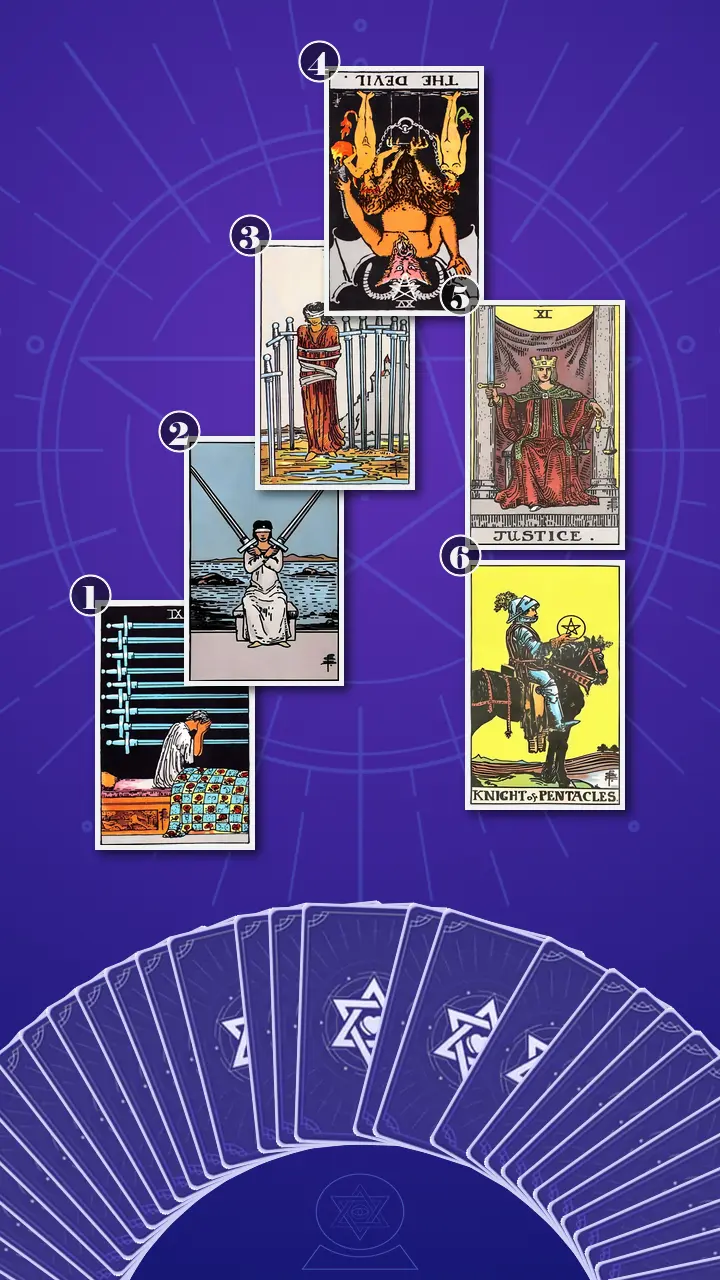
For this reading, I used the Four-Layer Insight Ladder · Context Edition, a custom six-card tarot spread for fellowship decision self-reflection. It fits because Jordan was not simply asking which of two options looked better. They were asking why the same doubt kept returning after research, drafts, conversations, and months of progress. A decision cross would foreground pros and cons, while a past-present-future line might arrange events without showing the mechanism that keeps restarting the question.
This spread moves upward through the visible doubt loop, its reactivation cue, and the belief beneath the crossroads. At the apex, one card reveals the repetition mechanism. Then the path descends through a clarity standard and a grounded experiment. That structure lets me explain how tarot works as a disciplined cognitive mirror: the images give shape to card meanings in context, while Jordan remains the person who evaluates the fellowship's actual fit and chooses what happens next.
I told Jordan that the first card would show the observable pattern, the third would name the belief making uncertainty feel like a cage, the fourth would expose the short-term bargain inside the loop, and the final two would turn insight into evidence and a manageable next step. The cards could clarify how Jordan was deciding. They could not accept or decline the fellowship on Jordan's behalf.
Reading the Map Behind the Doubt
Position 1: The Night Court of the Nine of Swords
Now I turn over the card representing the visible doubt loop, the observable cycle of rumination, comparison, reassurance-seeking, and delayed response. It is the Nine of Swords, in upright position.
In the Rider-Waite-Smith image, the figure covers their face while nine swords line the darkness behind them. I read the Air here as excess: thought has become so loud that repetition begins to impersonate evidence. At 11:38 p.m., the fellowship portal is open on Jordan's laptop, but the practical work is finished. They reread one sentence, imagine five versions of future regret, and feel their chest tighten. No new fact has arrived, yet the mind's activity makes the question seem newly urgent.
This is the browser-history-as-courtroom feeling of late-night career research, where every hypothetical consequence is submitted as evidence. The card does not say the fellowship is wrong. It shows how mental replay can turn a hard-won career path into an internal tribunal. I asked, "What is one fact you know, and what consequence are you only rehearsing?"
A small, bitter laugh escaped Jordan. "That is painfully accurate. It is almost cruel. I finish the actual task and then treat the fact that I am still thinking about it as a new warning." Their fingers stopped above the trackpad, and they looked at the cold tea instead of the alumni tabs.
I let the laugh stand without trying to make it inspirational. "The card is describing an experience of thought, not issuing a sentence about your future. Recurring doubt is already a pattern worth examining, but repetition alone does not make it reliable evidence." I could feel the first defensive layer loosen, just enough for us to continue.
Position 2: The Guarded Gatekeeper of the Two of Swords
Now I turn over the card representing the reactivation cue, the moment progress makes the fellowship feel real, consequential, or difficult to revise. It is the Two of Swords, in upright position.
The blindfold and crossed swords show guarded neutrality. The energy is blocked, not because Jordan lacks intelligence or options, but because they are holding every route at equal distance until every variable can be resolved. After the fellowship deadline email arrived, Jordan kept the fellowship and every imagined alternative open in the same Google Sheet. They reread the requirements, equalized the pros and cons, and left the response unsent. Choosing one column as preferred would make responsibility feel real.
I pointed to the still water beneath the figure and said, "This is not only a choice between options. It is a choice about whether you are allowed to have a preference before uncertainty disappears." I asked, "What happened the last time the fellowship started to feel tangible? Was it the deadline, the money question, or imagining yourself telling people that you chose it? What did your body and browser do next?"
Jordan's thumb moved toward their phone, then stopped. Their shoulders rose a fraction, as if bracing for another request to produce a perfect answer. "The moment I can picture committing, I make both paths equally defensible again," they said. "Then I call that fairness."
I nodded. "We can call it protection without shaming it. The stalemate briefly keeps you from feeling exposed, but it also prevents either path from giving you lived information. A spreadsheet can organize uncertainty; it cannot choose a value for you."
Position 3: The Cage Made of Eight of Swords
Now I turn over the card representing the belief beneath the crossroads, the limiting belief that turns doubt into a judgment about worth, judgment, or control. It is the Eight of Swords, in upright position.
The figure is blindfolded and loosely bound, surrounded by swords, with a castle visible beyond them. The energy is restriction experienced as total. Jordan has real questions about time, money, workload, and the shape of the fellowship, but those constraints have fused with a second conclusion: "If I choose this and later question it, everyone will know I cannot trust myself." The visible commitment is real. The permanent identity verdict attached to it is an interpretation.
This is where I used my Shadow Path Analysis. I looked for the fear-based subconscious logic beneath the pause, not to label Jordan or prove that every concern was conditioning. The logic sounded like this: if certainty is absent, action is unsafe; if action later needs revision, the original choice exposes a lack of worth and control; therefore, more analysis must come before ownership. That chain can feel rational while quietly making movement impossible.
I placed the fellowship email beside the untouched draft response and said, "The deadline is real. The permanent verdict I am attaching to it is a conclusion." I let the difference remain visible between an actual requirement and the imagined sentence about who Jordan would be if they chose imperfectly.
I saw three small reactions arrive in sequence. First, Jordan's breath paused and their fingers tightened around the pen. Then their eyes went unfocused, as though they were replaying the deadline email, the budget questions, and every confident LinkedIn update at once. Finally, their hand opened, the pen rolled onto the table, and a long breath moved out of their chest. "I have been treating the choice more like a worth test than a career decision," they said. The room was quiet, and I did not rush to fill it.
I asked, "Which constraint can you point to and measure, and which one is an imagined judgment waiting for you at the end of the road? You do not have to answer both today. You only have to stop giving them the same name."
Position 4: The Loose Chain of The Devil Reversed
Now I turn over the card representing the repetition mechanism, the protective bargain in which returning doubt offers short-term control while preventing lived information. It is The Devil, in reversed position.
I do not read this card as a threat, an external force, or a prediction. In this position, the reversed energy is a blockage beginning to loosen because the bargain has become visible. After a positive fellowship conversation, Jordan feels a brief surge of pride, then opens comparison tabs and drafts a withdrawal message. The search promises control. Ten minutes later, the same question returns before the browser has even cooled down.
"More tabs can lower anxiety for ten minutes and leave the decision untouched," I said. "One more answer will settle this. Then another alert appears. Why do you need the answer again ten minutes later?" The loose chains in the image gave us a concrete analogy: the connection to the loop is strong, but it is not invisible or beyond examination.
As I studied the card, I remembered something I had learned while traveling across cultures: a rule can sound like neutral common sense simply because it is repeated in a familiar voice. My Jungian lens asks whose voice is saying, "A meaningful path must feel certain," and whose voice is saying, "If you question it later, you will be exposed." That is not an argument against ambition, responsibility, or practical research. It is an invitation to distinguish an inherited pseudo-expectation from an authentic desire.
Jordan glanced at their phone. "The search is part of the loop," they said. Their thumb hovered over LinkedIn, and then they turned the phone face down. I told them, "Not every concern should be dismissed. We are looking for the point where research stops producing facts and starts postponing experience."
When Justice Took the Decision Off Trial
Position 5: Justice, the Clarity Standard
The room grew still as I reached the card representing the clarity standard, the principle that can separate evidence, values, and fear without having the cards or another person decide the fellowship question. It was Justice, in upright position.
The scales are level. The sword is upright. The figure looks directly ahead between two gray pillars. The energy has changed from Air in overdrive to Air organized by fair criteria. Justice does not demand a yes or no, and it does not reward Jordan for having worked hard by requiring them to continue. It asks for an honest appraisal of the fellowship's concrete commitments, practical demands, values fit, feared consequences, and unresolved questions.
This is where I brought in my signature method, Authentic Desire Decoding. I asked Jordan to strip away the inherited societal and parental pseudo-expectations that can cling to a macro career choice, such as the need to look impressive, prove competence, or make one clean decision that explains an entire identity. Then I asked what remained when those voices became quieter: the kind of learning, work, community, autonomy, and contribution Jordan actually wanted to experience. The goal was not to find a pure desire untouched by context. It was to reveal which motives were truly theirs and which had been mistaken for instructions.
I brought us back to the kitchen table from the opening scene. At 11:38 p.m., Jordan sat with the fellowship portal open, a cold mug beside the laptop, and three alumni tabs glowing. They had done the work, yet their chest tightened as one more comparison turned a hard-won route into a verdict about who they were.
Stop treating the return of doubt as a verdict that cancels the work you have done; weigh the fellowship path's real evidence and your chosen values with Justice's scales, then let one grounded step rather than perfect certainty inform clarity.
For a beat, Jordan's hand froze above the notebook and their breath stopped just below the collarbone. Their eyes widened, then lost focus as the last week seemed to replay on a silent screen: the deadline email, the alumni tabs, the unsent draft, and the friend's reassuring voice. Their fingers tightened around the pen, released it, and rested flat on the table. The radiator clicked, and no catastrophe followed. A flush gathered at the corners of their eyes, not because the card had delivered a prediction, but because doubt no longer had to carry the whole decision alone. When Jordan spoke, their voice was low and unsteady. "I can weigh this without putting myself on trial." Relief reached their shoulders first, followed by a small, dizzy blankness. A fair process meant responsibility was still theirs. I let that vulnerability stay in the room.
I asked, "Now, use this new perspective to revisit last week. Was there a moment when this insight could have made you feel different?" Jordan named the positive fellowship call that had been followed almost immediately by a withdrawal draft. They could now see the call as one piece of information, the fear as another, and neither as the entire truth.
This was the first meaningful crossing in the emotional transformation: from contracted rumination to balanced discernment, from doubt-as-verdict to doubt-as-information. Clarity is not the absence of doubt; it is knowing what gets to count as evidence. Jordan did not become certain in that chair. They became more able to judge fairly without turning uncertainty into a judgment of personal worth.
Position 6: The Knight of Pentacles and the Ground Beneath the Map
Now I turn over the card representing the grounded experiment, the practical action and integration point that lets Jordan learn from behavior instead of repeating more hypothetical analysis. It is the Knight of Pentacles, in upright position.
The horse is still, the pentacle is held carefully at eye level, and the cultivated field is orderly beneath the figure. After the Swords, this is a deliberate movement into Earth. The Knight does not promise that one task will predict the whole fellowship or erase every uneasy feeling. The card suggests a careful action with a clear endpoint: update the budget with actual numbers, confirm one practical commitment, or schedule one specific conversation with the fellowship contact.
I said, "Let one lived step teach you what another hypothetical cannot. You can complete one task and still keep the right to reassess after new information arrives. A bounded commitment is not a permanent identity sentence." Jordan wrote one line in the notebook: "Ask about review points and actual time away from work." Their shoulders were not completely relaxed, but the line was visible, specific, and theirs.
I asked, "What can you complete this week in fifteen to twenty-five minutes that would teach you something without deciding your entire future?" Jordan did not ask me to choose the answer. They circled the budget check and placed a small mark beside Friday.
A Decision Record, Not a Life Sentence
I gathered the cards into one story. Months of effort had made the fellowship more than an opportunity; it had become a map of the capable person Jordan had worked to become. Each milestone made that map feel more permanent, and each peer comparison supplied another polished route to inspect. The Nine of Swords turned the map into a courtroom, the Two of Swords kept every route equally defended, and the Eight of Swords added the invisible rule that one wrong turn would prove Jordan could not trust their own judgment. The Devil reversed showed how comparison and reassurance briefly soothed the pressure while keeping the loop alive. Justice offered a fair standard, and the Knight of Pentacles gave that standard somewhere to land.
The cognitive blind spot was not that Jordan cared too much or had chosen badly. It was treating the recurrence of a thought as proof of the thought's accuracy. The same doubt returned after every milestone, but Jordan had been promoting its repetition to fresh evidence instead of asking what triggered it, what relief it promised, and whether it created any new information. The key shift is practical: test recurring doubt against written values, observable evidence, and one bounded next step.
I explained that this is the value of a custom six-card Four-Layer Insight Ladder tarot spread for fellowship decision self-reflection. It does not predict whether Jordan should accept the fellowship. It makes the decision process observable enough to examine. The cards gave us a language for rumination, stalemate, perceived entrapment, the certainty bargain, fair discernment, and grounded follow-through. Jordan remained the author of the choice, and therefore the person with the authority to revise it when reality supplied new information.
For actionable advice, I kept the next steps small enough to begin during a demanding Toronto workweek. I offered my Persona Detox Protocol as a three-day experiment, not an assignment or a test of discipline. Its purpose was to separate what Jordan thought they should want from what they actually desired, so the inner compass could be recalibrated before more outside opinions entered the room.
- Make a Justice decision recordBy Wednesday, spend ten minutes in a notes app or on paper writing three criteria that genuinely matter, then create four labels: Evidence, Values, Fear, and Unresolved Question. Before reading another alumni story, place each concern in one category. For the next three evenings, add five minutes of my Persona Detox Protocol: write what you think you should want, then what you actually desire, without showing it to anyone.Implementation tip: write "provisional" at the top and revise the weighting once, not every time a new fear appears.
- Run one bounded fellowship experimentBy Friday, choose one fifteen-to-twenty-five-minute task with a clear endpoint: update the fellowship budget with actual numbers, confirm one concrete commitment, or schedule one specific conversation with the fellowship contact. When it is done, write two lines: "What did this action show me?" and "What did it not answer?"Implementation tip: completing one task does not obligate you to the entire path. Let the action create lived-fit evidence, then review it at a named time.
- Use a twenty-minute doubt delayFor one week, when the urge to open comparison posts, alumni pages, or an iMessage reassurance thread appears, write the returning doubt in one sentence and note the relief you expect from searching. Wait twenty minutes before checking or messaging, then choose freely among verifying one specific fact, taking the bounded action, or doing nothing for now.Implementation tip: set a timer and close the extra tabs. If the pause feels too activating, stop; the boundary is an invitation to observe the loop, not a requirement to override your needs.
None of these steps asks Jordan to silence fear, perform confidence, or make an irreversible declaration. They ask for a fair record, a small amount of honest desire-decoding, and one reliable data point from real life. That is how analysis can return to its proper role: supporting judgment instead of replacing it.

The First Quiet Proof
Six days later, I received an iMessage from Jordan while I was making coffee. They had updated the fellowship budget using actual numbers, written down three criteria, and sent one specific question about workload and review points. The reply had not solved the entire decision. It had answered something real, which felt different from collecting another stranger's opinion online.
Jordan wrote, "I still have the question, but it is not expanding every time I look at it. I can tell you what is a fact, what is fear, and what I need to learn next." I read the message twice. The language was not triumphant. It was steadier, and steadiness was the evidence we had been looking for.
That night, Jordan slept through. In the morning, their first thought was still, "What if I am wrong?" They smiled, opened the budget, and sent one clarification email. The plan was clearer but fragile, and the doubt remained; it simply no longer held the send button.
Ownership, Not Certainty
I call that a Journey to Clarity because we did not manufacture a perfect feeling. We changed the relationship between the feeling and the choice. The tarot images made the pattern easier to see, my Jungian lens helped name the fear beneath it, and Jordan supplied the values, evidence, and action. The querent, not the cards, remained the author of the next chapter.
When a hard-won path becomes real, your chest can tighten because you are trying to trust your effort and protect yourself from the shame of choosing wrongly at the same time.
If your next fellowship-related step could be a small piece of lived-fit evidence rather than a verdict on your judgment, what might you be curious enough to notice this week, before one more browser tab gets to act as judge?