Changing “I led” to “we helped”—Then Leaving Both Roles Named

When Team Credit Became Self-Erasure
If your role rewards teamwork but reviews demand individual impact, I may already know the exact edit that makes launch week hurt: “I led” becomes “we helped.” At 8:47 p.m. on a Tuesday, Jordan joined my video session from a Toronto condo kitchen. The radiator clicked behind them; cold coffee left a bitter film on their tongue; their phone had warmed their palm from scrolling through the Slack launch channel. A celebratory post tagged the director and designer. Jordan reopened Google Docs version history and hovered over the sentence they had changed from “Jordan developed the messaging framework” to “the team developed the messaging framework.” Their throat tightened. Their breath rose no farther than their collarbones. “I want everyone included,” they told me, “but I don’t want inclusion to require my disappearance.”
Jordan described the resentment as a hot coin lodged beneath their tongue: too sharp to swallow, yet somehow impossible to speak around. They wanted to share credit fairly, but every attempt to prove their generosity made their own contribution less visible. “By the time I’m angry,” they said, pressing both hands around the coffee mug, “I’ve already told everyone I’m fine.”
“I don’t think wanting an accurate record makes you petty,” I said. “You are trying to protect collaboration and belonging. We’re going to examine where that protection turns into self-erasure, then find a way to preserve both your work and everyone else’s.” I let the radiator fill the brief silence. “Shared success does not require blurred authorship. Let’s draw a map through this fog and find the next sentence you can actually use.”

Choosing a Map for the Credit Table
I invited Jordan to take one slower breath and hold the consultation question in mind: “Why do I keep sharing credit until my contribution disappears?” I shuffled without theatrics. The physical rhythm was simply a transition, a way to move from replaying Slack notifications to examining one pattern at a time.
I chose the five-card Relationship Spread · Context Edition. This is how tarot works in my practice: the cards do not expose coworkers’ secret motives or predict whether a manager will grant recognition. They create a structured surface on which behavior, evidence, fears, and choices can be separated. This spread suited workplace self-advocacy because the problem lived inside an exchange: what Jordan said about their work, what the observable record communicated back, and how those two things reinforced each other.
I explained the map for the reader as I laid it out. The first position would show Jordan’s contribution stance. The center would reveal the Mutual Deprivation Loop between generous praise and silent expectations. The upper card would identify the belief pressing on the exchange, while the final card would offer a repeatable credit-negotiation experiment rather than a guaranteed outcome. On the table, the cross looked like a negotiation desk with unspoken tension above it and a written agreement waiting below.
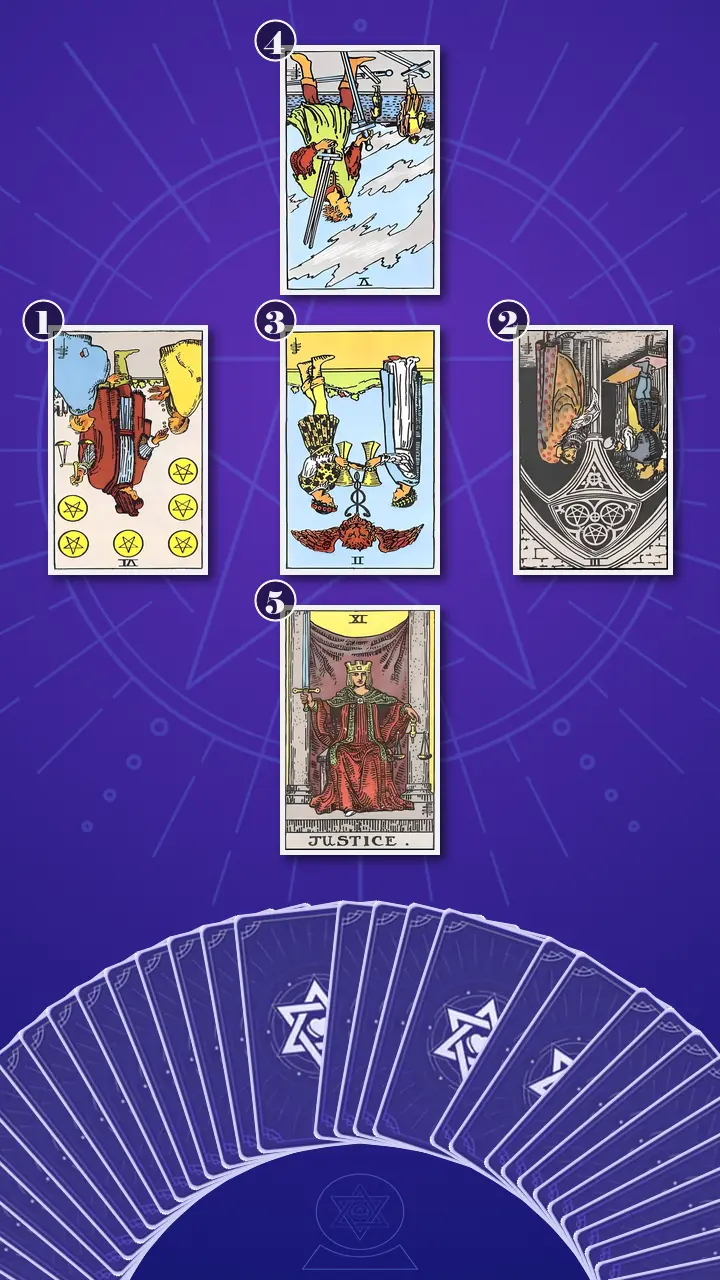
The Scales Jordan Tilted Against Themself
Position One: The Hand That Distributed the Credit
The card I turned over now represented Jordan’s contribution stance: the concrete habit of over-distributing credit and reducing specific ownership in order to appear generous. It was the Six of Pentacles, reversed.
I pointed to the figure who ordinarily holds the scales while distributing coins. “You are not powerless in this image,” I said. “You often control the recap wording. You have the drafts, approval threads, research notes, and calendar history needed to name each person’s role. But the scale reverses against you. ‘I developed the messaging framework’ becomes ‘we all helped with messaging.’ The immediate relief is the last coin leaving your hand. The next morning’s Slack omission is the material result: nobody can attribute work that the shared record no longer names.”
I read the reversal as an excess of giving paired with a deficiency in receiving, not as a warning that Jordan should stop acknowledging collaborators. The imbalance came from treating identical credit as the only moral form of teamwork, even when the roles were materially different. It was like setting every track in a team mix to full volume except their own, then wondering why nobody could hear the part they recorded.
I wrote down the sequence Jordan had described: “I want to be fair. I should add everyone. Naming my part feels selfish. Why am I invisible again?”
Jordan gave one short laugh, but there was no amusement in it. Their fingers tightened around the mug, their gaze dropped to the reversed scales, and then their shoulders sank. “That’s so accurate it’s almost cruel,” they said. I shook my head gently. “The card isn’t accusing you. It’s showing that generosity needs proportion, or it stops being fair to the giver as well as the group.”
Position Two: A Polished Deck With No Credits
The card I turned over now represented the observable response in the credit-sharing environment: documented wording, repeated communication cues, and role ambiguity that could be verified without claiming to know coworkers’ private motives. It was the Three of Pentacles, reversed.
I asked Jordan to picture the launch deck projected in the glass meeting room. The research synthesis, positioning, writing, design, and rollout work were all visible, yet the recap connected none of those crafts to their owners. A manager could see a polished collective result but could not verify that Jordan built the messaging architecture because the document said only “the team.” Like the institutional split in Severance, the finished output was highly visible while the individual human effort behind it had become strangely detached.
“The observable response doesn’t require a villain,” I said. “Coworkers may repeat vague language because vague language is the record available to them.” I read this reversal as a blockage between craftsmanship and attribution. The skill existed. The work existed. The authorship had fallen out of the blueprint.
“You are not failing to do valuable work; you are editing the evidence out of the record.”
Jordan’s mouth opened, then closed. They looked toward another browser tab where their performance-review form waited. “My manager keeps asking for individual impact,” they said. “I thought I needed better examples.” I watched their thumb move once across the mug’s rim. “You may already have the examples,” I replied. “The missing piece is the sentence that connects your name to them.”
Position Three: The Recognition Bargain Nobody Signed
The card I turned over now represented the Mutual Deprivation Loop itself: how over-giving, silent expectations, vague attribution, and disappointed reciprocity reinforced one another. It was the Two of Cups, reversed.
I described the Friday scene Jordan had mentioned. At 4:58 p.m. in a downtown coworking lounge, the espresso machine hissed while they posted detailed praise for a designer and an analyst. Jordan refreshed the thread, hoping someone would name the launch narrative they had created. Only celebration reactions and broad team praise appeared. I did not interpret that as deliberate withholding. Jordan had clearly labeled everyone else’s cup while leaving the label off their own.
The reversal showed misalignment in reciprocity. Jordan was operating an unspoken API contract: send named recognition outward, then wait for the missing return field to populate on its own. “If I recognize them generously, they’ll know how to recognize me,” I said, reflecting the rule back to them. “But unspoken recognition is an agreement nobody else knows they made.”
Jordan’s breath paused. Their finger stopped halfway to the trackpad; their eyes drifted away from the screen as if they were replaying the Slack thread; then a low exhale left their chest. “I never actually asked,” they said. “I just thought fair people would notice.”
“That hope makes sense,” I replied. “But when you remove the evidence and wait for someone to reconstruct it, both sides lose information. You lose visible authorship. Your colleagues lose the chance to respond to a need that has been stated clearly.”
Position Four: The Conflict That Followed Jordan Home
The card I turned over now represented the central challenge beneath the pattern: the belief that accurate self-attribution would create conflict, selfishness, or loss of belonging. It was the Five of Swords, reversed.
I brought Jordan back to a hybrid meeting. A senior colleague had said, “We came up with this direction,” while Jordan’s messaging framework filled the projector screen. Jordan had pressed both palms into the cold table and heard two thoughts collide: “That isn’t accurate” and “Correcting it will make me the aggressor.” The agenda moved on. The disagreement did not. It traveled home in their locked jaw, tapping foot, and the imaginary responses they rehearsed after the facts were no longer fresh.
I read the reversed Sword as blocked air: precise language turned inward. Jordan was treating a factual distinction as if it must produce a winner and a loser. “Accuracy is not aggression,” I said. “A ten-second clarification can preserve two roles at once: ‘For accuracy, I developed the messaging framework from the interviews, and Priya shaped the rollout plan.’ Nobody has to be diminished for that record to be correct.”
The spread contained no Wands, no automatic fire of initiation. I told Jordan that the missing fire did not mean they lacked courage. It meant the pattern would not change through more private analysis alone. One timely sentence, delivered while the details were verifiable, could supply the initiative the spread lacked.
Jordan’s jaw tightened before it released. “Saying that out loud makes my skin prickle,” they said. “But it doesn’t actually insult Priya.”
“Exactly,” I replied. “Your body can register unfamiliar exposure without becoming a reliable judge of whether the statement is fair.”
When Justice Put Both Names on the Scale
Position Five: The Fair Witness at the Review Table
The final card I turned over represented a repeatable credit-negotiation experiment: using evidence and contribution-specific language to acknowledge collaboration without deleting individual ownership. The room seemed to narrow around the card as Justice, upright, appeared between its pillars.
I placed my finger near the level scales and then the upright sword. I read this as balance made practical. The scales did not give everyone identical weight; they held different contributions in proportion. The sword was the precise ownership verb that kept the account clear. In Jordan’s working life, Justice looked like entering a manager one-to-one with a short contribution log and saying, “I led the customer research synthesis and messaging framework; Priya developed the rollout plan; together we delivered the launch on schedule.”
Justice also activated a diagnostic lens I call Career Cycle Phase Identification. Before telling someone to work harder, I separate three possibilities: a skill gap, an organization-wide or industry-wide contraction, and a visibility bottleneck. Tarot cannot establish a company’s budget cycle or labor-market conditions, so I said plainly that those required observable evidence such as hiring plans, scope changes, and leadership decisions. But Jordan’s drafts proved that the strategic skill and completed work already existed. The immediate bottleneck was that the shared record no longer connected their name to the skill.
I thought of the planetary charts I had studied over the previous decade. A careful reading never blames a person for an entire season of contraction, but it also never asks them to surrender the small course corrections still available. Justice offered that distinction: Jordan did not control every organizational orbit, yet they did control whether an accurate sentence remained in the document.
I brought Jordan back to 8:47 p.m.: celebration reactions were gathering beneath the launch post while version history still preserved the accurate sentence they had softened. Their shoulders had sunk because everyone was repeating the collective wording they created, even though part of them had hoped the team would somehow see through it.
Fair credit is not selfish scorekeeping; it is accurate accountability, and Justice's scales can hold both your contribution and theirs without erasing either.
Through Jordan’s microphone, the radiator clicked once and fell silent.
Jordan’s breath stopped. Their index finger, still resting against the warm mug, went motionless. For a second they stared beyond the card, and I watched their eyes lose focus as the version history, the Slack post, and the meeting room seemed to replay behind them. Their eyebrows drew together before their eyes reddened. “But doesn’t that mean I’ve been doing this to myself?” they said, sharper than before. “Was I wrong all this time?” I let the anger have room. “It means you found a strategy that protected belonging in the moment and charged you later,” I said. “That is not a character flaw. It is a pattern you can update.” Their hand tightened once, then opened flat on the table. Their shoulders dropped, but the relief left them briefly unsteady, as if putting down a heavy bag had revealed how tired their arm was. The next breath arrived with a tremor. “Okay,” they said. “Then I need a record.”
“Now, using this new perspective, think back to last week,” I said. “Was there a moment when this insight could have changed how you felt?” Jordan returned to the glass meeting room. “When he said ‘we came up with it,’ I could have made the distinction without accusing him of anything,” they replied. “I could have named my framework and Priya’s rollout plan in the same breath.”
I invited Jordan to set a ten-minute timer and open one recent recap. They drafted three private lines: “I led X. They contributed Y. Together we achieved Z.” I asked them to add one evidence link if it was readily available. They did not have to send anything during our session, and they could stop if the exercise felt too exposed. The minimum version was filling in X.
This was not a prediction of effortless recognition. It was the first move in a deeper emotional transformation: from resentful self-erasure and silent bids for recognition to evidence-based self-advocacy and proportionate credit. Jordan was moving from waiting to be discovered toward becoming a fair witness to their own work.
Receipts Before Resentment
I read the full spread as one connected workplace story. The past remained visible in Google Docs version history: accurate authorship had existed before fear softened it. The Six of Pentacles showed Jordan weighting generosity against themself. The Three of Pentacles showed the resulting record, polished but unable to connect craft with contributor. The Two of Cups revealed the silent hope that specific recognition would return without being requested. The Five of Swords exposed why Jordan stayed quiet: they had confused role clarity with interpersonal combat. Justice supplied the resource that had been missing, a factual standard strong enough to hold both individual ownership and shared success.
The cognitive blind spot was not simply “I need more confidence.” Jordan had been treating the physical discomfort of self-attribution as evidence that the attribution was unethical. They were also expecting other people to recover information Jordan had deliberately removed. The transformation direction was narrower and more practical: replace blanket “we” language with contribution-specific sentences that distinguish who led, who contributed, and what the group achieved.
I gave Jordan three small experiments, each designed to produce information rather than demand a personality transplant.
- The Fair Witness Contribution LogOn Monday morning, open Notion, Google Sheets, or a notes app and create five columns: project, deliverable, what I led, what others contributed, and evidence link. Spend ten minutes adding only the most recent launch. For the next 30 days, use my Micro-Orbit Observation alongside it: note factual “blueshifts,” such as a manager requesting your input or naming your expertise, and “redshifts,” such as repeated role omissions, shrinking scope, or broader budget signals. This separates your attribution habit from organizational conditions instead of blaming you for both.Keep receipts, not resentment. The minimum version is one deliverable and one evidence link in two minutes; this is role clarity, not a leaderboard.
- The Three-Part Attribution CheckBefore the next status update, write three separate sentences: “I led X.” “Avery contributed Y.” “Together we achieved Z.” Read them aloud once, then ask one trusted colleague in a 15-minute chat whether the wording accurately reflects the facts.Invite factual corrections, not a vote on whether you deserve credit. If a sentence feels selfish, check its accuracy before obeying the feeling.
- The 48-Hour Record RepairWithin 48 hours of the next milestone, review the shared recap and correct one vague ownership sentence in Google Docs or by private Slack message. Save this template: “Small attribution note for accuracy: I led X, Sam contributed Y, and we partnered on Z.”If speaking live makes your throat close, send the written version. The smallest action is one document comment while the details are still verifiable.
I reminded Jordan that these actions could improve the record without guaranteeing a promotion, praise, or a particular response. If accurate clarification triggered retaliation or materially affected compensation, they could preserve evidence and seek context-specific support from a manager, mentor, HR or union representative, or employment adviser. Justice asks for proportion, including proportion in how much risk one person should carry alone.

A Week Later, One Sentence Stayed Named
Six days later, I received a message from Jordan. After a product milestone, they had found a recap sentence that said the team had developed the revised narrative. Their throat tightened, so they used the saved template instead of reopening the argument in their head: “Small attribution note for accuracy: I led the narrative revision from customer interviews, Priya shaped rollout, and we partnered on launch delivery.”
The author accepted the edit and replied, “Helpful distinction, thanks.” Jordan did not describe it as a dramatic victory. What mattered was that the sentence remained in the shared document with both names intact. For the first time, their private evidence and the public record told the same story.
That night Jordan slept through until morning. Their first thought was still, “What if that sounded like too much?” This time, they laughed softly, opened the recap, and left the accurate sentence untouched.
I did not see tarot hand Jordan recognition. I saw it give structure to facts, fears, and choices that had become tangled together. Jordan supplied the missing fire by making the edit. Their Journey to Clarity was not a move from discomfort to perfect certainty; it was a move from letting discomfort write the record to letting evidence do it.
When your throat tightens over one accurate ownership sentence, it can feel as though belonging depends on making your work smaller before anyone else gets the chance to reject it. Simply noticing that bargain means the scales have already begun to move.
So, if collaboration did not require invisibility, what is one recent contribution you could leave in the owner field this week, with Justice’s scales holding both your name and theirs?