At 11:40 p.m., Twelve Tabs Gave Way to One Career-Fit Test

The 11:40 p.m. Career Pivot Spiral
I have seen one flat Tuesday and one former coworker’s promotion post turn ordinary dissatisfaction into a full night of Career Pivot Anxiety. The polished LinkedIn carousel lands; suddenly, a private question feels like a public deadline.
When Alex joined my video call from their Toronto apartment, it was 11:40 p.m. Cold tea sat beside the trackpad while twelve tabs glowed across their face: unrelated jobs, certificate programs, career quizzes, and a spreadsheet called New Plan. The laptop fan hummed, a streetcar bell cut through the window, and their fingers kept tapping.
“I just need to pick something and move,” Alex said. “If I slow down, I’ll lose another year. But I want the answer before I’ve done the experiment.” The urgency seemed to tug their whole body forward like a rideshare whose destination kept changing while the car was already moving.
I did not tell Alex to quit, stay, trust fate, or wait for a perfect calling. I said, “You want a career direction that genuinely fits, but slowing down feels like proof that you’re failing to progress. Let’s make that conflict visible. We’re not asking the cards to choose a career for you. We’re using them to draw a map of what happens between the trigger and the click.”
Choosing the Compass: The Five-Card Shadow Spread
I asked Alex to close the checkout and job-board tabs, place both feet on the floor, and take one unforced breath. I shuffled slowly while they held a single question in mind: “Why do I keep rushing a career pivot before I know what fits?” The small ritual was a transition of attention, not a performance of mysticism.
For anyone wondering how tarot works in a career reading, I use the cards as a structured mirror. Through a Jungian psychological lens, an image can externalize a pattern that is difficult to examine while it is racing around inside us. A card does not prove what will happen. It gives intuition and logic a shared object to investigate.
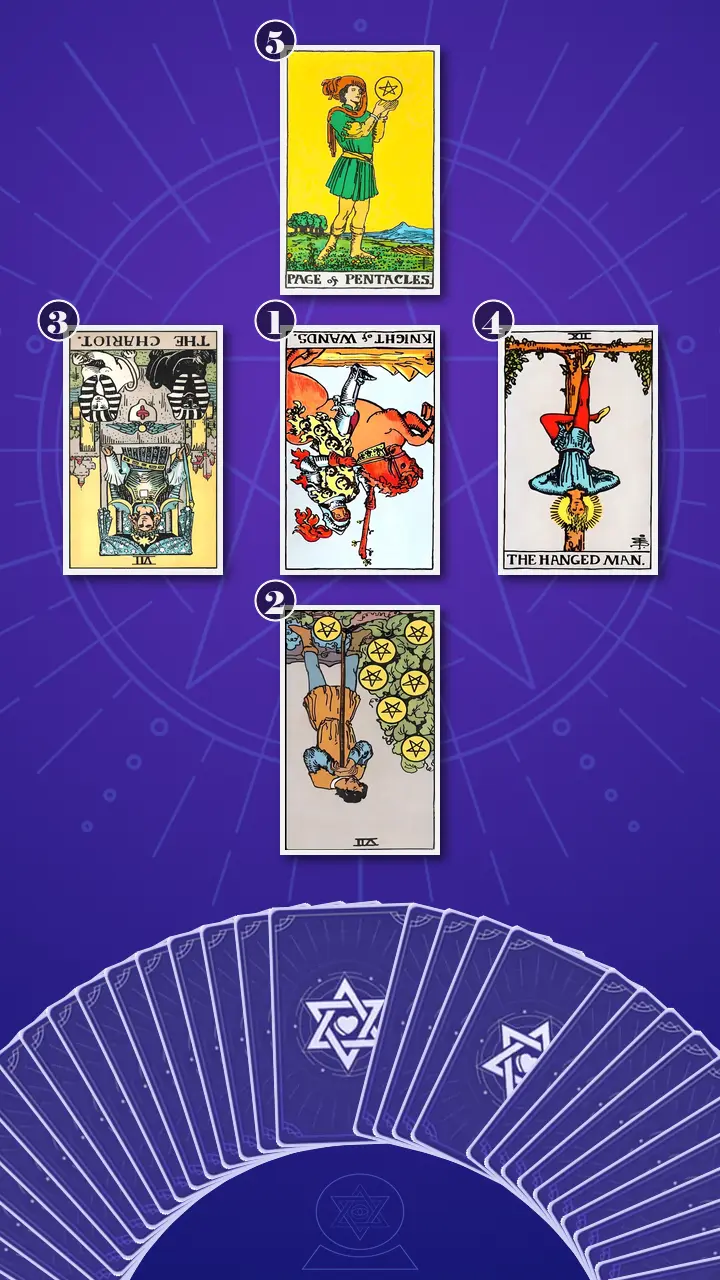
I chose the five-card Shadow Spread because Alex’s question was not primarily, “Which job should I take?” It was, “What keeps recreating this rush?” The spread was precise enough to follow one loop without adding the unnecessary layers of a larger Celtic Cross: the visible behavior, its hidden root, the protection it provides, the quality that can interrupt it, and the practical action that can embody a new response.
I placed the first card at the center for the current pattern, the second below it for the buried belief, and the third to the left for the pattern’s protective function. The fourth would sit to the right as the capacity Alex could reclaim. The fifth would rise above the center as an embodied next step. On the table, the layout resembled a plant in cross-section: root below, pressure around the stem, and a bloom that had to be supported rather than pulled open.
Reading the Pattern Beneath the Progress Panic
Position 1: The Horse Already in Motion
The first card I turned over represented the current behavioral expression of Forced Progress: the rush into applications, courses, and identity changes before career fit has been defined. It was the Knight of Wands, reversed.
I pointed to the horse caught in a forward surge and the wand already raised. “This is a body committed to motion before the destination is stable,” I said. “In your life, it’s the sequence from bad meeting to warm laptop to four unrelated listings, a LinkedIn headline edit, and a course checkout page. The actions create the visual texture of progress, but they aren’t testing the same fit hypothesis.”
The Knight’s Fire was not deficient in ambition. It was excessive in acceleration and blocked in direction. Alex had plenty of energy for change, but emotional activation was making each new option feel urgent before its ordinary working conditions had been examined. The private script underneath it sounded like: I don’t know whether I want this, but at least sending it means I’m moving.
Alex gave a short, bitter laugh. Their hand left the trackpad and folded under the other arm. “That is too accurate. Almost rude, honestly.”
I smiled without softening the point. “The card isn’t criticizing your ambition. It’s separating intensity from direction. Your drive is real. The question is whether tonight’s action produces useful evidence or only ten minutes of relief.”
Position 2: The Seed Dug Up Too Soon
The card I opened below the Knight represented the hidden belief beneath the Forced Blooming Trap: that slow cultivation is wasted time and an unfinished answer threatens self-worth. It was the Seven of Pentacles, reversed.
The traditional image shows a worker leaning on a tool and reviewing a crop that has grown but is not ready to harvest. Reversed, that review period can feel intolerable. I connected it to Alex’s abandoned task log: four days of energy notes, one exploratory conversation, no complete verdict, and then a return to salary rankings and accelerated-course pages.
“It’s like digging up a seed because it hasn’t sprouted on your schedule,” I said. “The underlying thought is, If this hasn’t given me a complete answer yet, it must not be working. But an unfinished experiment is not a failed experiment. It may simply contain too few observations to reveal a pattern.”
Here, Earth was blocked by impatience. Alex wanted tangible evidence, which was sensible, but they were demanding identity-level certainty from beginner-level data. Their index finger stopped tracing the edge of the laptop. Their gaze shifted away from the cards as if replaying the moment they had closed that four-day note.
“I called it unproductive,” they said quietly. “But I think I meant that I couldn’t post an answer yet.”
Position 3: A Steering Wheel Gripped Too Hard
The card to the left represented what the rushing pattern was trying to protect or secure: the temporary sense of control created by output, deadlines, and rapid decisions. I turned over The Chariot, reversed.
I showed Alex the black and white sphinxes facing from beneath a rigid charioteer with no visible reins. In their modern-life version of the image, a color-coded 30-day pivot tracker sat beside applications to fields that promised completely different Tuesdays. Higher pay, meaningful work, security, autonomy, creativity, and less stakeholder contact were all present, but none had been ranked.
The Chariot’s willpower was operating in excess while alignment remained deficient. Alex could increase application quotas and tighten a resignation deadline, but force could not decide which competing criterion deserved to steer. “A tighter timeline cannot align criteria you haven’t named,” I said. “It can only make you choose before naming them.”
Their shoulders rose first, almost defensively. Then their breath left in one long stream. “So the plan isn’t making me clear. It’s making me feel supervised.”
I thought of the cities and work cultures I have crossed, each with its own performance of success, and of how portable the fear of looking undecided can be. The costume changes; the shadow of the Driver remains recognizable. I told Alex, “The tracker is doing a job for you. It briefly quiets the fear that you’re falling behind. We don’t need to shame that protection. We need to give it a better assignment.”
When The Hanged Man Stopped the Scroll
Position 4: The Pause That Changes the Question
The room seemed to settle before I opened the card representing the quality Alex could reclaim to interrupt the cycle: a deliberate pause capable of producing a new perspective and more accurate fit evidence. It was The Hanged Man, upright. A streetcar bell sounded once in the distance, and then even the laptop fan seemed quieter.
I drew Alex’s attention to the suspended figure’s calm face, radiant halo, and single foot attached to living wood. “This is not a person stranded by indecision,” I said. “The suspension is chosen. In daily life, it can look like a two-week period with no non-urgent applications, paid course commitments, resignation deadlines, or public identity changes. Observation remains active. Forced commitment pauses.”
At the basic level, I saw Alex caught in the familiar 11:40 p.m. equation: the blank fit-criteria column tightened their jaw, and choosing anything felt less exposing than admitting that the answer still needed evidence.
This was where I used what I call Imposter Syndrome Auditing. I drew a line down a notebook page and separated two ledgers that urgency had merged. On one side sat Alex’s objective competence: three years of professional experience, completed projects, learned skills, and responsibilities other people already trusted them to carry. On the other sat the fear that not knowing the next title would expose them as directionless or less valuable.
“The career-fit question is genuinely unresolved,” I said. “Your competence is not. Speed has been trying to counterfeit proof of worth because those two ledgers were mixed together.”
I put the practical distinction plainly: A pause with a named question is not the absence of progress. It is where you collect the career-fit evidence that urgency keeps deleting.
Rushing is not proof that you are progressing; choose a deliberate suspension, and let The Hanged Man's inverted view reveal what forced motion cannot.
Alex’s inhale stopped. Their fingertips hovered above the trackpad, then slowly curled into their palm. Their eyes lost focus for a moment, as though the last several months were replaying in rapid cuts: a draining meeting, a hot phone on the TTC, a promotion carousel, a checkout page, a new plan. Then their eyebrows pulled together and a flash of anger entered their voice. “But doesn’t that mean I’ve been doing all of this wrong? That I wasted months?” I held the silence for a beat before answering. “No. It means the strategy gave you short-term control and has now reached its limit. Seeing that is evidence, too.” Their fist opened. Their shoulders lowered, and their next exhale trembled between relief and the vertigo of having no instant replacement plan. I asked, “Now, using this new view, think back to last week. Was there a moment when this insight could have made you feel different?”
“After the stakeholder meeting,” Alex said. “I could have asked whether I hate marketing, or whether I hate being in reactive meetings all day. I wouldn’t have needed to make a bootcamp answer that question.”
I nodded. That distinction marked the first crossing from pressured urgency and fear of falling behind toward grounded confidence built on observed career-fit evidence. It was not certainty. It was the willingness to let uncertainty hold information. A pause with a question is still career work.
One Pentacle Instead of Twelve Tabs
Position 5: The Ordinary-Tuesday Test
The final card represented the practical behavior through which Alex could embody the new perspective: one grounded career-fit experiment completed without declaring a total pivot. I turned over the Page of Pentacles, upright.
The Page studies one pentacle at eye level while standing in a cultivated landscape. I read that steady attention as balanced Earth: focused, teachable, and willing to gather tangible evidence. The distant mountain allows ambition to remain, but it does not demand a leap tonight.
“Instead of asking which career you must become,” I said, “choose one hypothesis. Maybe: I could prefer research-heavy work to constant stakeholder coordination. Test it through one 20-minute informational conversation or one free sample task. Then record your energy before and after, the skill you used, and the working condition you noticed. No headline change. No identity announcement. No same-day verdict.”
This was the difference between running a small product beta and rebranding the entire company before anyone had tested the user experience. Alex did not have to become a researcher, strategist, or UX professional to learn whether one part of that work fit them.
“So I’m allowed to be a beginner without turning the experiment into a promise?” they asked.
“Exactly. Test the Tuesday, not the title. Tarot is not naming your destination here. The Page is helping us design a better method for choosing it.”
Alex looked at the single pentacle, then at the row of minimized tabs. Their mouth softened into a small, uncertain smile. I could still see the discomfort of slowing down, but curiosity had entered the room beside it.
The Fit-Before-Fix Path
I gathered the five cards into one story. Alex’s past three years had built real competence, but recurring disappointment had left career fit unresolved. The reversed Knight turned that discomfort into scattered motion. The reversed Seven treated slow evidence as failed evidence. The reversed Chariot then used stricter plans to protect Alex from the shame of appearing stalled. Together, they formed the image of a closed bud being pulled open: substantial effort applied to a process that needed observation as much as force.
The Hanged Man interrupted that sequence by reclaiming deliberate suspension, and the Page of Pentacles converted the pause into one manageable experiment. The blind spot was not a lack of effort. It was the belief that visible movement proved worth while unfinished exploration revealed failure. The transformation direction was therefore specific: replace each immediate pivot decision with a bounded evidence window, then review energy, strengths, and working conditions before making a larger commitment.
I also noted that no Cups or Swords had appeared. I did not treat that absence as an omen. I treated it as a practical prompt: Alex needed to add felt preference and explicit criteria to all that activity. A job could look impressive and still flatten their energy. A sample task could feel awkward because it was new and still reveal an appealing working condition. Body signals were data, not commands; financial constraints, Toronto rent, access, health, and real deadlines still belonged in the decision.
The Next Two Weeks: Small Moves That Produce Evidence
I gave Alex two actions, each deliberately smaller than a career declaration:
- Open an eight-minute Fit-Before-Fix note.The next time career urgency spikes, write one question about daily fit, such as, “Do I want more analytical work, or do I only want relief from this week’s meetings?” Then use my Competence Anchoring Exercise: create two headings, “Evidence I Am Competent” and “Evidence I Still Need About Fit.” Add up to three verifiable achievements or pieces of feedback on the first side and one observation to collect on the second. Place a 48-hour cooling-off boundary around any non-urgent application, paid course, resignation decision, or LinkedIn identity edit.Tip: The minimum version is one achievement, one question, and one observation. A real deadline can be handled as a real deadline; the boundary is for activated, non-urgent commitments.
- Run one Ordinary-Tuesday career beta.Within the next seven to fourteen days, choose one hypothesis and test it through either a 20-minute conversation about someone’s actual workday or a 60- to 90-minute sample task using free material. Immediately afterward, record four lines: energy before, energy after, skill used, and working condition noticed. Do not turn the note into a permanent career verdict that day.Tip: Cap the experiment at two hours and no expensive software. If energy is low, one conversation or a 20-minute sample still produces a valid row of evidence.

A Week Later: One Clean Row of Evidence
A week later, I received Alex’s message: they had closed a course checkout, kept the 48-hour boundary, and booked one 20-minute research call. They slept through the night, woke thinking, “What if I’m wrong?” and smiled before adding one clean row to the fit log.
I did not see a life magically solved by tarot. I saw Alex use a symbolic map to notice their own pattern, test a different response, and reclaim authorship of the next step. Their movement had become slower, but it was finally leaving evidence behind.
When someone else’s promotion makes your leg bounce and your hand reach for a job board, I want you to remember that the hardest part may be feeling that the time required to find a real fit is also the time in which your worth looks hardest to prove. Simply noticing that pressure means LinkedIn’s highlight-reel algorithm is no longer setting your deadline without your consent.
If The Hanged Man’s pause could count as movement in your own career, what single Ordinary-Tuesday question would you carry into a two-week evidence window?