When 'Helped' Replaced 'Led': Naming Quiet Work in a Self-Review

Invisible Labor in a Self-Review on the 504 King
When Maya (name changed for privacy) told me about her commute-home ritual, I knew I was looking at invisible labor getting lost in self-review language. She was a 29-year-old operations manager in Toronto, exactly the kind of person who could untangle a messy launch in real time and still go blank in front of a box labeled key achievements. She described 8:47 p.m. on the 504 King streetcar: Notes app open, phone hot in her palm, fluorescent lights flattening everyone's face, cold air slipping in every time the doors opened. She would type a strong line with her thumb, feel her chest tighten, and then soften it before her stop.
She did the behind-the-scenes work. The panic started when the document asked her to make that work legible. I could almost see the movement in her body as she described it: shoulders folding toward the laptop, jaw setting, breath going shallow, as if a seat belt had locked across her sternum the moment a sentence sounded too direct. Her core contradiction was painfully clear: she was good at doing the invisible work and deeply uncomfortable naming it in a self-review.
"I don't want a gold star," she said. "I just want the work to be seen accurately."
I nodded. A lot of smart people are not bad at self-review; they are bad at translating invisible labor into office language. I told her, "You did the work. The panic starts when the box asks you to name it." Even before I touched the cards, I knew this needed a Five-Card Cross tarot spread for performance review clarity and self-advocacy. Not because tarot was going to hand her a script from the sky, but because it could separate the symptom from the deeper recognition knot underneath it, and help us find that steadier thing she actually wanted: clarity.

Choosing the Compass: A Five-Card Cross for Performance Review Clarity
I asked her to plant both feet on the floor, take one unhurried breath, and hold the review question in mind while I shuffled. That tiny ritual matters to me because it is not about mystique. It is a way of getting the nervous system to stop sprinting long enough for the pattern to become visible.
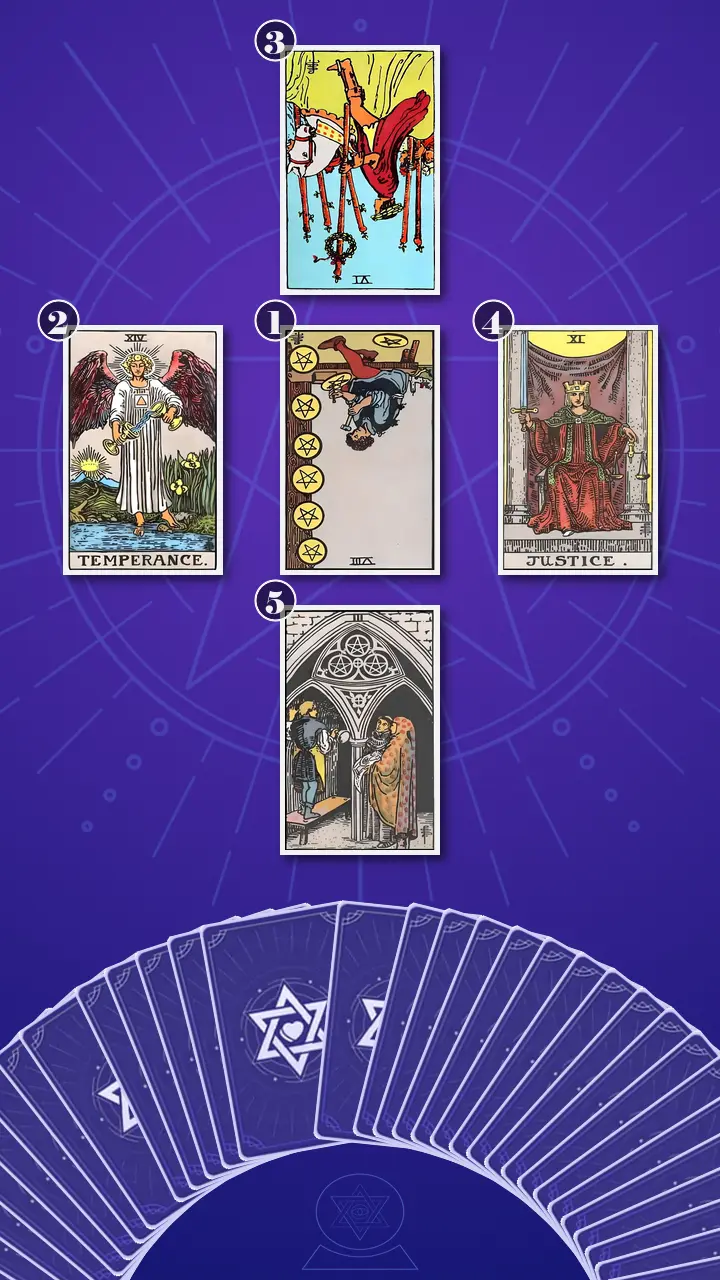
I chose a Five-Card Cross. For a question like this, it is the cleanest structure I know: large enough to hold the full story, small enough to stay precise. A three-card line would have flattened an important distinction between the real value of Maya's quiet work and the fear that naming it would sound arrogant. A larger spread would have added noise. The cross lets the present knot sit in the center while the overlooked strength, the deeper block, the corrective lens, and the practical next step gather around it like directions on a compass.
I told her how I would read it. The center card would show the current symptom: what the deadline was making her do in real time. The card above it would name the root block: the deeper script that made recognition feel risky. The card to the left would reclaim the hidden value sitting underneath the visible output. The card to the right would offer the key reframe, and the card below would show the applied path for writing this review in clear, team-relevant language this week. That is one of the ways tarot works best for me: not as a verdict, but as a map.
Reading the Knot in the Document
Position 1: The Bullet That Kept Getting Smaller
I turned the center card first. This was the card representing the current symptom: how the review deadline was turning skilled work into over-edited, under-described bullet points. The card was the Eight of Pentacles, reversed.
I told her this card felt exactly like that half-finished self-review at 10:14 p.m., when one line gets revised six times while the real story stays blank. Vendor follow-ups, calendar resets, Slack nudges, cleanup work, handoff repair, quiet prevention of a problem before it becomes public drama: all of it is real contribution. But reversed, the Eight of Pentacles shows contracted earth energy. Craft turns inward on itself. Precision stops serving clarity and starts serving self-erasure.
I said, "This is the loop, isn't it? Too strong. Too vague. Safer, I guess." It is the career version of editing an Instagram caption until every interesting word is gone. Maya let out a short laugh with a bitter edge. "That is literally my draft," she said, and then shook her head. Her fingers tightened around her mug, then loosened. Instant recognition. The card was not accusing her of incompetence. It was showing me how her competence had been trapped in tiny fragments.
Position 3: The Tiny LinkedIn Stage in Her Head
Next I moved to the card above the center, the one representing the root block: the fear of recognition and the self-minimizing script that made claiming contribution feel risky. The card was the Six of Wands, reversed.
This is the card that always tells me visibility has become emotionally expensive. In modern work language, it is the moment a smooth rollout ends, someone asks who drove the coordination, and your whole body wants to evaporate before the sentence can start. Reversed, the fire here is not absent. It is blocked. The contribution exists; the ease around being seen with it does not.
Through my Jungian lens, I could feel the deeper pattern immediately. This was not a simple wording problem wearing office clothes. This was a recognition complex. The moment Maya typed a direct verb like led, coordinated, or reset, some old internal judge translated accuracy into exposure. If she said she led it, would people think she was overstating? If she did not say it, no one would know. That is a brutal little double bind.
When I named that, she went quiet. First her jaw shifted. Then her gaze dropped from the card to the table, as if she were watching an entire quarter of half-deleted sentences scroll past. Then came the exhale. "I hate how exposed self-reviews feel," she said softly. The card gave language to something she had been managing with extra composure and over-control.
Position 2: The Skill Hidden Inside the Handoff
Then I moved to the card on the left, the position of hidden value: the real coordinating, balancing, and problem-preventing work sitting underneath the visible output. The card was Temperance, upright.
I smiled the moment I saw it. Temperance is one of the clearest cards for invisible coordination as real contribution. I told her this was the part nobody screenshots for LinkedIn: noticing the timeline will jam, clarifying who owes what in Slack, updating the handoff, chasing the vendor email, preventing duplicate work, and quietly preserving trust between teams. Nothing dramatic happens, which is exactly why people mislabel it as "just support." In reality, it is the ops version of air-traffic control. If you do it well, nobody notices how many collisions did not happen.
Energetically, this card is balance restored. It is flow between moving parts. One foot on land, one in water; one hand in the measurable, one in the human mess of timing, personalities, and competing priorities. In my own mind, I had a quick flash of what I call Authority Archetype Integration: she was already functioning like the person who sets the standard and stabilizes the system, but her language still belonged to someone asking permission to matter.
I told her, "If the team moved smoother because of you, that is not background noise. That is contribution." She looked back up fast, almost startled. Then came the pause I was hoping for. "Wait," she said, "that does count." Her shoulders dropped a fraction. It was a small shift, but an important one: from I was just keeping things moving to actually I was stabilizing the whole flow.
When Justice Asked for Accuracy, Not Shrinkage
Position 4: The Scale That Changed the Standard
When I turned the fourth card, the atmosphere changed. A sliver of late light caught the printed scales on my desk, and for a second even the room felt more still. This was the key reframe of the reading, the antidote card: the fair standard for turning quiet effort into evidence without inflating it. The card was Justice, upright.
This is one of my favorite cards for career self-advocacy because it removes all the fog. Justice does not ask whether you are likable. Justice asks what is true, what is fair, and what can be named cleanly. In the context of a performance review, its message is simple and radical: stop treating the document like a personality test and start treating it like a record. Less personal brand, more receipts.
I could see Maya still sitting inside that familiar scene: streetcar window blurring with city light, phone warm in her hand, one bullet rewritten for the fifth time because she knew how much smoother the quarter ran because of her and still could not find a version that felt safe to say out loud.
Stop hiding behind "just helping" and put your work on the scales, because Justice asks for accuracy, not shrinkage.
A self-review is not the place to disappear politely. It is the place to leave an accurate trail of what worked better because you were there.
Then I gave her the cleanest flip I know: "Modesty is a tone choice. Minimizing is a data problem." And this is where I brought in one of my own diagnostic tools, what I call an Imposter Syndrome Audit. On one side of Justice's scales, I place the facts: you reset the vendor handoff, chased missing approvals, clarified ownership, and kept launch on schedule. On the other side, I place the exposure script: this is too small, this sounds arrogant, if it mattered someone would have been able to see it without me saying so. One side is evidence. The other is fear translated into tidy office language.
Maya's reaction came in three small waves. First, a freeze: her breath stopped for a beat and her hand hovered over the mug without lifting it. Then the recognition: her eyes lost focus just enough for me to know she was replaying a Teams call, a Google Doc, some line she had deleted to sound safer. Then the release: a long exhale, her shoulders finally dropping, followed by one sharp flicker of resistance. "But if I write it that plainly," she said, almost annoyed, "won't it sound like I'm taking too much credit?" I shook my head. "No. LinkedIn is performance. Justice is version history. Try this instead: I reset the vendor handoff across Product, Finance, and the external partner, which reduced last-minute back-and-forth and kept launch on schedule." I let that land, then asked, "Now, with this lens, think back to last week. Was there a moment when you prevented a mess before anyone else saw it coming?" She nodded slowly. That was the hinge I had been waiting for: one honest step from self-conscious minimization toward evidence-based confidence in naming real contribution.
Position 5: Pulling the Blueprint Out of the Noise
The last card sat below the center, representing the applied path: the concrete structure for writing the self-review in clear, team-relevant language this week. It was the Three of Pentacles, upright.
I loved this as the landing point. The Three of Pentacles takes solitary effort and places it inside a shared build. Instead of scattered fixes and isolated tasks, it asks for blueprint logic: what did you build, who did it affect, and what standard improved because of your work? This is how quiet contribution becomes legible. Not by getting louder, but by being contextualized.
Energetically, we were back on solid ground. The spread had moved from overworked earth and blocked fire into balance, then into the air of Justice, and now it returned to stable earth again. In plain language: better translation, not more effort. I told her, "Name your part in the build, not just the finished wall."
That landed cleanly. She sat a little straighter and reached for her phone, not to delete anything this time, but to open the Notes app. That is what I watch for in a good reading: the moment insight stops being abstract and starts changing the body's posture.
The Fair Accounting Draft
By this point, the story the cards had told was coherent. The reversed Eight of Pentacles showed the symptom: skilled work getting trapped in over-editing until it became tiny and forgettable. The reversed Six of Wands named the real choke point: being seen claiming contribution felt more dangerous than being overlooked. Temperance reclaimed the overlooked truth that her quiet coordination was not random helping but system-stabilizing skill. Justice gave us the corrective standard: fair accounting, not self-promotion. And the Three of Pentacles translated that insight into a structure a busy manager could actually scan and understand.
The blind spot was not a lack of impact. It was the belief that impact only counts if it arrives with perfect quantification, applause, or a flashy outcome. Her transformation direction was much cleaner than that: move from trying to sound modest to translating behind-the-scenes work into evidence of reduced friction, stronger coordination, and better outcomes. Or, as I put it to her, you do not have to sound bigger than you are. You only have to stop making yourself smaller than the facts.
When I suggested a protected fifteen minutes for drafting, Maya gave me the tired half-smile of someone in quarter-end ops. "Fifteen is ambitious this week," she said. I smiled back. "Then do the five-minute version. One accurate bullet is still proof. We are not building a museum. We are building a record."
So I gave her a simple plan:
- Fair Accounting DraftBlock 15 minutes on your calendar this week, ideally before meetings or right after lunch, and open a private document titled Fair Accounting Draft. Start with five raw bullets using direct verbs such as I coordinated, I clarified, I streamlined, I prevented delay by, or I reset. Under each bullet, add one proof line: who it affected, what moved faster, what stayed on track, or what confusion was reduced. I folded my Competence Anchoring Exercise into this step: facts first, worth second.If the cringe spike hits the second you use I, do not edit for humility yet. Keep it private, or voice-note one bullet instead.
- Friction Reduction AuditOpen your calendar, Slack or Teams, and one project thread from the last month. In 10 minutes, list three moments where you reduced friction for a specific workflow or group of people: clarified ownership, fixed a handoff, prevented rework, or kept timing clean.If your mind says it was too small to count, go back to the workflow itself. Directional proof still counts: fewer last-minute issues, clearer ownership, smoother handoff, less confusion.
- Blueprint Bullet MethodRewrite your strongest three bullets using this formula: I [action] across [people or process], which improved [quality, timing, or clarity]. Where collaboration matters, keep your role visible with wording like in partnership with rather than disappearing into a vague we. Group the final bullets under mini-headings such as Workflow, Cross-Functional Coordination, and Quality/Prevention so the pattern of your contribution is easy to see.Do not archive every task. Choose examples that show a repeatable pattern. Accurate shared credit is stronger than generic humility.

A Week Later, the Jaw Unclenched
Four days later, Maya sent me a screenshot instead of a long update. The first line read: I coordinated the vendor handoff across Product, Finance, and our external partner, which kept launch on schedule and reduced last-minute back-and-forth. The word coordinated was still there. So was I.
She submitted it, then sat alone in a coffee shop for twenty minutes staring at the confirmation, half proud, half braced. The next morning the old thought returned—What if I overdid it?—but this time she smiled, made coffee, and left the sentence intact.
That is what I trust about a Five-Card Cross tarot spread for performance review clarity and self-advocacy. It does not manufacture worth, and it does not ask anyone to perform certainty. It simply helps a person stop confusing self-erasure with virtue and return to something steadier: the work that prevented the mess still counts as the work.
If you are sitting in front of a blank key achievements box tonight with your shoulders climbing toward your ears, knowing how much you carried and still not trusting yourself to write it plainly, I want to say this as gently as I can: noticing that old minimization script already means you are no longer fully inside it.
So the next time review season tries to turn your self-review into a likability test, what piece of quiet air-traffic-control work would you finally let appear in full on the scales?