Insight or Armor?

See how self-analysis becomes protection, which tarot cards reflect the pattern, and what surfaced in related reading insights.

Weaponized Self-awareness
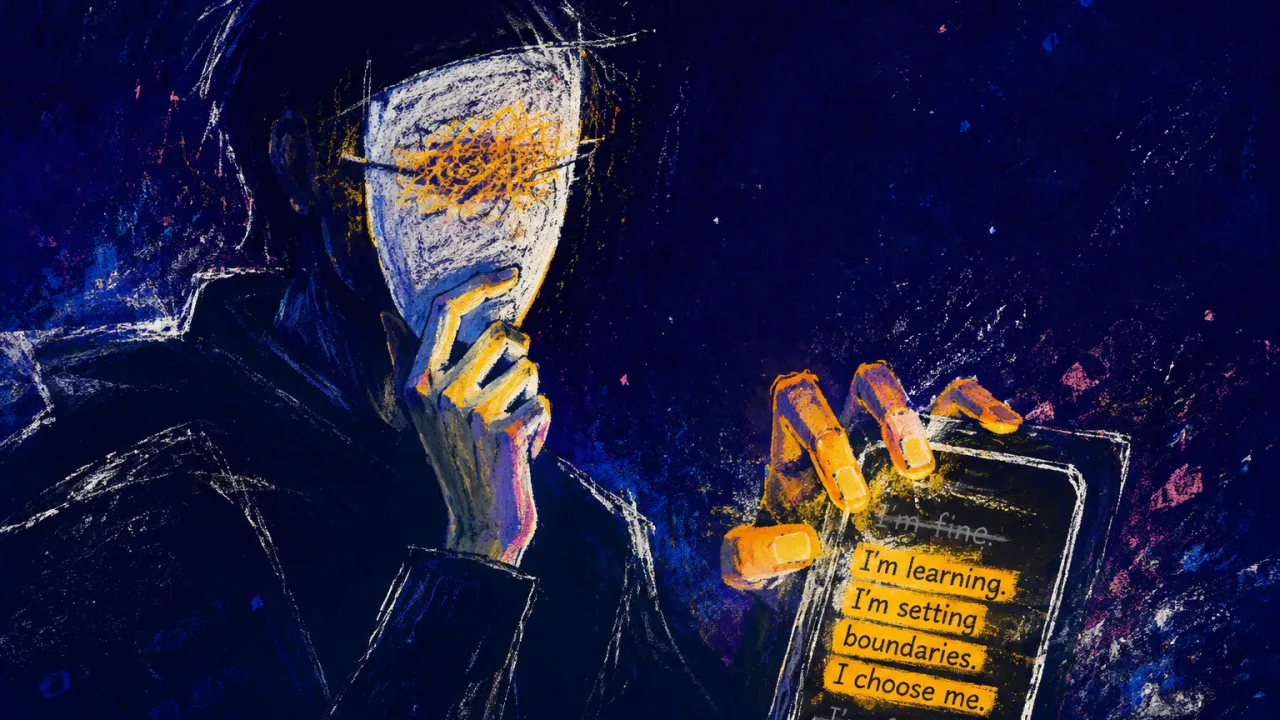
An upright figure touches their jaw while holding a phone, amber text layered over a fading grey sentence.

What is this really?

You can name your defensiveness, avoidance, or projection before anyone else does, turning tense conversations into polished explanations of your own behavior. Explaining yourself first helps you keep control of the frame: if you have already identified the pattern, criticism feels less exposing and uncertainty has less room to catch you off guard. Yet the more convincingly you can sound accountable, the easier it becomes to leave both the feeling and the behavior untouched; the version of you who can explain everything stays composed while the part of you that is hurt, angry, or unsure remains unheard, much like the Two of Swords, blindfolded and holding crossed blades in front of still water.

Why did it happen?

In situations where showing uncertainty or being corrected made the room feel less predictable, explaining yourself first helped you keep your footing and shape what happened next. Now the inner pattern can switch on before you have felt the moment: your mind starts narrating, your shoulders stay lifted, and the conversation moves on while you remain mentally overdrawn.

How does it feel?

  • When someone says, "That hurt," you lift one palm, give a quick half-smile, and say, "I know exactly what I do," before they finish the thought. In that pause, your jaw may stay set and your breath may turn shallow even while your voice remains steady. You can let the unfinished moment stay unfinished for now.
  • During feedback at work, you nod twice, open a notes app, and restate the comment in sharper language than it was given, then add the reason before your manager continues. A few seconds later, your shoulders may still be lifted and your eyes may feel fixed on the screen. Not having an immediate explanation ready is allowed.
  • While drafting a message after a date, you type a long paragraph explaining why you went quiet, delete the one plain sentence about what you wanted, and keep editing the analysis. Your fingertips may hover above the phone while your chest feels oddly hollow. The blank space can remain without needing to become a conclusion.
  • Alone with a journal or notes app, you create neat headings for what happened, what you noticed, and what it "means," then stop when the page asks what you feel right now. Your eyes may go dry from staring and your shoulders may sink as the cursor keeps blinking. It is okay to notice the pause without filling it.
  • When apologizing, you press your lips together, say, "I know I made it about me," and move quickly into context before naming the specific moment. Afterward, your palms may feel cool and your jaw may ache from holding it still. That physical response can be present without becoming another thing to solve.

Weaponized Self-awareness in Tarot Cards

Weaponized self-awareness can look like naming your reaction before the other person has finished, while your jaw stays set and your breath turns shallow. Jungian archetypal theory offers a frame for the gap between the polished explanation and the feeling it keeps at a distance. The Tarot Cards below mirror the unconscious dynamics beneath that reflex:

Justice
Reversed
The sword and scales place discernment, measurement, and judgment at the center of the scene, while the figure's frontal posture suggests confidence in the process being applied. Reversed, this evaluative structure can become a closed court in which naming the offense and explaining its cause are mistaken for completing the sentence of change. You may become highly skilled at determining exactly how you failed, which defense took over, and what earlier experience shaped it. The audit remains incomplete when judgment is the final product, because accurate classification can preserve the identity of being self-aware without generating a different response under the next real-world trigger.
The Hanged Man
Reversed
The suspended figure displays a bright halo and a composed face while his body remains bound to a single position. In the reversed orientation, the image can hold a form of reflection that has become part of the attachment, allowing the person who understands the pattern to remain separate from the person who must test a different behavior. You may produce increasingly precise accounts of your avoidance, defensiveness, or need for control and experience that precision as progress. The audit becomes more useful when it distinguishes recognition from revision, making visible the moment when describing a pattern starts protecting it from direct experimentation.
Judgement
Reversed
The trumpet, banner, and rising figures portray insight as a summons into a changed state, with recognition extending through the entire scene. Reversed, that summons can be absorbed into interpretation, allowing the mind to study the call while the rest of the system remains below the threshold of response. You may experience a sharp realization about how you control conversations, avoid feeling, or pre-empt criticism and immediately translate it into a compelling personal narrative. The realization becomes transformative only when the audit tracks what happens under the next trigger, separating a breakthrough that enlarges the explanation from one that changes participation.
King of Cups
Reversed
The king holds his cup above a moving sea without allowing the surrounding turbulence to disturb his fixed posture. In reversed expression, the image can describe an internal manager who knows how to label emotion while remaining structurally separate from its movement. You may identify sadness beneath anger, fear beneath defensiveness, or avoidance beneath composure and still notice little change in your body. The vocabulary is not the problem; the defensive function appears when naming the emotion becomes the endpoint, allowing the observing self to remain composed while the emotional self remains unheard.
Three of Pentacles
Reversed
The craftsperson stands above two figures who hold plans inside a detailed structure, placing skill, evaluation, and collaborative interpretation in the same scene. In reversed expression, the exchange can become a performance of competence in which the learner controls the discussion rather than remaining available to correction. You may identify every limitation in an essay, project, or research design before an evaluator can do so and provide an advanced explanation of each one. That fluency can protect you from feeling inexperienced, but it also lets self-awareness occupy the space where surprise, clarification, and actual revision would otherwise occur.
Two of Swords
Upright
The blindfold, crossed blades, and fixed seated posture form a closed system in which awareness is managed through control rather than expanded through contact. The balanced swords make the defense look disciplined and coherent, which helps explain why articulate self-knowledge can feel more developed than the behavior it protects. You may know the names of your patterns, predict your reactions, and explain the history behind them without allowing new evidence to reorganize your response. Growth becomes measurable when the swords can lower enough for uncertainty, impact, and embodied feeling to enter the audit alongside the explanation.
Five of Swords
Upright
The figure collecting the swords remains engaged with the logic of the conflict while the other people have already turned away. The physical distance between them shows how a person can retain the argument and lose the shared relational space at the same time. You may name your fear, avoidance, or defensiveness with complete accuracy while leaving little room for a friend to say what the behavior cost them. The self-analysis becomes weaponized when its sophistication makes further challenge seem unnecessary or unfair, encouraging withdrawal instead of restoring trust.
Seven of Swords
Upright
The figure carries an armful of swords away from the camp while keeping his head turned toward what he is leaving. The posture combines disclosure, caution, and retreat, suggesting a person who remains mentally connected to the relationship while physically preserving an exit. You may tell a friend that you know you disappear under pressure, become self-focused, or intellectualize conflict, and the confession may sound deeply reflective. The defense remains active when naming the flaw allows the conversation to move on before the friend's experience, requested boundary, or conditions for restored trust have been fully addressed.

Weaponized Self-awareness in Tarot Card Reading Insights

When weaponized self-awareness lets you explain your reaction before anyone else has finished, others have brought that same reflex into readings and noticed what appeared around the cards. The Tarot Reading Insights below show where this pattern surfaced in those readings:
Psychological Patterns Related to Weaponized Self-awareness