Opening Chapter 4 Before Notion: One Rough Question as Evidence

The 8:47 p.m. Desk That Looked Ready
I met Casey (name changed for privacy), a 22-year-old university student in Toronto, after she asked me, “Why do I keep perfecting my study setup instead of studying?”
At 8:47 on a Tuesday night, I watched her shared-apartment desk become more orderly by the minute. Cold tea sat beside her laptop. The radiator clicked behind her. Under her restless palms, the computer gave off that familiar, slightly too-warm heat as she renamed three Notion pages, nudged the lamp twice, and swapped one lo-fi playlist for another. The assigned PDF stayed closed behind a row of tabs.
“I was supposed to start the reading after dinner,” Casey told me. “But then the headings looked messy, my timetable did not feel realistic, and I thought I should find a better active-recall method first. I just need the setup to feel right first.”
I could see the pattern in the way her shoulders had climbed toward her ears and in the small, quick movements of her hands. Each adjustment gave her a brief, clean flicker of relief, like straightening a picture frame in a room where the fire alarm is going off. Then the relief curdled. The desk looked ready; the student still felt on trial.
I did not treat that as laziness, a character flaw, or a prediction about her grades. I told her that a genuinely unusable environment deserves care: pain, access needs, missing course materials, an unsafe shared space, or software a course actually requires are real barriers. But an adequate setup can also be quietly treated as unfinished when the first page feels exposing.
“We are not here to make you force yourself through something,” I said. “We are here to map the moment when preparation turns into protection, and to find one small way back to your own control.”

Choosing a Compass for Study-Setup Procrastination
I asked Casey to take one slow breath and hold her actual question in mind, not as a test but as a point of focus. I shuffled while the apartment settled around us: a cupboard shut somewhere down the hall, the radiator clicked again, and her untouched laptop waited on the table.
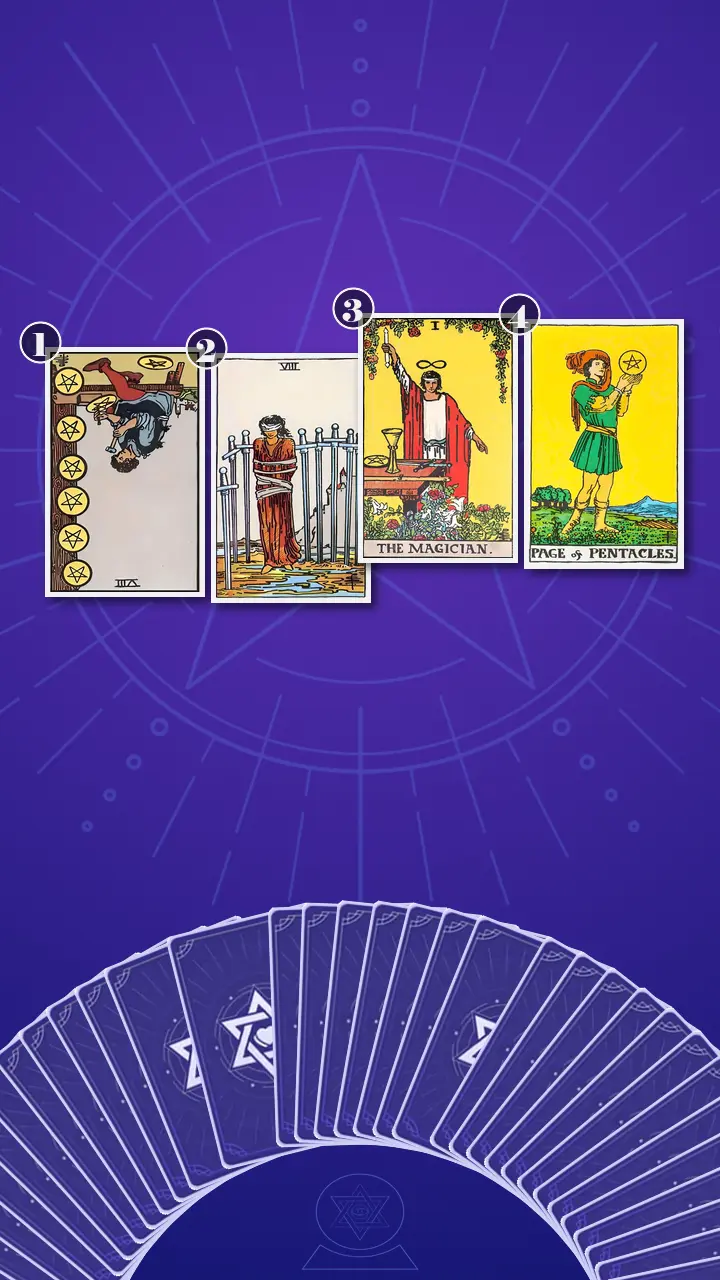
I chose the Four-Layer Insight Ladder · Context Edition. This is a four-card tarot spread for self-exploration, not a machine for predicting what will happen to someone. For a question about productive avoidance, I wanted the shortest useful route through the pattern: the visible behaviour, the hidden restriction beneath it, the transformation hinge, and one practical way to integrate the insight.
A larger spread could have given us more context, but Casey did not need ten more things to manage. She needed clarity about why preparing to study felt safer than studying, and a behavioural experiment small enough to try before redesigning it. The first position would show where her effort was visibly going. The second would reveal the private rule making an adequate desk feel unusable. The third would identify the bridge from displayed readiness to deliberate agency. The fourth would turn that insight into a grounded next step.
Reading the Map: From Displayed Readiness to Real Contact
The Apprentice Who Never Opens the Book
I turned over the card representing the current symptom: the observable setup-optimization behaviour that was taking up Casey's study sessions. It was the Eight of Pentacles, reversed.
In its usual current, this card honours craft, repetition, and learning by doing. Reversed here, I saw its practical Earth energy blocked and diverted. The apprentice is still working hard, but the effort has slid away from the skill itself and into the appearance of readiness. I pointed to the figure bent over one pentacle and the completed pentacles displayed along the wall.
“This is the thirty-minute setup block,” I told her. “The aligned stationery, renamed folders, adjusted fonts, rebuilt timetable, and search for the exact playlist. It is detailed work, so it feels defensibly productive. But the assigned reading is still closed.”
Casey looked at her laptop, then gave a short laugh that caught at the end. “That is too accurate. Almost rude.”
I smiled with her, because recognition does not need to become shame. “Productive-looking is not the same as learning-producing. Caring about your tools is not the problem. The question is whether the system is serving the study, or whether the system has become a place to hide from the study.”
I asked her what her mind usually says in that moment. After a pause, she answered, “This is useful, so it cannot be procrastination. I will start as soon as this one detail is fixed.” Her fingers moved toward the trackpad without touching it. That small, almost automatic reach showed me how visible order had become a relief button.
The Rule That Makes an Open Desk Feel Locked
I turned over the card representing the underlying root: the core fear and self-reinforcing belief beneath the setup loop. It was the Eight of Swords, upright.
The blindfolded figure is surrounded by swords, but the bindings are not as final as they appear, and open ground remains behind her. In Casey's reading, the card did not say that she had no options. It showed how an internal rule had made movement feel unsafe: if she began with an imperfect desk, rough notes, or an unclear first paragraph and struggled, then the struggle might seem to prove she was incapable.
“This is like sitting at a usable desk and treating every imperfection as a locked door,” I said. “The laptop, course text, and an hour of time are there. But the thought becomes: if I start like this and struggle, it means I cannot study properly.”
The card's Air energy was constricted. Instead of using thought to examine the material, Casey was using thought to build a case against beginning. One confusing instruction could send her into Notion procrastination, another study-method video, or a new template because changing settings postponed the feared verdict.
For a moment, Casey went very still. Her breath paused high in her chest. Her eyes lost focus, as if she were replaying a dozen library sessions at once: the buzzing fluorescent lights, a difficult paragraph, the instinct to open six tabs about active recall. Then her jaw loosened.
“I honestly thought I was trying to become more disciplined,” she said quietly. “But I think I am trying to avoid finding out that I am bad at this.”
“That fear is understandable,” I said. “It is also a harsh standard to place on one ordinary study session. An imperfect attempt is data, not a character reference. Confusion can tell you something about a paragraph, a skill gap, or a method. It does not get to define your worth.”
When the Magician Reached for What Was Already There
The Table Is Not an Online Shopping Cart
The room seemed to quiet before I turned over the third card, the key transformation in the spread. It was the Magician, upright.
I saw the raised wand, the lowered hand, and the table carrying every suit: wand, cup, sword, and pentacle. In a study session, I translated that table into what Casey already had within reach: one laptop, one assigned text, one note page, one timer, her attention, and the willingness to make a beginning before confidence arrived.
At 8:47 p.m., the assignment can still be closed while someone renames pages, moves the lamp, and queues another focus playlist. The shoulders tighten because the desk now looks ready, but there is still no evidence that the first page can be faced. The Magician changes that scene without demanding a better desk, a new app, or a flawless mood. The card asks for conscious direction: close the comparison tab, put the phone face down, open the assigned page, and press Start.
In my twenty years of hearing stories across the warm smell of coffee, I have learned that a daunting syllabus often behaves like an overstuffed cupboard. The more frightened someone feels of opening it, the more they reorganize the labels outside. I use a tool I call Syllabus Deconstruction: I strip the huge emotional demand out of a deadline until only a mechanical instruction remains. Not ‘master Chapter 4.’ Instead: ‘Read paragraphs one through three, write one rough question, and circle one unfamiliar term.’ It is not a prettier plan. It is the next physical movement.
Casey stared at the four symbols on the Magician's table, then at the laptop in front of her. I could feel her caught between the old hope that one more system would make her safe and the unnerving possibility that she already had enough to begin.
A perfect setup cannot prove readiness; use the tools already on the table and let the Magician's deliberate hands turn preparation into one actual act of study.
The sentence landed slowly. Casey's fingers froze above the edge of her notebook. Her pupils widened for a second, then her gaze went soft and distant as I watched her mentally revisit the previous week: the calendar blocks recoloured three times, the focus app downloaded at 11:41 p.m., the draft cursor still blinking on an empty page. Her mouth tightened, almost in resistance. Then she breathed out from deep in her chest, and her shoulders lowered by a fraction.
“But if I only do ten minutes,” she said, her voice thin with the old argument, “am I not just lowering my standards?”
“No,” I replied. “You are changing the standard from proving yourself before you begin to gathering information while you work. Ten minutes is not a claim that the assignment is small. It is a container that lets you meet it without turning the meeting into a verdict.”
I watched relief arrive alongside something more vulnerable: the slight blankness that can come after a heavy rule loses its authority. There was room now, but there was also responsibility. No app could make the first move for her. That was not punishment. It was agency.
“Now, with this new perspective, can you think of a moment last week when this insight could have changed how you felt?” I asked.
“The statistics worksheet,” Casey said. “I kept formatting a formula sheet because I did not know how to start Question One. I could have just written a bad first line and found out what I actually did not understand.”
That was the crucial crossing: from anticipatory anxiety and perfectionistic preparation toward grounded self-trust through imperfect study practice. The Magician did not promise ease. It returned the steering wheel to Casey's hands.
The Page Who Studies One Real Thing
I turned over the card representing action and integration: the small, observable study behaviour that could make this insight lived rather than admired. It was the Page of Pentacles, upright.
The Page holds one pentacle with both hands and studies it with a steady gaze. The distant mountains still exist, but they are not the assignment of this minute. The card's Earth energy was balanced: patient, concrete, and willing to learn without demanding instant proof of expertise.
“This is one paragraph, one practice problem, one rough thesis sentence, or five flashcards,” I said. “Your job for these minutes is to meet one piece of material, not prove that you are a perfect student.”
I connected the card to a scene Casey knew well: a difficult worksheet open in a group-study room while another student made messy pencil notes. Instead of adjusting the document margins because a rough attempt might be seen, the Page invites her to put pencil to paper and let the attempt be visibly unfinished for the length of the timer.
Casey let her palms rest flat on the table. “I think I keep trying to redesign the whole semester tonight,” she said.
“Exactly,” I told her. “The Page does not ask you to solve the semester. Let the work earn the right to change the setup.”
The Study-Before-Setup Path
When I placed the four cards in sequence, I could see a clear story. The reversed Eight of Pentacles showed effort being spent on visible preparation. The Eight of Swords showed the fear underneath: a rough start had become tangled with self-worth. The Magician restored choice by asking Casey to use what was already available. The Page of Pentacles brought that choice down to one quiet act of learning.
The blind spot was not that Casey valued organisation too much. It was that temporary control had started to masquerade as progress, and preferences had started to masquerade as barriers. Her transformation direction was not from organised to careless. It was from polishing the desk lamp while the page stayed closed to using an adequate light long enough to see what the page actually asks of her.
I offered her three actionable next steps. I kept them deliberately plain, because this was not another productivity system to perfect.
- The 10-Minute Study-Before-Setup BlockAt the next planned session in the library or shared apartment, Casey will put her phone on Do Not Disturb, open the exact assigned page or problem, and run a 10-minute timer before changing any app, playlist, folder, font, or desk item. She will keep a sticky note beside the laptop saying, ‘Study first; optimize from evidence.’ When an adjustment urge appears, she will write it down instead of acting on it.Success means contact with one piece of material, not finishing the topic. If ten minutes feels too loaded, use two minutes. At the timer's end, she may stop, continue, or address one genuine obstacle.
- The One-Object StudentFor the next week, Casey will choose one tangible study object for each block: one paragraph, one practice question, one rough draft sentence, or five flashcards. When the timer ends, she will write one plain sentence in a notebook or phone note: ‘I learned...,’ ‘I am still unsure about...,’ or ‘The next physical step is....’Smallness is the design feature. A modest encounter gives her real feedback; it is not evidence that her goals are modest.
- The Three-Line Friction AuditOnly after one timed block, Casey will write: ‘What interrupted me?’ ‘What did not matter once I started?’ and ‘What one change would make the next block more workable?’ She will circle one evidence-based adjustment, make it in under five minutes, and leave the rest alone.A distracting notification may justify one setting change; disliking a note colour usually does not. No formatting, dashboards, or elaborate tracking are allowed here.
I also gave Casey my Desktop Reset Ritual, with a boundary that mattered. If physical clutter, shared-space conditions, or an access need truly blocks her from opening a textbook, she can schedule one 15-minute reset at a session boundary: clear cups and loose papers, leave the assigned material visible, and stop when the timer ends. She does not initiate that ritual because a difficult paragraph makes her nervous. In that moment, the 10-minute study-first block comes first. The reset is for a real environmental need, not an escape hatch from uncertainty.
“You are allowed to care about a workable environment,” I said. “You just do not have to make the environment prove that you are ready before you let yourself learn.”

A Week Later: The Quiet Proof
A week later, I received a message from Casey. She had opened Chapter 4 before touching Notion, set a 10-minute timer, and written one rough question beside the first confusing paragraph. She said she still woke the next morning thinking, “What if I am doing this wrong?” Then she laughed, made coffee, and started another small block.
That was not a miraculous cure or a finished semester. It was the first proof of a different loop: one imperfect action produced useful evidence, the evidence reduced the need for more ritualised preparation, and self-trust had somewhere real to grow.
I did not give Casey readiness. The cards did not hand her a perfect routine. Our Journey to Clarity helped her notice that the capability she wanted to feel was built through participation, not granted by a photogenic desk.
When your own page stays closed while your hands keep fixing the desk, the tightness in your shoulders may not be only about lost time. It may be the fear that one messy attempt could say something final about your worth. It cannot.
If the next 10 minutes could be information rather than a verdict, which single page, paragraph, or problem would you be curious to meet with the setup you already have?