A Sunday Study Block Slipped Into Tomorrow Until One Prompt Counted

The Sunday Study Block That Slipped Into Tomorrow
I first understood Morgan (name changed for privacy) through one Sunday evening they described to me in exact, painful detail. At 7:03 p.m., the final-year student sat in a small Toronto bedroom with three unread modules glowing beside Friday's deadline. The laptop fan hummed. A radiator clanked against the wall. Blue screen light caught the carefully labelled folders above their desk while a warm phone rested in their palm.
Morgan read four lines of the lecture deck, saw that the first topic was larger than expected, and opened Notion to rebuild the week. They changed subject tags, moved two calendar blocks, checked the course group chat, and watched part of a video about active recall. By 8:15, the plan looked cleaner, the material remained untouched, and the remaining time suddenly seemed too short for a proper session.
"I keep planning the version of me who will study tomorrow," they told me across my table the following afternoon. "I want to learn things properly. Then I delay until a summary or 1.75x playback is basically the only option. I hate that panic works, because it teaches me to wait for panic."
I heard the central contradiction immediately: Morgan wanted thorough learning, yet the standard for doing it thoroughly kept postponing the imperfect starts that thorough learning requires. Their anticipatory dread felt less like a thought than wet concrete poured into their limbs, while the phone became a warm magnet and each glimpse of the deadline pulled an invisible cord tighter across their shoulders.
"You want enough time to learn it properly, so you wait for enough time to do it properly," I said. "Then the waiting removes the time, and the shortcut begins to look responsible. I don't want to judge that cycle or make a prediction about your grades. I want us to put it somewhere visible, so we can see where your choices begin to narrow and where they can open again. Let's make a map of the fog."

Choosing the Four-Layer Insight Ladder
I invited Morgan to take one slow breath while naming the question in plain language: "Why do I keep delaying studying until shortcuts feel unavoidable?" I shuffled as my coffee cooled beside the deck. For me, this small ritual is a transition from living inside a problem to looking at it from across the table. It is a focusing tool, not a supernatural test.
I chose the Four-Layer Insight Ladder tarot spread because Morgan did not need a broad forecast or an elaborate Celtic Cross. They needed a compact inner excavation of one repeating loop. This four-card structure is designed to connect visible behaviour to the belief beneath it, identify a balancing principle, and translate that insight into one observable experiment.
For anyone wondering how tarot works in a practical consultation, this is the essential point: I do not treat cards as commands or fixed outcomes. I use their images and established meanings as an objective cognitive tool. Card meanings in context can separate behaviour, fear, resources, and choices that have become tangled together in everyday life.
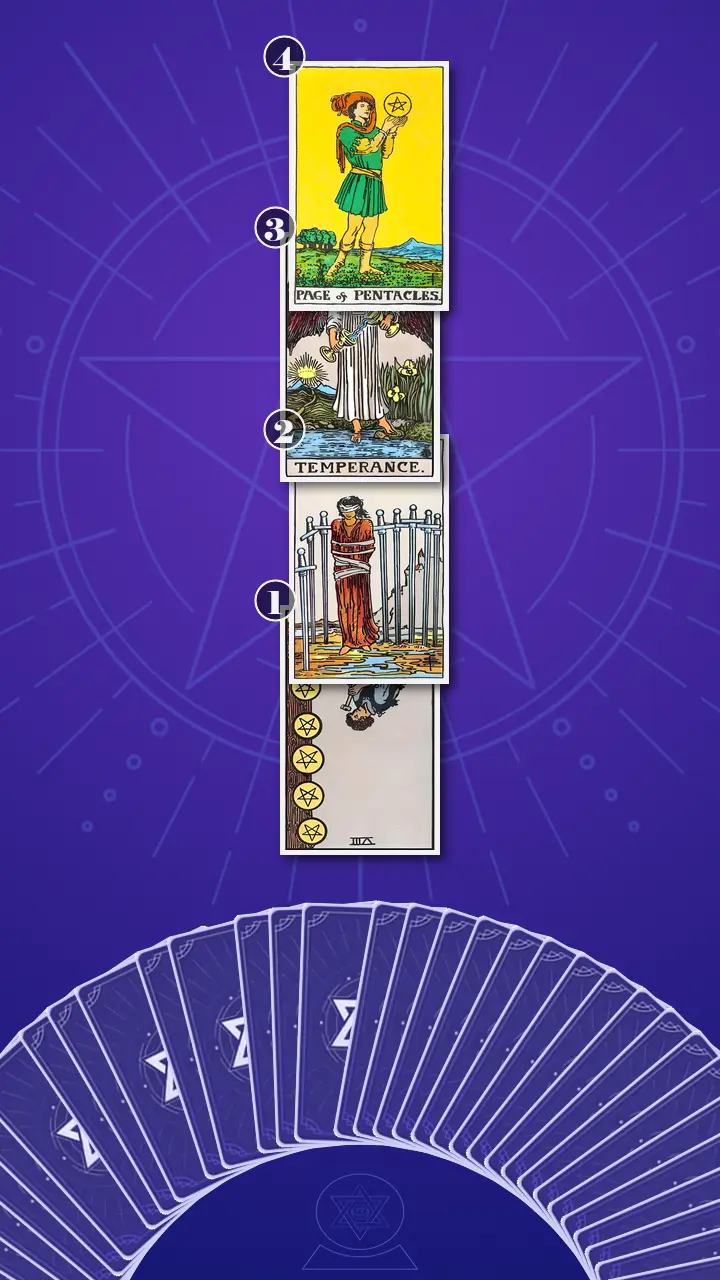
I laid the cards in a vertical line, like four rungs of a simple ladder. The first position would show where the planned study block visibly broke down. The second would reveal the hidden rule and fear maintaining that breakdown. The third would offer the bridge from urgency to a deliberately smaller start. The fourth would turn that bridge into one concrete study action. Each rung needed to be manageable; none required Morgan to become a different person overnight.
Where the Workshop Became a Cage
Position One: Practice That Never Reaches the Material
I turned over the card representing Morgan's observable blockage: the point where planned study periods are postponed until reduced-quality review and shortcuts replace sustained practice. It was the Eight of Pentacles, reversed.
In the upright image, the craftsperson raises a mallet over one pentacle while a vertical row of completed pieces records repeated practice. Reversed, the relationship between the hands, tools, and next unit of work had been disrupted. The workstation was ready, but the craft itself had become difficult to touch.
I brought the image directly into Morgan's 7:00 p.m. routine. The lecture deck was open, yet the cursor travelled through calendar blocks and folder labels. Active-recall methods were compared. The desk looked disciplined. No practice question was attempted. By 8:15, a condensed summary seemed necessary because the time for direct contact with the material had been spent performing readiness.
"The private sentence underneath this card sounds something like, 'I am technically working on studying, but I still haven't touched the part that could show me what I don't know,'" I said. "The issue isn't a lack of tools. The tools have become a waiting room."
The reversal showed blocked Earth energy: practical repetition was not absent because Morgan did not care, but because perfectionism about how practice should look had grown excessive. A study session needed to be long, efficient, and complete before it could count. That performance standard interrupted the modest repetition that would actually build skill.
"You are not failing to plan; planning has become the place where starting gets postponed."
Morgan gave a short laugh that carried no amusement. "That is so accurate it is almost rude." Their thumb rubbed the seam of the coffee cup while their eyes stayed on the upside-down craftsperson.
I did not rush to make the recognition feel positive. "I can understand why the planning feels useful," I said. "It gives you a few minutes in which the workload appears controllable and your competence hasn't been tested. We can respect that protective function without letting it run the whole evening."
I asked Morgan to describe what their hands had physically done during the last lost study hour. They listed moving a calendar block, checking WhatsApp, changing a folder label, searching Reddit for "why can I only study under pressure," and saving a study-with-me video. That inventory made productivity procrastination concrete. It was no longer a character flaw floating over their life; it was a sequence of observable actions that could be interrupted.
Position Two: The Two Tabs That Pretended to Be the Whole Browser
I turned over the card representing the limiting pattern and underlying fear: the belief that only a long, efficient session counts, combined with the fear that an imperfect start will expose a lack of control. It was the Eight of Swords, upright.
I pointed to the blindfold, the loose bindings, and the uneven ring of swords. The workload around the figure was real. I would never use this card to tell a student that deadlines, paid work, fatigue, or a cumulative syllabus exist only in their mind. But the image also contained an opening between the swords. The restriction was partly being maintained by what Morgan could not yet count as a legitimate route.
I translated that route into a familiar screen. It was as though Morgan's browser had only two pinned tabs: "finish the whole unit in a perfect multi-hour session" and "find an emergency summary later." A third tab, "attempt one question for twenty minutes," had been closed before the evening began.
In the campus library, that binary appeared when Morgan saw a classmate's colour-coded tracker beside an untouched practice set. The coffee went cold. Their jaw tightened. Finishing the whole unit before a retail shift felt impossible, but a short closed-book attempt felt emotionally dangerous. If they started small and drifted, they feared the attempt would become evidence that they could not control their attention. If they waited, at least the deadline might force everything else out of the frame.
The card's Air energy was operating in excess. Analysis had hardened into an enclosure, while decision fatigue made the same two extremes look like the complete menu of choices. The upright card did not say Morgan was trapped forever. It showed how one restrictive interpretation was blocking sight of an awkward but workable opening.
I asked, "When you imagine starting for twenty minutes and then losing focus, what does that seem to prove?"
Morgan's fingers stopped moving. Their gaze drifted past the cards as though a familiar evening were replaying against the wall. "That I don't actually have discipline," they said at last. "Panic gives me an excuse. If I can't focus when I have time, then it feels like the problem is just me." Their shoulders rose, held for a moment, and lowered with a long breath.
I placed the two Eights beside each other. One repeated pentacles; the other repeated swords. "Repetition can become a workshop or a cage," I said. "Every postponed evening makes tomorrow look like a fresh chance, but tomorrow opens with the same rule. The question is not whether you repeat. It is what your repetition rehearses."
The pain in Morgan's face softened, but only slightly. Recognition had arrived with a sting: the last-minute system had rescued assignments often enough to look functional, even while it trained them to distrust ordinary starts.
"An imperfect start is not a verdict on your discipline; it is one unit of practice," I told them. "The opening between these swords does not need to be wide. It only needs to be visible."
When Temperance Changed the Engine
Position Three: The Transfer Between Two Cups
The rain that had been ticking sharply against the window settled into a steadier rhythm as I reached for the third card. I turned over the position representing the key transformation from waiting for urgency to tolerating and repeating a deliberately small study start. It was Temperance, upright, the bridge card at the centre of the reading.
I let Morgan look before I spoke. Water travelled continuously between two cups. One foot stood on land and one in water. A narrow path led towards light without pretending the whole distance could be crossed in a single stride.
Temperance carried balanced energy: moderation, emotional tolerance, patient self-regulation, and trust in cumulative effort. Water softened the rigid Air of the Eight of Swords, while measured movement restored the voluntary initiation that panic had been supplying. This was not a promise that beginning would feel comfortable. It was a way to make discomfort proportionate enough that Morgan could act before it became an emergency.
I translated the stream between the cups into a study sequence: ten minutes of reading, ten minutes of closed-book recall, and five minutes checking one gap. The module could remain unfinished when the timer ended. The block did not need to prove that Morgan could focus for the entire night. It only needed to transfer one piece of knowledge from exposure into retrieval.
At that moment I thought of the hundreds of oversized problems I have heard named over coffee during twenty years of readings. A syllabus, a career, a relationship, a future: each can gain enormous emotional authority when it arrives as one indivisible noun. My mind moved naturally to Syllabus Deconstruction, the diagnostic lens I use to strip paralyzing dread from a massive deadline by reducing it to mechanical, emotionally neutral daily tasks.
For Morgan, deconstruction did not mean creating a more beautiful hierarchy in Notion. It meant refusing to treat "study the module" as a valid task. Read for ten. Recall for ten. Check one gap for five. Stop. The syllabus remained large, but it no longer got to enter the room all at once.
I asked Morgan to picture the familiar setup again. At 7:00 p.m., the lecture deck was open, the study app was being reorganised, and their hand kept reaching for the phone. By 8:15, the plan looked cleaner, the material was untouched, and tomorrow had quietly inherited the whole job. They had been asking one start to prove an entire night's discipline.
I said, "Urgency is an engine, but it is not your only engine. Momentum can begin with one small transfer of effort before panic starts making the choices for you."
You do not need panic to make studying real; build momentum through small, repeatable transfers of effort, as Temperance pours steadily between the cups.
I stopped speaking and let the sentence remain between us.
For a beat, Morgan's breath stopped. Their fingers hovered above the mug, then tightened around it. Their eyes moved past me as though replaying every night when a clean plan had replaced a rough attempt. Then their brows pulled together. "But doesn't that mean I've been doing it wrong the whole time?" they asked, their voice sharper than before. I let the anger stand; it was protecting the effort they had spent surviving. "It means the old method had a cost, not that you were foolish for using what worked under pressure," I said. Their grip loosened first. Then their shoulders lowered, their jaw released, and one unsteady breath left them. Relief arrived with a brief blankness: if panic was not in charge, they would have to choose a start themselves. Their eyes shone, but they smiled. I asked, "Now, using this new perspective, think back to last week. Was there a moment when this insight could have made the experience feel different?"
Morgan remembered forty minutes between a seminar and a retail shift. They had dismissed it because the whole reading would not fit. "I could have tested myself on one section," they said slowly. "It still wouldn't have finished anything."
"Correct," I said. "Temperance is not asking that block to finish the reading. It is asking the block to perform one honest transfer. Complete coverage and useful contact are not the same measure."
To keep the insight from becoming another attractive idea, I offered a five-minute Temperance transfer at the table. Morgan chose one course concept, spent three minutes writing what they remembered without looking, and used two minutes to check one gap. I stopped the timer even though their final sentence was incomplete. I also made the minimum explicit: on a day when five minutes was unavailable or their energy had reached a real limit, they could write the concept name and one remembered fact, pause, or deliberately choose another time without turning that choice into a verdict.
This was the reading's central crossing: from anticipatory dread and crisis-driven shortcuts towards repeatable pre-deadline practice and grounded self-trust. It was not full confidence. It was the first evidence that ordinary effort could exist before urgency narrowed the options.
One Pentacle Brought the Course Into Focus
Position Four: The Learning Target That Could Fit on a Desk
I turned over the final card, representing practical integration: selecting a single learning target and completing a predefined block before urgency peaks. It was the Page of Pentacles, upright.
The Page held one pentacle at eye level. The wider landscape remained visible, including cultivated fields and distant mountains, but the Page's gaze did not scatter across all of it. This was the Student-Apprentice energy in balance: focused curiosity, respect for one concrete task, and willingness to learn without demanding immediate proof of mastery.
I brought the image into Morgan's room. One practice prompt sat on an otherwise cleared desk. The required source, a blank sheet, and a timer remained within reach. The phone rested inside a zipped backpack. The course was still large, but for twenty-five minutes the job was not to conquer it. The job was to attempt the one object in front of them. A rough explanation or incomplete solution would count because completion meant direct contact, not total coverage.
I used my second diagnostic lens, Study Environment Auditing, to look at the physical systems quietly spending Morgan's limited psychological bandwidth. The labelled folders were not inherently a problem. Neither were Notion, Anki, a focus playlist, or a Pomodoro timer. The drain came from leaving every tool, chat, backlog, and unfinished task visually available at the moment one concept needed attention. The desk was functioning like a browser with twenty tabs open, each one making a claim on the same small patch of working memory.
"The Page is not saying you need a more impressive setup," I explained. "It is asking what the setup allows your eyes and hands to do next. Single-task mode is not a personality. It is an environment you can arrange for one bounded attempt."
I asked Morgan to name one target and an exact start time. They chose the first unresolved practice question from the next module and 6:30 p.m. the following Monday. As they said the time aloud, their eyes moved from the wider spread back to the Page's single pentacle. Their fingers made one small square on the table, as though the task had finally acquired edges.
I also removed the moral charge from condensed resources. A summary could be an accessibility tool, a preview, a gap check, or a final review. It did not need to symbolise failure. "A shortcut changes when you choose it before panic chooses it for you," I said. The Page asked only that Morgan name the resource's job and make one direct attempt before surrendering the entire decision to the deadline.
A Study Plan Small Enough to Survive Real Life
I read the four cards back as one causal story. Past deadline rescues had shown Morgan that they could produce something under intense pressure, and friends who saw only the finished result had unintentionally reinforced the system. In the present, the reversed Eight of Pentacles showed practical effort fragmented by the demand to look disciplined. The Eight of Swords exposed the hidden rule that only perfect study or emergency study counted. Temperance introduced proportion, and the Page of Pentacles restored Earth through one calm, material contact with the work.
The cognitive blind spot was subtle: Morgan had been treating each successful rescue as proof that panic created their ability to focus. The cards suggested a more precise explanation. Panic may not create the ability; it may simply remove every competing option at a high cost. That distinction mattered because an ability that exists only in crisis feels inaccessible, while an ability that can be given one small target, a boundary, and fewer distractions can be tested under ordinary pressure.
The transformation direction was equally specific. Morgan did not need to move from procrastination to perfect consistency. They needed to shift from waiting for enough urgency to completing one predefined twenty-five-minute block at a scheduled start time, even when it looked incomplete. Shortcuts could then become optional tools rather than emergency necessities.
I reminded Morgan that the cards had not completed a reading, opened a practice question, or made a choice for them. The spread had externalised the loop and provided language for the hidden rule. Morgan remained the person who would decide whether the next repetition became another cage or one unit of a workshop.
When I introduced the Desktop Reset Ritual, Morgan immediately raised a practical objection. "But if I have to clean for fifteen minutes before every twenty-five-minute block, that's forty minutes. That's exactly how this gets huge again."
"Then we don't use it that way," I replied. "The fifteen-minute reset happens once to establish the environment. After that, the daily reset is sixty seconds. A strategy that ignores your evening shifts, sleep, energy, or access needs is not grounded enough to keep."
The Two Experiments We Put on the Calendar
I reduced the actionable advice to two tests. Neither was a pledge about Morgan's identity. Each was small enough to produce information about what genuinely supported learning.
- The Desktop Reset and One-Pentacle Rule I asked Morgan to set one fifteen-minute timer at their usual desk on Sunday evening. They would remove everything except one written practice prompt, the required source, paper, and a timer; place the phone inside the zipped backpack; and put every unrelated task on a one-line parking list without opening another app. When the timer ended, the reset was finished, even if the room was not perfect. The practical minimum is a five-minute clear or a sixty-second reset on later days. Physical order is meant to return attention, not become another performance project.
- The Temperance Transfer Block I asked Morgan to schedule Monday at 6:30 p.m. in their phone calendar, with the event named after one concept rather than the whole module. At the start time, they would read for ten minutes, recall without looking for ten minutes, and check one gap for five minutes. When the timer ended, they would write, "What I can now retrieve is..." in the calendar event and stop, even if the topic remained unfinished. The minimum valid version is three minutes of recall and two minutes of checking. Before opening a summary, name its purpose as preview, gap check, or final review. Resize or move the block deliberately when work, rest, disability access, or depleted energy requires it; no adjustment becomes a moral score.
I called these experiments pre-panic practice. Their purpose was not to prove that Morgan would never procrastinate again. Their purpose was to collect evidence that direct learning could begin while choices were still available.

The Quiet Proof at 6:30 p.m.
A week later, I received a message from Morgan. At 6:30 on Monday, they had placed one practice prompt beside the timer and zipped the phone into their backpack. Streetcar noise moved past the window. Their fingers had twitched towards the bag when recall stalled, but they stayed with the blank page until the timer ended.
They did not finish the module. They wrote four rough points, corrected one gap, and entered one sentence in the calendar: "What I can now retrieve is the difference I kept mixing up." Then they stopped. A later block had to be moved because a retail shift ran over, but Morgan rescheduled it without drafting a seven-hour recovery plan.
That night they slept through. Their first thought the next morning was, "What if twenty-five minutes is still not enough?" They told me they smiled, because the module was still unfinished and Monday's block still counted.
I did not see a life transformed by a magical card. I saw a small, credible piece of grounded self-trust: Morgan had acted before panic made the choice, learned something observable, and left enough room to return. That was their work. The tarot had simply helped us tidy reality until the next available step could be seen.
If tonight you also want to learn properly but feel your shoulders tighten at the first imperfect start, I hope this reading lets you recognise why postponing can feel safer than finding out whether your attention will stay with you. Noticing that protective rule means you are already looking at it rather than only obeying it.
If one unfinished-looking twenty-five-minute Temperance transfer were allowed to count, which single pentacle, one concept, one question, or one gap, would you be curious to place in front of you first?