Interrupting Tutorial Hell: Wire the Filter, Ask What It Teaches
The 9:18 Tutorial Hell Loop
'I work a junior digital design job in Toronto, open my personal project after dinner, and save another step-by-step video the moment the blank screen asks for an original decision. That is Tutorial Hell wearing the clothes of preparation,' Alex (name changed for privacy) told me.
At 9:18 p.m. on a Tuesday, I watched Alex sit at the kitchen table with the personal web app open beside a cold coffee. The laptop fan breathed warm air against their wrists, the monitor painted their jaw blue, and their hand opened a new YouTube tutorial just as the unfinished screen asked them to choose a layout.
'Every tutorial makes sense until the work asks me to choose,' they said. 'I want to make the thing, but I do not want the first version to become evidence against me.'
I could see the core contradiction in the way their shoulders had risen toward their ears: making something visible and learning through use on one side, hiding in instruction to avoid an imperfect result on the other. Their frustration sat behind their teeth like a browser tab playing a warning sound no one else could hear; their hands kept moving, but the project did not.
'I am not going to treat this as laziness or a character flaw,' I said. 'A tutorial can lower uncertainty without moving your project one pixel. Let us look at the pattern without turning it into a verdict. Our work tonight is to draw a map through the fog and return the decision to the person who has to make it: you.'
Choosing a Ladder Through the Fog
I asked Alex to put both feet on the floor, take one unhurried breath, and name the question exactly as it had arrived: Why do I keep hiding in tutorials instead of making the thing? Then I shuffled slowly. The point was not to summon a fixed future; it was to give attention a clean transition from the open browser to the pattern underneath it.
I explained to Alex, and to anyone reading this, how tarot works in this kind of consultation. The cards provide images and structured prompts. I use them as a reflective tool for connecting behaviour, emotion, and choice, not as a prediction that removes responsibility from the person in the chair.
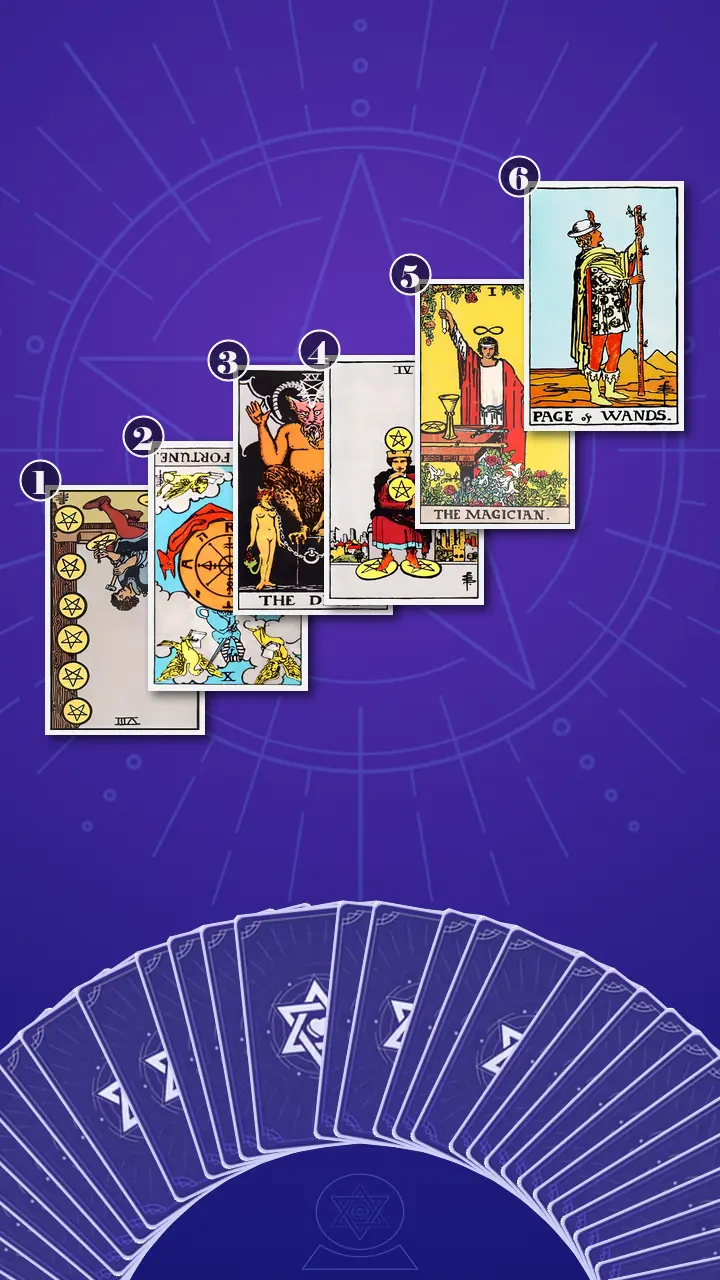
For this question, I chose the Six-card Four-Layer Insight Ladder - Context Edition. A Celtic Cross would have spread the issue across too many categories, while a Decision Cross would have implied that Alex was choosing between two external options. The real subject was a self-reinforcing loop: a personal project became uncertain, uncertainty became another tutorial, the tutorial brought short-term relief, and the project stayed unfinished.
The first four cards would move from the visible Tutorial Hell behaviour to its repeating mechanism, its hidden attachment, and the protection that also limited movement. The fifth card would show the Making Threshold, and the sixth would translate the insight into Integrated Practice. I placed them in a rising line, a short stairway leading out of a circular track.
The Workbench, the Wheel, and the Locked Room
Position 1: The Workbench with No Finished Artifact
Now I turned the card for Surface Pattern / The Visible Loop, the position that shows the present situation and its most observable expression. It was the Eight of Pentacles, in reversed position.
The upright Eight of Pentacles speaks of apprenticeship, focused craftsmanship, and skill built through repetition. Reversed, the earth energy is blocked or misdirected: effort continues, but it is no longer connected to completion. The craftsperson is still at the workbench, the hammer is still in hand, and the repeated pentacles are still displayed, yet no original object is leaving the room.
The card took me straight to the scene at 9:32 p.m. after Alex's Toronto design shift. They had followed a tutorial to perfect one isolated component in Figma and VS Code. The component looked increasingly polished, the notes were neatly organized, and the laptop fan kept humming, but the personal app still had no feature another person could try. The workshop had become repetition without completion.
'This is productive-looking avoidance,' I said. 'You are not doing nothing. You are practising in a way that keeps the most revealing part of the work postponed. The question is not whether you have worked hard. The question is which single skill you already learned can become one tiny finished feature today.'
Alex gave a short, bitter laugh rather than nodding. 'That is too accurate. It is almost rude.'
'Then we will be precise instead of cruel,' I replied. 'I am not asking you to throw away tutorials or rush a public launch. I am asking whether practice can cross the small distance between knowing how a component works and letting one person click it.'
Alex's thumb stopped above the trackpad. Their mouth tightened, then softened, as if the distinction had found a place the word procrastination never could.
Position 2: The Wheel That Keeps Returning to the Same Station
Now I turned the card for Repeating Mechanism, the underlying influence that sustains the present situation. It was the Wheel of Fortune, in reversed position.
The Wheel usually carries cycles, changing conditions, movement, and the possibility of a turning point. Reversed, its energy is active but trapped in a groove. It describes apparent motion that keeps arriving at the same starting point, which is why a repeating tutorial loop can feel like progress while leaving the central decision untouched.
I described what I saw in ordinary terms. An independent decision produces an error, so Alex switches from React to Webflow, from one course platform to another, or from one instructor to a new framework comparison. For a few minutes, the browser feels full of clean beginnings. A week later, the new setup reaches the same open-ended project question, and the blank screen is waiting at the same Toronto station.
'I want you to notice the exact moment the wheel turns,' I said. 'Is it the error itself, the uncertainty about what the error means, or the instant the work begins to feel like a judgment?'
Alex looked down at the line of cards. Their restless fingers became still. 'Usually it is when I cannot find an exact tutorial match. I tell myself I need stronger foundations, but mostly I feel this drop in my stomach and then relief when someone else gives me the next step.'
I suggested a twenty-minute tutorial pause, not as punishment and not as a ban. When the urge appeared, Alex could leave the project open, write down the discomfort and one decision they could make with the information already available, then choose deliberately. A pause would make the wheel visible before asking it to stop.
Position 3: The Loose Chain That Feels Like Shelter
Now I turned the card for Shadow Attachment, the hidden influence or blind spot shaping the issue. It was The Devil, in upright position.
I always handle this card carefully. It is not a prophecy, a moral label, or a claim that something outside Alex had control over them. In this position, it showed attachment: the private bargain between staying informed and staying unseen. The loose chains around the figures mattered. They were psychologically compelling, but they were not a permanent identity.
I brought the modern scene into the room. A friend posts a rough but working app on LinkedIn. Alex feels admiration first, then a hot drop in the stomach, and opens a course on product architecture. The lesson supplies clear steps and lowers the tension in their shoulders. It also gives them a reason not to show the unfinished screen. The learner identity remains safe; the maker identity remains untested.
'I am not just looking for instructions,' I said, naming the line I heard beneath the search. 'I am looking for five more minutes before my work can say anything about me.'
Alex's eyes moved to the browser queue beside the private repository. 'The tutorial refuge lets me avoid the part where the thing can fail in front of someone. If I am still learning, I do not have to say, I made this.'
I let that sentence stand without correcting it. The pattern was not a fixed identity. It was a refuge that offered information and emotional relief at the same time. That was why it had lasted.
Position 4: The Pentacle Held Too Tightly
Now I turned the card for Protective Payoff and Cost, the position that shows what the pattern protects and what it prevents. It was the Four of Pentacles, in upright position.
The figure holds one pentacle against the chest, stands on two more, and keeps another above the crown. I read that arrangement as guarded knowledge, private drafts, and control held at every level. The earth energy is not absent; it is clenched. Security has become rigid enough to limit circulation.
Alex had kept the GitHub repository private, refused to send a rough screen, and treated every saved tutorial as something that had to be mastered before feedback was allowed. This protection made practical sense. It preserved privacy and gave them control over how the project represented them. But it also kept every useful observer outside the door. No trusted peer could say what worked. No real user could reveal what needed fixing. No finished version could teach the next question.
'Keeping a draft private is not a failure,' I said. 'The question is what kind of privacy serves the work. Does it give you a safe place for a ten-minute experiment, or does it require the entire project to become polished before it is permitted to exist?'
Alex rubbed their thumb along the edge of the coffee cup. Their breathing was still shallow, but the movement no longer looked like frantic escape. They were beginning to distinguish protection from progress.
The Magician's Table and the First Deliberate Build
Position 5: The Magician at the Making Threshold
The room grew quiet when I reached the card for Making Threshold, the central resource and turning point available to Alex. I turned it slowly. It was The Magician, in upright position.
Before I explained the image, I asked Alex to picture 9:18 p.m. at the Toronto kitchen table: the project open, the laptop fan warm, the jaw tight, and a new tutorial already queued. 'You are not lacking effort,' I said. 'You are standing at the exact point where effort becomes visible choice.' The distinction made the air feel unusually still.
The Magician does not wait for a perfect toolset. The raised wand joins intention to action, while the table holds a cup, sword, pentacle, and wand: feeling, thought, material skill, and creative energy already available for use. This is the card's agency. It does not promise a perfect result. It asks what can be combined now.
I translated the table into Alex's actual desk: Figma, VS Code, a browser, one rough idea, and one technique already understood. I asked, 'What can I make with what is already here?' Not the ideal stack. Not the definitive architecture. One interaction, one screen, one deliberately limited experiment.
This was the moment for my signature lens, Cognitive Paradigm Excavation. On an archaeological dig, I do not stand over a collapsed wall and call the civilization incapable. I ask which old structure has fractured, which purpose it once served, and what can be rebuilt without carrying every stone forward. Alex was not missing a final piece of information. An obsolete intellectual era was collapsing: the era governed by the law, I must understand the whole system before I am allowed to make one visible piece.
I used Core Philosophy Stratigraphy to sort the layers. Curiosity belonged in the next stage. So did care, craft, and the wish to make something meaningful. The layer that could remain in the past was the belief that a first draft must certify competence. A rough artifact could be evidence of practice without becoming a verdict on worth.
Then I placed the central sentence between us.
You are not trapped in preparation by a lack of information; place the tools already on The Magician's table into one deliberate act and let making, rather than more collecting, build self-trust.
For a moment, Alex's breath stopped and their fingers hovered above the trackpad. Their gaze left the card and landed on the open Figma file, then on the VS Code tab, as though the tools had changed simply because they were being seen together. I watched recognition travel through a replay of recent evenings: the error, the search bar, the clean relief of another instructor's voice.
Then a small, chest-deep 'Oh' escaped. Alex's shoulders lowered by a fraction, and the hand that had been gripping the coffee cup opened against the table. Relief arrived, but it brought a brief blankness with it, almost a light-headedness. A path had become visible, and a visible path carried responsibility. The old question, What if I choose wrong, did not disappear. It became smaller than the next action.
I did not rush to fill the silence. After a breath, I asked, 'Now, use this new perspective and recall last week. Was there a moment when the blank project was asking for one testable decision, while you answered with another hour of preparation? What might have felt different if you had made the smallest version instead?'
Alex nodded once, carefully. This was not instant certainty. It was the first movement from shame-driven, hyper-analytical preparation toward grounded self-trust: the willingness to let direct contact with the work create the next question.
I offered a ten-minute threshold. For two minutes, name the urge to search. For six minutes, build the smallest testable piece. For two minutes, write what the attempt taught. The version could stay local or private. Alex could stop, reduce the task, or return later. The choice stayed theirs.
Position 6: The Single Budding Wand
Finally, I turned the card for Integrated Practice, the conscious direction that follows from applying the insight. It was the Page of Wands, in upright position.
The Page does not arrive with a completed portfolio or a flawless plan. The Page carries one budding wand and looks at it attentively, curious about what it might become. This is balanced beginner energy: enough fire to begin, enough humility to observe. It turns The Magician's agency into a repeatable experiment.
I described the modern version. Alex could build one rough interaction, send a private link to one trusted peer, and ask, 'What do you think this feature is meant to do?' The response would be information about the prototype, not a global assessment of its maker. One finished experiment could create the next build task without requiring a complete career plan.
Alex smiled briefly. It was not the polished confidence they had been waiting to feel. It was curiosity. 'This is small enough to teach me something,' they said.
'Exactly,' I replied. 'Progress is the thing you can point to, plus the question it gives you.'
The New Law of the Workshop
I laid the six cards in their rising line and told the story they formed. The Eight of Pentacles showed effort trapped in technical repetition. The reversed Wheel showed that changing courses and tools reset the emotional clock without changing the project. The Devil revealed the private refuge of perpetual learning, while the Four of Pentacles showed its payoff: privacy and control, purchased with feedback, completion, and movement. Then The Magician placed the existing resources within reach, and the Page of Wands carried them into one small act.
The deeper issue was not that Alex needed to learn less. It was that instruction had begun to postpone exposure. The cognitive blind spot was treating every artifact as a competence exam and every error as evidence about identity. More information felt like the missing solution because it supplied someone else's sequence. Yet the project needed a decision, not a larger library.
The shift I wanted Alex to practise was simple and demanding: move from using instruction to delay visibility toward using one learned skill in a deliberately small, testable creation. No public build-in-public performance was required. No rushed launch was required. The work only needed enough contact with reality to produce information.
The Paradigm Shift Manifesto
I gave the exercise a name from my own communication practice: The Paradigm Shift Manifesto. I asked Alex to write the old governing law, the values worth carrying forward, and the new law that could govern the next chapter. The old law was, I must understand the whole system before I am allowed to make one visible piece. The values to keep were curiosity, care, and craftsmanship. The new law was, I use one existing skill to make one small thing, and I let the result tell me what to learn next.
Then I turned that law into actionable advice. The following practices were intentionally small enough to begin after work, while concrete enough to create visible iteration.
- The One-Skill Visible BuildDuring the next after-work session this week, choose one skill already used in a tutorial, such as a responsive card, form interaction, or filtering pattern. Open the current project in Figma or VS Code, write the finish line, By the end of 30 minutes, one person can see or click this one small thing, and build only that feature. Save a screenshot or short screen recording.Keep the current tools and do not open a second course until the 30-minute block ends. If the feature feels too exposed, make a private local version or reduce it to one interaction. A timer is a boundary, not a test.
- The Feedback-Sized PrototypeAfter the first build, label the rough feature v0.1 or test draft and send it through a private link or message to one trusted peer. Ask one narrow question: What do you think this feature is meant to do? Record one observation from the response and use it to choose the next build task.Public posting is unnecessary. Ask for consent before sending the demo, name it as intentionally unfinished, and choose a still image or local review if a live link feels too intense. Control the audience, timing, and kind of feedback.
- The Three-Line Build Evidence LogAfter each build block this week, write three plain lines: What I tried, what happened, and what I am curious about next. When the urge to start a new tutorial appears, write the exact uncertainty in the same note and wait 20 minutes before deciding whether outside instruction is needed. At week's end, count finished experiments and tested features rather than hours watched or resources saved.Use a simple phone note with no polished template. If note-taking starts to feel like another refuge, keep the log under two minutes. The purpose is to preserve evidence of direct experience, not to create another impressive system.
I reminded Alex that the cards had not made the creative decision. The Six-card Four-Layer Insight Ladder had mapped the visible behaviour, the repeating mechanism, the hidden attachment, the protective cost, and the next practice. The agency belonged to Alex before the reading, during it, and after the cards were put away.
A Week Later, the First Quiet Proof
Four days later, Alex sent me a message: 'I wired the filter.' They had made a rough private demo and sent it to one trusted friend. Then they sat alone with a cold brew, proud and strangely quiet; the draft had moved, but the old fear had not vanished.
I liked that the fear had not vanished. The point was not to replace one rigid demand with another demand to feel fearless. Alex had made a small decision while the jaw was still capable of tightening. The peer's response created one useful observation, and that observation created the next build task. Learning had become active contact instead of a waiting room.
That was the first evidence of the emotional transformation we had named: from shame-driven preparation and private avoidance toward grounded self-trust through visible, imperfect iterations. Finding clarity did not mean knowing the whole system. It meant knowing what could be tested next, and allowing the result to speak about the work rather than pronounce judgment on the maker.
When the blank project makes your jaw tighten, it can feel safer to keep collecting instructions than to let one imperfect screen reveal what you still need to practise. I have seen that draft begin to feel like a verdict on worth, but I have also seen the old intellectual era fracture when one small action enters the room.
If one learned skill could become a tiny, unfinished thing this week, what would you be curious to let that version show you?