Self-Help Choice Paralysis: From Three Apps to One Fair Trial

Self-Help Choice Paralysis at 11:40 p.m.
If you have a paid meditation app, a half-used journal, and a Notion template called Final Routine v4, the problem may not be a lack of motivation. It may be that restarting has become easier than staying with one method long enough to learn anything from it.
When Alex (name changed for privacy) joined my video call from their small Toronto condo, they were curled into the corner of the sofa beneath the blue wash of three open habit apps. A YouTube comparison of morning routines played through tinny laptop speakers. The fan hummed beneath it, their peppermint tea had gone cold, and a fresh template covered most of last week's half-used journal on the coffee table.
I watched their thumb move from one app to another while their shoulders climbed toward their ears. They wanted one meaningful result, but the moment progress became ordinary or ambiguous, they started searching, comparing, and rebuilding. Choosing again felt safer than waiting without proof.
"I have a system for choosing systems," Alex said, turning their phone face down and then immediately turning it over again. "But I still don't have a practice. Why do I keep switching self-help methods before one can work? What if the method really is the problem and I'm wasting another month?"
The frustration in their body looked like a browser trying to run twenty comparison tabs with no memory left for the actual task. Beneath that heat was something quieter: the fear that committing to an imperfect method might expose how little control they felt they had over changing their own life.
"I don't hear someone who doesn't care," I told them. "I hear someone trying very hard to protect their time, judgment, and hope. The trouble is that novelty may be restoring certainty faster than repetition can create evidence. Let's make a map of that loop. We aren't asking the cards to choose a guru, app, or routine for you. We're looking for the point where your own agency can re-enter the story."
Choosing the Grid That Could Hold the Loop
I invited Alex to place both feet on the floor and take one slow breath while holding the question in mind. I shuffled deliberately, not as a mystical performance, but as a transition from restless searching into focused observation.
I chose the Transformation Path Grid · Context Edition, a six-card tarot spread designed to map a feedback system. For anyone wondering how tarot works in a situation like this, I use the cards as a structured cognitive mirror. Card meanings in context help separate what is visible from what is reinforcing it, so a vague feeling of being stuck can become a sequence of observable choices.
A decision spread comparing two self-help methods would have fed the same optimization loop Alex was trying to understand. A timeline spread would also have missed the mechanism, because this was not simply a past-present-future problem. It was a circuit: uncertainty led to comparison, comparison created relief, switching interrupted practice, and the lack of practice created more uncertainty.
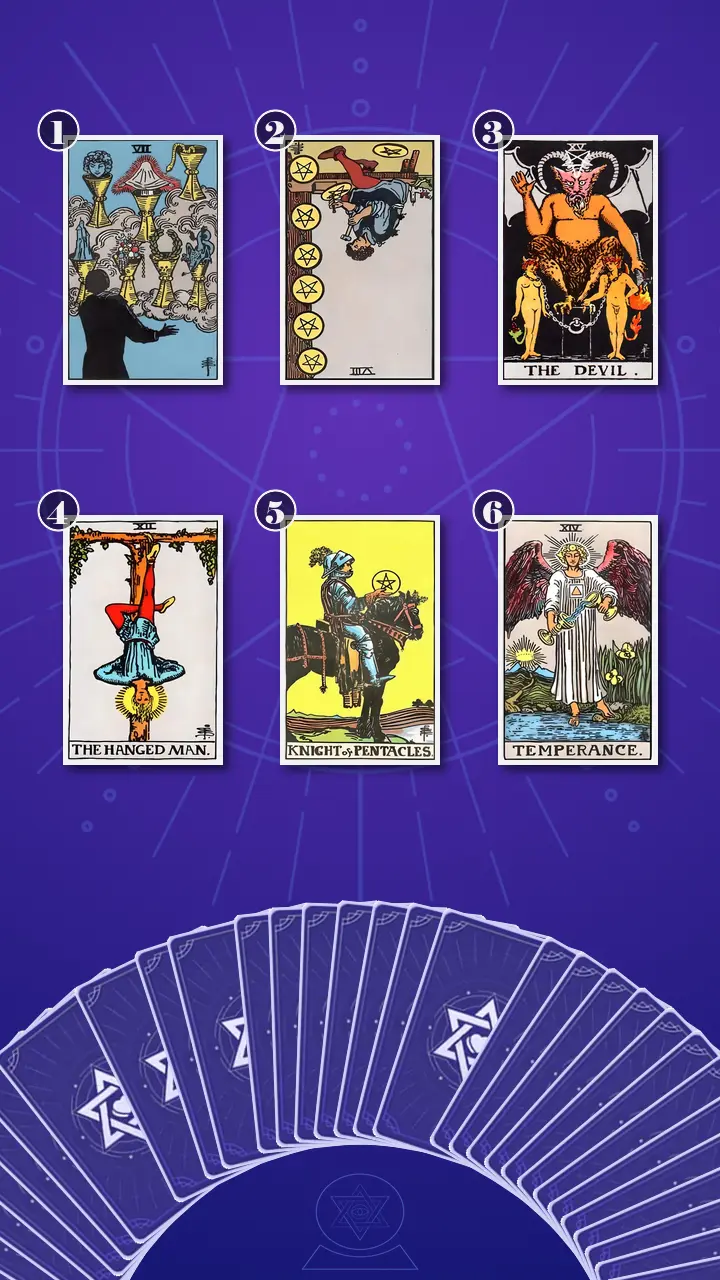
I arranged the cards in two rows of three. The top row would reveal the visible pattern, the immediate behavioral blockage, and the hidden reward keeping the loop alive. The lower row would show the interruption, the practical experiment, and the form of integration available after enough personal evidence had been collected. At the center, the second and fifth positions would face each other like a hinge: disrupted practice above, dependable practice below.
"This spread won't tell you that one method is destined to work," I said. "It will show us where your current process stops producing usable information, and what you can do differently at that point. You still decide what to test, when to stop, and what any result means for your life."
Seven Futures Floating Above the Coffee Table
Position 1: The Options That Never Reach the Ground
"I'm turning over the card that represents the visible pattern in your consultation question: accumulating self-help options and switching before one can be evaluated," I said. "It is the Seven of Cups, upright."
I pointed to the silhouetted figure facing seven cups suspended in clouds. Each cup held a radically different vision, and every vision was available to be admired. None was being held, tested, or used.
"This is your Sunday night," I said. "Three habit apps are open, a morning-routine comparison is playing, and a new Notion template is covering the journal you used last week. One option promises focus. Another promises calm. Another offers fitness, confidence, or the feeling that Monday will finally begin cleanly. Every future is visible, but no single exercise is in your hands long enough to meet your actual life."
The upright Cups energy held a genuine abundance of imagination and curiosity. Those were not flaws. In excess, however, possibility had become projection. Alex was comparing the polished fantasy attached to each new method with the unfinished, inconvenient reality of the method already underway. It was like scrolling a streaming menu for forty minutes because every thumbnail promised a better evening than the show already playing.
"The new plan feels clearer because it has not met real life yet," I said. "The useful question is not, 'Which option contains the most impressive future self?' It is, 'Which sufficiently suitable exercise can I physically use now?'"
Alex gave one short laugh, but there was no amusement in it. Their eyes dropped to the journal beneath the laptop. "That is so accurate it feels a little cruel," they said.
"Then let's be careful with the accuracy," I replied. "The card is describing a pattern, not insulting your curiosity. Having options is not the problem. Treating every option as a possible rescue route is what keeps your hands empty."
Position 2: The Workbench That Keeps Becoming a Dashboard
"Now I'm turning over the card that represents the immediate behavioral blockage: repetition gets interrupted whenever novelty fades or progress remains ambiguous," I said. "It is the Eight of Pentacles, reversed."
In the upright card, a craftsperson applies a hammer and chisel to one pentacle at a time. The repeated symbols form a visible record of patient work. Reversed, that rhythm was blocked. I saw the energetic problem as unstable Earth: Alex had plenty of information, but not enough repeated contact for knowledge to become embodied evidence.
"You plan ten minutes of journaling for seven days," I said. "Then you miss Tuesday. On Wednesday, instead of returning to the page, you build a more sophisticated tracker with new prompts, color-coded metrics, and stricter rules. The container improves while the practice disappears. The dashboard becomes cleaner, but the dataset never grows."
Alex's smile vanished. Their shoulders tightened, and one finger traced the edge of their mug as if following a familiar route.
"My thought is always, 'If this were working, I'd feel it already,'" they said. "So improving the setup feels more responsible than repeating something that might be useless."
I nodded. "That is where perfection disguises itself as efficiency. Apprenticeship looks ordinary from the inside. It contains missed days, uneven sessions, and stretches with no dramatic before-and-after moment. If you redesign the method every time it becomes ordinary, you never discover whether boredom is evidence of failure or simply evidence that you have reached the repeatable part."
For a moment, my mind flashed to unfinished work in my own studio. A painting never becomes itself during the exciting first sketch alone. The slower layers are less cinematic, but they are where the image acquires weight.
"The reversed Eight isn't asking you to force a punishing streak," I added. "It is warning against an overcorrection: turning a consistency experiment into an intensive protocol, then treating one missed session as a verdict. The repair is smaller. Ten minutes, one checkbox, and a return at the next available slot. Return is a better metric than perfection."
Position 3: The Relief Hidden Inside One More Search
"The next card represents the reinforcing root beneath the pattern: switching gives you short-term hope and temporarily restores a sense of control," I said. "It is The Devil, upright."
I watched Alex's expression sharpen at the name, so I addressed it before fear could fill the space.
"I don't read The Devil here as punishment, danger, or a prediction," I said. "I read it as an honest image of attachment. The two figures are chained, but the chains are loose. The card asks us to identify the reward that makes a harmful loop feel compulsory, and then notice where participation is still optional."
I brought Alex back to a crowded Line 1 train. Their current practice had begun to feel flat. A creator appeared on their phone promising that a different seven-day reset had changed everything. Alex knew the video could not evaluate their own results, but they opened it anyway. The brakes squealed, damp coats and takeaway coffee filled the carriage, and a quick lift arrived before the next stop: maybe this was the missing piece.
"The first inner line is, 'I'm not avoiding the practice; I'm making sure I don't waste time,'" I said. "The more honest second line is, 'For a few minutes, searching makes me feel back in control.' Novelty can relieve uncertainty without resolving it."
The Devil showed an attachment operating through immediate reward. The energy was not deficient; it was concentrated in the wrong interval. The search produced hope now, while the current practice could only produce evidence later. Each click trained the personal algorithm more effectively: whenever uncertainty rose, another transformation story arrived to soothe it.
Alex opened their mouth as if preparing to defend the research habit, then stopped. Their gaze shifted away from the card and settled somewhere beyond the screen. After several seconds, they exhaled through their nose.
"I do feel better when I find a new plan," they said quietly. "Not changed. Just... rescued for the evening."
"That distinction matters," I replied. "It means the loop is not mysterious. The trigger is uncertainty, the behavior is comparison, and the reward is immediate relief. Once you can see that sequence, the loose chain becomes a choice point. You don't have to shame the part of you that wants relief. You can give it a boundary that does not destroy the experiment."
When The Hanged Man Stopped the Scroll
Position 4: The Pause That Changes the Plot
The room seemed to become quieter as I moved to the lower row. Even the laptop fan on Alex's side had settled into a softer hum.
"I'm turning over the card that represents the key interruption to the loop: the pause between wanting to switch and adopting another method," I said. "It is The Hanged Man, upright."
I showed Alex the figure suspended upside down from living wood. The face was calm, and a halo surrounded the head. Nothing in the image suggested frantic optimization. The apparent lack of movement was voluntary, and that voluntary suspension made a different viewpoint possible.
"In daily life, this is a persuasive new routine appearing on your feed," I said. "You place the link in a folder called Review Later, dated for Sunday, and return to the current ten-minute exercise. You do not have to decide whether the recommendation is better. You can be interested without deciding today. The uncertainty stays, but the usual sequence has been interrupted."
The Hanged Man's energy was a deliberate balance rather than passivity: a feature freeze during a short sprint, not the abandonment of development. The pause created an observation window in which the urge itself could become information. Tight shoulders might say, "I want certainty." Restless fingers might say, "I want the relief of a clean start." Neither sensation had to become an instruction.
The Refusal of the Call Hidden Inside Constant Restarting
This was where I brought in the Hero's Journey Alignment lens I use when someone appears busy but remains stuck in the same scene. In story terms, Alex's switching resembled a subtle Refusal of the Call. They were not refusing growth by doing nothing. They were repeatedly accepting the trailer for a new adventure while cutting away before the actual character development began.
"Your call is not to discover the one perfect method," I told them. "It is to remain present when a workable practice loses its cinematic glow. That ordinary middle is where the character evolves. In your life's film, downloading the app is the opening montage. Returning after boredom, uncertainty, or a missed day is the scene that changes the protagonist."
I asked Alex to return to 11:40 p.m. on Sunday: three apps open, the comparison video running, and the old journal hidden beneath a clean template. Their shoulders tightened because choosing again felt safer than staying in a scene that had not yet produced proof.
"Switching methods gives you fast relief from uncertainty, but only a chosen pause gives your own experience time to become evidence," I said.
You do not need a more convincing method; you need a chosen pause long enough to see from The Hanged Man's inverted viewpoint and gather your own evidence.
I let the sentence remain between us.
Alex's inhale stopped halfway. Their thumb froze against the edge of the phone, and their eyes widened before losing focus, as though they were replaying a sequence of abandoned Monday resets. Their brow then drew tight. "But doesn't that mean I've been doing this wrong for years?" they asked, the words arriving sharper than anything they had said before. The anger held for two beats, protecting something more tender. Their jaw worked once. Their eyes shone, and they looked down at the half-used journal. Then their fingers loosened around the phone. A long breath left their chest, their shoulders dropped, and a small, unsteady laugh followed. I could see relief in the release, but also the slight vertigo that comes when a trap stops looking inevitable. If the pause was a choice, it also meant Alex would have to tolerate uncertainty without the familiar rescue of a new plan.
"It doesn't mean you were wrong," I said. "It means you found a strategy that genuinely worked for short-term relief, and now you can decide whether it still deserves that job. Now, with this new perspective, think back to last week. Was there a moment when this insight could have made you feel different?"
Alex remembered Thursday night. A friend's thirty-day challenge had appeared while Alex was preparing to do their own short exercise. They had taken the friend's visible result as evidence against a practice that had barely begun.
"I could have saved the post and kept my plan," they said. "I didn't actually need to decide anything that night."
"Exactly. The pause does not reject the new recommendation," I replied. "It protects your right to evaluate it later. That is the shift from borrowed certainty to personal evidence."
I asked Alex to begin a five-minute Review-Date Note. They wrote the method currently being tested, its smallest repeatable version, one observable metric called "session completed," and a review date seven days away. Beneath it, they added: "New recommendations go in Review Later until this date." I made the boundary explicit: this was a temporary experiment, not a permanent commitment. Three days could replace seven if pressure began to overwhelm clarity, and Alex could stop immediately if the method became unsafe, unaffordable, or clearly incompatible with their circumstances.
I saw the central emotional movement settle into place: from restless frustration and certainty-seeking toward grounded self-trust based on personal evidence. This was not certainty yet. It was the smaller, more durable capacity to let incomplete evidence exist without reopening the entire decision.
One Pentacle, Then Two Measured Cups
Position 5: The Practice That Only Has to Return
"I'm turning over the card that represents the practical experiment: one small version of one method, repeated for a fixed period and measured by completion rather than immediate transformation," I said. "It is the Knight of Pentacles, upright."
The Knight sat on a stationary dark horse, holding one pentacle with both hands. Cultivated fields extended behind the rider. After the Seven of Cups offered seven dramatic futures, this card looked almost stubbornly uneventful. That was precisely its strength.
"This is you choosing one ten-minute journaling exercise and scheduling it for 7:15 p.m. for seven days," I said. "You record only whether the session happened. If Wednesday is missed, you return on Thursday. You do not add modules, backfill the session, punish yourself, or rebuild the tracker."
The Knight's Earth energy restored what the reversed Eight had blocked. It held one variable steady long enough for the result to become interpretable. Reliability was in balance here, but I warned Alex not to push it into rigidity. A two-minute minimum version still counted as contact with the practice. A fair trial is temporary commitment, not a life sentence.
"This does not need to impress me today," Alex said, testing the language. "It only needs to be repeatable enough to produce data."
"Yes," I replied. "The Knight is not asking you to marry a journaling method. The Knight is asking you to keep one appointment with reality."
Alex selected a single prompt already available in the half-used journal. I watched them create the recurring calendar event without changing the rest of the week. Their movements were slower now. When the phone suggested adding another reminder, they declined it.
Position 6: Temperance and the End of the Total Reset
"The final card represents the integration available after a fair trial: reviewing evidence, retaining useful elements, and adjusting without a total restart," I said. "It is Temperance, upright."
I traced the measured stream moving between the figure's two cups. One foot rested on land and the other in water, holding practical facts and lived feeling inside the same process.
"Imagine reaching your scheduled review date at a Queen West café," I said. "You have seven completion marks and a few brief notes about friction. You notice that the prompt was usable, but late-evening sessions failed on office days. Instead of declaring the method perfect or useless, you keep the prompt and move the time to lunch for the next trial. That is Temperance: one measured change instead of another clean-slate restart."
Its energy was balanced integration. The card did not require rigid loyalty to a method, and it did not treat doubt as an enemy. Doubt could become information at the agreed review point. Feelings could be recorded without being promoted into automatic exit commands.
"At the review, ask only three things," I said. "What actually happened? What created friction? What is the one variable worth changing? Then choose to continue, adjust, or stop for a stated practical reason. All three outcomes remain valid. The important difference is that your decision will come from the experiment you lived, not the transformation story you happened to see that morning."
Alex looked across the full grid. Their attention moved from the Seven of Cups to the single pentacle, then to the controlled exchange between two cups.
"So I don't have to follow one system with total purity," they said. "And I don't have to burn it down when one part doesn't fit."
"Right," I said. "Temperance replaces belief versus rejection with calibration. You are allowed to keep what works, change what creates friction, and leave the rest behind."
The Review-Date Container
Why the Search-and-Restart Cycle Kept Repeating
I gathered the six cards into one coherent story. Alex's work life had trained them to scan dashboards, compare options, and react quickly to new information. Those skills helped in a marketing role filled with Slack messages, browser tabs, campaign metrics, and short deadlines. In their inner life, however, the same optimization reflex had started treating every uncomfortable feeling as a performance alert.
The Seven of Cups showed the visible overload. The reversed Eight of Pentacles showed where the sequence broke: Alex left the workbench before repetition could generate evidence. The Devil revealed why the interruption repeated, because searching provided an immediate dose of hope and control. The Hanged Man created a chosen pause. The Knight of Pentacles turned that pause into bounded repetition. Temperance made the eventual review proportional rather than absolute.
The cognitive blind spot was simple but consequential: Alex had been treating relief as evidence and ordinariness as failure. A new method felt more effective because it had not yet encountered fatigue, hybrid-office evenings, missed days, or a cold Wednesday kitchen. It was an untested trailer competing against raw footage from real life.
I returned to the metaphor that shapes my work as both an artist and a tarot reader. Our lives are films still in production. Alex did not need to keep replacing the script whenever a scene became difficult to shoot. They needed to let one small scene run long enough to discover what it contained, then enter the editing room with actual footage.
The transformation direction was therefore not stricter discipline or blind loyalty. It was moving from immediate certainty to a bounded experiment with a preset review date, one observable behavior metric, and one-variable adjustment. Options could remain available. They simply could not interrupt the experiment every time doubt appeared.
The Character Bible Directive
To turn the insight into actionable advice, I used my Character Bible Directive. In film production, a character bible defines how someone behaves under specific pressure. It does not say that the character is flawless. It tells the writer what they do when the old conflict returns.
I asked Alex to write the behavioral specifications of their Steady Practitioner, the future self they wanted to begin embodying now. This character did not feel certain every day. They saved new recommendations without adopting them, kept the smallest scheduled appointment, returned after a missed day, and waited for the review date before changing the plan. Through Vision Actualization, the limiting line "I'm not ready until I find the right method" became a more useful direction: "I become ready by gathering evidence from one workable experiment."
- Write the five-minute Character Bible.In a phone note, name one method already available, define its ten-minute version and two-minute minimum, choose one recurring time, add a completion-only checkbox, and set a review date three to seven days away.Keep the specifications behavioral. Do not require the future self to feel motivated, transformed, or certain.
- Install the Review Later pause.Create a phone note or browser folder called Review Later. When a new self-help recommendation appears before the review date, save it there, set a 90-second timer, and record the trigger, the body sensation, and what the new method seems to promise.The link is postponed, not rejected. Take one breath and return to the current practice. End the experiment early if it becomes unsafe, unaffordable, or clearly unsuitable.
- Run the one-variable Temperance review.At the chosen date, spend no more than ten minutes answering: What happened? What created friction? What one change is worth testing? Use completion marks and lived experience to choose continue, adjust one variable, or stop for a practical reason.Review only the experiment that actually happened. Leave every other comparison in Review Later, and use the Return-Not-Restart rule after any missed day.
"None of these steps asks you to prove that your chosen method is perfect," I said. "They create a temporary container in which your experience can speak loudly enough to be heard. The cards supplied the map. You decide where to place the boundary, what counts as useful evidence, and which direction you take afterward."

A Week Later: The Quiet Proof
Seven days later, I received a message from Alex with a screenshot of six checkmarks and one blank space. The blank was Wednesday. It had not been backfilled, decorated, or turned into a new dashboard.
"I missed one session and hated seeing the gap," they wrote. "But I did Thursday's session instead of designing Final Routine v5. I also saved two videos in Review Later. Apparently the world continued."
At their review, Alex saw that the journaling prompt was usable but the 7:15 p.m. time collided with the commute on office days. They changed one variable and moved those sessions to lunch. They paused an unused app subscription using actual use data rather than guilt. They had not solved self-improvement, and they had not become immune to comparison. They had completed one honest experiment.
They slept through the night after setting the next review date. Their first thought in the morning was, "What if this is wrong?" This time, they smiled and left the date where it was.
I think of that unchanged date as the quiet proof of our Journey to Clarity. Tarot did not predict the perfect method or manufacture Alex's progress. It helped us make the feedback loop visible. Alex created the change by pausing, returning, observing, and choosing what to do with the evidence. The authorship remained exactly where it belonged: in their hands.
If tonight your practice turns ordinary and your hand reaches for the phone, the tightness in your shoulders may be holding both sides of the struggle: your sincere need for change and your fear that staying long enough to receive an answer might expose how uncertain you feel. Simply noticing that moment means you are no longer standing at the original starting line.
If you did not have to prove that a method was perfect, which tiny practice could you leave unfinished but uninterrupted until one review date of your own, letting The Hanged Man's inverted pause protect the scene long enough for your experience to become evidence?