A Reunion Opened the Calendar; One Agreement Changed the Pace

When a Reunion Feels Like Proof of Relationship Readiness
“You can coordinate three launches at a Toronto tech company, but one warm message after weeks of silence still sends you into Relationship Readiness Anxiety before you have asked what has concretely changed,” I said to Avery.
I had asked Avery to describe the moment in detail. At 11:43 p.m. in their Toronto condo kitchen, they had screenshotted the message, “I think we finally get each other,” and opened next month’s calendar to check concert dates. The fridge hummed, the radiator clicked, and cold tile pressed through their socks. Their jaw stayed tight while their stomach fluttered, as if making a plan could build a bridge before either person had checked whether the old one still held.
“Why do I keep treating each reunion as proof we’re finally ready?” Avery asked. I heard the contradiction underneath it: the desire for every return to prove that the relationship was finally ready, set against the fear that perhaps neither person was finally ready at all. The reunion brought relief, but the relief arrived before any clear conversation about boundaries, repair, consistency, or what each person could actually offer.
I could hear longing in the way Avery reached for the phone again. It was not vague or decorative; it felt like a tight elastic band around the chest that loosened whenever contact resumed, only to snap back against the ribs when a reply was delayed. Hope, doubt, and grief were all sharing the same small space.
“You do not have to dismiss the tenderness to examine the conclusion,” I told Avery. “The reunion can be real, and we can still ask what it means in present-day behavior. Our work today is to let the cards help us draw a map through the fog, so you can decide your pace with more information and more self-trust.”

Choosing a Compass for Reunion Versus Reconciliation
I invited Avery to take one slow breath and name the question they wanted answered, without trying to force a final relationship label. I shuffled slowly while they listened to the cards move against one another. I use this small pause as a change of attention, not as a supernatural test: it gives the body a moment to stop reacting to the latest notification and gives the mind a cleaner place to begin.
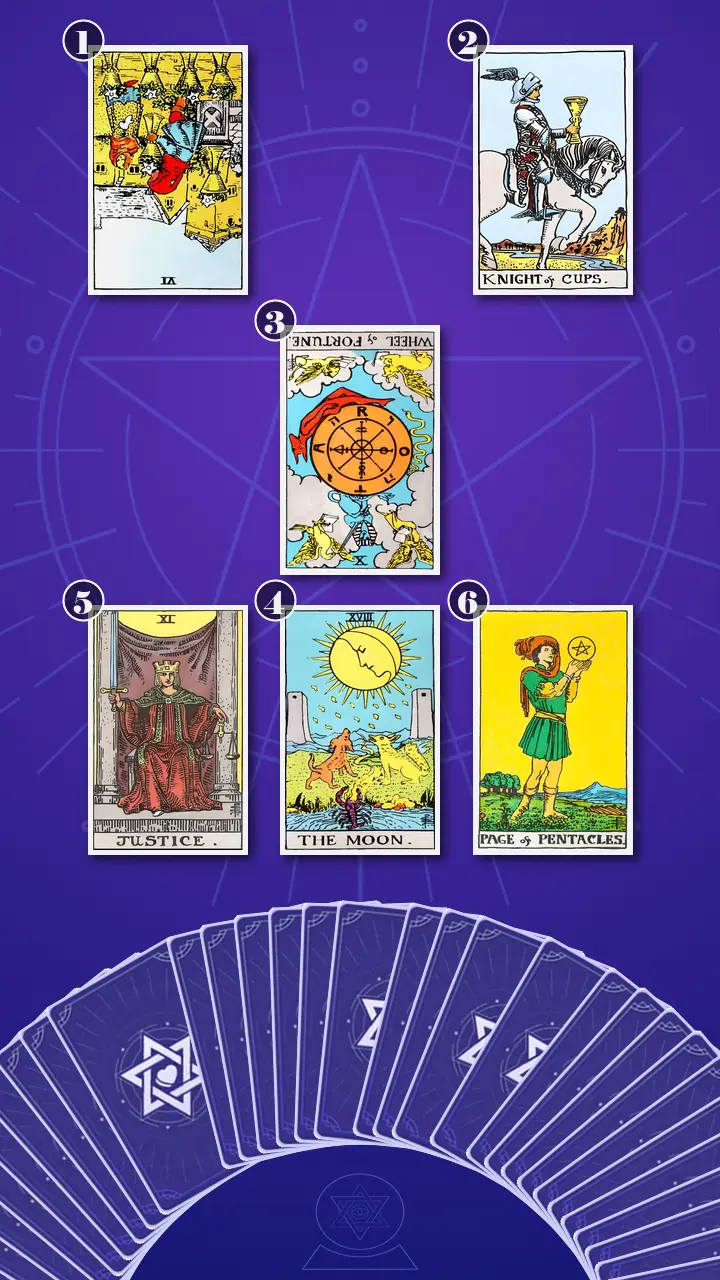
“Today I’m using the Relationship Spread · Context Edition,” I said. “It is a contextualized six-card relationship spread designed for a repeating reunion pattern. It does not predict whether you will stay, leave, reconcile, or separate, and it does not claim access to the other person’s private motives.”
I explained the method for anyone reading along with us. A classic six-position relationship spread is the smallest structure that can hold the whole question: Avery’s current stance, the observable reunion invitation, the shared cycle, the blind spot, the inner resource, and one practical next step. In this version, the second position focuses on what the other person actually says or does, and the sixth position becomes a self-directed experiment instead of a predicted outcome. That is how I use tarot as a reflective tool: the cards create an honest sequence of questions, while the querent remains the person who interprets evidence and makes choices.
“The first card will show how your own longing and post-reunion habits shape the meaning you assign to contact,” I continued. “The center card will show the repeating relationship pattern. Beneath it, we’ll look at the uncertainty or projection that keeps the pattern persuasive. Then Justice will show the resource of fair standards and accountability, and the final card will give us a small way to gather information without asking one reunion to settle everything.”
The Old Thread on the TTC
Position 1: Six of Cups Reversed and the Tenderness of the Past
“Now I’m turning the card for the position that presents your current stance and the specific habit of treating renewed contact as evidence that the relationship is finally ready.”
I turned over the Six of Cups, in reversed position.
The card showed me the emotional archive Avery kept reopening. On the morning commute after the latest reunion, Avery searched the iMessage thread for “miss you,” reread the messages that had once made the connection feel safe, and screenshotted the newest affectionate line beside them. When the Line 1 train entered a tunnel, the window became reflective. Avery saw their own face layered over the glowing conversation, and the thought arrived almost automatically: “Because this still feels tender, maybe it must be ready.”
In the current-stance position, the reversed Six of Cups shows an excess of preserved tenderness and a shortage of present-day checking. The feeling is genuine, but memory is being asked to answer a question it cannot verify. A saved message can prove that a feeling existed. It cannot confirm that the current version of the relationship has addressed the old issue.
I kept the distinction gentle. Nostalgia was not foolishness, and the history was not meaningless. I said, “The emotional continuity may be real. What I want to separate is emotional continuity from relational readiness. One belongs to what you have shared; the other has to be learned from what is happening now.”
Avery did not nod. They gave a small, bitter laugh and rubbed the edge of their phone with one thumb. “That sounds almost cruel,” they said. “Because the tender part is the part I can actually feel.”
“I understand,” I replied. “I’m not asking you to prosecute the tender part. I’m asking you not to make it carry a job it cannot do alone. The reunion is real; the conclusion still needs evidence.”
Avery looked down at the card, then slowly placed the phone face down. The gesture was small, but I saw the first separation between the warmth of the message and the meaning Avery had assigned to it.
Position 2: Knight of Cups Upright and the Invitation in Motion
“Now I’m reading the position that shows the observable reunion behavior or invitation being treated as evidence, without claiming to know the other person’s private intentions.”
I turned over the Knight of Cups, in upright position.
The Knight carried a cup forward at chest height, moving through a landscape beside a flowing river. I saw the image in the careful apology Avery had received after weeks of distance, followed by the message, “I want to see where this could go.” A date was proposed. The wording was emotionally articulate. The reunion felt intentional enough that Avery began to treat the invitation as a guarantee of future reliability.
The upright Knight of Cups brings sincere-seeming emotional movement, romantic language, and a beautiful offer. Its strength is the willingness to approach rather than disappear. Its imbalance is momentum without a settled place to land. A cup held forward is an invitation, not yet a pattern of reciprocal behavior.
“I can read the words and actions that were observable,” I told Avery. “I cannot use this card to declare what the other person secretly feels or what they will do forever. The useful question is: what practical conversation needs to accompany this invitation so that both of you understand what you are stepping into?”
Avery’s shoulders lifted as though preparing for a difficult meeting. Then they lowered them halfway. “I keep thinking that asking for the practical part will make the emotional part disappear.”
“That fear makes sense,” I said. “But a ready connection does not become less real because it can survive a clear question. The question gives the invitation somewhere honest to land.”
The Wheel That Kept Turning Under New Messages
Position 3: Wheel of Fortune Reversed and Recurrence Without Repair
“Now I’m turning the card for the shared relational pattern that turns repeated reunions into confirmation, including what gets relieved for a moment and what remains unresolved.”
I turned over the Wheel of Fortune, in reversed position.
The large wheel occupied the center of the card, with figures rising and falling around it while the sphinx remained above, sword in hand. I heard the sequence in Avery’s story: distance, a warm message, a reunion, couple-like closeness, an avoided conversation, ambiguity, and then another return. The dates changed. The apology changed. The neighborhood or occasion changed. The route remained familiar.
“This return feels new because the relief is new,” I said, “but what part of the pattern is actually new?”
Avery’s stomach dropped. Their breath paused halfway in. I watched their eyes lose focus as they silently counted previous reunions, then saw their fingers tighten around the phone before releasing it. “Oh,” they said quietly. “It’s the same sequence. I just keep giving each version a different title.”
The reversed Wheel is a blockage of integrated learning. There is movement, but no reliable sign that the movement has changed the underlying pattern. Reopening the same project ticket with a new title does not resolve the bug underneath it. A new message can make a recurring calendar event feel significant, but its reappearance proves repetition, not progress.
I used my Attachment Loop Diagnosis here as a map rather than a label. This tool helps me examine whether friction is being sustained by an anxious-avoidant trap, deep insecurity, or another repeating response pattern, without diagnosing either person from a single conversation. In Avery’s case, the most useful sequence was visible enough: contact resumed, relief softened the chest, closeness returned before the difficult question, ambiguity followed, and the next reunion became necessary to restore certainty.
“The point is not to blame you for participating in the loop,” I said. “The point is to see where you still have choice. You can observe what happens after the return before calling it transformation.”
Avery sat very still. The recognition was not comforting in a simple way. It had the weight of finding a familiar street on a map and realizing it led back to the same intersection. After a long silence, Avery whispered, “Recurrence is movement, but it is not automatically repair.”
I let the phrase remain between us. Then I added, “You do not need to break the loop with an all-or-nothing verdict. You only need to stop asking relief to sign the certificate.”
Position 4: The Moon Upright and the Facts Hope Completes
“Now I’m reading the position that identifies the blind spot in the assumption that renewed contact proves readiness, including the uncertainty or projection that hope may be filling in.”
I turned over The Moon, in upright position.
I returned with Avery to the late-night kitchen. The affectionate message was bright on the phone while the rest of the room stayed dark. The fridge hummed like a low electrical note. The screen showed what had been written, but it did not show how conflict would be handled, how often contact would happen, whether repair had been completed, or what either person could sustain.
“Try the split exactly as it is,” I said. “What I know is… What I am filling in is…”
Avery’s jaw tightened first. Their eyes moved from the message to the dark window, as if the answer might be written in the reflection. Then their chest rose and held. “What I know is that they apologized and asked to see me,” they said. “What I am filling in is that the next time things get hard, they’ll stay present.”
The Moon does not prove deception, hidden motives, or a false invitation. It shows incomplete information becoming emotionally conclusive. Its moonlight reveals enough to keep walking, but not enough to see the entire route between the two towers. Hope can act like autocomplete, finishing a sentence before the other person has actually written it.
I use Shadow Projection Analysis at this point as a way to identify what fear or unmet need may be entering the blank spaces. I was not telling Avery that their hope was imaginary or that their partner was secretly representing something sinister. I was asking whether the fear of losing belonging and safety had begun supplying answers that the present behavior had not yet provided.
“I can see how asking the question might feel like turning off the only light,” Avery said.
“We are not turning off the light,” I answered. “We are checking which part of the path it actually illuminates. You can hold longing and uncertainty in the same frame.”
Avery unclenched their jaw by degrees. Their phone stayed face down for the rest of the reading.
When Justice Asked for Words and Follow-Through
Position 5: Justice Upright and the Fairness of Evidence
The room became unusually quiet when I reached the key card. Even the sound of traffic outside seemed to flatten into a distant hush.
“This is the position of the internal resource that can separate longing from evidence through fairness, self-trust, accountability, and clear personal standards.”
I turned over Justice, in upright position.
The balanced scales and upright sword offered a different kind of clarity from the cups and moonlight. The scales were not a courtroom verdict. They were a fair comparison. One side could hold affectionate words, and the other could hold explicit agreements and repeated follow-through. Neither side needed to be erased to protect the preferred conclusion.
I moved the warm message thread to one side of the table and opened a plain note on my phone. I told Avery about my Projection Detachment Exercise, a structured journaling prompt I use to separate a partner’s actual behavior from the triggered internal narrative that can gather around it. I asked them to write two columns: “What felt meaningful” and “What was observably different.” Then I asked for one question that would need an answer before offering more emotional access. The question did not have to be sent that day.
At 11:43 p.m., the refrigerator hums while you screenshot one tender line and open next month’s calendar, your chest loosening before either of you has named what would be different this time.
Do not treat renewed contact as proof that you are finally ready; weigh what is observable, reciprocal, and accountable, like Justice balancing the scales before lifting the sword.
For a moment, I said nothing. The sentence seemed to settle over the old message thread without condemning it.
A reunion can reopen the door, but readiness is not the feeling at the threshold; it is the pattern of reciprocal, accountable behavior that follows.
Avery’s face went still. First, their breath stopped and their pupils widened slightly, as if the words had arrived before they could prepare a response. Then their gaze drifted toward the notes app, replaying the weekends, apologies, and postponed questions that had been stored as separate emotional flashes. Finally, their shoulders dropped with a quiet, almost startled release. The fist they had made in their lap opened finger by finger. Avery exhaled from deep in the chest, but the exhale carried a tremor rather than a clean victory.
“I don’t have to punish my hope,” they said. “I can ask it to share the room with evidence.”
“Exactly,” I said. “Now, use this new perspective to think back to last week. Was there a moment when separating what felt different from what was observably different could have changed how much access you offered?”
Avery nodded slowly, then stopped. The clarity had brought relief, but it also left a small, bright vulnerability behind. If a reunion was no longer a stamped certificate, Avery would have to participate in the evaluation. That responsibility felt steadier than helplessness, but it was still responsibility.
This was the first real movement from longing-driven confirmation seeking toward grounded self-trust based on observable relationship behavior. Nothing in the card promised a particular outcome. Justice gave Avery something more useful: a fair method for deciding what the next piece of closeness could rest on.
Position 6: Page of Pentacles Upright and the Smallest Honest Test
“Now I’m turning the position deliberately reframed as a self-directed, reality-based experiment for checking readiness through behavior rather than through the reunion’s emotional force.”
I turned over the Page of Pentacles, in upright position.
The Page studied one pentacle at eye level while standing in a cultivated field, with mountains visible in the distance. I saw Avery’s project-coordinator mind recognize the image immediately. This was not a full product rollout. It was a small pilot: one clearly defined feature, one transparent test, one review date, and no claim that the entire system had been rebuilt.
“Choose one mutually understood behavior,” I said. “For example, ask, ‘When plans change, how will we let each other know?’ Discuss only that question in a calm conversation. If you reach an agreement, observe what happens over seven days. Record three lines: Agreed. Observed. Still unclear.”
The Page’s upright Earth energy slows the demand for immediate certainty and turns Justice’s standards into patient learning. Avery does not need to monitor private activity, invent secret criteria, or force a dramatic declaration. One transparent agreement can produce more usable information than another night of decoding affectionate messages.
Avery glanced at the card and then at the blank note. “I don’t need the whole relationship solved tonight,” they said. “I can learn from one clear agreement.”
“That is the practical exit,” I replied. “You remain free to pause, revise, or decline the experiment. The card gives you a way to gather information; it does not take your choice away.”
From Emotional Intensity to Actionable Advice
When I placed the six cards together, the story became coherent. The reversed Six of Cups showed preserved tenderness answering a present-day question it could not verify. The Knight of Cups showed a compelling emotional invitation that deserved attention but not automatic trust. The reversed Wheel showed how each return produced relief before repair had been examined. The Moon showed how incomplete information became vivid enough to feel conclusive. Justice supplied fair standards, and the Page of Pentacles turned those standards into one modest practice.
The cognitive blind spot was not that Avery hoped. It was that hope had been asked to function as information. Avery treated renewed contact like a stamped certificate saying the relationship was finally ready, then moved back into couple-like routines before checking whether the underlying pattern had changed. The transformation direction was clear: shift from treating renewed contact as proof to testing readiness through specific agreements, accountable repair, reciprocal follow-through, and self-respecting boundaries over time.
I also named the fear underneath the cycle. If Avery stopped treating a reunion as proof, they might have to face the possibility that the relationship was emotionally real but still unable to offer belonging and safety in a consistent form. I did not use that fear to push Avery toward staying or leaving. I used it to explain why a practical question could feel more dangerous than another affectionate message.
- The Projection Detachment ExerciseWithin ten minutes of the next emotionally significant exchange, open a private phone note and set a seven-minute timer. Write one sentence under “What felt meaningful” and one under “What was observably different,” then add one question you would need answered before offering more emotional access.Keep the note about events, not motives. “They called when they said they would” is usable evidence; “They finally care” is an interpretation. If seven minutes feels too much, write one fact and one unclear point, then stop.
- The One-Agreement Readiness PilotBefore making a new shared plan this week, ask one calm, specific readiness question, such as “When plans change, how will we let each other know?” If an agreement is reached, set a seven-day calendar reminder and review only what was agreed, observed, and still unclear.Do not make the experiment a secret test or ask it to decide the relationship’s entire future. Both people should understand the agreement, and you can review the next single relevant interaction if seven days feels too loaded.
- The Emotional Access PauseBefore restarting daily messaging or accepting a couple-like plan, check what level of contact feels sustainable for the next week. If you need time, use a holding line such as, “I’d like to think about that before I commit. Can I get back to you tomorrow?”Frame the boundary around your own availability, not as punishment or leverage. You do not owe immediate access because contact has resumed, and you do not need to decide the final relationship label before choosing your pace.
“This is how the relationship spread becomes useful,” I said. “It does not replace your judgment. It gives your judgment a cleaner surface. You can let emotional truth and observable evidence sit beside each other, then decide what level of closeness is self-respecting for you.”

A Week Later, the Screen Stayed Dark
Six days later, I received a message from Avery while I was making tea. They had asked the readiness question about changed plans. The conversation had stayed warm, but it had also become specific. They agreed to communicate directly when plans changed, and Avery waited long enough to observe whether the agreement appeared in behavior before opening the calendar again.
Avery still woke with the thought, “What if I’m wrong?” The difference was that they smiled, checked the note, and did not immediately search the old thread. The plan was clearer, and the morning still contained doubt. That was the bittersweet proof: not a solved relationship, just one less decision made by panic and one more decision made from observed behavior.
I thought of the Page holding one pentacle against a much larger landscape. The point had never been to solve every question in one sitting. The point was to let one concrete fact become stronger than one emotionally vivid assumption. A reunion had reopened a conversation; Avery had begun learning what the conversation could actually hold.
That is the Journey to Clarity I wanted for Avery: not certainty borrowed from the cards, but a steadier way to notice, ask, wait, and choose. The power remained with Avery throughout. I was there to help untangle the knot, not to decide what the relationship should become.
When someone comes back warmly, the chest can loosen so quickly that hope feels like safety, even while part of you is still bracing for the old ambiguity to return. If this reunion were an invitation to notice rather than a verdict, what one small piece of follow-through would you be curious to watch?