Still Checking Your Ex While Dating: A Pause Before Escalation

The 12:40 a.m. Split-Screen: Rushing Into Someone New Before Letting Go
“You are 27, working a hybrid junior creative job in Toronto, and your Sunday Scaries now include checking whether your ex posted before reopening Hinge so the apartment does not feel quite so quiet.” I began with that sentence when Alex sat down across from me, because it named the pattern without turning it into a character flaw.
I could see the 12:40 a.m. scene they had described: a dark bedroom, the radiator clicking behind the wall, a streetcar grinding faintly somewhere beyond the window. Their phone was warm against their palm as they moved from the ex’s profile to a new match’s affectionate message, typed a suggestion for a weekend in Montreal, then returned to the ex’s page before sending. Their thumb would not stay still. Their chest had become a small locked room.
“Why do I keep rushing into someone new before releasing my ex?” Alex asked. “I know it is too soon, but slowing down feels worse. I keep calling it chemistry when I am really trying not to feel the gap.”
I heard the contradiction clearly: Alex wanted a genuine new relationship, but could not yet release the old bond. They were moving quickly toward someone new while keeping the former connection one tap away. Longing was not just an emotion in that room; it was like a tide pulling one hand toward the next shoreline while the other still clutched a key to the apartment they had supposedly left.
“The new person may be genuinely interesting,” I said. “We do not need to discredit that attraction to understand what else is happening. Today, we can look at the trigger, the behavior that follows, the brief relief, and the cost. Let us draw a map through the fog so you can decide what happens next. The cards can offer an objective mirror, but you remain the person steering your life.”

Choosing a Compass for the Relationship Loop
I invited Alex to put both feet on the floor, take one slow breath, and name the question again without trying to solve it. I shuffled at an ordinary pace, using the movement as a transition from scrolling and reacting into noticing. Tarot, in this setting, was not a supernatural verdict; it was a structured way to place an emotional system where we could both see it.
For this reading, I chose the Transformation Path Grid · Context Edition. For anyone asking how tarot works when the problem is rebound urgency, this six-card spread is useful because it follows a complete sequence: observable behavior, immediate blockage, compulsive root, transformative interruption, practical response, and integration. It does not ask me to predict whether an ex will return or whether a new match is “the one.” It examines the system Alex can actually change.
I explained the layout as I placed the cards in two rows. The first three would show the rebound rush, the grip beneath it, and the self-reinforcing root. The second row would show the conscious ending that could interrupt the loop, the pace that could support a new connection, and the internal closure Alex could build through their own actions.
“We are not reading someone else’s private feelings,” I said. “We are reading your relationship with triggers, access, urgency, grief, and choice. That keeps the reading grounded. It also gives the power back to you, where it belongs.”
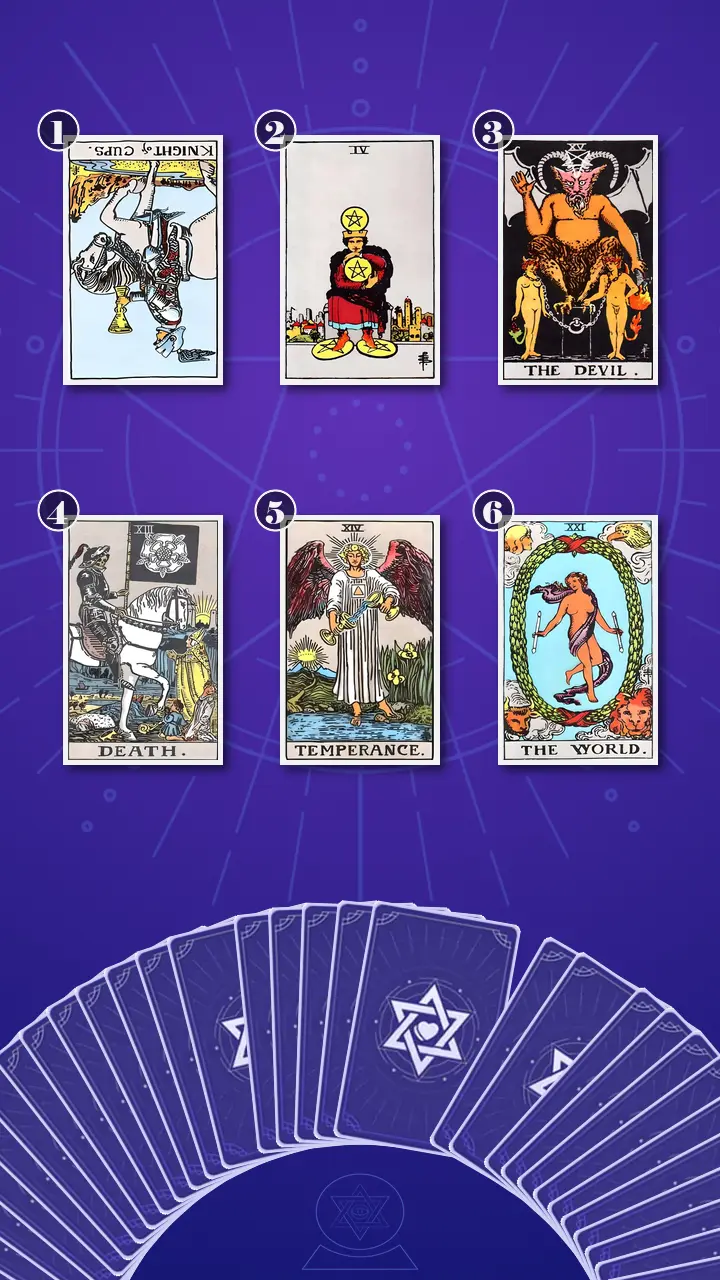
Reading the Map: The First Movement
The Offer That Outruns Readiness
Now I am turning over the card for the observable symptom from the diagnosis: accelerating messages, dates, and romantic projection with someone new while attention remains fixed on the ex.
The card was the Knight of Cups, reversed.
In the Rider-Waite-Smith image, the knight extends a cup as though carrying an emotional invitation, while the white horse advances with a controlled, measured step. Reversed, that measured approach becomes unstable. The romantic offer moves faster than the person carrying it has had time to become ready. I read this as an excess of emotional momentum and a deficiency of present-moment checking.
It matched the modern scene almost exactly. At 12:40 a.m., Alex received a warm message from a new match minutes after checking the ex’s profile. They moved from flirting to suggesting a weekend away and interpreted the rush in their body as proof of readiness, even though the urgency had begun with an old attachment trigger. It was like turning a promising Hinge chat into a full product launch before the first round of user research was complete.
“I am not saying the new match is fake or that you cannot like them,” I clarified. “I am asking whether the intensity is coming from this person in front of you, from relief that the silence has been interrupted, or from both. Those are different kinds of information.”
Alex gave a short, bitter laugh and looked down at the card. “That is too accurate. Honestly, it is a little rude.”
I smiled, but I did not soften the observation into something vague. “A useful mirror can feel rude for a second. It does not have to be a punishment.” Alex’s fingers stopped above their phone, and their shoulders lowered by a fraction. The attraction remained possible; the automatic meaning they had attached to it had begun to loosen.
I asked, “Think of the last time you checked your ex and then intensified a new chat. What did you send, suggest, or imagine within the next hour?” Alex mentioned a weekend plan that had seemed romantic when drafted and strangely urgent when reread in daylight. That distinction was our first piece of card meanings in context: emotional momentum was visible, but it was not yet the same thing as relational readiness.
The Pinned Tab Against the Heart
Now I am turning over the card for the immediate blockage behind the rebound rush: the attempt to preserve access, emotional ownership, or control over the former bond.
The card was the Four of Pentacles, upright.
The Four of Pentacles traditionally speaks of security, conservation, control, and clinging. In this position, its energy was an excess of preservation. I pointed to the figure pressing one pentacle against the chest while pinning two beneath the feet. Nothing could circulate because every point of contact was being held in place.
I translated the image into Alex’s digital environment: the old chat stayed pinned or immediately searchable, saved photos were one tap away, the ex’s profile remained in recent history, and online activity was monitored while a new match was asked for increasingly frequent reassurance. I said it sounded like keeping the ex’s chat as a permanently pinned browser tab while trying to focus on a new window.
“I am not trying to get them back,” Alex said quietly. “I just need to know I still could reach them. I need to know I still matter to them.”
“That is the important distinction,” I replied. “You may be preserving the meaning of the relationship, or you may be preserving immediate access to a reassurance ritual. Those are not the same. An ending can matter without every route back to it remaining open.”
I watched Alex glance toward the phone, then place it face down. Their breathing became shallow for a moment, as though their body had recognized the pinned chat before their mind wanted to name it. I did not ask them to delete photographs, make a dramatic announcement, or force themselves into total no contact. We only looked at which digital habits helped them remember and which ones kept the bond behaviorally current.
The Notification Loop Beneath the Surface
Now I am turning over the card for the self-reinforcing root: separation discomfort triggering replacement-seeking, temporary reassurance, deferred grief, and another round of checking.
The card was The Devil, upright.
I explained that this was not a prediction of danger, evil, or permanent captivity. In psychological tarot, The Devil can show a pattern that feels more powerful than it is because it is repeated often enough to become automatic. The chained figures in the image have collars loose enough to remove. That does not mean longing is voluntary. It means certain behaviors remain possible points where choice can re-enter.
I used my Attachment Loop Diagnosis as a lens, not a label. I mapped the sequence with Alex: an ex-related post or delayed reply; a drop in the stomach; checking the profile; intensifying the new chat; receiving an affectionate message; a brief physical relief; the relief fading; and the same sequence beginning again. The diagnosis did not ask whether Alex was an anxious or avoidant person. It asked what the loop was doing and what kept supplying it with energy.
“I cannot control missing my ex,” Alex said after a long pause. “So I try to control whether someone else wants me.”
“Exactly,” I said. “The new person is not the problem; the job you have given their attention is. Fast attention can feel like closure while keeping the breakup in charge.”
As I looked at the loose collars, I thought of Orpheus walking toward daylight while looking backward. I did not use the myth as a prophecy, only as a compact image for a familiar human contradiction: a person can sincerely want the threshold and still keep turning toward proof that the old world is there. My Jungian lens helps me ask what the image reveals, not claim that a card has diagnosed Alex’s childhood or fixed their future.
I then used my Shadow Projection Analysis carefully. I asked Alex what they might be placing onto the new match’s quick reply. Not a secret fact about the match, but a need or fear the reply had been recruited to carry. Alex named the fear of becoming unchosen and the hope that rapid intimacy could prove they were still important.
For several seconds, Alex’s breath froze and their fingers hovered over the phone. Then their eyes went unfocused, as if replaying the last few profile checks and affectionate replies in sequence. Finally, a low “Oh” rose from their chest, followed by a shaky exhale and an unplanned release in their shoulders. The insight synchronized with the body: the longing had arrived without permission, but the check-message-relief-repeat pattern was not the same thing as Alex’s worth.
When Death Raised the White Rose
The Threshold Where Release Becomes Observable
The room seemed to grow quieter as I reached beneath the first row. Even the radiator’s clicking felt spaced farther apart.
Now I am turning over the card for the key interruption capable of changing the loop: translating release from an abstract feeling into the conscious ending of specific bond-maintaining behaviors.
The card was Death, upright. I said its name slowly and immediately clarified what I meant: this card does not predict literal death, and it does not command Alex to erase the relationship, reject every new person, or perform an irreversible gesture. In the RWS tradition, Death is the necessary ending of a form. The white rose on the dark banner holds value and ending together; the sunrise beyond the two towers makes the unfilled space visible as a transition rather than a failure.
The life translation was concrete. Alex would not have to wait until they stopped missing the ex. They could pause one nonessential route of access for seven days and avoid compensating by escalating commitment with the new person. That might mean muting Stories, archiving the old chat, or removing a profile shortcut. It would not mean interrupting communication needed for safety, housing, finances, legal matters, shared care, or property.
Before I said more, I brought Alex back to 12:40 a.m.: the dark room, the warm phone, the ex’s profile, and a new match’s reply glowing beside a half-written Montreal weekend plan. Their chest tightened at the thought of putting either thread down; the empty space felt louder than the notifications.
“You do not need a replacement to survive an ending; name what is over and let Death's white-rose banner mark a conscious transition before you accelerate a new bond.”
I let the sentence remain between us. Then I gave them the sharper behavioral frame that had brought us to this card.
“Closure does not begin when you stop caring. It begins when you stop repeating the behaviors that keep the bond active.”
For a second, Alex’s breath stopped completely and their hand remained suspended above the face-down phone. Their gaze moved from the white rose to the blank edge of the table, replaying the profile check, the sudden Hinge reply, and the weekend draft as one connected sequence rather than three unrelated choices. Their eyes widened, then softened; their jaw released, and the fist resting against their knee slowly opened. A long breath left them with a faint tremor. The radiator clicked once, and the silence no longer sounded like an alarm. It sounded unfinished, which was different. Alex swallowed and whispered, “That means I can start before I feel done.” A small flicker of anger followed. “But does that mean I have been faking every feeling?” I told them no: genuine attraction and grief can coexist. The new person is not being declared false; they are simply being relieved of the job of proving that Alex is okay.
“Now, use this new lens to look back at last week,” I invited. “Was there a moment when ending one optional route of access could have made the next ten minutes feel different?”
This was the first real movement from urgent longing toward grounded readiness. Not a clean emotional finish, but a shift from waiting to feel released toward acting in alignment with an ending. Alex had found a place where behavioral closure could begin.
Between Two Cups, a Slower Yes
The Pace That Lets Attraction Tell the Truth
Now I am turning over the card for the practical response: slowing romantic escalation, separating attraction from relief-seeking, and allowing grief to be processed without immediate romantic substitution.
The card was Temperance, upright.
I pointed to the measured stream moving between the two cups and the angel’s balanced stance between water and land. Temperance does not demand withdrawal. Its energy is balance through repeated calibration. It asks Alex to let grief, attraction, boundaries, and readiness exist together long enough to become distinguishable.
I connected it to the promising new conversation. Alex could keep talking to the person without turning several days of chemistry into all-day contact, exclusivity language, sleepover plans, meeting-close-friends expectations, or a weekend-away fantasy. A slower pace was not a punishment for having feelings. It was a way to test whether each next step reflected present interest or the need to suppress an ex-related feeling.
“I can like this person and still wait before making this connection responsible for my stability,” Alex repeated, testing the sentence.
“Yes,” I said. “Slowing down is not the same as closing yourself off. It is giving genuine attraction enough room to become more specific than relief.”
Alex’s shoulders loosened. They pictured a coffee date with a clear beginning and end instead of an open-ended weekend designed to make the new person feel like a relationship immediately. The thought did not erase the ache, but it gave the ache less authority over the next message.
A Wreath Wide Enough for the Past
The World and the Shape of an Ordinary Tuesday
Now I am turning over the card for the integrated state that becomes available when the previous positions are understood and practiced: internal closure, a more complete identity, and the capacity to meet someone new without using them to replace the ex.
The card was The World, upright.
The World’s complete wreath became our image of closure. The central figure moves freely within a whole field rather than clinging to one corner of it. I explained that this was not a prediction of a new relationship or a promise that Alex would never miss the ex again. It was an integration target: the former relationship could become part of a larger life without remaining an open channel that organized every new expectation.
I asked Alex to imagine an ordinary Tuesday, not a dramatic final scene. The old chat could be archived. The ex’s online activity could go unmonitored. A new person could send a warm message and be met as a distinct person, not as evidence that the breakup had been defeated. Completion would be measured by Alex’s behavior and expanded identity, not by the ex’s response or by immediate commitment from someone new.
Alex studied the full six-card grid. Their eyes travelled from the knight’s extended cup to the pentacle held at the heart, then through the chains, the white rose, the two circulating cups, and finally the wreath. “I thought closure meant I would stop caring,” they said. “Maybe it can mean I stop asking the same rituals to keep the relationship alive.”
“That is the direction,” I said. “An ending can matter without remaining active.”
From Behavioral Closure to Paced Dating
When I placed the six cards together, I could see why Alex had felt stuck. The Knight of Cups reversed showed the visible rush: a warm message became a future plan before the body had recovered from the ex-related reminder. The Four of Pentacles showed the protective grip: keeping access to the old bond felt like keeping a door unlocked in case the new connection failed. The Devil showed the root loop: check, intensify, receive relief, lose the relief, repeat.
Death offered the interruption, not by demanding that Alex feel nothing, but by asking for one observable ending. Temperance supplied the skill of paced dating, where attraction could remain alive without being inflated into proof. The World showed the larger possibility: a complete self does not require an ex’s attention or a new person’s immediate commitment to establish belonging.
I named the cognitive blind spot plainly. Alex had been treating continued access as a way to honor the past and fast attention as evidence of moving on. Both behaviors actually kept the old relationship psychologically present. The new person was being asked to function as a replacement, a scoreboard, and a sedative at the same time. That was too much weight for any early connection to carry.
The key shift was simple to say and difficult to practice: pause romantic escalation for one week while naming the grief and attachment triggers that appear. The transformation was not from heartbreak to instant certainty. It was from using rapid new intimacy to escape breakup grief toward tolerating the space between relationships and approaching new connection with grounded readiness.
Alex looked at the list I had started writing. “I can barely find ten minutes,” they said. “My workday is Slack, Figma exports, the TTC, and then I am already tired. If I make this into another self-improvement project, I will probably avoid it.”
“Then we make it smaller,” I said. “This is not an exam, and you do not have to perform healing. The point is to gather information without shaming yourself. One sentence can be enough. Stop any exercise if it becomes too activating, and keep any necessary route of contact available.”
- The One-Route Threshold WeekOn one chosen evening, set a seven-day calendar event called Threshold Week. Pause one nonessential route of access to the ex, such as archiving the old chat, muting their Stories, or removing their profile from recent searches. Keep any route required for safety, housing, finances, legal matters, shared care, or property.Start with a 24-hour pause if seven days feels too large. No permanent deletion is required; the experiment is to notice what surfaces when one shortcut stops making the decision for you.
- The Projection Detachment ExerciseWhen the urge to check or intensify a new chat appears, set a ten-minute timer and open a blank note. Write two columns: Their actual behavior and My triggered internal narrative. Add the trigger, the body sensation, and what you hope the new person’s attention will prove. Then rate interest in this person and need for relief from the ex from 0 to 10.Do not use the ratings to judge the attraction. Use them to separate present evidence from the story activated inside you. If ten minutes is impossible, write one sentence in each column and stop.
- The 24-Hour Intimacy PauseFor seven days, save any message that introduces exclusivity, a trip, a sleepover, meeting close friends, or another future expectation. Reread the draft after 24 hours and ask whether it still reflects present interest rather than immediate relief. Keep genuine low-stakes contact, such as a coffee date from 2:00 to 3:30 p.m., without forcing it into couple mode.If 24 hours feels artificial, begin with two hours. You can say, “I like talking with you, and I want to keep the pace grounded.” A pacing boundary is information, not a loyalty test, and it does not require ghosting.
“So I am not trying to become detached from everyone,” Alex said.
“No,” I replied. “You are allowing each connection to meet you honestly. You are also letting the space between relationships be a space, rather than immediately assigning it the job of proving that you are wanted.”

A Week Later, the Quiet Proof
Six days later, I received a message from Alex while I was making coffee. They had muted the ex’s Stories, moved the old chat into an archive, and kept a future-oriented draft in Notes overnight instead of sending it at 12:40 a.m. The next morning, the message still felt warm, but it no longer felt like an emergency.
Alex also told me they had used the Projection Detachment Exercise after seeing a friend’s soft-launch photograph. Under actual behavior, they wrote that the new match had replied kindly and suggested another coffee. Under triggered narrative, they wrote, “If I do not make this serious now, I will become irrelevant again.” The two columns did not solve the grief, but they stopped those two facts from wearing the same coat.
They slept a full night, then woke with the old question, “What if I am wrong?” still waiting beside the bed. This time Alex smiled, left the archived chat untouched, and made coffee before opening the new person’s message.
I did not call that a finished transformation. Alex still missed the ex. They still had moments when both screens went quiet and their chest tightened. The proof was smaller and more credible: the next action no longer had to be dictated by the first surge of longing.
That is what I mean by a Journey to Clarity. The cards did not choose between the past and the future for Alex. The Transformation Path Grid made the trigger, the relief loop, the conscious threshold, and the next practical choice visible enough for Alex to choose with more room around the feeling.
When your chest tightens the moment both chats go quiet, it can feel as if releasing the old bond before securing a new one would leave you with no proof that you still belong anywhere. I do not treat that sensation as a verdict about your worth. I treat it as information asking for patience, language, and one behavior you can choose for yourself.
If the space between relationships did not have to prove anything about your worth, what is one small piece of that space—the unopened old chat, the unsent Montreal weekend plan, or ten quiet minutes after the streetcar—that you might be willing to leave unfilled tonight?