Six Dishes and a Ten-Minute Timer: From Refusal to a Chosen Start

When a Warm Mug Becomes an Autonomy Contest
If your workday ends and a self-written reminder makes you feel managed, I want you to know how specific that reaction can be. I met Alex (name changed for privacy), a 27-year-old non-binary product designer in Toronto, over video at 10:40 on a Tuesday night. They carried a warm mug toward the kitchen, saw the dishes beside the sink, and pivoted back to the sofa. Blue television light stretched across the condo floor. The fridge hummed under the faint scrape of streetcar brakes outside, and I watched their thumb open a stream of short videos almost automatically.
It was not that Alex did not see the task. Seeing it turned their evening into a negotiation.
"I want the kitchen to be clearer," they told me, still holding the mug. "But once I do it because I should, it stops feeling like my choice. I would rather leave it another night than feel like I gave in."
The resentment seemed to sit in their body like a house key clenched between their teeth: proof that the time was theirs, but painful to keep holding. Their jaw had tightened. Their shoulders were lifted toward their ears. When they returned to the sofa, I saw the brief exhale that came with postponement, followed almost immediately by the glance back toward the sink.
"So the question is not simply, 'How do I make myself do chores?'" I said. "It is, 'Why do I keep skipping chores when doing them feels like giving in?' You want a more comfortable home, but you also want ownership of the hours that remain after work. We are going to respect both needs while we look for clarity."
I added, gently, "You are not fighting the dishes. You are fighting what the dishes seem to mean."

Choosing a Ladder Through the Shadow
I asked Alex to put both feet on the floor, let their shoulders drop by one degree, and hold the question without trying to produce a perfect answer. I shuffled slowly. I do not treat this preparation as a mystical performance; it is a practical threshold between reacting to a problem and observing it.
For this reading, I chose The Shadow Spread, a focused four-card tarot layout. For anyone wondering how tarot works in a situation like this, I use the cards as structured prompts rather than commands or predictions. Their images help us separate behavior, protective fear, neglected perspective, and practical integration. That sequence made more sense here than a broad outcome spread because Alex did not need a forecast. They needed to examine the meaning their nervous system and inner dialogue had attached to an ordinary household task.
I placed the cards in two columns like the sides of a small ladder. The upper-left position would show the visible chore-skipping pattern. Beneath it, the second would reveal what the refusal was trying to protect. Across the diagonal, the third card would offer the key change in perspective. The fourth would bring that insight down into one bounded household practice.
The layout gave us two definitions of autonomy side by side: nothing gets to direct me on the left, and I choose what supports me on the right. The diagonal between them would matter most.
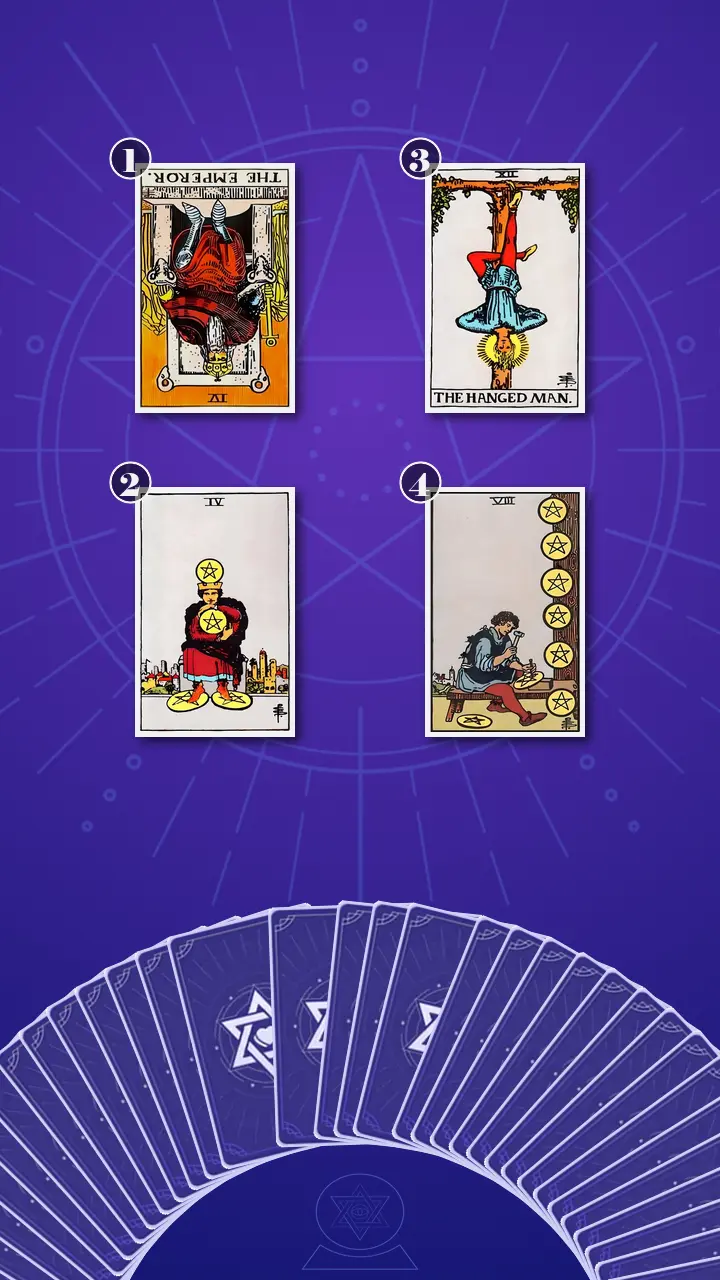
The Throne Hidden Inside a Todoist Alert
Position One: The Emperor Reversed and the Reflex to Refuse
"The card I am opening now represents the visible behavior," I said, "including the moment a chore begins to feel like compliance and your body contracts around the resentment." I turned it over: The Emperor, reversed.
I pointed to the stone throne, the armor, and the ruler's fixed posture. Upright, the Emperor can represent useful structure and self-governance. Reversed here, that authority energy was blocked and overcorrected. Alex was not lacking will. Their will had become so occupied with opposing structure that refusal was beginning to impersonate freedom.
I asked Alex to describe the previous Thursday. At 6:18 p.m., they had closed Figma after a hybrid workday. A Todoist notification appeared: take recycling down. Before they stood up, their jaw locked. They dismissed the alert, opened Instagram Reels, and left the blue bag beside the condo door.
"I wrote the reminder," Alex said, "but the second it appeared, it felt like a manager had assigned one more ticket."
That was the Emperor reversed in modern life. It was almost a Severance version of household administration: Alex felt managed by a system, except the system was one they had created for themselves. The scripts sounded different but formed the same authority contest: I have to do this now versus I refuse to let this tell me what to do. In both versions, the task still dictated the emotional terms.
"The notification disappears," I said, "but the recycling bag remains by the door. The task does not disappear when you postpone it; it starts renting space in your evening."
Alex gave a short, bitter laugh. "That is so accurate it is almost cruel." Their fingers tightened around the mug, then loosened as they looked from the card to the bag visible behind them.
"Accuracy should not become accusation," I replied. "This reaction has been trying to protect something real: your authorship over your time. We are only checking whether the protection now costs more freedom than it preserves."
Position Two: The Four of Pentacles and the Evening Held Too Tightly
"The next position reveals the protective mechanism underneath the refusal," I said. "It asks what feels at risk when ten minutes of maintenance seems capable of taking the entire night." The card was the Four of Pentacles, upright.
The figure held one pentacle against their chest while two more pinned both feet in place. I read this as an excess of protective earth energy: a real need for security and control had tightened into immobilization. What Alex guarded also prevented them from moving toward the comfort they wanted.
They described protecting an evening of scrolling, gaming, or watching a show as though it were a phone battery at three percent. Any chore seemed capable of draining the final charge. But the protected time was not fully restful. The dishes remained in peripheral vision. The recycling bag became something to step around. Saturday gradually filled with the maintenance that every weeknight had rejected.
"If I give ten minutes to the kitchen," Alex said, "my brain immediately asks what is actually left of my night."
I answered through a framework I call Rest Phase Legitimacy. In an orbit, not every phase is equally exposed, productive, or bright from our point of view. A low-energy evening is not a moral failure waiting to be corrected. Real recovery is necessary, especially when the same condo has already functioned as office, meeting room, and home.
But chosen rest and defensive paralysis are not identical. Rest can soften the body. Alex's current pattern left their shoulders braced while the unfinished task stayed active in the background. The Four of Pentacles was not telling them to optimize every minute. It was asking whether they were protecting recovery so rigidly that they could no longer use ten minutes of the evening to make the remaining time more comfortable.
"What feels most at risk?" I asked. "Your rest, your control over timing, or your confidence that you will be allowed to stop once you begin?"
Alex's eyes moved toward the kitchen. "The right to stop," they said after a while. "I do not trust a small task to stay small. Once I start, the whole apartment appears."
I wrote that sentence down. It shifted the problem from a character judgment into a design requirement: any useful next step would need a visible edge and a genuine exit.
When the Hanged Man Opened a Third Option
Position Three: Voluntary Stillness Instead of Defensive Stillness
Rain had begun tracing thin lines down Alex's condo window. The reflected city lights appeared upside down in the glass as I reached for the card at the top of the right-hand column. Even the room seemed to participate in the image before us.
"This position holds the neglected perspective," I said. "Its role is to separate useful yielding from capitulation and return authorship to you before the chore begins." I turned over The Hanged Man, upright.
I asked Alex to look first at the calm face and illuminated head, not the rope. The figure was physically suspended, but the relaxed hands suggested conscious stillness rather than defeat. The card carried a receptive energy that had been underused in Alex's loop: the ability to pause, observe the reflex to refuse, and change the meaning of participation before making a decision.
In everyday terms, I placed Alex beside an open dishwasher with their phone warm from scrolling. Instead of instantly tapping Dismiss or forcing themselves into a full kitchen reset, they could put the phone face down, place one hand on the counter, and ask, "Would loading six dishes make the next hour more comfortable for me?" They could choose the duration, the scope, and the stopping point before touching the first plate.
I then used my Micro-Cycle Energy Mapping as a diagnostic lens. I mapped the short orbit aloud: the laptop closed; Alex's energy naturally dipped; a reminder appeared; their jaw tightened; dismissal produced a quick rise of relief; scrolling extended the pause without making it restorative; guilt and backlog then pulled the next day lower. The map did not tell me Alex needed stricter discipline. It showed me that a legitimate recovery phase and an automatic avoidance phase had become tangled together.
"The goal is not to turn every low tide into a productivity opportunity," I said. "It is to notice the three-second gap before the reflex. That is where you can decide whether tonight calls for actual rest, one bounded act of comfort, or a consciously chosen later time."
I could see the familiar binary tighten around them: either obey the reminder and lose the night, or reject it and remain sovereign. Even the idea of a ten-minute task still sounded, at first, like a nicer label pasted over surrender.
You are not conceding to a command; you are choosing a perspective and an action that serve you, like the Hanged Man whose suspension is voluntary and changes what he can see.
I let the words settle. A streetcar bell sounded once through the rain.
You do not reclaim your time by making every task lose; you reclaim it by choosing what serves you and keeping the right to stop.
Alex's breath stopped for a beat. Their fingers hovered above the phone as if they had been about to dismiss another alert. Then their eyes lost focus, and I could almost see them replaying a week of doorways, laundry baskets, and half-carried mugs. Their brow drew inward. The first response was not relief but a flash of anger.
"But does that not mean I have been doing it wrong this whole time?" they asked. Their voice sharpened, then thinned. "Like I created half of the pressure I was trying to escape?" Their shoulders stayed high for another moment. Then one hand opened against their knee, their jaw released, and a long breath left their chest with a slight tremor. Their eyes reddened at the edges. The clarity seemed to bring both release and the unsteady feeling of discovering that a door they had been bracing against was never locked.
"It does not turn your past into a mistake or a verdict," I said. "Refusal gave you a fast way to protect yourself when your time felt overclaimed. We can respect that protection and still update it. You are learning that autonomy can include participation, not only resistance."
I asked, "Now, with this new perspective, think back: was there a moment last week when this insight could have made you feel different?"
Alex remembered standing beside the dishwasher on a rainy Wednesday at 8:47 p.m. One hand had been on the door while a home-reset video played on their phone. "I thought the only choices were do everything or walk away," they said. "I did not realize I could define six dishes as the whole agreement."
"Refusal is a choice," I said. "So is maintenance. A ten-minute chore can be an act of authorship, not a surrender of it."
This was the reading's central transition: from defensive resentment and oppositional delay toward self-authored, bounded household maintenance. It did not require Alex to enjoy chores, erase their resistance, or become the polished person in a Sunday-reset Reel. It asked for one deliberate pause in which the decision became theirs again.
One Pentacle, One Visible Finish Line
Position Four: The Eight of Pentacles and Done-Enough Practice
"The final position shows how the perspective becomes physical," I said. "This card represents the bounded household practice that preserves your right to choose while reducing the burden of postponement." I revealed the Eight of Pentacles, upright.
The craftsperson worked on one pentacle while the completed pieces formed an orderly sequence nearby. Here, earth energy had changed. In the Four of Pentacles, it had been an excessive grip that pinned the body in place. In the Eight, it became balanced, skillful repetition: hands moving on one defined object, without pretending the entire backlog had to disappear.
I asked Alex to remember the heat and detergent smell of their building's laundry room the previous Saturday. They had stood beside two overfilled baskets, refreshing TikTok with one thumb while half the weekend narrowed into catch-up labor. The Eight of Pentacles interrupted that overwhelming image with one unit of work: fold ten items, close one drawer, then decide.
"This is not a character test," I said. "This is one chosen pass."
Alex looked back at the card's single point of attention. I watched their shoulders lower slightly as they imagined the sound of one drawer closing instead of the visual demand of two complete baskets.
For them, card meanings in context mattered more than generic promises about diligence. The Eight of Pentacles did not say, "Become more disciplined." It said: wash only the mugs and bowls, take one bag to the chute, clear one desk surface, or fold ten pieces of laundry. Define what counts before starting. Practice choosing useful structure, then honor the stopping point.
"Done enough is still chosen," I told them. "Consistency here is not obedience. It is evidence that you can support your own comfort without giving away the right to change course."
The Ten-Minute Agency Window
When I read the spread as one story, the logic was clean. A workday full of deadlines had made Alex's remaining time feel scarce. The Emperor reversed turned a neutral reminder into distorted authority. The Four of Pentacles protected the evening by gripping it so tightly that neither movement nor full rest remained possible. The Hanged Man introduced a voluntary pause, and the Eight of Pentacles converted that pause into one precise act.
The blind spot was the assumption that refusal automatically proved autonomy. In reality, both I must finish and I refuse to start allowed the chore to determine the shape of the evening. The transformation was not submission to structure. It was a broader, more functional definition of self-governance: I choose what supports me, I define the boundary, and I retain the right to stop.
The spread's ladder now looked like a small orbital correction. Alex did not need to launch into a different personality. They needed to alter the angle of one recurring moment: reminder, breath, choice. That change was small enough to practice and meaningful enough to interrupt the autonomy-procrastination loop.
"Ten minutes still sounds like a productivity trick," Alex said. "What if I genuinely have nothing left after work?"
"Then rest can be the authored choice," I replied. "The timer is not an order wearing softer language. On a depleted evening, the most honest action might be one mug, a consciously selected later time, or no chore at all. The difference is that you observe the energy tide and decide, instead of letting guilt or reflex decide for you."
I gave Alex two actionable next steps, both deliberately small:
- Use the Dismiss-to-Choose Pause. The next time a reminder appears or one visible chore catches your eye, wait three seconds before obeying or dismissing it. Put both feet on the floor, take one breath, and ask, "What is the smallest version that would help my comfort tonight?" Choose a visible edge, such as six dishes or one recycling bag, set a ten-minute timer, and decide in advance that you may stop when it rings. Tip: If ten minutes feels loaded, reduce the agreement to one object or sixty seconds. The right to stop must remain real.
- Run the Lunar Routine Sync for one week. After closing the work laptop each evening, label the current energy tide as low, steady, or high. On a steady or high evening, give one narrow task a ten-minute window. On a low evening, choose either a sixty-second setup, such as placing the recycling by the door, or legitimate rest with a new self-selected time. Record the exact scope in a note titled "Done Enough": for example, "Tuesday: washed mugs, wiped the kettle counter, stopped." Tip: Treat the notes as Micro-Cycle Energy Mapping, not a streak or personality score. Expansion is optional, and a recovery night is valid data rather than failure.
The advice was intentionally modest. Alex was not being asked to clean the condo, repair every routine, or prove maturity through domestic performance. They were testing whether one bounded choice could make their space easier to inhabit while leaving their autonomy intact.
A Week Later, the Argument Went Quiet
Six days later, I received a message from Alex: "Wednesday. Six dishes. Ten minutes. I stopped when the timer rang. The weird part is that stopping made me trust starting more."
They had also taken the recycling to the chute at 7:20 on Friday, before Todoist could announce it. They did not complete a whole-home reset afterward. They returned to the sofa, chose a show, and noticed that the entryway no longer held an object they had to step around or mentally debate.
That night, the kitchen was not reset-perfect. Six dishes were away, rain kept ticking at the window, and Alex sat alone with the strange tenderness of having stopped on purpose. The mess remained; the argument had gone quiet.
I did not see that as proof that tarot had fixed a habit. The cards had supplied an objective map and a different frame. Alex supplied the pause, the boundary, the physical action, and the decision to stop. That was the quiet proof of our Journey to Clarity: agency returning before motivation arrived.
I think of clarity less as a permanent floodlight and more as the moment an orbit becomes visible through a break in the clouds. Alex still felt resistance. They simply no longer had to treat it as the only voice authorized to decide.
If a self-written reminder lands at the end of your own demanding day and your jaw locks before you touch the dishes, it may feel safer to live with the mess than to risk proving your time was never really yours. I hope you remember the Hanged Man's third option: you do not have to obey the task or defeat it. You can author its meaning, its size, and its endpoint.
If you kept the full right to stop, what one ten-minute act might you choose tonight, inside that three-second pause, simply because tomorrow-you would have a little more room?