Deleting the Hybrid Career Plan, Then Running the Third-Line Test
The Missing Third Line at a Toronto Career Crossroads
“You are a 27-year-old Toronto product designer with a promotion becoming real, a freelance portfolio becoming tempting, and Sunday Scaries that now arrive as a two-column spreadsheet,” I said when Riley (name changed for privacy) sat across from me.
At 4:38 p.m. on Sunday, I watched Riley drag the same three reasons between blue and green columns on their laptop. A streetcar ground around the corner, cold coffee left a bitter film on their tongue, and their fingers tapped the trackpad until their jaw tightened at the phrase keep the role plus one fixed-scope project. They deleted the row and returned to stay versus leave.
“I keep treating it as staying in my stable product role or leaving to build an independent path,” Riley told me. “Whenever I suggest a gradual transition, it feels like I’m avoiding the real choice. Why do these two choices make every third option disappear?”
I saw the confusion in the held breath, the restless hands, and the heavy pressure behind Riley’s eyes after every comparison. It had the texture of a maps app that offered only the fastest route and the cheapest route, then hid the mixed transit-and-walking option under more choices and called the remaining screen a complete map. The fear underneath was not a lack of ideas; it was the fear that a hybrid path would make Riley look unserious or indecisive.
“The spreadsheet is clean because the mess has been deleted, not resolved,” I said. “We can respect rent, benefits, and the desire for authorship without forcing one choice to become your entire identity. I’m Juniper Wilde, and I’ve always thought of our lives as films still in production. Today, I’m not going to cast a card as the director of your future. We’re going to use the spread as a clear, compassionate tool and hand you the pen for the next scene.”

Choosing the Compass for a False Binary
I asked Riley to place their phone face down, take one ordinary breath, and name the question without trying to make it sound confident. I shuffled slowly, treating the movement as a transition from the spreadsheet loop into focused observation rather than as a way to summon a fixed answer.
“Today we’ll use the Decision Cross · Context Edition,” I explained. “It’s designed for an either-or career decision because it lets us examine both visible choices without making either one the winner.”
For anyone wondering how tarot works in a career crossroads, the reason this spread fits is practical. Riley is not simply missing information. The two-choice frame has become identity-loaded, so more salary comparisons, weighted criteria, and group-chat votes might organize the same assumption without widening it. This contextualized Decision Cross gives each branch a value and a hidden cost, then gives the third possibility its own grounded position.
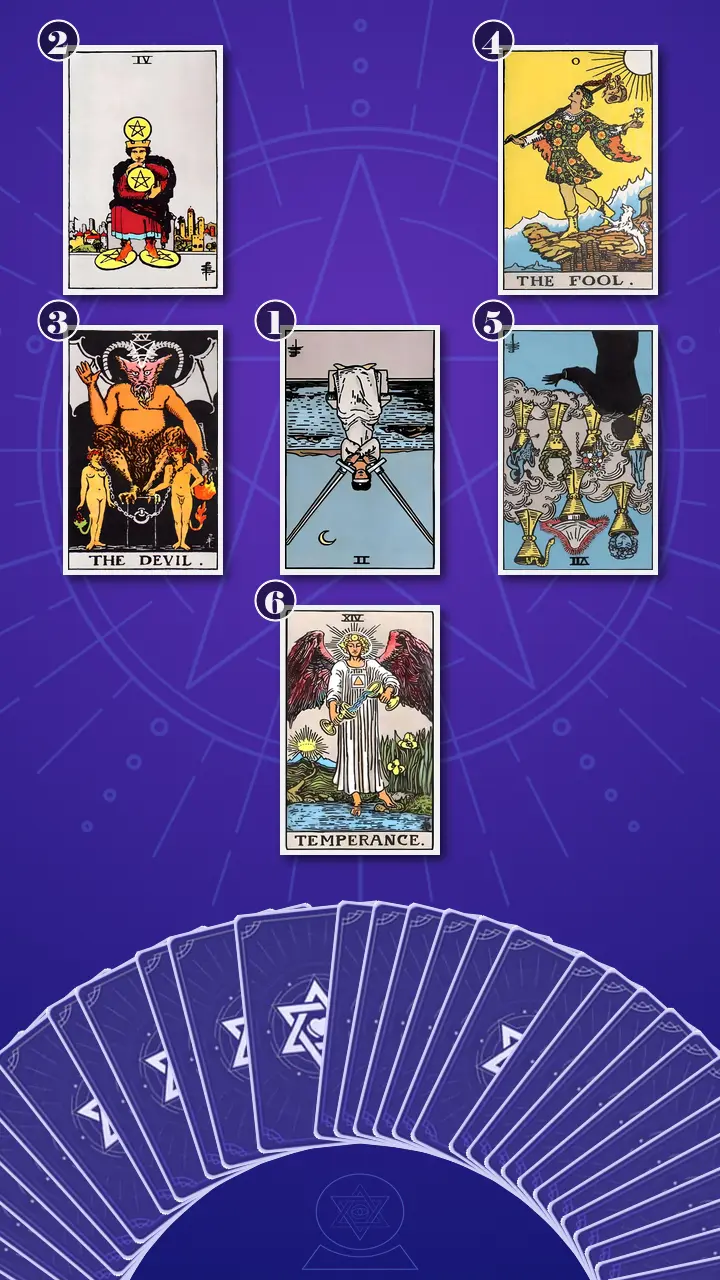
Position 1 would show the visible split and present-state behavior: the moment Riley redraws the situation as two exhaustive choices. Positions 2 and 3 would examine what the stable path protects and what it costs when it carries too much authority. Positions 4 and 5 would do the same for independent work. Position 6, the bridge beneath both branches, would ask what a small, testable combination could teach before any permanent career declaration.
Reading the Lines the Spreadsheet Erased
The Reversed Two of Swords and the Approved Columns
“Now I’m turning over the card that represents the visible split and present-state behavior: the observable moment when you redraw the situation as two exhaustive choices and make a third option disappear,” I said.
It was the Two of Swords, in reversed position.
I read the blindfold as a spreadsheet view that hides excluded rows, and the crossed swords as two defended columns held so tightly that no third category can enter. At 4:38 p.m. on Sunday, Riley had reopened the blue-and-green decision matrix, moved the same reasons between stay and leave, and deleted the row that combined a stable role with one independent brief. The reversed card showed me that the analysis was not neutral. It was protecting a narrowed view from information that might make the decision less clean but more complete.
In energy terms, this was blocked Air: thought had become contracted around a demand for one clean answer. The blindfold was not a punishment or a prediction. It was a visual reminder that perception had been narrowed by self-protection. Riley could handle difficult information, but the possibility of looking indecisive felt harder to tolerate than uncertainty itself.
“I can handle a difficult choice,” I said, following the imaginary cursor toward the deleted row, “but I cannot handle looking indecisive. Is that close to the private sentence beneath the comparison?”
I watched Riley’s fingers freeze above the trackpad. Their gaze moved to the empty space where the hybrid idea had been, and for a moment their breathing stopped. Then they gave a short, bitter laugh and looked down at their coffee.
“That is too accurate,” Riley said. “The spreadsheet looks calm after I delete the messy part.”
“Recognition is not a verdict,” I replied. “It is useful information. The next question is not which option wins. It is what information, value, or possibility the blindfold is keeping outside the decision.”
The Four of Pentacles and the Need for a Floor
“Now I’m turning over the card representing the meaning carried by the first visible choice: the value, need, or identity promise Riley is trying to protect through Choice A,” I said.
It was the Four of Pentacles, in upright position.
I read the pentacle held against the chest as the stable product role being held as proof of responsibility, while the coins beneath the figure’s feet became rent, benefits, savings, mentorship, and predictable progression. After Riley’s manager mentioned a possible promotion, Riley had opened the banking app and calculated what the structured path could protect. Those were legitimate material needs, not evidence of a lack of courage.
The upright Earth energy was balanced when it provided a floor. It became excessive when stability was asked to contain Riley’s whole self. The role had begun to carry security, employability, status, and a coherent identity at the same time, so even checking the cost of a limited experiment could feel like threatening the foundation.
“When you picture accepting the promotion, which need relaxes first?” I asked. “Is it reliable rent coverage, benefits, mentorship, predictable hours, status, or something else?”
I saw Riley’s thumb loosen around the edge of the card. They named rent coverage first, then mentorship. The answer did not produce a dramatic revelation; it produced two practical nouns, which was exactly what I wanted. I could work with nouns.
“Your options are carrying values, not entire identities,” I said. “Let’s keep the values visible and question whether the stable role has to be the only container that can hold them.”
The Devil and the Unwritten Employment Contract
“Now I’m turning over the card representing the hidden cost of the first-choice frame: what is sacrificed when Choice A is treated as the only meaningful answer,” I said. “I’m reading this as the connection between security, identity, and the pressure to control the outcome.”
It was The Devil, in upright position.
I told Riley that The Devil was not a threat, an omen, or a prediction of failure. In the RWS image, the chains are loose enough to be examined. For me, they represented an unwritten employment contract that existed mainly in Riley’s head: stable role equals responsible person; experimentation equals lack of discipline; leaving a respected track equals proof that earlier judgment was wrong.
“The stable option is sensible,” Riley said, and then stopped. I waited. “But if I stop holding it so tightly, what will that say about me?”
That was the private rule the card had brought into the room. A practical need for security had become compulsory self-definition. I used my Safe-Choice Sabotage Recognition lens here. I look for the moment when a seemingly logical option is recruited as a defense against a necessary inciting incident. The stable job might still be right for Riley. The sabotage appears when stability is made responsible for preventing every experiment, every revision, and every uncomfortable piece of evidence.
I watched a brief chain of reactions move through Riley. Their breath shortened and one hand pressed against their chest. Their eyes fixed on the loose chain in the illustration as if they were mentally naming the rule: leaving would prove I am reckless, while staying would prove I am scared. Then their fingers opened, slowly, and they let out a low breath that sounded more irritated than relieved.
“This does not mean the promotion is wrong,” I said. “It means the promotion cannot be allowed to decide what kind of person you are. We can honor caution without turning caution into a permanent identity contract.”
The Fool at the Edge of the Independent Path
“Now I’m turning over the card representing the meaning carried by the second visible choice: the value, need, or identity promise Riley is trying to protect through Choice B,” I said.
It was The Fool, in upright position.
I read the cliff edge as incomplete information, the white rose as an open motive rather than cynical escape, and the small dog as practical feedback that can accompany a beginning without dictating the whole journey. Riley’s independent path held authorship, variety, schedule control, and the wish to make work feel alive again. I did not read The Fool as an instruction to quit. I read it as permission to begin before the destination was fully named.
“Imagine finding a four-hour independent design brief,” I said. “What if the brief only has to teach you something about scope, energy, or authorship? What if it does not have to become a resignation plan, a new tax setup, a personal brand, and a five-year narrative before it counts?”
Riley’s shoulders loosened slightly. For a few seconds, I saw curiosity arrive before the future-planning questions could take over.
“What if this only has to teach me something?” Riley said. “That sounds less like freedom with a guarantee and more like an actual beginning.”
“Exactly,” I said. “The Fool’s openness becomes responsible when I give it a time box, a clear scope, and a visible stopping point. A first step can be brave without pretending to know the final scene.”
The Reversed Seven of Cups and the Tabs Without a Brief
“Now I’m turning over the card representing the hidden cost of the second-choice frame: how Choice B can become either a vague escape or another rigid identity when the third possibility is not translated into practical terms,” I said.
It was the Seven of Cups, in reversed position.
I read the seven cloud-held cups as browser tabs labeled freelance, studio, sabbatical, promotion, course, portfolio, and move abroad. Riley could open each possibility, imagine it as a total life conversion, and close every tab when the scale became frightening. The reversed Water energy showed both vague expansion and premature narrowing: the possibilities had not been given a time, cost, scope, or learning criterion, so they were dismissed as unrealistic before they could produce evidence.
“If I cannot picture the whole path, it must not be serious,” Riley said. Their hand moved toward the Notes app. “I do this with every independent-work idea.”
“A third option becomes real when it becomes testable, not when it becomes perfect,” I said. “Give one possibility observable conditions. You do not have to decide whether it deserves your whole career. You only have to decide what it could teach in a bounded experiment.”
I watched Riley type a small list: fixed scope, ninety minutes, zero client obligation, one learning question. The list was modest enough to breathe inside. For the first time, the third line was not being defended as a philosophy. It was being given a shape.
When Temperance Moved Water Between Two Cups
The Bridge Beneath Both Choices
“Now I’m turning over the card representing the adjusted third-option and integration lens: the position that turns the two visible choices into source material for a small experiment and restores the clarity you asked for,” I said.
The room grew quiet except for the low hum of the heater and the distant streetcar. It was Temperance, in upright position.
I read the angel moving water between two cups as deliberate value exchange, not compromise for its own sake. One foot on land and one in water gave me the exact image Riley needed: a stable material base paired with limited exploration. The path toward the mountain and rising sun did not promise a perfect destination. It suggested that proportion, patience, and repeated adjustment could create a direction worth trusting.
“This card answers your question directly,” I said. “The two choices are not the whole map because they are not really only choices. They are containers carrying different needs. The stable role carries rent coverage, benefits, structure, and mentorship. Independent work carries authorship, variety, autonomy, and a sense of aliveness.”
As an artist, I think in scenes and competing plotlines. I brought in my Narrative Fork Analysis lens and laid the two options out as parallel story arcs. The stay plot protects a floor but risks making one professional role carry the entire character. The leave plot opens authorship but risks turning freedom into another demand for instant certainty. The bridge plot is not a lesser version of either. It is a scene in which one stabilizing value and one liberating value meet long enough to generate real feedback.
“I do not need both careers at once,” Riley murmured. “I need one honest test of both values.”
I nodded. “That is the difference between a fixed identity and an adjustable arrangement. It is also why Temperance is the key card here. I am not asking the card to choose your life. I am asking the image to help you separate values from labels, so your next action can belong to you.”
The Third Line Becomes Visible
At 4:38 p.m. on Sunday, the Toronto streetcar groans past while you drag the same reasons between two spreadsheet columns. A hybrid plan flashes up, your jaw tightens, and you delete it before it can ask anything of you.
You do not have to pour your whole identity into one cup or reject the other; use Temperance's two vessels to mix a small, testable arrangement that honors what each choice is trying to protect.
I let the sentence settle. First, Riley’s breath stopped halfway in, and their fingers hovered above the trackpad. Then their pupils widened and their gaze went soft, as if replaying the deleted row, the promotion message, and every group-chat vote. Finally, a quiet “oh” rose from deep in their chest. Their shoulders sank, their clenched hand opened one finger at a time, and their eyes shone. The release carried a brief dizziness: a wider map also meant Riley, not the card, would choose what to test. Their brow tightened.
“But doesn’t that mean I was wrong before?” Riley asked. The irritation in their voice protected a tender place.
“No,” I said. “It means your earlier frame was doing a job under pressure. We can thank it for trying to protect you and still edit it. A revision is not evidence that the person who made the first plan was foolish.”
“Now, using this new view, was there a moment last week when this insight might have made you feel different?” I asked.
Riley returned to the Sunday spreadsheet and pointed to the deleted row. “That moment,” they said. “I treated the mixed plan like a confession about my character instead of a question I could test.”
I set a seven-minute timer and opened a blank note with three headings: Choice A protects, Choice B protects, and One-week mix. I asked Riley to name one value under each of the first two headings, then write one action under the third that took no more than ninety minutes and borrowed from both values. I reminded them that they were gathering information, not committing to a career change or promising work to anyone, and that they should check any employer conflict-of-interest rules before testing paid work. If the exercise felt too loaded, naming the two values alone was enough for that day.
I named the crossing plainly: this was a movement from contracted binary confusion and identity-based career pressure toward values-based curiosity and grounded clarity through a testable third arrangement. The release was real, but it was not the end of uncertainty. It was the first moment uncertainty could become information instead of a verdict.
From Career Verdict to Working Prototype
I gathered the cards into a story Riley could use. The repeated spreadsheet ritual had narrowed the present state until the reversed Two of Swords made two columns look exhaustive. The Four of Pentacles showed the legitimate need beneath the stable role: rent coverage, benefits, mentorship, and a dependable floor. The Devil showed how that need had become an identity rule. The Fool reopened movement, while the reversed Seven of Cups showed why independent work needed a smaller brief instead of a grand escape fantasy. Temperance turned all of it into a workable process of observation and adjustment.
“Your decision frame is like a product form with only two radio buttons and a hidden custom field,” I said. “Then the submitted data gets treated as proof that no other answer exists. A Figma prototype is allowed to be incomplete because it exists to create feedback. Your career experiment can have the same function. It does not have to announce the finished product or prove your identity.”
The Blind Spot Beneath the Either-Or Thinking
The cognitive blind spot I saw was the belief that identity coherence must come before experimentation. Riley had been asking one decision to prove responsibility, freedom, self-respect, and control all at once. That made a provisional path feel morally weaker than a definitive announcement, even though a gradual transition could provide better information and protect real financial needs.
The transformation direction was clear: replace the demand to name one final winner with a one-week experiment that identifies what each choice protects and tests one workable combination of those values. A hybrid career path is not automatically commitment avoidance. It becomes meaningful when it has a defined scope, a time limit, a learning question, and permission to be revised or stopped.
How tarot works here is grounded and non-predictive. Each image interrupts the familiar loop and gives the mind a different question. The positions separate present behavior, practical values, identity attachments, possibility, and integration. Then real life checks the interpretation. The cards do not create Riley’s agency; they help Riley notice where agency has been narrowed and choose whether to widen it.
The Third-Line Test
“For the next seven days, I want actionable advice to stay small enough that your nervous system can believe it,” I said. “We are not choosing a destiny. We are designing a short test and agreeing in advance what counts as useful information.”
- Run the Two-Value Ingredient CheckOn Tuesday evening at the kitchen table, open a phone note titled What Each Option Protects. Under Stable Product Role, list no more than three values, such as reliable rent coverage, benefits, or mentorship. Under Independent Work, list no more than three, such as authorship, variety, or schedule control. Circle one value from each side and add a third spreadsheet row called testable combination. Do not score or rank that row for one week.Keep the salary and rent numbers available, but place the value labels before the calculations. If three headings feel like too much, use two sticky notes and write one word on each.
- Use the Protagonist Pivot ActionWithin 24 hours of our session, execute one 20-minute micro-action aligned with the more daunting but authentic plotline: draft a fixed-scope independent service or redesign one portfolio case-study page at the kitchen table. Then reserve one 90-minute block this Saturday with a clear start and stop time. Before using a real client brief, check the employee handbook, confidentiality terms, and conflict-of-interest rules.Keep the test private, reversible, and free of client promises. If paid outside work is restricted or your energy is low, use a mock brief. The minimum version is one rough sketch with no public posting.
- Keep an Evidence-Before-Identity LogAfter the Saturday test, make a three-row note labeled time used, energy before and after, and what became more specific. Write one energizing detail, one draining detail, and one unanswered practical question. Review the note next Sunday for ten minutes and choose only whether to repeat, adjust, pause, or discard the test, not which career must win.Ban total scores and identity verdicts such as real freelancer, coward, serious person, or failure. Evidence can include fatigue or a need for more support. The minimum version is one sentence beginning I noticed.
“Keeping a base while testing a direction is a design, not a failure to commit,” I said. “A third option does not need to be impressive enough for LinkedIn. It needs to be honest enough to teach you something.”
I handed Riley the pen and asked them to write the first value, not the final answer. The most constructive way to work with this Decision Cross tarot spread was not to make the cards responsible for a career choice. It was to let the cards return responsibility in a form Riley could actually hold: one bounded action, one week of evidence, and the freedom to revise.

A Week Later, the Map Had a Third Row
Four days later, I received a message from Riley: “I checked the outside-work policy, built a private twenty-minute mock brief, and learned that I like setting the scope more than I expected. I’m keeping the promotion conversation open, but I’m not making it carry my whole identity.”
Riley told me they had slept through the night after finishing the outline, but woke with the thought, “What if I’m wrong?” Their hand still reached for the spreadsheet. This time they added a third row, smiled at the imperfect draft, and made coffee before opening LinkedIn.
I did not read that message as proof that independent work was Riley’s destiny, or as proof that the stable role would become the answer. I read it as the first small piece of lived evidence. Riley had moved from contracted binary confusion toward values-based curiosity, and the map had widened without pretending the road ahead was certain.
Ownership, Not Certainty
When I look back on our Journey to Clarity, I see a simple but meaningful shift. Riley stopped asking which single path could guarantee a coherent self and started asking which values deserved a safe, observable experiment. Temperance did not remove the crossroads. It helped Riley stand at it with both feet present.
Clarity can begin as evidence before it becomes a declaration. The cards offered images, questions, and structure; Riley supplied the judgment, the consent, the boundaries, and the next act. That is where the real authority remained all along.
When the same two columns keep tightening your jaw, it can feel as if allowing a third line would make your whole identity look less coherent, even though what you are really trying to protect is your sense of control.
If you let the two choices become ingredients instead of identities for one week, what tiny combination would you be curious to observe?