A Comfortable Job Stayed Open Late Until One Hour Made Room to Explore

The Comfortable Job That Stayed Open After Hours
I recognize the reliable operations coordinator in Toronto who checks Slack before getting out of bed, then says yes when a manager adds one more task. Jordan sat across from me with her phone face down, its screen still glowing faintly through the case.
At 7:40 a.m., the cold blue light from her phone had spread across the duvet while the kettle clicked in the kitchen. By 8:30 p.m., she was still at the small desk in her hybrid-work apartment, reopening a routine process document that had already been good enough; the laptop fan hummed, the keyboard sounded sharp in the quiet, and her dry eyes kept returning to the same sentence.
She looked at me and said, 'The job is comfortable, so why am I still dissatisfied? I keep confusing being good at this job with wanting to keep doing it.'
I could see the contradiction in the way her hands kept moving even while she described it: she wanted to move beyond a comfortable but directionless career, yet the salary, benefits, flexibility, and familiar sense of being needed made staying feel safer than asking what came next. Her restlessness was not an abstract mood. It was like an automation that had no step for checking whether the destination still mattered, so every quiet moment triggered another task.
I told her about my years on Wall Street, where uncertainty could sit beside a glowing monitor long after everyone else had gone home. 'I know how heavy that kind of quiet can become,' I said. 'We do not have to turn this into a dramatic resignation or a prediction. Let us use the cards as an objective map, connect the pattern to what is actually happening, and find one small way for you to take your narrative back.'

Choosing a Map for a Directionless Career
I asked Jordan to take one slow breath and name the question she wanted the reading to hold. I shuffled gradually, giving the movement a practical purpose: it marked the transition from reacting to every work notification to observing the pattern that had been running her evenings.
For this career crossroads, I chose the Four-Layer Insight Ladder · Context Edition, a six-card spread designed for a self-reinforcing loop rather than a simple stay-or-leave decision.
I want to be clear about how tarot works in this reading. The cards cannot decide whether Jordan resigns, accept a promotion, changes industries, or keeps her current role. They give me a structured set of images and questions, allowing visible behavior, emotional need, financial protection, and practical next steps to be examined together. The interpretation becomes useful only when it meets real evidence from her life.
The first card would show the observable after-hours overworking loop. The second would reveal the immediate payoff that made the loop feel responsible and safe. The third would name the root belief beneath it, while the fourth would surface the meaning-based need Jordan kept postponing. The lower row would then offer the hinge: a perspective shift, followed by a bounded career experiment. It was the smallest structure I could use to explain why a comfortable job had become so difficult to question without turning her future into a verdict.
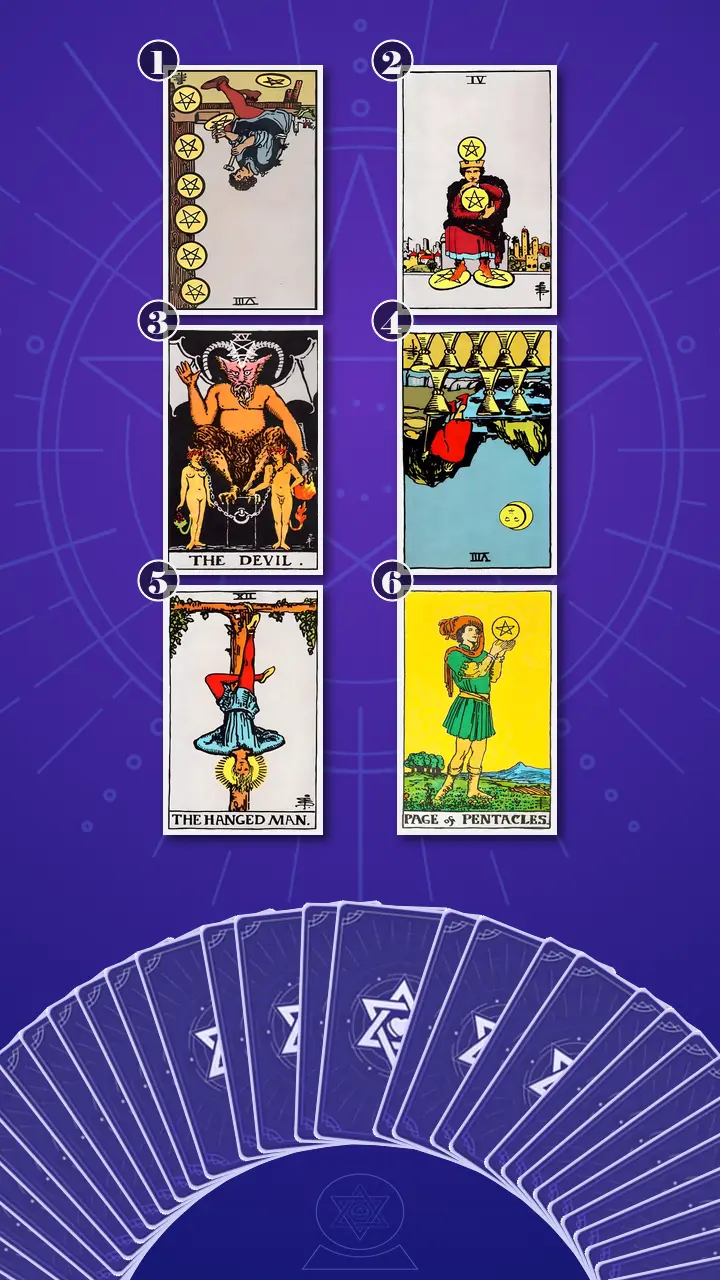
The Workbench, the Grip, and the Unasked Question
Position 1: The Workbench That Would Not Close
I began with position 1, which represents the observable overworking loop: the after-hours behaviors showing Jordan's workaholic tendency and the outgrown quality of the role.
I turned over the Eight of Pentacles, in reversed position.
In the RWS image, the craftsperson sits at a workbench, hammer raised over one pentacle, with rows of completed pentacles behind them. I saw Jordan's reopened Google Doc in that workbench. At 8:30 p.m., she had changed a sentence no one had asked her to change, then checked the document again as if another quality pass could tell her whether the job still belonged in her future.
The reversed energy was blocked craftsmanship: an excess of effort and a deficiency of meaningful development. Jordan was not lacking discipline or competence. She was directing those strengths toward maintaining an existing routine instead of building a skill, relationship, or possibility that could point beyond it. One form of effort produced genuine learning; another produced only more proof that she could endure the same work.
I asked her to distinguish one task that had built a future capability from one that had merely polished the current routine. 'What would happen,' I asked, 'if a finished document were allowed to stay finished long enough for you to notice what you actually want to learn?'
Jordan gave a short, bitter laugh. 'That is so accurate it is almost rude,' she said. Her mouth tightened after the laugh, and she looked down at the card as though the familiar workbench had just been moved into the middle of her living room.
Position 2: The Coins Held Against the Future
I moved to position 2, which reveals the short-term payoff sustaining the loop: the comfort, control, usefulness, and stability attached to Jordan's current job.
The card was the Four of Pentacles, in upright position.
The figure in the RWS card holds one pentacle against the chest, places another over the head, and keeps two beneath the feet. Security occupies feeling, thought, and movement. In Jordan's life, the coins became her salary, benefits, hybrid schedule, manageable rent, and the manager's steady trust. These were not imaginary advantages. They genuinely supported her life.
The upright energy was protective, but overconcentrated. Extra work bought her a brief sense of control and renewed the identity of being the person who could handle anything. Each time a manager wrote, 'Could you take this one too?', Jordan replied yes before checking her evening schedule. The role's comfort had become a safety net she was gripping so tightly that she could not reach toward another rung.
I said, 'The Four of Pentacles is not telling you that comfort is bad. It is asking whether protecting comfort has quietly become more important than discovering direction. A stable job can be a resource without becoming a permanent identity.'
Jordan's shoulders lowered when I named the salary and benefits as real rather than something she needed to apologize for. Then her fingers closed around the edge of her mug. I could see the relief and the fear sitting beside each other: she wanted permission to value stability without having to worship it.
Position 3: The Slack Notification as a Loose Chain
I turned to position 3, the root cause and hidden mechanism beneath the visible pattern: the belief and deepest fear that made overworking feel safer than moving beyond the comfortable job.
I drew The Devil, in upright position.
I do not use The Devil as a threat, a diagnosis, or proof of an inescapable condition. In this spread, the card makes an inner contract visible. Its loose chains, the unequal height between the chained figures and the elevated figure, and the enclosed setting all spoke to a learned bargain between usefulness, comfort, and fear.
I placed a small Slack notification beside the card. 'This is the loose chain,' I said. 'Technically, you can step away. But the learned contract says usefulness must be continuously renewed. If you stop answering, stop volunteering, or stop being the default backup, the old story begins to speak.'
I asked Jordan to finish the sentence without trying to make it sound reasonable: 'If I stop doing this, then I might have to admit...'
She stared at the notification. Her breath stopped halfway, and her hand hovered above her phone without touching it. Then her eyes lost focus, as though they were replaying the 7:40 a.m. check, the manager's extra task, and the course tab she had abandoned. Finally, her jaw tightened and released on a long exhale.
'If I stop doing this, then I might have to admit I do not know what I want next,' she said. 'And if I do not know, I might not be able to keep my life safe.'
I let the silence remain kind and unhurried. 'That is the contract,' I said. 'It is powerful because it has protected something real. It is also not the only contract available to you. The question is not whether you are trapped forever. The question is which part of this bargain you are willing to examine first.'
Position 4: The Cups Left Beneath the Moon
I opened position 4, the hidden truth and unaddressed inner influence: the existential signal Jordan kept postponing, the thing her outgrown role no longer provided.
The card was the Eight of Cups, in reversed position.
In the RWS image, a cloaked figure stands near eight abandoned cups and turns toward a moonlit path and distant mountains. The interrupted departure looked exactly like Jordan's saved browser tabs. She could see possible courses and roles, but whenever one option became real enough to require a first step, she returned to Slack, accepted another task, or promised herself she would revisit it after the next busy stretch.
The reversed energy was a blockage in acknowledging emotional and existential incompleteness. It did not command her to resign. It asked her to name what the job no longer gave her before deciding what deserved exploration. The distinction mattered because a dramatic exit could simply replace overwork with a different kind of avoidance.
I slid a notebook toward her. 'Complete this sentence on a quiet evening,' I said. 'This role no longer gives me... You do not need to name a replacement job. You only need to stop making the unanswered question carry the whole weight of your future.'
Jordan looked toward the window, where the Toronto evening had turned the glass into a dark mirror. 'It no longer gives me a reason to care about the work after I have done it well,' she said. Then she added, almost under her breath, 'Being good at the job is not the same as wanting the job.'
Her eyes became wet, but she did not look away. She pressed her thumb into the notebook's edge, held it there, and then let go. The moonlit path was not an instruction to walk into the dark. It was an honest acknowledgment that the question had been waiting for her attention.
When The Hanged Man Turned the Workday Upside Down
Position 5: The Pause That Became a Bridge
The room seemed to quiet when I reached the lower-left card. I turned to position 5, the transforming influence and bridge between the old pattern and a choice Jordan could own.
It was The Hanged Man, in upright position.
The calm face, the halo, and the figure suspended by one foot from a living tree offered a very different kind of movement. This was not passivity and it was not failure. It was a deliberate interruption of the reflex to fill every open hour with visible usefulness. The card asked Jordan to see her current job as information and support, rather than as the final definition of her value.
At 8:30 p.m. in a Toronto apartment, Jordan is still revising a routine process document that was already good enough. A career-course tab waits behind Slack, but the next small task feels easier to open than the question of why a stable job now feels so empty.
Extra hours can protect a comfortable life, but they cannot tell you what that life is for. You do not need to keep proving your worth through work before you are allowed to investigate what comes next.
You do not need to keep proving your worth through extra hours; choose a deliberate pause that lets you see the comfortable job from a new angle, like The Hanged Man's inverted perspective.
Jordan's fingers stopped above the imagined keyboard. For one beat, she held her breath, as if the sentence were a performance review she had to answer correctly. Then her gaze moved from The Hanged Man to the window and lost focus. I watched the memories arrive: the 7:40 blue glow, the manager's casual one-more-task, the finished document reopened after dinner, and the course tab abandoned when choosing felt real. Her jaw tightened first, then softened. Her hands curled around the edge of the chair and slowly released. A short laugh caught in her throat, followed by an uneven breath. Her eyes shone, and her shoulders dropped, but the release brought a small, unsteady blankness too. Without the old task, the next minute belonged to her. She looked relieved, then briefly frightened by that much ownership. I did not rush to fill the silence. I asked, 'Now, use this new perspective to remember whether there was a moment last week when this insight might have helped you feel differently.'
Before we moved on, I offered her a ten-minute, nonbinding test. She could write two lines: 'This job currently gives me...' and 'This job no longer gives me...' Then she could circle one phrase that might become a low-risk experiment. She did not need to decide, apply, resign, or tell anyone that day. The pause was allowed to remain a pause.
Once her breathing settled, I brought in the analytical lens I call Transferable Asset Pricing. During my Wall Street years, I learned to separate the value of an asset from the market currently using it. I now use that distinction for career pivots. I asked Jordan to list the evidence behind her operations judgment, cross-team coordination, process design, and calm handling of pressure, then consider where those skills could travel beyond her current title.
This did not promise that another industry would pay more or feel meaningful forever. It stripped away the corporate distortion that equated her value with her current role. The pause gave her enough distance to see that the job had been using her skills, not owning them. That was the shift from productivity-based self-worth and fear-driven career avoidance toward grounded agency, curiosity, and self-trust.
Position 6: One Pentacle, Not a Five-Year Plan
I turned to position 6, the practical advice and integration action: the bounded experiment that could support career exploration without demanding an immediate resignation or a guaranteed answer.
The final card was the Page of Pentacles, in upright position.
The Page's attentive gaze rests on one pentacle. Behind the figure is a green, cultivated field and a distant mountain range. I read that focused gaze as curiosity becoming evidence. Jordan did not need another browser tab full of possible futures. She needed one tangible beginning that could tell her something about attention, energy, and fit.
The upright energy was balanced, grounded learning. It took the diligence that had been maintaining the golden cage and redirected it toward a personally chosen capability. One introductory lesson, one low-pressure conversation, or one small practice task could become a beta test rather than a full product launch. The Page did not ask her to perform certainty. The Page asked her to learn.
Jordan's eyes returned to the card, this time without the earlier flinch. She picked up her phone, opened the saved course tab, and wrote the title in her notebook instead of enrolling impulsively or closing it. 'I can try the first lesson without making it mean I have to leave,' she said.
'Exactly,' I replied. 'A first step is evidence, not a verdict. You can keep the salary and benefits while you learn what deserves a second step. Comfort can fund a next step without becoming a permanent identity.'
From Golden Cage to Comfort-as-Runway
When I placed the six cards in their ladder, the story became coherent. The reversed Eight of Pentacles showed Jordan polishing routine work long after it had stopped developing her. The Four of Pentacles showed why: extra responsibility protected a genuinely useful lifestyle and renewed her feeling of being indispensable. The Devil named the hidden contract linking usefulness to safety. The reversed Eight of Cups showed the emotional cost of postponing the truth that the role no longer offered meaningful direction. Then The Hanged Man interrupted the automatic motion, and the Page of Pentacles gave that new perspective a practical form.
The repeated pentacle motif made the progression visible. First, effort produced rows of finished tasks. Then security became something Jordan held against her chest, head, and feet. Finally, one pentacle became an object of patient study. The problem was not her capacity for effort. It was the direction and meaning assigned to that effort.
I also noticed what the spread did not contain. There were no Wands demanding a dramatic burst of ambition and no Swords asking for another round of analysis. More initiative and more research were not the immediate remedy. The missing movement was a deliberate pause, an honest naming of the unmet need, and one grounded experiment.
Jordan's cognitive blind spot was treating the goodness of the job as evidence that she owed it permanent loyalty. She had mistaken competence for desire and availability for safety. The transformation direction was more precise than simply leaving or staying: protect one weekly hour to identify what the role no longer provides, then test one realistic direction while letting financial stability support the exploration.
I described the next steps as a Protected-Hour Direction Test. I used my Leverage Mapping Protocol inside it because Jordan's fear became less foggy when we identified her true bargaining chips before any future performance review or salary negotiation. She could protect her lifestyle by understanding her portable value, not only by remaining permanently available.
One protected hour can tell you more than another late night. I wrote the following actionable advice in plain language so that the reading could leave the table and meet a real Toronto workweek.
- Book the Direction HourToday, create one 60-minute Google Calendar block this week titled Direction Hour, outside core work time. Close Slack, place the phone face down, and write three short answers: What does this job give me? What does it no longer give me? What would I like to learn more about? Use the first 15 minutes of my Leverage Mapping Protocol to list three transferable skills, the evidence for each, and where each could become a bargaining chip in a future performance review or salary negotiation.If an hour feels impossible, book 30 minutes first. The block can hold a walk, a notebook, or quiet. Stop when the timer ends; it does not need to produce a career title.
- Run One One-Pentacle ExperimentChoose one saved Coursera or LinkedIn Learning course and complete only its introductory lesson with a 20-minute timer this week. Afterward, save three lines of evidence: what held your attention, what felt flat, and what question became more specific. Treat the result as information about a possible direction, not a commitment to leave.Do not compare ten options before beginning. Finish one small lesson, then decide later whether it deserves a second step. A beginner action is allowed to remain private.
- Separate Progress from ProofAt the end of three workdays, record one task you completed, one task that built a future skill, and one task that only preserved the existing routine. After one defined quality check, close the document and sign out of Slack at a chosen time before deciding what to do with the evening.Use an after-hours status message if appropriate, and make urgent-work exceptions specific rather than automatic. If resistance rises, try the 10-minute version and notice what the quiet brings.
I did not ask Jordan to become less responsible. I asked her to include herself in the definition of responsibility. The small shift was from saying, 'I can think about change after this busy stretch,' to saying, 'I can collect one piece of evidence before the next busy stretch arrives.' Stop polishing proof; test a possibility.

A Week Later, One Quiet Proof
Six days after our session, I received a message from Jordan while I was making coffee. She had booked the Direction Hour, closed Slack for the first half-hour, and completed the first lesson of the course she had kept behind her work tabs. 'It did not tell me to quit,' she wrote. 'It told me I stayed focused for twenty minutes without needing anyone to praise me.'
That night she slept a full night, but woke with the old thought, 'What if I am wrong?' She smiled at it, made coffee, and left the next lesson in her calendar. The room was quiet; this time, she did not fill it immediately.
The job had not changed in six days. Her salary, benefits, hybrid schedule, and responsibilities were still there. Jordan had not solved her entire career or forced a decision before she was ready. She had simply created a small piece of evidence that comfort could be a runway rather than a command, and that curiosity could coexist with financial care.
Ownership, Not Certainty
That was Jordan's first proof of grounded agency. The cards had not chosen a future for her. They had helped me hold up a clear structure long enough for her to see the pattern, name the fear, and select the next experiment herself. In that sense, the querent remained the author and decision-maker throughout the Journey to Clarity.
When a job keeps your rent paid but leaves your jaw clenched in the quiet after work, it makes sense that you keep proving you can create safety there, even as the extra hours keep you from finding a direction that feels like yours. Noticing that bargain is already a move toward self-trust.
If you allowed one protected hour, like a small Hanged Man pause at your own kitchen table, to be a place for noticing rather than deciding, what question about the next direction would you be willing to let stay open?