Who Are You Off Duty?
Explore the pressure of carrying too many roles, the tarot cards that mirror it, and reading insights from shared sessions.

Role Overload
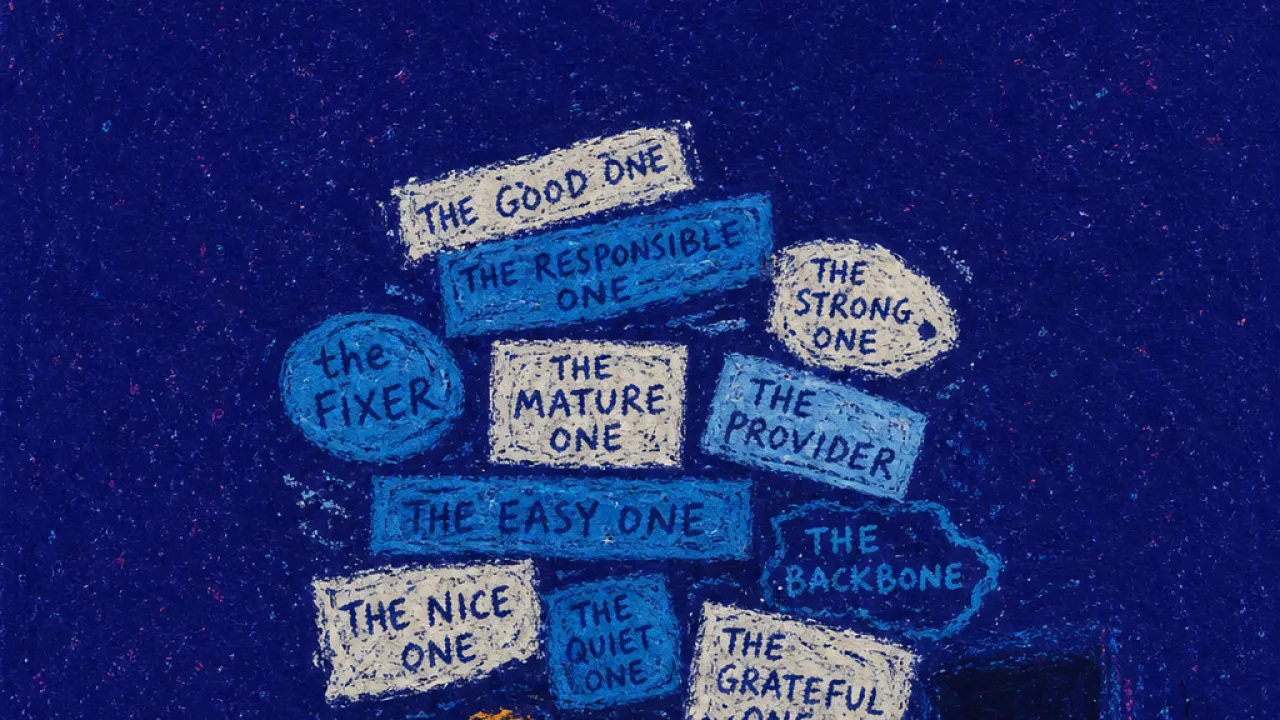
What does this feel like?
Role Overload — you notice it in the tiny pause before you answer a simple message, because even a simple message arrives wearing a job title: friend, partner, employee, student, sibling, fixer, planner, person-who-has-it-together. You are standing in the kitchen with one hand on the counter, shoes still on, bag still over your shoulder, scrolling through unread notifications while something on the stove goes cold, and your body is already moving through the next three versions of you before you have even taken a full breath. Your shoulders sit too high. Your jaw keeps locking. You tell yourself you just need to get through this week, then the week becomes a month, and somehow every room you walk into hands you a different script before you can remember what your own voice sounds like. At work or school you become competent and fast, answering before anyone has to ask twice. With friends you become easygoing, low-maintenance, the one who says "no worries" even when your chest tightens. With family you become available, reasonable, the one who can explain, smooth over, remember, organize. Alone, you are supposed to become yourself again, but instead you sit on the edge of the bed with your phone in your hand, too wired to rest and too drained to do anything that would feel like living. The hardest part is that none of these roles are completely false. You care about the people, the work, the plans, the promises. That is what makes it so difficult to put anything down. You are not pretending to be many people; you are trying to be all the parts of yourself at once, with no place to set the weight, until your own needs start to feel like one more demand on the list. The cost is quiet and cumulative: you begin to measure your worth by how well you keep everyone else's world from wobbling, while the private center of you grows harder to reach, much like the figure on the Ten of Wands, bent forward under a bundle so large it hides the path ahead.
What's pulling at you?
You're not stuck because one part of your life matters too much; you're stuck because too many meaningful parts are asking for you at the same time. You are trying to stay reliable, responsive, ambitious, kind, and steady all at once, while the part of you that exists without a role keeps getting pushed to the edge.
How It Shows Up?
- You wake up and reach for your phone before your feet touch the floor, already sorting who needs which version of you today: the efficient one, the patient one, the calm one, the one who remembers everything. Your eyes feel dry, your shoulders are already lifted, and there is a tight little pull in your stomach before the day has technically started. You do not have to choose your whole self before breakfast; noticing the first pull is enough for this minute.
- At work or school, someone asks if you can "just quickly" handle one more thing, and you hear yourself say yes before your body catches up. Your chest goes tight, your fingers hover over the keyboard, and the task lands on top of the others like another staff added to a bundle you are already carrying. It is allowed to let the request sit for a moment before you answer.
- A friend or partner asks what you want to do tonight, and your mind goes blank because wanting something feels less familiar than accommodating everyone else's preferences. You smile, shrug, say "I'm easy," while your throat tightens and a small tiredness settles behind your eyes. You can name something small without making it a declaration of who you are.
- You are at a group dinner, switching tones every few minutes: funny with one person, thoughtful with another, reassuring with someone else, checking your phone under the table in case another role needs you elsewhere. Your face keeps moving, but your ribs feel crowded, like there is not enough room inside your body for all these versions to stand at once. It is fine to step outside, feel the air, and let your face rest.
- Late at night, the apartment is finally quiet, and instead of relief you feel a strange pressure because now there is no role telling you what to do next. You sit on the edge of the bed with your shoes half-off, neck stiff, hands cold, and the silence feels less like freedom than a room full of unfinished tabs. You do not have to turn the quiet into a plan; you can simply let the day end.
Role Overload in Tarot Cards
Role Overload lives in the place where every room seems to ask for a different version of you, and none of those versions can fully step away. You can feel it in the raised shoulders, the locked jaw, and the shallow breath that shows up before you even answer a message. From an existential angle, the structural framework is about what happens when care, competence, and availability all crowd the same inner space. The Tarot Cards below mirror that crowded shape without explaining it away.
Role Overload in Tarot Card Reading Insights
When Role Overload turns every message, task, and relationship into another version of you to perform, it often follows people into readings as a question about what can finally be put down. The pieces below shift from the cards themselves into how this pressure appears inside shared reading sessions. Tarot Reading Insights for this pattern are gathered here.

A Three-Hour Reply Turned Role Overload Into a Capacity Boundary
Topic:Direction Tarot Reading
Struggle:Opportunity-Compass Split
Context:Undefined Role Scope

Two Calendars, One Temporary Lead: A Day Job and Side Hustle Test
Topic:Direction Tarot Reading
Struggle:Boundary Ambiguity Lock
Context:Always On Availability