After Twelve Advice Tabs, One Rough Sentence Appears on the Page

The 9:10 p.m. Tab Spiral: When Study Advice Becomes Procrastination
If you are a final-year student balancing coursework with part-time shifts, and a blank assignment sends you straight into YouTube study advice, you may know productivity-content procrastination from the inside. You meant to write one paragraph, but the moment the instructions felt uncertain, you opened another expert video so you could feel ready first.
At 9:10 on a Tuesday evening, I sat across from Jordan (name changed for privacy), a 22-year-old student, at the small table in their shared Toronto apartment. Their assignment occupied the left side of the laptop. Twelve tabs about active recall, focus timers, and note-taking systems crowded the right. The radiator hissed, yesterday's coffee smelled stale, and the trackpad had grown warm beneath their restless fingers.
I watched Jordan rename a study folder while their jaw tightened. The cursor continued blinking on an untouched paragraph.
“I have a study system for everything except actually studying,” they said. “I keep thinking the next video will tell me how to start. Why do I keep collecting study advice instead of getting back to work?”
I could see the contradiction clearly: Jordan wanted to return to the coursework, but beginning without one more piece of advice felt dangerously exposed. Their apprehension behaved like a smoke alarm wired to the blank document; one unclear instruction set it off in their jaw, hands, and stomach, even though no verdict had actually been delivered.
“I don't think you're lazy or short on discipline,” I told them. “I think preparation has started doing a second job: protecting you from seeing an imperfect first result. Let's give that pattern a clear shape, then find the smallest exit that belongs to you.”

Choosing the Ladder Above the Noise
I asked Jordan to place both feet on the floor and take one unforced breath while looking at the assignment. I shuffled slowly, using the motion as a transition from rapid tab-switching into focused observation rather than as a piece of mystical theatre.
I chose the Four-Layer Insight Ladder · Context Edition, a six-card tarot spread designed to map a self-reinforcing loop. In my practice, this is how tarot works: the cards do not issue commands or predict an unavoidable future. They give me a structured set of images through which I can separate behaviour, fear, protection, cost, capacity, and next steps.
I chose this spread because Jordan's question was tightly bounded. A ten-card Celtic Cross would have introduced more external influences than I needed. This ladder let me examine the visible habit first, then the fear and hidden payoff beneath it, followed by the delay that needed interrupting, the resource already available, and one repeatable action.
I arranged the cards in an ascending zigzag. The first would show what Jordan did when the work became uncomfortable. The second and third would expose the fear and short-term reward maintaining that behaviour. Higher on the ladder, one card would show what had to be released, another would reveal the capacity that could create movement, and the final card would ground the reading in practice.
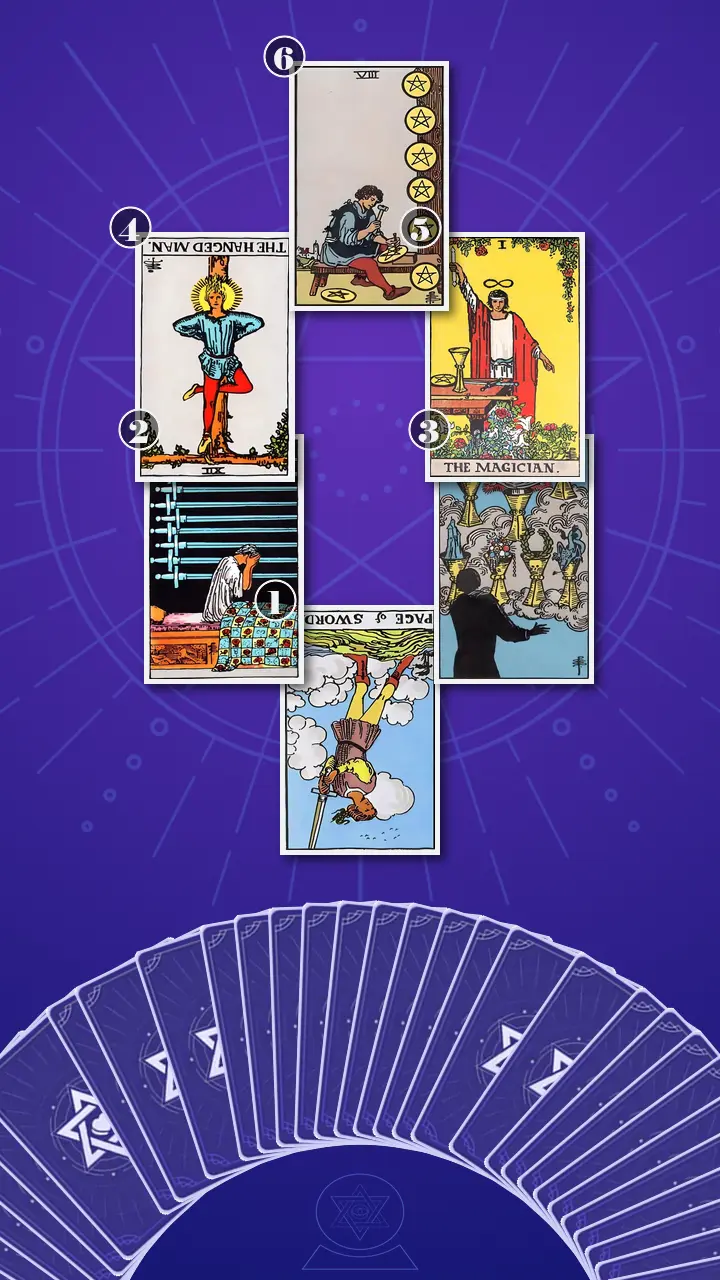
Reading the Wind Behind Twelve Open Tabs
Position One: The Vigilance That Looked Like Preparation
The card I turned now represented Jordan's diagnosis-level behaviour: opening and organising more study advice when they intended to return to coursework. It was the Page of Swords, reversed.
I pointed to the Page's raised but undirected sword and sideways, watchful gaze. “This is the moment one YouTube video leads to a Reddit thread, then a Notion template, then a comparison of focus timers. Your mind is alert and genuinely curious, but none of that information is being directed into the paragraph or problem in front of you.”
I read the reversal as excess Air combined with blocked application. Curiosity had become constant monitoring. Jordan was mentally rehearsing every possible route while remaining physically separated from the work. Their personal recommendation algorithm had also learned the pattern: every uncertainty-driven click produced another method, so the feed kept offering preparation instead of returning them to the assignment.
“The inner line sounds something like, ‘I'm not avoiding the work; I'm making sure I do it properly,’” I said. “But the untouched paragraph gives us a more objective measure of what the session produced.”
Jordan let out a short laugh, but there was no amusement in their eyes. Their fingers tightened around the coffee mug, then loosened. “That is too accurate,” they said. “Honestly, it feels a little brutal.”
“Accurate doesn't have to mean condemning,” I replied. “The Page still carries curiosity, which is useful. We simply need to give that curiosity a defined question and a route back to the task. You are not short on study advice; you are short on evidence that can only come from an attempt.”
Position Two: The 2 a.m. Verdict
The card I turned now represented the mechanism-level fear that imperfect work could be interpreted as evidence of inadequate worth. It was the Nine of Swords, upright.
I described the card's seated figure covering their face while nine swords remained fixed above the bed. Jordan told me how, after a café closing shift, they sometimes left the unfinished document open on the desk and lay awake listening to the radiator click. A task-level fact such as “I don't understand this section yet” would expand into “Maybe I'm not as capable as people think,” then into fears about finishing the degree and finding a stable first job.
I read the card as an excess of untested mental rehearsal. The mind was using one rough attempt as the entire data set for an internal performance review. That escalation explained why general advice felt safer: it created activity without generating the measurable work Jordan feared might expose them.
“A rough attempt is information about the task, not a verdict on your worth,” I said. “Not understanding one question yet is a local fact. ‘I don't deserve to be here’ is an identity conclusion your mind has added.”
Jordan's breathing paused. Their gaze drifted from the card to the dark laptop screen as if they were replaying several late nights at once. Then they pressed a hand lightly against their stomach and released a long breath. “I do that jump so fast I don't even notice it,” they said.
I did not ask them to replace the thought with forced positivity. I asked only that they begin labelling the two layers: task fact and identity verdict. The distinction gave the fear less authority without pretending the coursework was easy.
Position Three: Every Untested Method Gets to Remain Perfect
The card I turned now represented the defense strategy's short-term payoff: preserving hope, possibility, and control without submitting one method to a real test. It was the Seven of Cups, upright.
I translated the seven cloud-borne cups into Jordan's phone screen: Anki, Quizlet, blurting, interleaving, Pomodoro variations, AI study planners, complete Notion systems, and expert threads. Each option offered a slightly different future Jordan who felt focused, organised, and unquestionably capable.
I read this as excess Water: imagination and hope had become so diffuse that commitment was deficient. Choosing one ordinary method would expose its limits and temporarily close the fantasy of the others. The pattern resembled scrolling a streaming menu for an hour because choosing one imperfect option would end the possibility of finding the perfect one.
“Every untested method gets to remain perfect,” I said. “The method isn't merely a tool while it stays in the folder. It is also a protected version of who you might become.”
Jordan's mouth pulled into a rueful half-smile. They looked at the folder they had renamed minutes earlier and rubbed the hinge of their jaw. “That folder is basically a museum of future versions of me,” they said.
I asked which saved method answered a specific question in the current assignment. Jordan searched for an answer, then shook their head. I could see the recognition arrive with a sting: the advice had provided real temporary hope, but hope without contact with the task had kept resetting the same loop.
Position Four: The Loading Screen That Never Resolved
The card I turned now represented the long-term cost of the loop and the behaviour that needed interruption: prolonged suspension producing neither completed work nor useful feedback. It was The Hanged Man, reversed.
I showed Jordan the illuminated head and the body held by one bound foot. “Your thinking is active,” I said, “but action and insight have become disconnected. Folders are renamed, schedules restart, and the official beginning moves to tomorrow. Reflection once promised clarity; now it behaves like a loading screen that never resolves.”
I read the reversal as blockage. A meaningful pause should produce a changed perspective, but this pause had stopped generating new information. Jordan kept expecting one final insight to unlock the assignment even though the missing feedback could only come from attempting it.
Jordan told me about a Sunday spent colour-coding a week around classes and café shifts. The kettle had clicked off, the coffee had cooled, and two study hours had disappeared. “I told myself I was still figuring it out, so the delay didn't count yet,” they said.
Their hand went still against the mug. Their eyes dropped to the card, then to the blank document. After a moment, their shoulders lowered by a fraction. I heard sadness in the silence, but I also heard the beginning of honesty.
“The answer isn't to punish yourself with an overnight marathon,” I said. “That would turn recognition into another extreme. The release here is smaller: let a deliberately rough output interrupt the suspension.”
When The Magician Ordered the Table
Position Five: From Optimisation to Authorship
The card I turned now represented the key shift from searching for readiness to directing the tools already available toward one concrete output. As I revealed The Magician, upright, the radiator fell quiet, and the room seemed to gather around the small table.
I showed Jordan the four suit emblems arranged within reach, one hand raised and the other pointing toward the ground. I translated the image into an ordinary working surface: one assignment, one set of notes, one timer, and one sticky note naming the result. Nothing new needed to be acquired. Each existing resource simply needed an assigned function.
I read The Magician as balanced agency: thought, feeling, intention, and practical reality working together instead of Air dominating the whole system. Seeing that ordered table, I thought of the hundreds of conversations I had listened to over coffee during the past twenty years. A cup, a notebook, and a deck become useful through attention and use, not through endless rearrangement.
I brought in a method I call Syllabus Deconstruction. I stripped the assignment of its identity-level weight and reduced it to emotionless mechanics: open the prompt, underline the task verb, choose one source, draft one rough topic sentence. Jordan did not need to “become a capable student” during the next block. They needed to perform one small, observable operation.
I looked from the blinking cursor to the crowded tab bar. Jordan's jaw was still tight, and I could see the hope that one more expert might remove the risk of beginning badly. Yet every saved method left the same question unanswered: what would happen when they used one on the actual work?
You do not need one more system to become ready; use what is already on the Magician's table and let one completed work block turn intention into evidence.
I let the sentence remain in the room without rushing to explain it.
Jordan's breath stopped first. Their fingers hovered above the trackpad, perfectly still, while their pupils widened and their gaze lost focus. I could almost see remembered study sessions moving behind their eyes. Then their eyebrows pulled together, and a flash of anger crossed their face. “But doesn't that mean I've been doing this wrong for months?” they asked, their voice low and tight.
“It means the strategy protected you from a fear until its cost became larger than its benefit,” I said. “You weren't foolish for wanting safety. You are simply allowed to choose a different strategy now.”
The anger softened. Their eyes grew wet without spilling over, their fist slowly opened beside the laptop, and their shoulders dropped as they breathed out with a faint tremor. Relief arrived, but so did the exposed feeling of having nowhere left to hide from the next small choice. Jordan stared at the assignment for several seconds and whispered, “Okay. That's clearer, but it also makes this mine.”
“Now, with this new perspective, think back: was there a moment last week when this insight could have made you feel different?” I asked.
Jordan chose the Sunday schedule spiral. They said a rough topic sentence would not have solved the essay, but it would have prevented the afternoon from becoming a referendum on their future.
I invited them to test the insight for eight minutes, with permission to stop when the timer ended. Jordan wrote “rough topic sentence” on a sticky note, closed the general advice tabs, and kept only the prompt and course notes open. When one imperfect sentence appeared beneath the blinking cursor, I watched apprehensive control-seeking give way to the first trace of grounded self-trust built through direct experience.
“Readiness is not another tab away,” I said. “It is evidence created by using one tool on one task.”
The Workbench at the Top of the Ladder
Position Six: Practice That Leaves a Visible Mark
The card I turned now represented a repeatable action: one focused work block, one visible attempt, and one adjustment based on direct evidence. It was the Eight of Pentacles, upright.
I pointed to the artisan using one tool on one pentacle while completed pieces remained visible nearby. I translated the rhythm into an ordinary study cycle: attempt, record, review, adjust, repeat. Jordan would complete one 25-minute block, note the paragraph or questions attempted, identify one obstacle, and change only one thing before the next block.
I read the card as balanced Earth. The Page had gathered information, the Nine had rehearsed danger, the Seven had preserved imagined possibilities, and the reversed Hanged Man had suspended action. The Eight of Pentacles finally gave the process weight: rough paragraphs, annotated pages, and attempted questions that could be reviewed.
I used The Karate Kid as the comparison. Reading about every technique could not replace the ordinary drill that allowed a learner's hands to understand what the mind could not settle in advance. Jordan did not need a dramatic productivity montage. They needed enough repetition for one ordinary method to teach them something real.
“Make the next block produce something you can point to, not another system you have to maintain,” I said. “This attempt doesn't need to prove you're good. It needs to show you what comes next.”
Jordan looked at the new sentence on the screen. Their shoulders were not completely loose, and the page was still mostly blank, but their hand no longer moved toward the closed tabs. “I can work with evidence,” they said. “Evidence feels less personal than a verdict.”
The Evidence-Before-Advice Rule
I gathered the six card meanings into one practical story. Each previous encounter with difficult coursework had taught Jordan to treat uncertainty as a threat to their identity. The reversed Page responded by collecting information; the Nine revealed the private fear beneath that activity; the Seven supplied temporary hope through ideal methods; and the reversed Hanged Man showed how protection hardened into delay. The Magician restored authorship, while the Eight of Pentacles showed how repetition could turn authorship into skill.
The core image was a workbench surrounded by tool reviews. Jordan had been standing beside the task, comparing equipment while the object itself remained untouched. The blind spot was not a failure to recognise the deadline. It was mistaking the sensation of control for evidence of progress, then treating an imperfect output as evidence about personal worth.
I named the transformation direction plainly: from searching for the best study method to using the available method before seeking more advice; from imagined readiness to applied feedback; from protecting an ideal study identity to building grounded confidence through visible attempts.
When I introduced a physical desk reset, Jordan immediately said, “I could turn fifteen minutes of clearing into a two-hour organisation project.”
“Then the boundary matters more than the tidiness,” I replied. “We clear only the working field. We do not redesign your life, label drawers, or rebuild Notion. At fifteen minutes, the reset ends and the work block begins.”
- The Desktop Reset RitualBefore the next session at the apartment or campus library, set a 15-minute timer. Clear only the immediate desk and browser field, leaving the assignment, current notes, one timer, and a sticky note naming one visible output such as “draft 150 rough words” or “attempt questions 1 and 2.”Stop when the timer rings, even if the space is not perfect. This is a working-surface reset, not a new organisation project.
- The 25-Minute Proof BlockUse the method already available for one 25-minute block before opening general study advice. When the timer ends, save the paragraph, annotations, or attempted questions under the plain label “Attempt 1.”If 25 minutes feels too activating after class or a café shift, use 15 minutes, five minutes, or one rough sentence. A smaller experiment still produces evidence.
- The Three-Line Evidence LogAfter the block, spend under two minutes recording “Attempted,” “Learned,” and “Next adjustment” in Notes, Google Docs, or a paper notebook. Test the same basic method across three blocks before deciding that it has failed.Choose only one adjustment per block. If a specific information gap remains, use one narrow search or ask one person, then carry the answer directly back to the open task.
I reminded Jordan that the evidence-before-advice rule was a boundary, not a punishment. Essential course instructions, accessibility tools, and genuinely missing information remained available. Missing a block would not invalidate the experiment, and there would be no need to compensate with an exhausting all-nighter.

A Week Later: The Quiet Proof
Six days later, Jordan sent me a screenshot: 173 rough words saved as “Attempt 1.” They had slept through the night; their first morning thought was still, “What if it's bad?” They told me they smiled, opened the file, and kept the question small.
I did not see the cards complete Jordan's assignment. I saw Jordan use the cards as a clean mirror, identify the loop, and choose a different input. The proof of this Journey to Clarity was not perfect certainty. It was a visible attempt and the next workable decision.
If tonight the cursor keeps blinking and your jaw tightens, I know it can feel safer to keep preparing than to risk seeing what an imperfect attempt might seem to say about your worth. But noticing that silent tug between protection and practice already means you are no longer standing at the beginning of the loop.
So if your next attempt did not have to prove anything about you, which small piece of work would you place on your own Magician's table and meet exactly as it is?