After Every Tab Closed, 45 Minutes Made a First Page Instead of a Plan

Why the Golden Cage Felt Like Care at 8:47 PM
“You are around thirty, working a dependable operations job in London while quietly building a second life in your notes app, and every time a creative opportunity asks for a visible first step, Career Pivot Anxiety turns research into another reason to wait.” I said this to Alex (name changed for privacy), gently enough that it could land as recognition rather than accusation.
At 8:47 PM on Sunday, Alex sat at the small kitchen table in their London flat with a laptop open to a document titled "Possible Next Steps," a savings spreadsheet, and three unfinished applications. The radiator clicked behind them. The kettle gave off a fading metallic smell, and the blue screen warmed their hands while I watched them close every tab and prepare for the same Monday routine.
“I keep waiting for confidence to arrive before I make the first move,” Alex said. “I know I want a more self-directed creative life, but the stable job pays my bills. Why do I keep choosing golden-cage comfort over the life I actually want?”
I recognized it as a self-protective comfort loop: the practical reasons were real, but they were being used to postpone the moment when desire would become visible. The contradiction was not simply stability versus freedom. It was the life Alex wanted versus the fear that losing familiar comfort, even temporarily, would expose failure, irresponsibility, or a lack of worth.
Alex’s ambivalence sat in their chest like a train held between stations, its engine running while every door stayed closed. Longing pulled one way, guilt pulled another, and dread waited for either movement to become proof that they had chosen badly.
“You are not doing nothing,” I told them. “You are doing everything that lets you feel informed without becoming visible. Wanting more is not the same as being ungrateful. Let’s see what the cards can help us separate: genuine support, fear-based avoidance, and one small move that does not require you to destroy the stability you need. Our Journey to Clarity begins by drawing a map, not by demanding a dramatic escape.”

Choosing a Compass for a London Career Crossroads
I invited Alex to take one slow breath and hold the question in a precise form: what keeps familiar comfort in charge when a desired possibility becomes concrete? Then I shuffled slowly. The purpose was not to summon a verdict. It was to give the mind a clean transition from looping through possibilities to observing a pattern.
For this reading, I used the Four-Layer Insight Ladder · Context Edition. This is a four-card tarot spread for fear of leaving a stable job because it follows the minimum causal sequence this question needs: the visible grip, the hidden bargain beneath it, the conscious choice that can interrupt it, and the beginner-sized action that can create evidence.
If you are reading this as a reflection on your own safe life, this is how tarot works best here: not as a prediction of whether a career change will succeed, but as a way to place an abstract fear beside a concrete behavior. The Four of Pentacles will show what is being held. The Devil will examine the attachment and the fear beneath it. The Lovers will act as the bridge between approval-seeking and values alignment. The Page of Wands will turn desire into a reversible experiment.
I explained that the first two cards formed the diagnostic pair, while the final two formed the transformation and action pair. The spread would move from security held tightly, to attachment recognized, to a values-led choice, and finally to one practical next step. Nothing in the layout required Alex to resign, relocate, or make a permanent commitment.
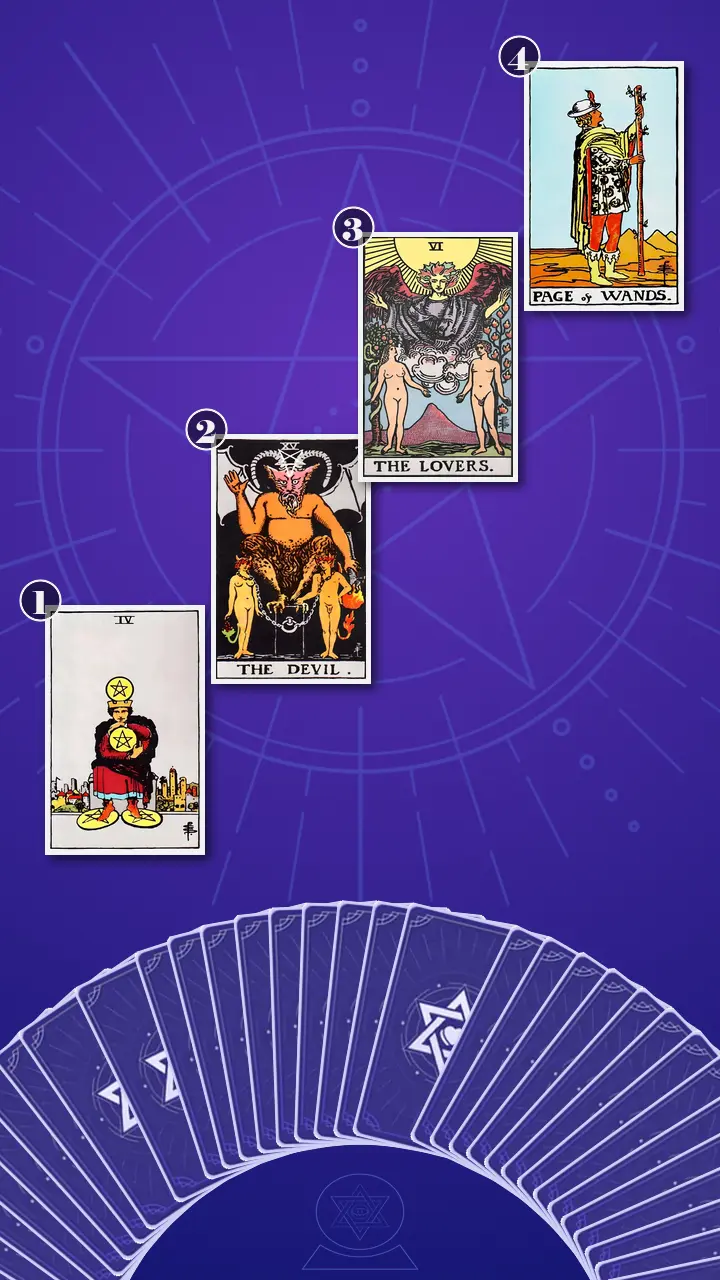
The Climb from Holding to Experiment
The Pentacle Pressed to the Chest
“Now I am turning over the card for the present pattern and visible expression of the issue,” I said. “This position shows the concrete behavior of keeping familiar comfort close, postponing desired-life experiments, and protecting stability before movement can begin.”
The card was The Four of Pentacles, in upright position.
In the Rider-Waite-Smith image, the figure presses one pentacle against the chest, plants both feet on two others, and sits before a walled city. I saw Alex’s stable operations role, savings plan, and familiar weekly routine in that posture. The support was real. The wall was also real. Alex kept looking at the city beyond it, researching creative roles, courses, and portfolio ideas, but treated that wider life as accessible only after perfect certainty arrived.
The card’s upright energy was not a warning against financial caution. It was earth in contraction, security becoming a boundary around agency. Alex was using a stable job and a functioning budget as proof that staying was responsible, then mistaking the absence of a dated experiment for evidence that change was unrealistic. The spreadsheet could measure the runway; it could not choose the destination. The card’s meaning became clear in context: the grip protected the present while quietly preventing new evidence from forming.
Alex gave a small, bitter laugh. “That is almost rude,” they said. “I open the job board, compare the salary and commute, update the savings number, and then tell myself I have made a sensible decision because I did not apply.”
I nodded. “That response matters more than a polite agreement. The question is not whether your caution is bad. It is whether it is still serving the life you say you want. What form of comfort is genuinely supportive, and what form is being protected at the price of your agency?” Alex’s hand moved from the laptop trackpad to the warm mug, and their shoulders stayed high, but their attention remained with the card.
The Auto-Renewing Chain
“Now I am turning over the card for the hidden root and underlying fear,” I said. “This position looks beneath the visible choice and examines the bargain that makes staying feel safer than finding out.”
The card was The Devil, in upright position.
I placed it beside the rent spreadsheet. The RWS figures stood beneath a dark pedestal with loose chains around their necks. I did not read that image as a sentence about Alex’s future. I read it as a pattern available to examine. The Devil’s chain was like an auto-renewing subscription to relief: every time Alex avoided the uncertain step, the payment was small today, while the restriction lasted another month.
Alex had been calling the current arrangement responsible because it guaranteed familiar income, a predictable commute, and an identity that looked sensible from the outside. What I also heard was the fear of discovering that a creative direction might require patience, revision, or a beginner’s awkwardness. The immediate relief of not risking failure had begun to masquerade as proof of safety, while the long-term cost was a smaller sense of agency and trust in personal judgment.
I asked Alex to complete two sentences aloud. “I call this responsibility because…” I prompted. Alex looked down at the rent figures. “Because I can pay my bills, and because leaving would feel brave for a week and irresponsible forever.”
“And what I am also avoiding is…”
Alex held their breath. Their fingers stopped moving against the mug. Their gaze lost focus, as though the invitation to share an unfinished creative piece near London Bridge had just appeared again in the room. Then their jaw tightened before slowly releasing. “What I am also avoiding is finding out that I might try and still not be good enough.”
“That is the difference between a practical fact and a fear-based bargain,” I said. “The rent is a fact. The prediction that an unsuccessful experiment would prove something permanent about your worth is an interpretation. The Devil names the attachment without declaring you powerless. A chain can feel serious and still be loose enough to question.” Alex’s breath came out in a long, quiet exhale. Their eyes remained on the two figures, and the room seemed to make space around the silence.
When The Lovers Opened the Room
The Conscious Choice Beneath the Angel
By the third card, I slowed down. “Now I am turning over the card for conscious transformation and inner resource,” I said. “This position asks what values-led choice can challenge the demand for certainty while keeping practical support intact.”
The card was The Lovers, in upright position, the bridge card of the reading.
The RWS image showed two open figures beneath an angel, with a mountain rising between and behind them. The mountain did not disappear because the figures were open. Desire, consequence, and uncertainty remained visible. What changed was the posture toward them. Instead of asking whether leaving the stable role would guarantee a successful creative career, Alex could ask which value they wanted the next week to practice through one visible choice.
I returned to the Saturday cafe scene Alex had described. Their trusted friend had asked, “What would you actually choose if you did not have to defend it?” Alex had answered with rent, workload, timing, and every possible way a change could go wrong. I placed that risk list against the two open figures beneath the angel.
“The question is not which option removes uncertainty; it is which value you are willing to practice while uncertainty is still present,” I said. “Approval and alignment are not the same thing. Neither are certainty and conscious commitment.”
Alex looked at the card, then at the blank space beside the spreadsheet. “I do not have to decide my whole future tonight,” they said slowly. “I can let one value have a turn.”
For a moment, the radiator clicked once and went quiet. The laptop light fell across the open figures, and the room seemed less like a locked kitchen and more like a place where something could be placed on the calendar.
The Sentence That Changed the Question
It was 8:47 PM in the scene we had started with. The laptop still showed "Possible Next Steps," the savings spreadsheet, and three unfinished applications. The radiator clicked, the kettle cooled, and Alex’s shoulders rose as the familiar Monday routine waited. I asked them to notice that the pressure came not only from wanting change, but from believing that trying and failing could become evidence against their worth.
You do not need to prove that the cage is safe before moving. Choose the value you want to embody and stand with it openly, like the figures beneath the Lovers' angel.
Comfort is allowed to be your base, but it does not get to make every decision for you. A values-led choice does not prove that the future will work. It gives you lived evidence that your life can move before certainty arrives.
For one beat, Alex’s breath stopped, and their fingers hovered above the edge of the spreadsheet. Their eyes widened, then lost focus as if the London Bridge conversation had opened inside the room. Their jaw tightened. “But doesn’t that mean I have been wrong all this time?” they asked, with anger arriving before tears. I kept my voice level. “It means the strategy protected you. It does not mean it was foolish, and it does not get to own the next decision.” Only then did their shoulders fall a fraction. Their fist loosened. A shaky breath left them, followed by a quieter one. The corners of their mouth moved, not into a smile exactly, but into recognition. They looked at the two open figures again and wrote autonomy in the margin. The relief had a dizzy edge, the blankness that comes when a familiar rule stops issuing orders.
“Now use this new perspective to remember last week,” I said. “Was there a moment when this insight could have allowed you to feel different?”
Alex told me about the unfinished piece they had kept private. They had spent an hour comparing software and portfolio standards, then reorganized their existing commitments when the invitation to share it became real. I asked them to spend ten minutes with the note or spreadsheet they already used and make two columns: "What this comfort gives me" and "What it asks me not to test." From the second column, they could choose one value and name one reversible experiment. No resignation, relocation, or permanent promise was required.
At that point, I used the diagnostic lens I call Pseudo-Growth Eradication. Years ago, on Wall Street, I learned to distrust a strategy that sounded sophisticated but never changed a position. I still apply that discipline gently. I strip away the self-help fluff, then audit the actual return and execution rate of an idea. Alex’s wish for a creative life had high emotional truth, but until it reached a calendar, its execution rate was zero. The Lovers gave that wish a cleaner test: not “Will this future definitely work?” but “Which value can I practice once this week?”
This was the first movement from contracted vigilance and certainty-seeking toward grounded self-trust built through values-led experimentation and lived evidence. The card had not chosen a career for Alex. It had returned the choice to the person who would live with it.
The Flowering Wand, Not a Final Product
“Now I am turning over the card for the grounded next step and lived experiment,” I said. “This position translates the conscious choice into one small, open-ended action that can create evidence without demanding a total break from practical stability.”
The card was The Page of Wands, in upright position.
The Page stood in an open landscape, looking directly at a flowering wand. The figure was not holding a finished identity. The Page was studying what had begun. I connected that image to a 45-minute rough draft at the kitchen table, one exploratory message to someone working in a loosely related field, or one honest review of a real pathway. The point would be contact with the work, not proof of a final career.
Its upright fire was balanced, curious, and beginner-sized. It did not demand impulsiveness. It offered a way out of the all-or-nothing bargain: let action inform the next reflection. The Page of Wands was a beta release, not a final product, and certainty was not the entry fee for evidence.
Alex’s thumb stopped hovering over their phone. They opened the calendar and typed a tentative Wednesday evening block. “That feels different from applying for a whole new life,” they said.
“Exactly,” I replied. “A small experiment is not a resignation letter. It is a bounded career experiment that lets you learn what holds your attention, what creates resistance, and what question deserves to come next.”
Finding Clarity with Comfort as a Base
I laid the four cards in their rising line. The Four of Pentacles showed why the stable job and savings plan had become so tightly held. The Devil revealed the hidden bargain: staying lowered uncertainty immediately, but made comfort the judge of self-worth. The Lovers interrupted that bargain with a values-led choice. The Page of Wands gave the choice a modest behavior through which Alex could gather lived evidence.
The story was not that Alex had chosen the wrong life. It was that practical stability had been asked to do a job it could not do. A savings spreadsheet could measure the runway, but it could not decide which direction was worth walking toward. The stable role could support a creative experiment without becoming a verdict on whether creativity was realistic. The central shift was from using comfort to avoid disconfirming uncertainty to using stability as a base for one deliberate, reversible experiment.
I named the cognitive blind spot plainly: Alex had been treating an unchanged routine as evidence that the desired life was impractical, even though avoidance had prevented any new evidence from forming. The absence of movement had been mistaken for information. A more useful question was, “What can I test without making the result mean anything permanent?”
Then I applied my Potential Actionability Assessment. I translated the abstract upgrade, values alignment, into disciplined milestones: a value named, a behavior scheduled, a session completed, and one observation recorded. I also gave Alex my Evolution KPI Framework, a 30-day execution challenge designed to force a philosophical realization into measurable real-world behavior. The KPI would not be a new job, a perfect portfolio, or a guaranteed outcome. It would be repeated contact with the desired direction while practical support remained in place.
- Name the value and put it on the calendarOn Sunday evening at the kitchen table, write three values you want your next month to express, such as creative practice, autonomy, or honest communication. Circle one, then schedule one visible behavior lasting 10 to 45 minutes on a specific day this week. Keep your current operations role, routine, and financial support intact.Keep the exercise to three values and one calendar entry. If it feels exposing, use the 10-minute version and stop there. This is a values-to-calendar experiment, not a resignation plan.
- Make the Page of Wands first draftOn Wednesday at 7:30 PM, at the kitchen table or a nearby library desk, set a 45-minute timer and make one deliberately rough output: a first page, draft concept, short visual study, or basic portfolio outline. For 30 days, repeat one such session each week. Measure contact with the work, not quality, income, or a finished career identity.Use the simplest tool already available and define success as staying with the work until the timer ends. Afterward, write one sentence about your energy and one about resistance. You may keep the result private or show it to one trusted person.
I told Alex to review the four-week record only for evidence: What held attention? What felt draining? What became more interesting after beginning? What would be worth testing next? A strict framework can still be humane when it measures behavior rather than worth. The purpose was to replace worst-case forecasting with curious testing, not to turn a creative life into another performance review.

A Week Later, the Quiet Proof
Six days later, I received a message from Alex while morning light was catching on the windows of the flat. “I did the 45 minutes,” they wrote. “It is rough, but I made a first page instead of another plan. I think I want to understand what happens if I keep going.”
Alex had not quit the stable job or solved the entire career crossroads. They had kept the financial support that mattered and created one small piece of evidence. The plan was clearer, but the first thought the next morning was still, “What if I am wrong?” This time, Alex smiled at the question before making coffee.
That was the quiet proof I wanted from our Journey to Clarity. Tarot had not removed uncertainty, and I had not asked it to. It helped Alex distinguish comfort as a resource from comfort as a verdict, then make a cautious values-led choice that their own life could answer. The first evidence belonged to Alex, because Alex had created it.
If a wanted possibility tightens your chest and braces your shoulders, I do not read that as proof that you do not want it. I read it as the old fear asking you to make trying carry the weight of your worth. You do not have to abandon practical care to move toward a self-chosen life.
If comfort could remain your base rather than your answer, what small experiment might let one value you care about have a say this week?