Booking a 20-Minute Informational Call: From Forecasts Toward Evidence

The 10:47 p.m. Loop of Career-Change Analysis Paralysis
You can explain the salary, rent, commute, and benefits trade-offs across six spreadsheet tabs, yet the moment a recruiter suggests a 20-minute call, comparison paralysis suddenly looks like responsible planning.
At 10:47 p.m. on a Tuesday, Maya joined my video call from the kitchen of her condo near Toronto's waterfront. Seven browser tabs glowed behind our call window: an unfinished application, a course page, LinkedIn, a salary calculator, and several TTC commute maps. I could hear the laptop fan humming through my headphones. She lifted a mug, tasted the cold tea, and set it down with a small wince. Her jaw was tight, her shoulders almost touching her ears, and the phone in her palm had gone warm from an hour of scrolling.
“Nothing is wrong enough to justify leaving,” she said. “But every time the change becomes real, I add another column, save the application as a draft, and move the reminder to next month. I keep preparing for a decision I never actually make.”
I heard the central conflict immediately: Maya wanted the agency and aliveness of a career change, but she feared losing the salary, benefits, routine, housing security, and professional identity she had already built. Her restless dissatisfaction felt like a smoke alarm sealed inside a beautifully furnished room: muted enough to tolerate, persistent enough to make rest impossible.
She called it Career Pivot Anxiety. She had also searched “golden handcuffs meaning” after a positive performance review made her feel more trapped instead of more secure. I told her, “I am not here to condemn stability, predict a resignation, or talk you into a leap you cannot afford. I want us to examine how safety is being used. Let us draw a map of the fog and find one place where your own judgment can move again.”

Choosing the Ladder Out of the Locked Courtyard
I asked Maya to place both feet on the floor, take one unforced breath, and hold a single question in mind: Why does a safe life keep me from making the change I want? I shuffled slowly, using the pause as a transition from spiraling into observation rather than as a performance of mystery.
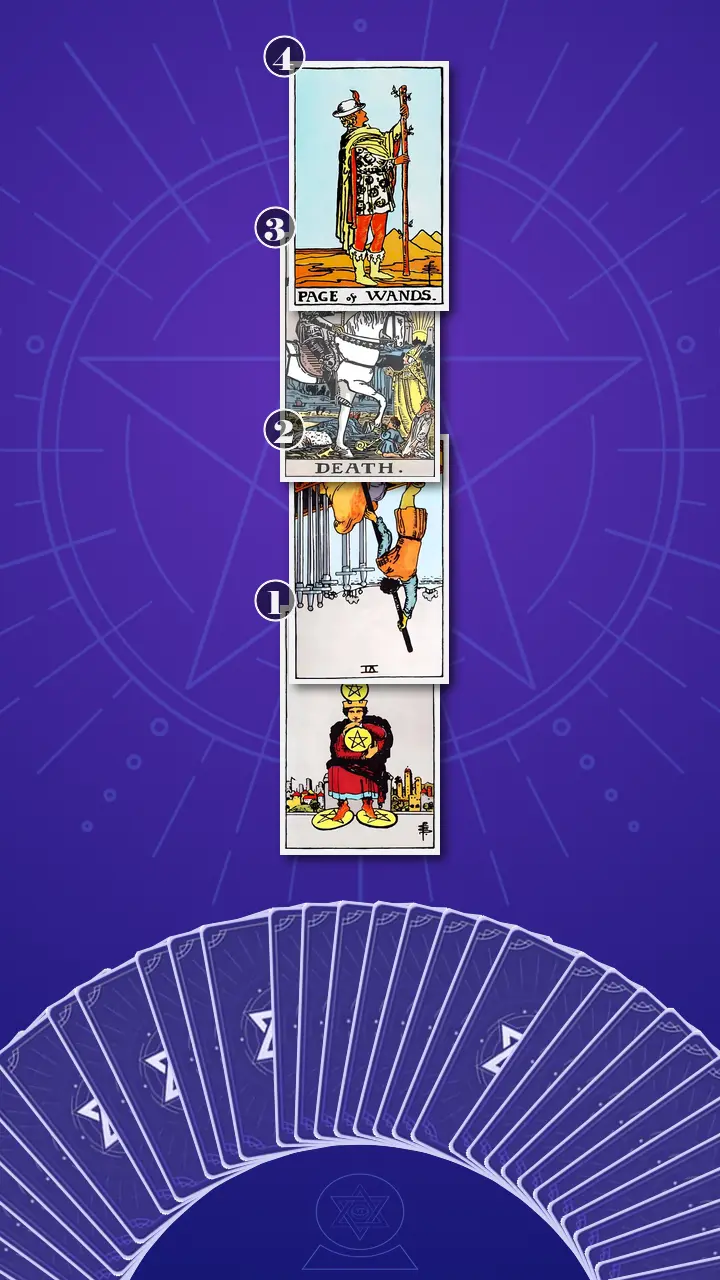
I chose the Four-Layer Insight Ladder, a focused four-card tarot spread for career-change uncertainty. For anyone wondering how tarot works in a consultation like this, I use the cards as structured prompts, not fixed predictions. Maya's question was causal, not a simple choice between two jobs, so a ten-position Celtic Cross would have added more material than we needed. This shorter surface-root-shift-integration reading could show the visible behavior, the fear beneath it, the rule that needed to change, and an actionable next step.
I arranged the cards vertically like a ladder rising from a locked courtyard. The first position would show how Maya protected her safe setup. The second would reveal the fear keeping the crossing stalled. The third would identify the transforming threshold. The fourth would turn insight into one time-boxed, reversible experiment.
Reading the Grip Before the Crossing
Position One: When Useful Security Acquires Veto Power
Now I turned over the card representing the diagnosis-level behavior through which Maya protected salary, benefits, routine, and planning while keeping her desired change hypothetical. It was the Four of Pentacles, upright.
I pointed to the figure pressing one pentacle against his chest while pinning two beneath his feet. “This is preservation in excess,” I said. “You are not wrong to value what you have built. But the resources meant to support your life have fused with your identity and restricted your movement.”
I connected the card to the performance review Maya had described. After receiving her raise, she had opened the benefits-renewal PDF beside the career application she had been drafting for weeks. She copied the pension match, health coverage, salary, and hybrid schedule into her comparison sheet, then treated each advantage as evidence that the application could not be submitted.
“Nothing is wrong enough to leave, yet nothing changes because nothing is wrong enough,” I said. “The problem is not security. The problem is giving every useful part of your current setup the power to veto exploration.”
Maya gave a short laugh that landed somewhere between recognition and grief. “That is too accurate. Honestly, it feels a little brutal.”
I let the laugh settle. “Accurate does not have to mean condemning. Your grip developed for a reason. We are only asking whether it still protects your options or now protects you from discovering them.” Her fingers stopped worrying the mug's handle, though her shoulders stayed raised.
Position Two: The Boat Packed With Seven Browser Tabs
Now I turned over the card representing the psychological mechanism beneath the stagnation: the fear that moving without guarantees would destabilize Maya's life and expose a lack of control. It was the Six of Swords, in reversed position.
I showed her the boat pointed toward a distant shore. Reversed, its Air energy was blocked. Thought was not navigating the crossing; thought was circling it. I brought the image directly into her Tuesday night: the unfinished application, course page, salary calculator, Google Maps commute comparisons, and spreadsheet were six swords packed neatly into a boat that remained tied to the familiar bank.
“Research becomes avoidance when it replaces the experiment that could answer the question,” I said. “Your internal rule sounds like, ‘I will move as soon as I know where this ends.’ But the only evidence you accept is evidence you cannot obtain without moving.”
I asked her for the exact worst-case sentence that appeared when her finger hovered over Submit.
“If I leave a good situation and regret it, I will have no excuse,” she said. Her breath paused. Her eyes shifted away from the cards as if replaying every saved draft. Then she exhaled through her nose and lowered one shoulder. “Closing the tab feels responsible for about ten minutes. By morning, I just trust myself less.”
I nodded. “That short-term relief is real. It is also expensive. It removes tonight's discomfort while preserving tomorrow's uncertainty.”
When Death Raised the White Rose
Position Three: The Ending That Does Not Require a Resignation
The radiator clicked behind Maya just as I reached for the next card, and the room seemed to become unusually still. Now I turned over the card representing the key shift: ending the rule that certainty must precede exploration while preserving every support that remained genuinely useful. It was Death, upright.
I clarified immediately that I did not read Death as literal death, disaster, or a prediction that Maya's job would end. Its energy here was balanced release. I focused on the white rose carried across the black flag and the sun rising between two towers. “The ending here is a rule, not necessarily a job,” I said.
The image took me back to my years on Wall Street, where an obsolete policy could create friction long after the market conditions that justified it had disappeared. I ran what I call a Pseudo-Growth Eradication audit. I stripped away the polished Notion boards, saved podcasts, comparison sheets, and self-development language, then looked at actual return and execution. Maya had invested a year of attention. The outward execution rate was close to zero. The main return had been brief relief after postponement.
I was not dismissing her preparation. I was identifying the internal policy that had captured it: No experiment may begin until success is guaranteed. Death was retiring that policy, not deleting the salary, apartment, benefits, or systems that still worked.
I brought Maya back to 10:47 p.m.: the warm laptop, the benefits spreadsheet, the extra contingency column, and the jaw releasing at Save Draft. I asked whether she had been calling that physical relief responsibility, even though no fresh evidence had entered the room.
Your safe life is not a command to remain unchanged; let Death's white rose mark the end of certainty as permission, then make one reversible, living choice.
I stopped speaking. First, Maya's breath froze and her fingers hovered above the mug. Then her gaze lost focus, as if she were watching the past year of postponed deadlines play back behind the screen. Her brow tightened.
“But does that mean I spent a whole year doing this wrong?” she asked, with a flash of anger that sounded more vulnerable than defensive.
“No,” I said. “It means your caution gathered useful support, and one part of the strategy has now outlived its job. You are allowed to update it without prosecuting your past self.”
Her eyes reddened slightly. She pressed her lips together, loosened her grip, and let both shoulders descend. A shaky breath left her chest, followed by a small, almost disoriented silence, the kind that arrives when a burden drops and personal responsibility becomes visible underneath it. I asked, “Now, with this new view, can you remember a moment last week when this insight might have made you feel different?”
She named the performance review. I watched her recognize that the raise could fund a bounded pilot instead of dictating permanent loyalty. I named the shift for her: from restless, guilt-laced containment and certainty-seeking to curious experimentation and grounded self-trust. It was not a completed transformation. It was the first honest threshold.
The Page Who Wanted Evidence With Fingerprints
Position Four: A Beginner's Pilot, Not a Verdict
Now I turned over the card representing one time-boxed, reversible experiment that could generate direct evidence and begin rebuilding self-trust. It was the Page of Wands, upright.
I read its Fire as the energy Maya had been underusing: curiosity expressed through contact. The Page studies a sprouting wand rather than pretending to hold a finished map. I pictured Maya in a quiet Toronto cafe, notebook open to three questions, joining a 20-minute informational call with no resignation letter in sight.
“You are not deciding your whole future on that call,” I said. “You are finding out what the work feels like up close. Beginnerhood is not a loss of status. Here, it is a research method.”
I used my Potential Actionability Assessment to test the insight. Inspiration received no credit unless it could become a dated action with a clear time limit, financial boundary, and exit condition. “A reversible test can give you what a perfect forecast cannot: evidence with your fingerprints on it.”
Maya looked toward the application tab, then back at the Page. “A call feels different from ‘change careers,’” she said. I watched curiosity enter without erasing fear, which was precisely the point.
Turning Safety Into a Runway
I read the four cards as one coherent sequence. Over the previous year, Maya's identity as the prudent, reliable employee had taught her to grip useful stability. That contracted Earth fed blocked Air: every forecast created another reason not to cross. Death interrupted the circuit by retiring certainty's veto, and the Page of Wands introduced exploratory Fire through direct experience. The missing Cups mattered too. Longing, guilt, and grief had been excluded from the spreadsheet, even though they were part of the cost calculation.
I told Maya that her cognitive blind spot was not a failure to gather enough information. It was the assumption that forecasted certainty and lived evidence were interchangeable. They were not. The transformation direction was clear: keep the current support, stop asking it to make every future decision, and use it as a runway for one bounded career pilot.
The Evolution KPI Framework: Thirty Days of Observable Movement
I gave her three small commitments. I explained that my Evolution KPI Framework is strict about execution and measurement, not harsh about outcomes. Success would mean producing evidence, not proving that she should quit.
- Write the Eight-Minute Policy Retirement Note. During one lunch break this week, open a note titled “One Reversible Test.” Replace “I must know the alternative will work” with “I need enough safety to run one bounded test.” Name one support to preserve, one rule losing veto power, a maximum time or money limit, and an exit condition. Tip: If eight minutes feels activating, write only one question for someone in the field and stop after five minutes.
- Create One Outside-World Data Point. By Wednesday evening, send one concise LinkedIn or email message requesting a 20-minute informational conversation. State clearly that you are exploring the work, not asking for a job or promising a career change. Tip: Draft for ten minutes, send one message, and do not turn contact research into another comparison project.
- Track Evidence for Thirty Days. Every Friday, record three binary KPIs: whether one outward experiment occurred, whether it produced three concrete facts, and whether you named one emotional cost of staying or testing. Complete one 45-minute sample task by day fourteen, then log what felt engaging, draining, easier, and harder than expected. Tip: Do not score yourself on confidence, certainty, or a final career decision. The metric is contact with reality.
I reminded Maya that she controlled every boundary. No recruiter, friend, tarot reading, or productivity framework had the authority to push her into resignation, major spending, or an experiment she wanted to stop. Tarot had helped us identify the pattern. Maya remained the person holding the calendar, the budget, and the steering wheel.

A Week Later, the Quiet Proof
A week later, I received Maya's message: she had sent the request and booked a 20-minute call. She had slept through the night, then woken thinking, “What if I am wrong?” She told me she smiled because the question no longer had the authority to cancel the test.
I did not call that a solved career or a guaranteed new direction. I called it the first observable proof of our Journey to Clarity. The cards had not rescued Maya from uncertainty. They had helped her separate support from veto power, and she had chosen to create evidence of her own.
If an open tab becomes a real Submit button and your jaw tightens, I want you to remember what I saw with Maya: the change you want may carry the frightening possibility that you cannot control what comes after, while postponement preserves both your safety and your unanswered longing. Simply noticing that split means you are no longer standing at the exact same starting point.
So I leave you with the question held inside Death's white rose: if your current safety became a runway instead of a veto, what one reversible, living choice would you let teach you something this week?