Stress Spending After Work: From Urge to a Five-Minute Evening Anchor

The Stress-Spending Loop at 6:20 p.m.
If you are the dependable junior coordinator who keeps six client threads moving but loses the evening to Uber Eats and retail tabs the second you reach your Toronto apartment, your stress spending after work may be happening at a very specific transition point. I recognized that pattern in Maya (name changed for privacy) before she finished taking off her coat.
At 6:20 p.m. on a Tuesday, she had dropped her bag beside the apartment door and left the evening checklist open on the kitchen counter. The fridge motor hummed behind her, wet traffic hissed outside, and her phone felt warm as her restless fingers moved from a delivery app to two retail tabs. The prepared meal waited in the fridge, the ten-minute reset waited on the counter, and the banking page stayed minimised on her laptop.
She looked at me and said, Why do I keep stress-spending instead of following a routine? Then she described the sequence she knew too well: a day of shifting client requests, one late Slack message, hunger, browsing that felt almost productive, a few small purchases, and the heavy drop that arrived with the confirmation emails.
I could see the contradiction in the way she held her phone: she wanted the steadiness and financial breathing room of a modest evening routine, but when stress rose, immediate comfort felt easier than the first boring step. Her stress seemed to move through her like a smoke alarm that kept blaring whenever the room became merely uncomfortable. I told her that I heard a strained transition, not a defective character. We could use the cards as a structured mirror, slow the sequence down, and begin our Journey to Clarity by drawing a map of the moment before checkout.

Choosing a Map When the Road Keeps Switching
Before I shuffled, I invited Maya to put both feet on the floor, take one unforced breath, and name the question once. I washed the deck slowly through my hands. The small ritual was not meant to summon a fixed answer; it gave her attention a clean edge between client mode and personal time.
For this reflective tarot reading, I chose the six-card Transformation Path Grid, Context Edition. I use tarot as a non-predictive cognitive tool: the imagery makes a pattern visible, the positions give it structure, and the querent tests every interpretation against lived facts. The value is in the conversation and the choices that follow, not in treating a card as a verdict.
This spread suited Maya because her question was not only about one purchase or one budget. It was about a self-reinforcing stress-spending and routine-reset loop. The six-card structure could hold the visible symptom, the reward mechanism, the underlying belief, the transformation trigger, the repeatable action, and the integrated capacity without turning her private struggle into a moral lesson.
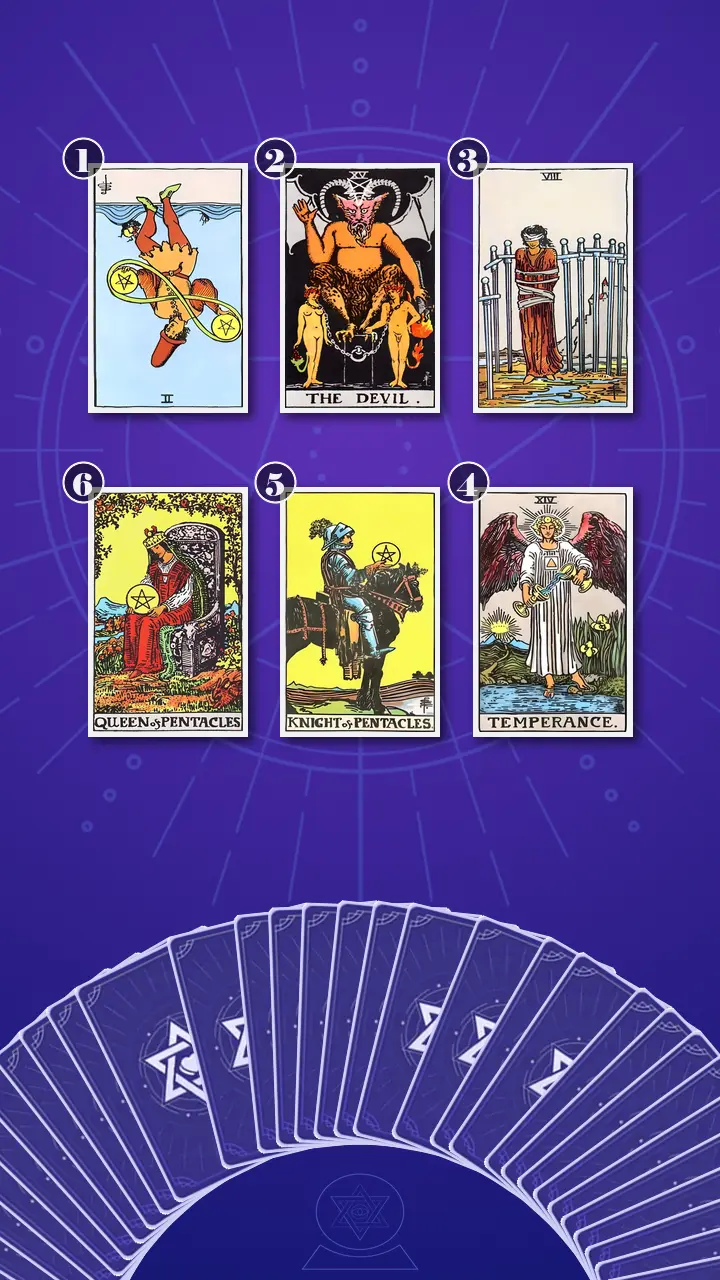
I told her that the first card would show where the pattern appeared in daily life, the second would identify the force keeping it compelling, and the third would reveal the belief beneath routine avoidance. Then the lower row would move toward the flexible pause, the small action that could carry it into an ordinary evening, and the kind of grounded self-care that might grow through repetition.
Reading the Pattern Beneath the Apps
The Two of Pentacles and the Evening That Never Lands
I turned over the card for the observable symptom in the diagnosis, the place where stress disrupts practical coordination and shopping or delivery apps replace the first step of the intended evening routine. It was the Two of Pentacles, in reversed position.
In the Rider-Waite-Smith image, the juggler keeps two pentacles moving inside an infinity-shaped ribbon while ships rise and fall on rough waves behind him. I saw an immediate modern translation: at 6:20 p.m., Maya had a delivery app, two retail tabs, and a minimised banking page open at once. Switching between prices and delivery times gave her the sensation of handling the evening, even as the prepared meal, transaction check, and ten-minute reset dropped out of motion.
I read the reversal as a deficiency of stable coordination combined with an excess of task-switching. The energy was busy, but it was not supporting the priorities that were meant to steady her. The card did not say that Maya lacked discipline. It showed a daily rhythm losing its balance under pressure, like a Notion board where every task is marked in progress and nothing reaches done.
I asked her to listen for the thought beneath that activity: I am technically handling things, so why is nothing I meant to do getting done? She let out a short, bitter laugh instead of nodding. That is too accurate, almost cruelly accurate. Buying one small thing feels easier than doing the next boring step.
I did not push her toward agreement. I asked where the first routine step disappeared on the last difficult evening: eating, changing clothes, tidying, or checking transactions. Maya looked down at the card, rubbed her thumb along the edge of her phone, and named the prepared meal. The problem became smaller and more precise as soon as she stopped calling the whole night a failure.
The Devil and the Bargain That Moves Faster Than Choice
I turned to the position that identifies the reward mechanism sustaining the repetition compulsion, the force that makes immediate novelty and relief more compelling than the slower benefit of routine. I found The Devil, upright.
The chained figures in the Rider-Waite-Smith image are not sealed into an unbreakable prison. The chains are loose enough to remove, which mattered to the way I read this card. Maya had a saved payment method, one-tap checkout, a push notification, and a free-shipping threshold. Each feature shortened the space in which another choice might appear.
I brought her to the familiar 8:47 p.m. moment. A notification announced twenty percent off for two hours while she was still in her work clothes, hungry and irritated. She opened the app just to look, added one practical item, then added another to reach free shipping. The countdown turned browsing into an urgent task, and checkout delivered a few minutes of alertness and relief.
The purchase is small; the bargain is not. I meant that the bargain included attention, agency, tomorrow's financial flexibility, and the routine displaced before she had consciously evaluated the trade-off. I was not asking Maya to condemn the purchase or prove that she could resist every offer. I was asking which cue made the sequence feel pre-decided and what she expected the item to change in the next ten minutes.
My mind went to a sound check from my ten years of sound energy research. I was not hearing a bad person making bad choices. I was hearing one urgent note amplified until it covered the quieter notes of hunger, rest, money awareness, and deliberate preference. Maya's chest tightened when I said that, and her jaw set for a moment. Then she named the notification she most often obeyed: the limited-time sale that arrived just after work.
The Eight of Swords and the Hidden Custom Setting
I turned over the card for the root belief beneath routine avoidance, the fear or conclusion that made structure feel restrictive and spending look like the only quickly available kindness. It was the Eight of Swords, upright.
The blindfolded woman stands among eight swords in an incomplete enclosure. To me, the opening was the important detail. Maya was not seeing an empty landscape; she was seeing an interface with only two imagined buttons: follow the whole plan or give up and buy something for relief. A flexible custom setting existed, but her attention could not reach it at the most depleted point of the day.
I connected the image to the Sunday reset she had described. At 9:14 p.m., blue light from a polished weekly-reset video reflected across the laundry basket while the kitchen bulb buzzed. She decided she needed a new planner and storage set before Monday could feel manageable. The sentence underneath was blunt: If I cannot do it properly, there is no point starting.
I read the Eight of Swords as restrictive Air, a conclusion formed in a narrowed state rather than an unavoidable fact. The routine felt like confinement because Maya had designed it as a complete test of control. Spending felt like relief because it required no proof that she could sustain anything tomorrow. I asked what a third option might look like if it only had to survive five minutes. She went quiet. Her eyes lost focus as if a series of missed checkboxes were replaying behind the blindfold, then her fingers slowly loosened around the phone.
When Temperance Made Room for Comfort
I slowed the reading before turning to the fourth card. The apartment grew quiet except for the soft click of the kettle settling on its base, and a strip of streetlight moved across the table like a narrow path. We had reached the card that would not demand a perfect answer, only a different rhythm inside the existing sequence.
The Stream Between Strictness and Relief
I turned over the card for the key transformation trigger, the flexible pause that lets comfort and practical care coexist before a purchase decision is completed. It was Temperance, upright.
The angel stands with one foot on land and one in water, pouring a steady stream between two cups. I read the water as emotional pacing, not suppression. Maya did not need to choose between punishing restriction and unrestricted relief. She could adjust the blend of food, rest, time, attention, and spending while keeping the final decision in her own hands.
This was where I used my signature Somatic Rhythm Mapping. I traced the sequence through the body and the daily architecture: tight jaw, lifted shoulders, restless fingers, a warm phone, rapid app-switching, and no transition beat between client urgency and personal choice. I call that tempo misalignment an arrhythmia as a metaphor, not a diagnosis. The problem was not that Maya could not follow a routine. Her routine entered at the wrong tempo, asking for quiet consistency precisely when her body was still tuned to incoming demands.
At 6:20 p.m., the checklist was open, dinner was already there, and three shopping tabs felt easier than one boring step. By checkout, Maya's shoulders had dropped for a second, but tomorrow's cleanup had already begun. The familiar relief was arriving quickly, while the cost was waiting just outside the frame.
The pause is not there to take comfort away. It is there to make sure stress is not the only voice authorizing the purchase.
You are not trapped between strict deprivation and instant relief; choose one measured action, like Temperance pouring between two cups, and let balance come before checkout.
Maya froze before she could nod. Her breath stopped halfway, and the hand holding her phone hovered above the table. Her eyes moved from Temperance to the open cart without quite focusing, as if she were replaying the bag by the door, the untouched food, the discount alert, and the checkout screen. Her fingers tightened once around the phone, then released. The corner of her mouth trembled; her eyes shone, and her shoulders sank with a long, uneven exhale. I do not have to earn comfort, she said, almost testing the words. And I do not have to let urgency make the whole decision. I invited her to try the smallest version during the next urge: place the phone screen-down, set a five-minute timer, choose tea, prepared food, soft clothes, or a quieter seat, and write, I want this purchase to change how I feel by ___. Buying, waiting, or closing the app would all remain valid choices. Stopping would also be valid if the exercise felt more pressuring. Then I asked, Now, with this new view, can you remember a moment last week when this insight might have made the evening feel different?
Maya swallowed and looked toward the kitchen. I watched a small looseness arrive in her face, followed by a brief blankness that was not quite relief. Clearer choices meant she would be the one making them, and that responsibility felt lighter than the old loop but unfamiliar in her hands.
I asked her to rehearse the pause with the cart already open. At the exact moment between adding an item to reach free shipping and pressing Place Order, she set her phone face down. The kettle began to hiss. Her jaw unclenched by a fraction as she said, I can still decide in five minutes. I told her, A cart is an option, not a contract. The point was not to force a no-spend result. It was to replace urgency with pacing and total prohibition with temporary space.
That was the first meaningful movement from stress-driven immediate relief toward flexible, repeatable self-regulation. The relief did not come from the card taking control. It came from Maya noticing that comfort and resource care could enter the same decision.
The Knight of Pentacles and the Boring Proof
I turned to the position that translates the key shift into one repeatable behaviour, the practical action that can carry the new perspective into an ordinary stressful Tuesday. The card was the Knight of Pentacles, upright.
The horse is still. The Knight holds the pentacle level, studying it with deliberate attention while cultivated fields extend behind him. Nothing in the image competes with the stimulation of a shopping feed. That was its strength. I explained that Maya's new practice needed to be simple and dependable enough to happen when it felt boring, unimpressive, or slightly inconvenient.
For one week, I suggested the same five-minute sequence before discretionary checkout: phone down, one available comfort first, one sentence about the urge, then a fresh decision. No full budget overhaul. No twelve-task evening reset. No total no-spend challenge drafted in response to guilt. I asked her to measure success by completing the anchor, not by whether she bought, waited, or closed the app.
I compared the Knight to a modest recurring calendar event that keeps running after a bad Tuesday, rather than a productivity dashboard rebuilt after every disrupted day. Maya gave a small nod and wrote the sequence in her Notes app. This counts even if it does not fix the whole evening, she said. Her shoulders remained a little high, but her thumb did not open another tab.
I added the sentence I wanted her to remember: A routine becomes trustworthy when you can return to it imperfectly. The repetition was no longer reserved for checkout. It could become a source of stability.
The Queen of Pentacles and a Life That Includes Pleasure
I turned over the final card, the position that defines the integrated capacity Maya could practise over time: grounded self-care that includes comfort, routine, and awareness of material resources without punitive control. It was the Queen of Pentacles, upright.
The Queen cradles the pentacle in a fertile garden, with a rabbit close to the ground. I read the image as practical tenderness. Money did not have to sit above comfort as a judge, and comfort did not have to appear as a loophole that destroyed the plan. Both could belong to one supportive evening system.
In real life, that might mean accessible food, a brief look at recent spending, and a chosen pleasure such as a show, a bath, a walk, a call, or an intentional purchase. If a client emergency or spontaneous order disrupted the plan, Maya could return to one anchor the next evening instead of drafting stricter rules. The Queen did not promise permanent perfection. She offered a form of practical self-trust that could survive an imperfect week.
Maya placed her palm flat beside the cards. She looked less triumphant than settled, which I trusted more. The desire for comfort had not disappeared, and neither had the possibility of buying something. What had changed was the idea that one urge had to become the entire architecture of the night.
The Five-Minute Route From Insight to Action
When I read the six cards as one story, I saw why the loop had become so persistent. Shifting client requests and the blurred work-to-home transition pushed Maya into unstable practical coordination. The Devil attached a fast material reward to that instability through notifications, saved payment details, and checkout. The Eight of Swords supplied the hidden rule that routine meant restriction and that a missed step deleted the whole evening. Temperance introduced the bridge, the measurable pause. The Knight gave that bridge a repeatable form, and the Queen showed how comfort, money care, food, rest, and routine could function as one system.
The core metaphor was the fire alarm: Maya had been pulling it whenever the room became uncomfortable, then trying to rebuild the entire building the next morning. Her cognitive blind spot was not a lack of awareness about spending. She already knew the transactions added up. The blind spot was treating the pause as a failure unless it produced a purchase-free result, while treating a strict reset as success even when it could not survive pressure.
The transformation direction was therefore not from buying to never buying. It was from stress automatically authorising the next action to Maya creating a repeatable moment of deliberate choice. The key shift was clear: complete one five-minute routine anchor before deciding whether to spend. The cards showed possibilities and patterns. Maya remained the person who could choose the route, change the route, or pause the experiment.
For the next steps, I used my Frictionless Tempo Calibration, a three-day micro-habit sequencing experiment for changing task-entry rhythm without triggering burnout. I asked Maya to change the doorway into the evening one small piece at a time, then keep only what felt workable.
- The Five-Minute Before-Buy AnchorFor the next three after-work evenings, choose one comfort that already exists in the apartment, such as heating the prepared meal, making tea, changing out of work clothes, or sitting by an open window. Write the choice near the place where browsing usually begins. At the next discretionary-shopping urge, put the phone screen-down, set a five-minute timer, complete the anchor, write I want this purchase to change how I feel by ___, and decide again when the timer ends.If five minutes feels impossible, use sixty seconds. Completion is the measure, not whether the final decision is to buy, wait, or close the app.
- The Notification-Free Transition WindowBefore the next workday ends, mute promotional notifications from one delivery or retail app for seven days. Maya could keep receipt and delivery-status alerts, move the highest-trigger app off the first home-screen page, and set a neutral 6:15 p.m. reminder that asks what would make the next ten minutes easier without deciding the whole night.This is a short test of the cue, not a permanent ban on shopping or spontaneity. The smallest version is moving one app icon for one evening.
- The Three-Transaction Neutral ReviewOn one chosen evening this week, set a five-minute timer and look at only the three most recent discretionary transactions in the banking app. Beside each one, write a neutral context word such as late workday, hunger, sale alert, or social scroll. Finish with one sentence identifying the first routine step that disappeared before checkout.Do not turn this into a punishment session, cancellation project, or new no-spend rule. If the banking app feels too intense, write down only today's known purchases and stop there.
I reminded Maya that this was actionable advice, not a test of moral discipline. If the pause made the evening feel more pressured, she could stop and return to a preferred form of comfort. The point was to create one moment in which the next choice felt less predetermined. Repetition would provide the evidence, not one flawless week.

A Week Later, the Quiet Proof
Three days later, I received a text from Maya: Phone down, tea first. I still bought the book, but it felt like my choice. A week later, she told me she had slept through the night after using the anchor. At breakfast, the thought What if I get it wrong? still arrived, but she made tea before reaching for her phone. The fear remained; it simply no longer held the device.
I consider that a real beginning. Tarot did not remove stress, make the apps disappear, or decide what Maya should buy. It helped her see the cue, the bargain, the restrictive story, and the bridge between them. She supplied the pause, tested the routine, and became the author of the next repetition.
When I picture the warm phone in a restless hand and the untouched checklist, I remember that the hardest part is not wanting comfort. It is fearing that any pause will take comfort away and prove that we cannot trust ourselves with the choice.
If comfort did not have to disappear, what tiny pause, perhaps the same five-minute Temperance pause between a warm phone and an untouched checklist, might make tonight's next choice feel a little more like yours?