One Ten-Minute Calendar Block: Turning Saved Advice Into a Real Trial

The Sunday Reset That Looked Like Progress
I have learned that if a job rewards research, comparison, and process thinking, productive procrastination can look almost identical to doing the work. That was the problem Alex (name changed for privacy), a 28-year-old product operations coordinator in Toronto, brought into our reading.
At 8:52 on a Sunday night, Alex joined my video call from the small kitchen table in their shared west-end apartment. A morning-routine video was autoplaying behind our conversation until they found the tab and muted it. Their tea had gone cold; the laptop fan whirred beneath the host's frozen smile, and the radiator clicked against the winter quiet while Alex dragged habit cards around a polished Notion reset board.
“My saved folder has changed more than my mornings have,” they said. “I know exactly what I should do, which somehow makes it worse. Why do I keep consuming advice instead of changing my daily life?”
Their shoulders stayed close to their ears. Their thumb kept flicking toward the trackpad, and the hinge of their jaw moved as if they were chewing a question that would not break down. Their frustration had the physical texture of a song stuck buffering at the same bar: a burst of hopeful sound, a sudden stop, then the same opening notes again.
Alex was not short on advice, tools, or understanding. They were caught between wanting change through repeated action and wanting enough certainty to make an imperfect attempt feel impossible to regret. Every new framework briefly promised control. Testing one would expose it to a rushed Wednesday, a late TTC train, low energy, shared space, and the possibility that it might simply not work.
“I keep telling myself, ‘I am not avoiding it; I am finding the version I can finally sustain,’” Alex said. “Then the time I could have used to start is gone.”
I told them I did not hear laziness or a lack of discipline. I heard an intelligent safety strategy that had become too good at protecting them from evidence. “We are not going to use tarot to predict whether you will succeed,” I said. “I want us to make the loop visible, find where your agency is getting interrupted, and give this fog a map you can test in real life.”

Choosing the Switchback Map
I asked Alex to close the remaining advice tabs, place both feet on the floor, and take one unforced breath. I shuffled slowly while they held the question in mind. The preparation was not about summoning an answer from elsewhere; it was a deliberate transition from reacting to the problem toward observing it.
I chose the Transformation Path Grid · Context Edition, a six-position tarot spread arranged in two rows of three. The upper row would expose the visible behavior, the active blockage, and the root fear. The path would then turn sharply downward into the catalyst, move through a practical experiment, and finish with an integration state that could be cultivated rather than guaranteed.
For anyone wondering how tarot works in a situation like this, I use card meanings in context as an external cognitive map. Alex's problem was not a simple either-or decision, and it did not need a future prediction. It was a self-reinforcing system: difficult action triggered research, research brought temporary relief, too many options increased comparison, delayed action created self-criticism, and self-criticism triggered more research. This spread was compact enough to show both the maintenance loop and the point where a different response could enter.
I placed the first three cards from left to right. Beneath the third, I placed the fourth, then continued back toward the left with the fifth and sixth. The shape resembled a switchback trail. We would first see why Alex kept circling above the problem, then trace a grounded route back into ordinary daily life.
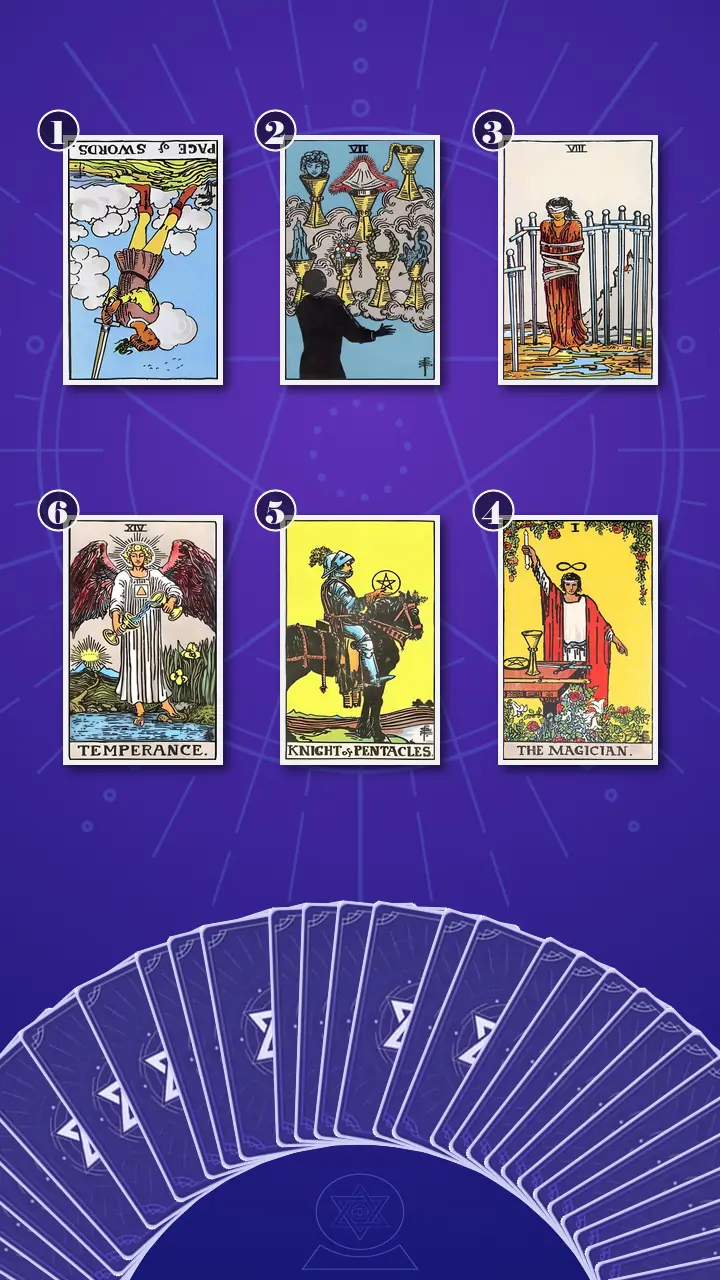
The Upper Trail of Open Tabs
Position One: The Page Who Kept Scanning
The card I turned over first occupied the position for the visible present pattern: repeatedly consuming, saving, and organizing advice while the routine itself remained unchanged. It was the Page of Swords, in reversed position.
The Page held the sword upright with both hands while looking sideways into a windblown landscape. I read the image as a mind prepared for every new possibility but unable to settle its attention on one direction. In Alex's case, the Air energy of thought was in excess, while embodied execution was in deficiency. Curiosity had not disappeared; it had become scattered scanning at precisely the moment action started to feel exposing.
I asked Alex for the most recent example. They described Tuesday at 11:40 p.m.: sitting on the edge of the bed with a warm phone in one hand, a productivity podcast playing through one earbud, a habit app open, and three routine videos queued. The gym clothes intended for that morning were still folded on a chair. They had renamed Wednesday's routine twice, but had not assigned its first repetition a time, place, or minimum version.
“The sentence beneath that scene is probably, ‘I am not avoiding it; I am making sure I do it properly,’” I said. “Your mind stays active, informed, and hopeful. Your body stays on the bed. The activity is real, but it is not producing the evidence you came looking for.”
Alex gave a short laugh that carried more sting than amusement. Their hand rose to cover their mouth, then fell back to the table. “That is so accurate it is kind of brutal.”
I slowed down. “Accurate does not have to mean condemning. Research is one of your strengths, and it makes sense that you reach for a familiar competence when beginning feels vulnerable. We are only asking whether that strength is doing the job you think it is doing after 11 p.m.”
Their shoulders lowered by a fraction. I asked, “The last time you opened another routine video, what concrete action had just begun to feel awkward, boring, or exposing?”
“Putting on the clothes and doing five minutes,” they said. “Because five minutes feels embarrassingly small, and thirty minutes feels like something I will fail to sustain.”
Position Two: Seven Possible Mornings
The next card represented the active blockage: the expanding field of self-improvement options, ideal routines, and supposedly better methods that made temporary selection feel dangerously final. I turned over the Seven of Cups, upright.
Seven incompatible visions floated above a silhouetted figure. In Alex's daily life, those cups looked like seven polished systems held open across YouTube, TikTok, newsletters, podcasts, and Notion: a 5 a.m. routine, an energy-based schedule, habit stacking, a dopamine reset, a minimalist tracker, an elaborate dashboard, and a no-routine philosophy.
The Water energy of imagination was in excess. Discernment through lived experience was deficient. Each option promised a slightly different identity, and each remained attractive because it had never encountered a delayed train, an urgent Slack message, or a low-energy Tuesday. The spread was showing advice overload not as an absence of good choices, but as an abundance that had never been filtered through reality.
“It is a little like the branching selves in Everything Everywhere All at Once,” I said. “Every possible Alex stays vivid at once. Choosing one five-minute trial can feel like abandoning six better lives, even though the only life available for testing is this ordinary week.”
Alex pressed their palm lightly against their chest. Their gaze moved across the seven cups, pausing on each as if it were another thumbnail. “The thought is always, ‘If I choose this one, what if I miss the method that would finally work?’”
“Exactly,” I said. “More options can feel like freedom right up until none of them gets a trial. If every route remains open, you preserve possibility, but you postpone the evidence that could make your next choice easier.”
I asked them to name the three systems they were actively comparing and the five-minute behavior those comparisons had displaced. As Alex listed them, their voice became quieter. The methods were different. The postponed behavior was the same: put on the clothes and move after breakfast.
Position Three: The Door Marked Certainty
The third card occupied the position of the root mechanism: the belief or fear connecting advice consumption to the need for complete certainty. I turned over the Eight of Swords, upright.
A blindfolded figure stood loosely bound inside an incomplete enclosure of swords. Open ground remained visible, but the figure could not yet use what they could not perceive. Here, Air had shifted from excess into blockage. Thought was no longer merely multiplying options; it was enforcing a rule that said action was unsafe until understanding was complete.
I asked Alex to picture a genuine ten-minute opening before work. They could begin a small action, but the full routine would need thirty minutes. “What happens next?” I asked.
“I decide ten minutes does not count,” they said. “Then I use it to find something more flexible.”
“And beneath that practical objection?”
Alex's breath stopped. Their fingers hovered above the blank corner of the Notion board. Their eyes lost focus for a moment, as if they were replaying several abandoned Mondays in quick succession. “If I start and stop after three days, it proves I cannot control my own life,” they said. The last few words came out almost as a whisper.
I did not tell them the constraint was imaginary. Shifting deadlines, fatigue, shared space, disability access, money, and sleep can all place real limits on a routine. The Eight of Swords asked for a more precise distinction: which conditions were fixed, and which prerequisites had been promoted into locked doors? Needing a calm week, thirty uninterrupted minutes, stable motivation, or certainty that the habit would last were movable rules, not universal entry requirements.
I also brought in the lens I call Somatic Rhythm Mapping. I use it as a reflective metaphor, never as a medical diagnosis. Alex's restless thumb, tight jaw, and suddenly heavy limbs revealed a sharp tempo break in their daily architecture. Advice kept the nervous momentum fast and bright; action required an abrupt shift into slower physical contact. The problem was not simply low motivation. Their routine had no bridge between those tempos.
“Your body is moving from a hundred beats per minute of scrolling to a standing start,” I said. “No cue, no transition, and no minimum version. That tempo change creates friction, then your mind interprets the friction as evidence that the plan is wrong.”
Alex loosened their fingers and exhaled from deep in their chest. The sound carried recognition and a trace of grief. “Starting badly feels more exposing than researching well.”
“Yes,” I said. “The blind spot is not that you secretly do not want change. It is that you have been treating imperfect follow-through as a verdict on your identity instead of evidence about the design of an experiment.”
When the Magician Put One Tool to Work
Position Four: The Table Was Already Full
The room became unusually still when I reached the turn in the spread. Even the radiator paused between clicks. The card beneath the Eight of Swords represented the catalyst: the transformation from seeking a complete explanation to running a focused experiment with resources already available. I turned over The Magician, upright.
The Magician stood with all four suit emblems on the table, one hand raised and the other pointing toward material ground. I did not read this as supernatural command. I read it as balanced agency: thought, feeling, intention, and physical resources directed toward one observable result. Alex already had a calendar, a timer, gym clothes, saved guidance, and enough knowledge for a safe minimum attempt. The missing movement was deliberate use.
Looking at the card, I flashed back to years of studying sound setups in which an elaborate arrangement failed because the signal never reached the speaker. More analysis of the score could not repair missing contact. The source, cable, and output had to form one path.
I used my Execution Block Dismantling framework to identify Alex's equivalent dissonant chord. The intended action was movement after breakfast. The hidden starting friction was a thirty-minute definition of success, clothes left across the room, no calendar cue, and an advice app available before their feet reached the floor. The system was asking inspiration to do work that the environment had never been arranged to support.
The Magician changed that signal path: close the advice apps, put the clothes beside the door, attach movement to breakfast, reserve ten minutes, and define five minutes as a complete attempt. Alex was not choosing the perfect system. They were choosing what to test.
At 11:40 p.m., the podcast could still be playing while the untouched clothes waited on the chair. Alex's familiar mind would insist that tomorrow remained fixable, provided nothing had to be tested tonight. The Magician challenged that exact bargain by making one already-known idea visible in the calendar, the room, and the body.
More information is not the missing ingredient; choose one tool already on the Magician's table and make it visible through one small action.
I let the sentence sit between us.
Alex's breath stopped for a beat. Their fingers froze above the trackpad, then slowly folded into their palm. Their pupils widened as their gaze shifted from the card to the cold tea and back again, as though the last several months were replaying without their usual commentary. A flush rose across their cheeks. “But does that mean I have been doing it wrong this whole time?” they asked, the words sharper than anything they had said before. I heard anger first, then hurt beneath it. “No,” I said. “It means the strategy gave you relief and control when you needed them. Now you can see its cost clearly enough to choose a different use for your intelligence.” Their fist opened one finger at a time. A long, uneven breath left their chest, their shoulders dropped, and their eyes grew damp. The release was followed by a brief blankness, the vulnerable pause that comes when clarity returns responsibility to the person who can act.
I asked, “Now, using this new perspective, can you think back to last week? Was there a moment when this insight could have made the situation feel different?”
“Wednesday morning,” Alex said. “I had ten minutes. I thought five minutes would not count, so I watched a video about consistency. I could have treated the five minutes as a test instead of a promise.”
We made the idea physical before continuing. I set a ten-minute container. Alex chose one suggestion they had already saved and typed: “For seven days, after breakfast, I will do five minutes of movement and record only done, partial, or skipped.” They closed the advice tabs, moved the gym clothes beside the bedroom door, and placed a ten-minute block in the calendar they already used.
Then they completed a two-minute version of familiar, gentle movement that they felt comfortable doing. I reminded them that the goal was evidence, not self-punishment. Any experiment could be reduced, replaced, or stopped if it caused pain, risk, significant distress, or conflict with professional guidance.
This was not a complete personality transformation. It was the first crossing from restless, certainty-seeking consumption toward grounded confidence built from observable evidence. The vulnerability remained, but it now had somewhere practical to go.
The Lower Trail Into an Ordinary Week
Position Five: Boring Is Not Broken
The fifth card represented the practical behavior that could carry the catalytic insight into ordinary life. I turned over the Knight of Pentacles, upright.
The Knight held one pentacle steadily while the horse remained still and cultivated fields stretched behind them. Earth energy had entered the spread in balance. After restless Air, imagined Water, and the Magician's spark, this card offered repetition without spectacle: one cue, one behavior, one simple metric, and enough time for reality to answer.
I showed Alex seven ordinary calendar blocks containing the same five-minute action. One belonged to a rushed Wednesday. Another sat on an unimpressive Friday when motivation would probably be low. The point was not to prove discipline or protect a perfect streak. It was to hold one variable steady long enough to learn how the action behaved under normal conditions.
“Boring is not the same as broken,” I said. “When novelty wears off on day three, that is not automatically a sign to redesign the system. It may be the first moment you are finally gathering information the feed cannot give you.”
Alex nodded, then frowned. “Wednesdays are chaos. What if I genuinely cannot do five minutes?”
“Then partial is data,” I said. “Do sixty seconds, record partial, and continue at the next cue. Do not restart the week, add penalties, or commission a full product relaunch for your morning.”
Their smile arrived cautiously. “A seven-day beta instead of a new operating system every Monday.”
“Exactly. You are not proving who you are. You are observing what happens.”
Position Six: Advice Waits Its Turn
The final card occupied the integration position: the balance Alex could cultivate between selected advice, direct experience, and evidence-based review. I turned over Temperance, upright.
The figure poured water carefully between two cups, with one foot on land and one in water. The energy was balanced and responsive. Reflection remained welcome, but it stayed in contact with material conditions. I translated the image into a weekly rhythm: select one input, run one trial, review what happened, then decide whether more input would answer a specific question.
“This is not an anti-advice card,” I said. “Curiosity was never the enemy. The problem was allowing input to replace experience. Advice can return after experience has had a turn.”
I asked Alex what they would examine on the eighth day. Together, we reduced the review to three questions: What happened? What got in the way? What is the smallest adjustment worth testing next? Continuing, changing one variable, stopping, or selecting one new source would all be valid outcomes. None would need to establish a moral truth about Alex's character.
Their jaw finally rested. They looked at the spread rather than the muted video tab. “That feels different from banning myself from self-help content,” they said. “It is more like giving advice a rate limit.”
“Yes,” I said. “Temperance is not deprivation. It is proportion. You are letting experience participate in the conversation.”
From a Library of Maps to One Walked Block
I drew the six cards into one coherent story. The reversed Page of Swords showed Alex's professional strength in research spilling into scattered after-hours scanning. The Seven of Cups revealed how every new system kept another ideal self alive. The Eight of Swords uncovered the rule beneath the overload: action must wait until failure cannot expose a lack of control. The Magician interrupted that rule by assigning one available tool to one observable act. The Knight of Pentacles carried the act through an ordinary week, and Temperance returned advice to a measured input-trial-review rhythm.
Alex had been collecting maps without walking a block, then interpreting the absence of firsthand knowledge as proof that another map was needed. Their cognitive blind spot was the belief that certainty should precede action. In this kind of habit change, useful confidence usually arrives in the opposite order: a small action produces evidence, evidence makes the terrain more legible, and clarity becomes grounded enough to guide the next action.
The key shift was specific. Alex would test one already-saved suggestion for seven days before consuming more advice on the same topic. They remained free to make the action smaller, account for real constraints, or stop. Tarot had not chosen the behavior for them. It had made the loop objective enough for Alex to choose with more awareness.
I translated the reading into three actionable next steps.
- Put One Tool on the Magician's Table Tonight, spend no more than ten minutes in one saved-content folder. Choose one suggestion related to the routine you want to change, move it into a note titled “This Week's Test,” place the physical tool where the action will happen, and schedule one block after an existing cue. Start with a two-to-five-minute version. Keep the experiment low risk, and seek appropriate guidance for medical, legal, financial, or physically risky decisions.
- Use Frictionless Tempo Calibration Over the first three days, rehearse entry into the action after the same cue: sixty seconds on day one, two minutes on day two, and up to five minutes on day three. For days four through seven, repeat the smallest version that remained workable. Log only done, partial, or skipped. The sequence adjusts starting tempo without demanding burnout-level momentum. If a day is missed, resume at the next cue; do not restart the week or rebuild the system.
- Give Experience a Full Turn Until the eighth-day review, place new content about the same topic on a Later list without opening it. At the review, take seven minutes to answer: What happened? What got in the way? What single adjustment is worth testing next? Continue, modify one variable, end the trial, or choose one new source. The result is information about fit and conditions, not a verdict on your discipline.

A Week Later: The Quiet Proof
Seven days later, I received a screenshot from Alex. The grid showed four done entries, two partial entries, and one skipped entry. Wednesday had indeed been chaotic. The old pattern would have turned that missed block into a late-night search for a more flexible routine. Instead, Alex had completed sixty seconds on Thursday and continued.
“Nothing dramatic happened,” their message read. “But I know more about my actual mornings than I did after months of videos. Also, I put three new routine links on the Later list and did not open them. That was weirdly hard.”
That night they slept through. In the morning, their first thought was, “What if this is too small to matter?” They smiled, put on the shoes, and let the question come along.
I did not read that week as proof that Alex had solved their life. I read it as the first credible evidence of their Journey to Clarity: restless hope had become tentative curiosity, and curiosity had finally made contact with the ground. The cards supplied a map, but Alex closed the tabs, moved the clothes, entered the calendar block, and walked the route.
I know the moment when a thumb keeps scrolling, a jaw tightens, and another plan feels safer than one imperfect attempt. Keeping every option open can protect the hope that life might still be done exactly right. If you recognize that rhythm, simply hearing it clearly means you are no longer standing at its beginning.
So, if one saved idea did not have to prove your discipline and only had to leave the Magician's table as a five-minute experiment, which tiny version would you be curious to try once this week?