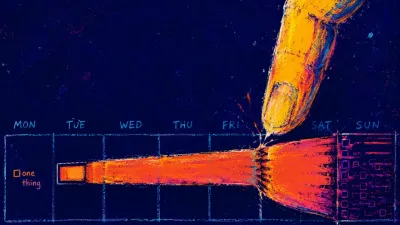
Netflix Covered the Portfolio; Four Rough Drafts Marked a Turn
The Evening the Algorithm Chose
I first met Alex (name changed for privacy), a 28-year-old remote customer-success associate in Toronto, through a video reading. They could clear a queue of other people's problems all day, then freeze over one self-chosen portfolio task after 7 p.m. Their question was direct: “Why do I keep choosing ease when it makes my life feel aimless?”
To show me what they meant, Alex walked me through a Tuesday evening at 7:10. The last customer tab was closed, and a portfolio document sat open on the laptop. The radiator clicked beside the window; traffic hissed over wet pavement below. Alex rewrote the heading twice, reached an unclear section, and felt their shoulders fold as one hand found the warm phone almost before they noticed it moving.
TikTok became a delivery order. The order became three familiar episodes. At 10:14, the portfolio cursor was still blinking behind the browser.
“I keep making life easier,” Alex said, “but I don't know what all the saved effort is for. Nothing is seriously wrong, which somehow makes the drift harder to interrupt.”
I heard dissatisfaction less as a dramatic crisis than as a phone vibrating beneath a sofa cushion: muffled enough to ignore for hours, persistent enough to make the whole evening hum. In the moment, the lowest-friction option offered relief. Later, the absence of completed evidence felt like proof that Alex had no direction.
That was the central conflict I wanted us to hold without turning it into an accusation: Alex wanted a life that felt personally chosen, yet each uncomfortable beginning was handed over to an algorithm designed to remove the need for choice. A frictionless evening can still leave a heavy morning.
“I don't hear laziness here,” I told them. “I hear an after-work avoidance loop that is very good at reducing uncertainty in the short term. Rest, delivery, streaming, and a soft life are not moral failures. Our work is to distinguish recovery you actually choose from a default that keeps choosing for you. Let's give this fog a map.”
Choosing a Map for the Closed Loop
I asked Alex to place both feet on the floor, let one ordinary breath reach the bottom of their ribs, and hold the question without trying to improve it. I shuffled slowly. The point was not to create a mystical performance; it was to mark a transition from replaying the problem to examining it.
I chose the Transformation Path Grid · Context Edition, a six-card tarot spread designed to move from symptom to integration. For anyone wondering how tarot works in a reading like this, I use the cards as structured prompts rather than predictions. Their symbols help me separate parts of a loop that usually arrive in the mind as one heavy, self-blaming conclusion.
A Past-Present-Future spread would have made Alex's experience look too linear. This pattern repeated nightly: discomfort prompted convenience, convenience rewarded postponement, and the lack of purposeful evidence made the next attempt feel even less worthwhile. I needed a map that could show the feedback system itself.
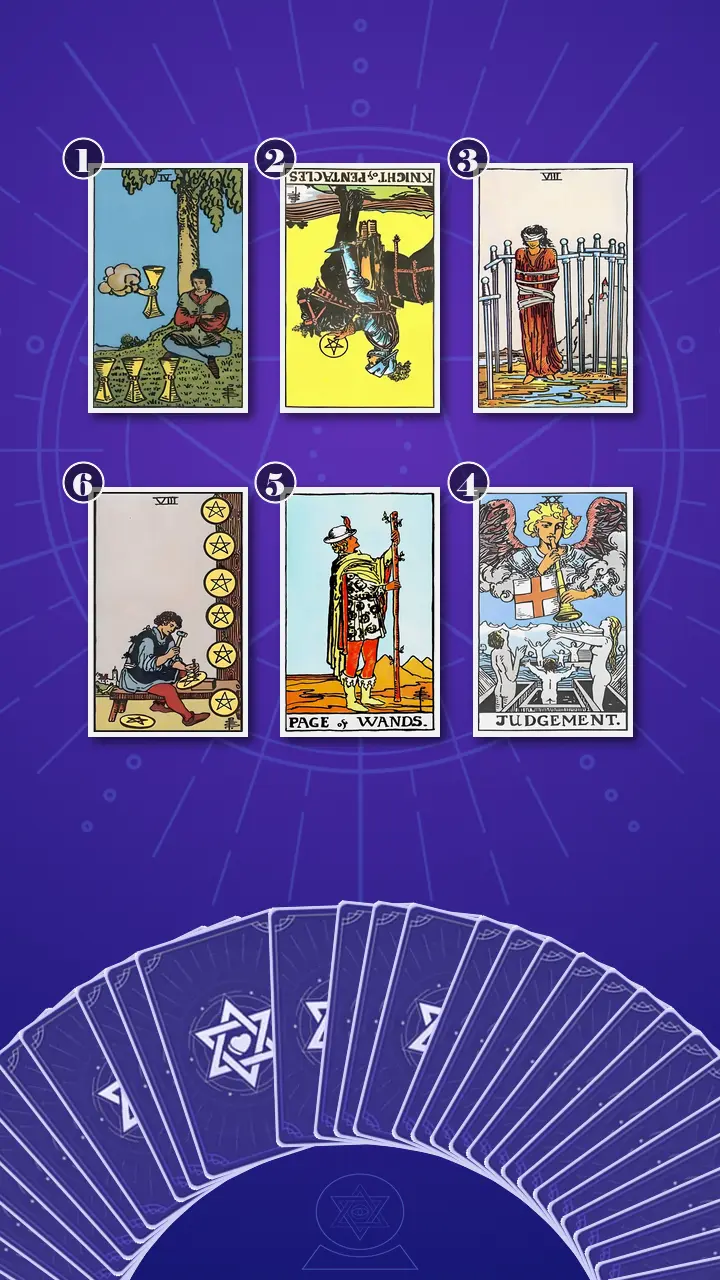
I arranged three cards across the top and three beneath them. The top row would show the observable symptom, the routine maintaining it, and the deeper fear underneath. The lower row would identify the catalyst for change, a bounded experiment, and the sustainable capacity that could grow from repetition. The layout reached the end of a corridor, turned, and came back on firmer ground.
“None of these positions tells you what your purpose is,” I said. “They help us see what currently prevents you from gathering the experiences through which purpose might become clearer. The cards can show the pattern. You decide what to do with it.”
Reading the Closed Circuit
Position 1: The Cup Behind the Browser
I turned over the card representing the observable current-state symptom: the way Alex disengaged from meaningful possibilities, defaulted to passive comfort, and later experienced the evening as aimless. It was the Four of Cups, upright.
I pointed to the seated figure's crossed arms and lowered gaze. A fourth cup was being offered, but the figure neither accepted it nor decisively refused it. The possibility remained present and unanswered.
“This is your portfolio tab behind Netflix,” I said. “At 7:10, you open the document, rewrite the heading, and reach the first unclear step. Your chest closes. Your hand reaches for the phone. Forty minutes later, another window covers the project. The opportunity hasn't disappeared, and you haven't consciously decided against it. You have stopped participating in the moment when participation asks something from you.”
The Four of Cups showed a Blockage in Water energy. Alex had feelings, interests, and available options, but repeated passive soothing had flattened their responsiveness. It reminded me of the split in Severance: the externally structured work-self remained highly functional, while the personally authored self seemed to vanish when the assigned queue ended.
I gave voice to the posture I saw in the card: “I do want something more, but not if I have to feel this unclear right now.”
Alex did not nod. They let out one short, bitter laugh and looked away from the screen. “That's too accurate. Kind of brutal, actually.”
“Accurate doesn't have to mean condemning,” I replied. “This card is not saying you reject your life. It is showing the small moment when consumption feels easier than responding. It also shows that the offered cup is still there.”
I asked which available activity they might be dismissing simply because it required participation rather than observation. Alex named the portfolio, then added a beginner ceramics class whose registration page had been open in a browser tab for six weeks.
Position 2: The Routine That Worked Too Well
I turned over the card representing the mechanism keeping the loop active: a convenience-based routine that converted short-term relief into repeated procrastination and practical inertia. It was the Knight of Pentacles, reversed.
Upright, this Knight is patient, methodical, and able to sustain a rhythm. Reversed, the same strength can become over-contained. The horse stands still. The pentacle is carefully protected, but no new ground is crossed.
Alex already knew how to maintain a routine. They closed the same work queue, opened the same feed, ordered from the same saved list, and let autoplay carry the rest of the night. Slack closed; TikTok opened; Uber Eats followed; Netflix removed the final stopping cue. The sequence worked so smoothly that intention barely had time to appear.
“The routine works; the question is what it works for,” I said.
This reversal held an Excess of maintenance and a Deficiency of forward movement. Alex was dependable when an obligation arrived from someone else. Around self-directed work, their reliability had been recruited to preserve comfort instead. The blockage was not an inability to build systems. It was that their best-maintained system reliably carried them around the action they claimed to value.
I also named the overcorrection hidden in this card. After a guilt-heavy evening, Alex often built a fresh Notion dashboard, bought a new productivity tool, or planned a 6 a.m. reset. The redesign produced a quick sensation of control. Missing one morning then produced another sweeping verdict: “I can't sustain anything.”
“The routine works so smoothly that I barely notice it is making the choice for me,” I said, reflecting the card's logic back to them.
Alex's chest lifted and held for a second. Their eyes moved away from me as if replaying the same sequence across several evenings, and the hand resting beside the phone tightened before slowly opening. “I'm weirdly competent at maintaining the life I say I don't want,” they said.
“You are competent at responding to structure,” I corrected gently. “That is a resource. We need to redirect a small part of it, not destroy the whole routine.”
Position 3: The Gap Between the Swords
I turned over the card representing the deeper fear beneath the blockage: the fear that sustained effort might still fail to create meaning and therefore challenge Alex's sense of control over their own life. It was the Eight of Swords, upright.
I centered the loose bindings and the visible gap between the swords. I did not describe the figure as freely mobile or pretend the restriction was imaginary. The fear was real in its effect. But the card did show one limited route that did not require a complete map.
In Alex's life, the blindfold was the demand to see a guaranteed destination before taking today's smallest step. A course exercise asked for one rough portfolio sample. Instead of producing it, Alex searched YouTube and Reddit for advice on finding the right career direction. Research preserved every option and prevented the feared result from being tested.
The Eight of Swords held an Excess of Air: too much analysis trying to manufacture certainty, with experimentation Blocked until certainty could be supplied. The internal rule sounded like this: “If I really try and still feel lost, I lose the excuse that I just needed a better plan.”
I asked, “If you gave one project a serious month and it still didn't become your direction, what would you be afraid that meant about you?”
Alex's thumb stopped moving along the edge of their mug. Their gaze went unfocused, then settled on the cards. “That I can't actually run my own life,” they said. “If I don't fully start, I can keep believing the right plan would fix me.”
“That makes the procrastination protective,” I said. “Not helpful in the long term, but understandable. Not trying keeps a frightening conclusion outside the lab. The card is asking whether one reversible experiment could provide information without being allowed to define your entire future.”
When Judgement Sounded Like a Notification
Position 4: Evidence Without a Verdict
The radiator clicked once and fell quiet as I turned the card representing the key trigger for change: reviewing what the pattern actually produced and making a conscious response without self-condemnation. The central card was Judgement, upright.
The visual contrast was immediate. The Four of Cups had shown a lowered gaze and closed chest. Judgement showed figures rising with open arms toward a trumpet. I framed the trumpet as a clear notification from Alex's own evidence, not a supernatural summons and not proof that the universe had assigned them one hidden calling.
I brought Alex back to 7:10 p.m.: the portfolio file still open behind Netflix, the feed refreshing beneath their thumb. Nothing dramatic had broken. Yet they were caught in the demand that the next move feel certain before it could count as right.
I said, Ease is not what makes life aimless. Ease keeps the wheel when every uncomfortable beginning is treated as evidence that the direction must be wrong.
The trumpet is not proof of a predetermined calling; it marks the moment you stop sleeping through your own evidence and rise, like Judgement's figures, to answer with one chosen action.
I let the sentence remain in the room without immediately explaining it away.
Alex did not relax at first. Their inhale stopped halfway, and their fingers stayed suspended over the mug as if the body had paused before the mind could follow. Their eyes shifted toward the portfolio window visible behind our call, then lost focus while several evenings seemed to replay at once. Resistance arrived before relief. “But doesn't that mean I chose all of it?” they asked, their voice suddenly sharper. “Doesn't it mean I've been the problem this whole time?” I watched their jaw set, then tremble slightly at one corner. I told them no: the pattern had solved a local problem by reducing uncertainty, and that did not make it a useful life strategy or a character defect. Their fist loosened. Their eyes grew bright. A long breath left their chest, lowering their shoulders, but the release carried a brief, unsteady look. Clarity had removed an excuse and revealed responsibility at the same time.
“Now, with this new perspective, think back to last week,” I said. “Was there a moment when this insight could have made the evening feel different?”
Alex remembered waiting under the condo lobby's cold LED light for a delivery. The bag was warm and smelled of fried garlic; a portfolio reminder flashed in the lift, and their stomach dipped. “I could have called the order deliberate rest,” they said, “or admitted that I'd already followed the default. Either answer would have been more honest than pretending the evening hadn't been decided yet.”
I asked Alex to set an eight-minute timer and open a private note titled What My Evenings Actually Produce. I gave them only three lines: “I intended...”, “Ease became automatic when...”, and “What remained afterward was...” They could use fragments, omit anything that felt too exposing, or stop after one sentence. This was an evidence check, not a prosecution of every hour.
For that Tuesday, Alex wrote: they intended to draft three portfolio bullets; ease became automatic when the next section required a decision; what remained was an untouched file and an evening of entertainment they had barely noticed choosing. Netflix was not listed as a crime. The unexamined switch was the useful fact.
“I do not need a verdict on who I am,” Alex said quietly. “I need to answer what this pattern is producing.”
That distinction opened the door for one of my core tools, Micro-Cycle Energy Mapping. I drew four simple columns: time, physical energy, point of friction, and default response. I asked Alex to trace one ordinary evening rather than invent an ideal one. Their energy dipped after closing the customer queue, recovered slightly after food, then dropped sharply when the portfolio demanded an uncertain choice. The phone reach was tied not only to tiredness but to a precise rise in task ambiguity.
I paired that map with what I call Rest Phase Legitimacy. After years of looking at life through planetary cycles, I have learned not to treat a low-energy arc as a failure of movement. Every sustainable orbit includes phases that look quiet from one angle. Genuine recovery does not have to earn its legitimacy by producing a file first.
But Alex's map revealed something more specific: the same app chain took control during genuine depletion, mild boredom, fear of imperfection, and simple uncertainty. Rest was not the problem. The loss of distinction was. A natural low tide deserved recovery; a momentary rise in friction did not automatically deserve the authority to cancel a chosen experiment.
Judgement restored Balance by separating accountability from shame. It asked Alex to review operational data, much like a weekly Screen Time report, and change one hinge point instead of firing the whole self after a difficult week.
I named the shift I could already see: this was not a leap from aimlessness to certainty. It was the first move from numb dissatisfaction and guilt-driven avoidance toward curiosity, visible agency, and grounded self-trust built through repetition. Alex had not found a destiny. They had recovered the ability to test a direction.
Position 5: One Spark Before the Scroll
I turned over the card representing the bounded experiment that could interrupt procrastination before motivation or long-term certainty arrived. It was the Page of Wands, upright.
The Page studied a sprouting wand in an open landscape. I emphasized the living shoots, not the distant horizon. This Page did not need to become an expert, announce a career pivot, or know where the road ended. The card carried Fire in an early, usable Balance: enough curiosity to begin, without demanding a permanent identity.
For Alex, the wand became one deliberately plain calendar block: Write three portfolio bullets, 20 min. It was not another colour-coded life overhaul. It was a seven-day test performed before TikTok, Instagram, Netflix, or a delivery app opened the low-friction chain.
“This does not have to become my purpose,” I said. “It only has to give me new information.”
Purpose is not the entry requirement; it is one possible result of participation. The Page of Wands replaced the search for a guaranteed calling with a small beta test. Interest, boredom, difficulty, and renewed energy could all count as results.
Alex picked up a pen, then caught themselves beginning to design a month-long schedule. They smiled with a trace of embarrassment and crossed it out. “Seven days,” they said. “One section. No personal rebrand.”
Position 6: The Work That Left Receipts
I turned over the final card, representing integration as a sustainable practice rhythm through which Alex could build visible evidence of agency and purpose over time. It was the Eight of Pentacles, upright.
The artisan shaped one pentacle while completed pieces remained visible on the wall. I placed this card beside the Eight of Swords. Both Eights contained structure and repetition, but they used structure differently. In the Swords, repeated thought immobilized the body. In the Pentacles, repeated action developed the hands.
I translated the displayed pentacles into a folder named Completed Experiments: one dated draft, lesson exercise, edited image, or practice log at a time. The work could remain rough and private. Its purpose was not to impress LinkedIn or compete with someone else's polished milestone. It was to give Alex a material record that their unstructured hours could contain personally chosen action.
The card showed Earth energy restored to Balance. The reversed Knight had maintained routine without crossing ground. The Eight of Pentacles kept the useful part of consistency and gave it a chosen object. Intensity was unnecessary; a modest unit completed three times could teach more than another elaborate roadmap.
I thought of the charts I had studied across years of guiding people through planetary cycles. A single point of light does not reveal an orbit. The pattern becomes legible through repeated observations. Human direction often works the same way: one attempt may feel inconclusive, but several visible returns begin to show what the person is willing to keep meeting.
“Direction may look less like a revelation and more like evidence I can see accumulating,” Alex said.
“Exactly,” I replied. “Direction becomes believable when it leaves receipts.”
Alex sat further back from the screen, no longer folded around the phone. Their shoulders had lowered, but their expression was not triumphal. I saw curiosity mixed with the vulnerable awareness that the next choice still belonged to them. That was enough. Tarot had clarified the terrain; it had not walked it on their behalf.
A One-Week Orbit With Room for Rest
I gathered the six cards into one causal story. Repeated comfort had flattened Alex's responsiveness, as the Four of Cups showed. The reversed Knight revealed a dependable routine organized around avoiding meaningful friction. The Eight of Swords exposed the rule underneath: effort was not allowed to begin until the future could guarantee that it would matter. Judgement interrupted the circuit with honest evidence; the Page of Wands offered one live experiment; and the Eight of Pentacles turned that experiment into visible, repeatable craft.
The spread reminded me of an airport moving walkway. Alex was moving, spending time, and saving effort, but the infrastructure had selected the route. Their cognitive blind spot was treating the discomfort of an unclear beginning as proof that the direction was wrong, then treating the absence of completed experiments as proof that no direction existed.
The transformation direction was practical: stop waiting for motivation to certify the path. Complete one preselected, values-linked action before default leisure, at an output level that respects the day's real energy. Then review what participation reveals.
- The Eight-Minute Evidence-Before-Verdict CheckTonight, open Screen Time or Digital Wellbeing and note the first entertainment app used after work, including the time but no moral label. Set an eight-minute timer and review one evening only. Complete three fragments in a private note: “I intended...”, “Ease became automatic when...”, and “What remained afterward was...” Finish by writing one alternative response beside tomorrow's charger or work laptop.Tip: Stop when the timer ends. If eight minutes feels heavy, use a two-minute version with only “intended, defaulted, produced.” Leisure does not need to justify itself, and nobody else needs access to the note.
- The Lunar Routine Sync: A Seven-Day One-Spark ExperimentBefore Wednesday evening, choose one concrete test, such as drafting a single portfolio section. At the end of each workday, rate the actual energy tide as low, medium, or high. Use a five-minute minimum on low-energy action days, ten minutes on medium days, and no more than twenty on high days. Name up to two genuine zero-output recovery days without guilt. On action days, open the file before the usual leisure apps, save one dated unit in a folder called “Completed Experiments,” and mark only “started” and “completed.”Tip: Choose by mild curiosity and startability, not by whether the experiment could define your future. Stop at the planned endpoint. If even five minutes is unavailable, spend two minutes preparing the next visible action and preserve the rest phase without turning it into a failed test.
I told Alex that these were experiments, not new standards by which to prosecute themselves. A high-energy evening did not create a duty to overwork. A low-energy evening did not erase their agency. The aim was to let their expectations wax and wane with actual capacity while protecting one small place where intention could become visible.
“The cards are not asking you to reject comfort,” I said. “They are asking you to put a pause before the algorithm and decide what this part of the orbit is for.”
A Week Later, Direction Left Receipts
A week later, Alex messaged me. They had saved four rough portfolio sections in Completed Experiments. On Sunday morning, the first thought was, “What if this goes nowhere?” They saw the dated files, smiled at the doubt, made coffee, and chose a real day off.
I did not see a life suddenly solved. I saw a more reliable form of clarity: Alex could now point to evidence that uncertainty had been explored rather than automatically escaped. Their rest felt different because it followed a choice instead of disguising the absence of one.
The cards had not given Alex purpose or manufactured discipline. They had helped me make the loop visible, and Alex had used that clarity to change one response. The agency was theirs. So was the recovery day.
I would leave anyone who knows the warmth of that phone and the familiar folding of the shoulders with this: the hardest part is not wanting comfort. It is sensing that another automatic evening may leave you with less evidence that your life can still be directed by you. Noticing the handoff means you are no longer entirely asleep inside it.
So I ask you: if purpose did not need to arrive before action, what one small experiment would you be curious to let tomorrow's open hour hold before autoplay decides, and what visible receipt would tell you that the choice was yours?