FOMO-Driven Overcommitment Meets the 48-Hour Readiness Pause

The 11:47 p.m. Yes
When a job, apartment, relationship, or project offer says "we need an answer by tonight," you may say yes before checking rent, deadlines, or energy, then search why do I overcommit when excited? I know the particular brightness of that moment: movement feels safer than waiting, and FOMO-driven overcommitment can disguise itself as confidence.
Alex (name changed for privacy) sat at the kitchen table of a shared Toronto apartment at 11:47 p.m. An acceptance email glowed beside a crowded Google Calendar, while the unread terms waited in another tab. The refrigerator hummed through the room, the phone warmed their palm, and their thumb moved before their shoulders had finished rising. A friend texted, "Have you actually thought it through?" Alex replied, "Already done."
For one bright second, their chest loosened. Then the calendar came back into focus: overlapping deadlines, a personal project, two social plans, and the ordinary recovery time none of the colored blocks admitted to needing. Alex looked at me and said, "It felt completely right when I said yes. I can figure out the details once I am in."
I could hear the deeper contradiction underneath the words: Alex wanted to secure a major commitment quickly, but needed enough time to know whether it was sustainable. The urgency was not an abstract mood. It was like sprinting for a TTC train because the doors were closing, stepping aboard before checking the destination, then trying to read the route map while the carriage was already moving.
"You call it confidence because waiting feels like losing," I said gently. "We do not need to shame the excitement or predict what will happen. We can look at the moment when desire turns into obligation, and draw a map before you make the next decision."

Choosing the Compass for a Career Crossroads
I asked Alex to place the phone face down and name the question one more time: "Why do I keep rushing into major commitments before I am ready?" I invited three slow breaths, then shuffled the cards. The small ritual was a transition into attention, not a test of fate. It gave the body a chance to stop performing an answer.
For anyone wondering how tarot works in a grounded reading, I use the cards as an external cognitive tool. Their images give the subconscious something visible to respond to, while the questions keep the interpretation connected to calendars, money, conversations, boundaries, and actual choices. The cards do not decide for Alex. They help Alex see the decision more clearly.
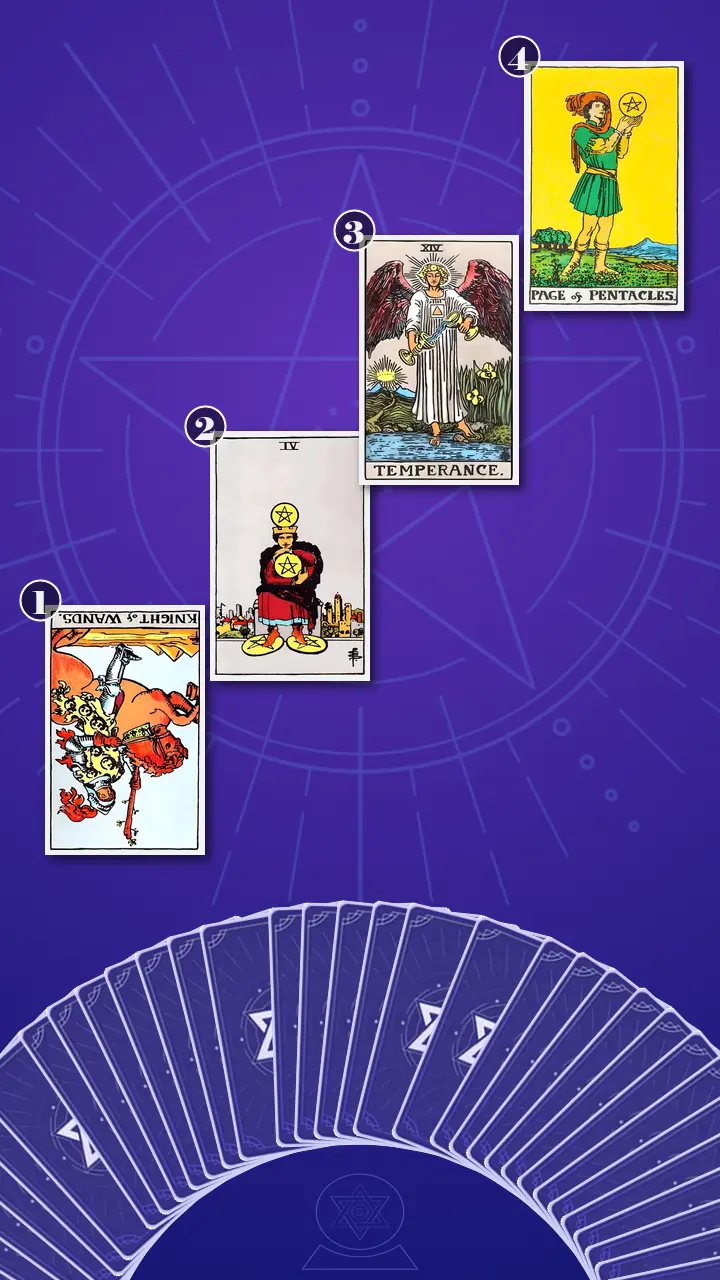
I chose the Four-Layer Insight Ladder, a focused four-position tarot spread for understanding commitment pressure. A Celtic Cross could offer ten kinds of context, but this question needed a narrower path: present pattern, root fear, transforming capacity, and practical integration. The spread traces exactly how a fast yes becomes a hard-to-revise obligation, then shows where a different response can begin.
I arranged the cards as an ascending diagonal from the lower left to the upper right, leaving a little more space between the second and third positions. The first card would show the observable current pattern. The second would reveal the protective belief beneath it. The third would identify the balancing principle that could interrupt the rush. The fourth would turn that insight into an experiment Alex could practice without promising to become a completely different person overnight.
Position 1: The Raised Hooves Before the Send
"Now turned over is the current-pattern layer," I said. "This position shows the observable behavior of accepting and activating a major commitment before readiness has been checked, along with the chaotic urgency driving the sequence." The card was The Knight of Wands, in reversed position.
The horse's front legs were lifted from the ground, the wand thrust forward, the red plume streaming as if the whole image had been caught in the instant before impact. Reversed, the Knight's Fire was not absent. It was overextended. Acceleration had outrun direction, and enthusiasm had been mistaken for durable capacity.
I connected it to Alex's familiar scene: answering a manager's exciting offer while the conversation was still happening, then opening the full PDF and checking the campaign calendar afterward. The warm phone, the acceptance message, and the fresh Notion board created that same visual charge. Movement looked like confidence until the recurring workload arrived and the body dropped around it.
"This is not a card calling you flaky or incapable," I said. "It shows an Adventurer in shadow. You know how to initiate, persuade, and generate momentum. The problem begins when a dramatic beginning becomes evidence that you can sustain every month that follows."
An image from the cities I have travelled through crossed my mind: someone can move quickly through an airport and still need to check the gate. I said, "Speed can end uncertainty without proving readiness. A private yes can let you stay interested without turning the first wave of excitement into a contract."
Alex did not nod. They gave a short laugh with a bitter edge and rubbed one thumb along the rim of their coffee cup. "That is almost cruelly accurate," they said. I let the sentence stand for a moment, then answered, "The accuracy is not a verdict. It is a place to interrupt the pattern before the next administrative step makes the choice harder to revise."
Position 2: The Grip That Keeps the Option Alive
"Now turned over is the root layer," I said. "This position reveals the need for control beneath the fast yes and the belief that pausing may cause the opportunity to disappear." The card was The Four of Pentacles, upright.
The figure clutched one pentacle against the chest, pinned two beneath the feet, and balanced another above the head. The city stood at a distance. It was a precise image of securing an option so tightly that the security itself began to limit movement.
In daily life, this could be a Toronto renter paying a deposit before comparing utilities and commute time, a worker accepting an offer before asking about recurring workload, or Alex posting the decision before reading the terms. The public announcement, DocuSign signature, calendar block, or payment brought short-term relief because uncertainty had been contained. But the same action also made reflection and negotiation feel expensive.
Alex's jaw tightened. Their hand moved toward their chest, then stopped. "If I do not secure this tonight, it may disappear," they said. After a pause, they added, "I locked it in so I would not lose it."
I use a diagnostic lens here called Hidden Cost Deconstruction. I do not look only at the advertised benefit or the financial price. I ask what emotional bills arrive attached to the option: the cost of renegotiating after a public promise, the shame Alex expects to feel if they revise the decision, the evenings lost to catch-up work, and the recovery time quietly spent pretending the calendar has more space than it does. We can estimate those bills without treating them as reasons to panic.
"An opportunity can be real without becoming yours tonight," I said. "Security through holding on is not the same as freedom to assess. The question is not whether you want the opportunity. It is what form of certainty you are asking the commitment to provide, and whether that certainty can be built in a less binding way."
Alex looked down at the pentacle and slowly opened their hand. The refrigerator started its cycle again, filling the silence with a low mechanical hum. For the first time, the grip itself became visible: the option was protected, but Alex had become less able to move around it.
When Temperance Let the Cups Speak
Position 3: The Measured Pour
The room seemed to narrow around the third card. "Now turned over is the transformation layer," I said. "This position identifies the capacity that can interrupt the rush: holding excitement and practical limits together long enough for a proportionate response to form." The card was Temperance, upright.
One foot stood on land and one in water. A controlled stream moved between two cups. Behind the figure, a long path led toward a glowing horizon. This was not a command to suppress desire or retreat from every exciting opportunity. It was an image of exchange. Readiness could be built by letting emotional pull, evidence, capacity, and language remain in conversation.
As the key transformation card, Temperance was both the catalyst and the antidote. The reversed Knight had overheated the first response. The Four of Pentacles had hardened that response into possession. Temperance introduced flow. It gave Alex a middle space between an instant yes and a total withdrawal.
I also noticed that no Swords card appeared in the spread. Explicit language, criteria, and questions were the least represented functions. That did not mean Alex lacked intelligence. It suggested that the missing move was simple and verbal: name the ongoing requirement, ask what could be negotiated, and request enough time to understand the answer.
The Sentence That Changed the Pace
At 11:47 p.m., Alex was back at the Toronto kitchen table: the acceptance email open, the crowded calendar glowing in another tab, unread terms waiting, and a friend asking, "Have you thought it through?" Alex had typed, "Already done," felt relief for one bright second, and then carried the full weight.
Readiness is not proven by how quickly you say yes; it is built by giving desire and capacity equal weight before committing.
An instant yes is not proof that you are ready, so let desire and capacity mix at Temperance's measured pour and commit from proportion rather than pressure.
First, Alex's inhale stopped halfway; their thumb hovered above the warm phone, and their pupils widened as if the email had changed while we watched. Next, their gaze lost focus. I could see the last week replaying there: the manager's quick request, the deposit screen, the calendar blocks, and the message sent before the terms were open. Their fingers tightened around the phone, then released it. Finally, their shoulders dropped a fraction. A long breath came out, unsteady but not defeated, and their eyes brightened. The relief carried a thin edge of responsibility; a clear choice would belong to them. In a low voice, Alex said, "But if I needed this pause, does that mean I got it wrong every time?" I answered, "No. It means the fast yes was protecting you from uncertainty. You can keep the desire and retire the emergency."
Now, with this new lens, look back at last week and ask: was there a moment when this insight could have let you feel differently? I placed two empty cups beside the acceptance email and the crowded calendar. Alex tried the sentence, "I can want this and still need to know what it asks of me." We contrasted "I need an answer now" with "I can let desire and capacity speak to each other before I choose."
This is the point where I use my signature method, Fear-Driven Logic Decoupling. I separate two lines in the decision matrix without shaming either one. The first asks, "What do I authentically want from this?" The second asks, "What am I afraid will happen if I wait?" Desire might say, "I want the launch experience and the chance to grow." Fear might say, "If I pause, they will choose someone else and I will prove I was never the obvious choice." Once those lines are separate, fear no longer gets to disguise itself as desire.
Alex placed one foot on the practical ground of the calendar and one foot in the feeling that still wanted the opportunity. "The pause is not a no," they said quietly. "It is where I find out what a yes would require." That was the first real movement in the reading: not a promise, not a prediction, but a pocket of room.
The shift was not from excitement to indifference. It was from urgency-driven commitment and control-seeking toward paced self-trust and grounded ownership of a considered choice. Alex was not finished. They were no longer asking the first burst of relief to impersonate readiness.
Position 4: The Pentacle Under Careful Study
"Now turned over is the integration layer," I said. "This position translates paced readiness into a concrete practice: a defined pause, a capacity review, and a reversible experiment before the least flexible form of commitment." The card was The Page of Pentacles, upright.
The Page held one pentacle at eye level in a cultivated field. Furrows ran through the ground, and distant blue mountains gave the scene a horizon without demanding an immediate climb. The image moved Alex away from claiming an entire future identity and toward examining one real unit of time, money, labour, or responsibility.
"Instead of saying, "Once I commit, I will become the version of myself who can handle it," you can become a learner," I said. "Request a scoped pilot. Shadow the recurring work. Test the commute or the budget. Agree to one deliverable and a review date. Evidence can teach you what enthusiasm cannot."
Alex opened a private Notes page and wrote one line: "I do not have to become my future self before checking the workload." The sentence did not erase the opportunity or the fear of losing it. It gave both a smaller place to stand.
The One-Page Capacity Check
The four cards told one coherent story. The Knight of Wands showed the first surge, where a quick reply turned movement into proof. The Four of Pentacles revealed the root strategy: lock in the option before uncertainty can expose a lack of control. Temperance offered a measured exchange between wanting and knowing. The Page of Pentacles gave that exchange a practical form, one learnable step at a time.
Alex's cognitive blind spot was not a lack of ambition. It was treating relief as evidence and treating hesitation as loss. A full calendar could create the appearance of direction while hiding the actual cost. A public announcement could create the appearance of certainty while making an honest revision feel humiliating. The transformation direction was clear: replace the same-day yes with a 48-hour pause, a written time-cost-energy check, and one reversible trial whenever the situation allows.
"Let desire open the door," I told Alex, "and let capacity help set the terms. You are allowed to be interested without becoming immediately obligated. That is not indecision. That is informed participation in your own life."
A 48-Hour Readiness Pause and Three Practical Next Steps
- Keep the yes privateFor the next major offer from a manager, landlord, partner, or project lead, write the immediate yes in a private Notes entry instead of sending it. Set a 48-hour reminder before replying, or ask the sender for the exact decision window. During the pause, do not announce the choice or fill the calendar with follow-up tasks.Label the reminder "capacity check" so you do not rely on willpower. If 48 hours is impossible, take the longest pause available and ask one clear question about the deadline.
- Run the three-column checkSpend ten minutes in Google Docs or Notes making three headings: "What it promises," "What it repeatedly requires," and "What I would need to negotiate." Estimate the weekly hours, recurring cost, and recovery or relationship energy for one ordinary week, then mark each demand as confirmed, unclear, or negotiable. Choose one fact that could materially change your answer and ask for it.Keep it to one page and use rough estimates. A realistic week is more useful than an ideal future schedule, and a sentence such as "I am interested, and I need to clarify the ongoing scope before I confirm" is enough to begin.
- Use the Shadow Choice ExperimentFor 48 hours, intentionally choose the option your defense system fears most: wait, keep the answer private, and ask for the terms before accepting. This is a paper exercise, not a contract. Write the first three thoughts that appear, such as "They will choose someone else" or "I will look indecisive," then identify the observable fact and the assumption in each thought. When possible, ask for a scoped pilot, one limited deliverable, one tested commute, one budget month, or a written review date.The aim is evidence, not a perfect spreadsheet or a test of your worth. If the other person cannot offer a pilot, choose the smallest reversible version and keep the decision open until you know what choices remain.
These next steps do not promise that every opportunity will wait or that every pause will produce a perfect answer. They create a fairer decision. They give excitement a voice without allowing it to sign the paperwork alone, and they give practical capacity a voice without asking it to destroy desire.

A Quiet Proof That Did Not Need an Announcement
Four days later, Alex sent me a screenshot of a message to their manager: "I am interested in leading the launch. Before I confirm, can we clarify the weekly hours, decision rights, and whether we can begin with a two-week pilot?" The manager agreed to a smaller starting scope and a review date. Alex had not solved every future demand. They had gathered one useful fact before turning possibility into obligation.
That night, the plan was clear enough for Alex to sleep through; at breakfast, the first thought was, "What if I get it wrong?" They smiled at the question, opened the calendar, and kept the review date visible.
I think of that as a quiet proof. The cards did not make the decision, and I did not make it for Alex. The images helped Alex notice the raised hooves, the clenched grip, the two cups, and the carefully studied pentacle already moving inside the choice. Tarot became a companion to practical reasoning, not a substitute for it.
Our Journey to Clarity ended with measured confidence rather than certainty. Alex could remain curious without rushing to become obligated, and could revise a commitment without treating revision as proof of failure. That is grounded ownership: not knowing every outcome, but knowing how to stay present long enough to choose.
When an exciting offer makes your chest tighten at the thought of waiting, it can feel safer to lock the future down than to risk discovering that your calendar, money, and energy need more time. The urgency is real, but it is not the same thing as readiness. Clarity can be the moment the fog thins enough for you to see your own hand on the decision.
If you let the answer stay private between Temperance's two cups for 48 hours, what small, reversible fact would you be curious to learn about what this commitment asks of you?