When Saying Yes Feels Like Falling Behind: Choosing a Career Lane

Career Opportunity Overload: When Every Open Door Looks Like a Direction
Jordan gave me a sentence that captured a familiar form of career opportunity overload: “You open your laptop to work on the career direction you actually want, then accept a manager's ‘quick favor’ and a freelance request before checking your calendar.”
At 8:47 PM on the Northern line home from work, she had scrolled past a former classmate's LinkedIn promotion while a freelance contact's message stayed open on her warm phone. The carriage lights buzzed above her, rain dampened the shoulders of her coat, and she moved a portfolio block to midnight before the train reached the next station.
Her question was direct: “Why do I keep taking opportunities that blur my real career goal?” She wanted to build a clearer identity as a communications professional, yet every new request felt like protection against falling behind. Busy enough to look capable, scattered enough to feel behind.
The feeling had the texture of an air-traffic controller trying to land every plane at once: alarms, landing lights, radio chatter, and no runway left for the one aircraft she actually wanted to bring home. Her shoulders stayed lifted, her hands kept searching for the next notification, and the work she most wanted to be known for remained untouched.
“I hear how much ambition is inside this pattern,” I told her. “I also hear the cost. We do not need to make you less ambitious. We need to see which opportunities are steering your week and give the work that matters a reliable place to land. Let us draw a map through the fog. That is our Journey to Clarity today.”

Choosing a Map for the Open Doors
I asked Jordan to place her phone face down, take one slow breath, and name the question without trying to solve it. I shuffled the cards slowly, treating the ritual as a psychological threshold: a small, deliberate pause between the newest message and the deeper pattern underneath it.
I chose the Four-Layer Insight Ladder · Context Edition, a four-position tarot spread designed for a repeating mechanism rather than one fixed decision. This is how tarot works in a reflective reading like this: the cards offer images and structured questions, while the person remains responsible for testing each interpretation against observable life.
The rationale was simple. Opportunity Pile-On supplies a stream of inputs, the Workaholic Tendency turns each input into more labour, and the Manifestation Gap then seems to prove that another opportunity is still needed. This spread is small enough to keep the pattern visible. It moves from current expression, to root mechanism, to the clarity move, and finally to an actionable integration point.
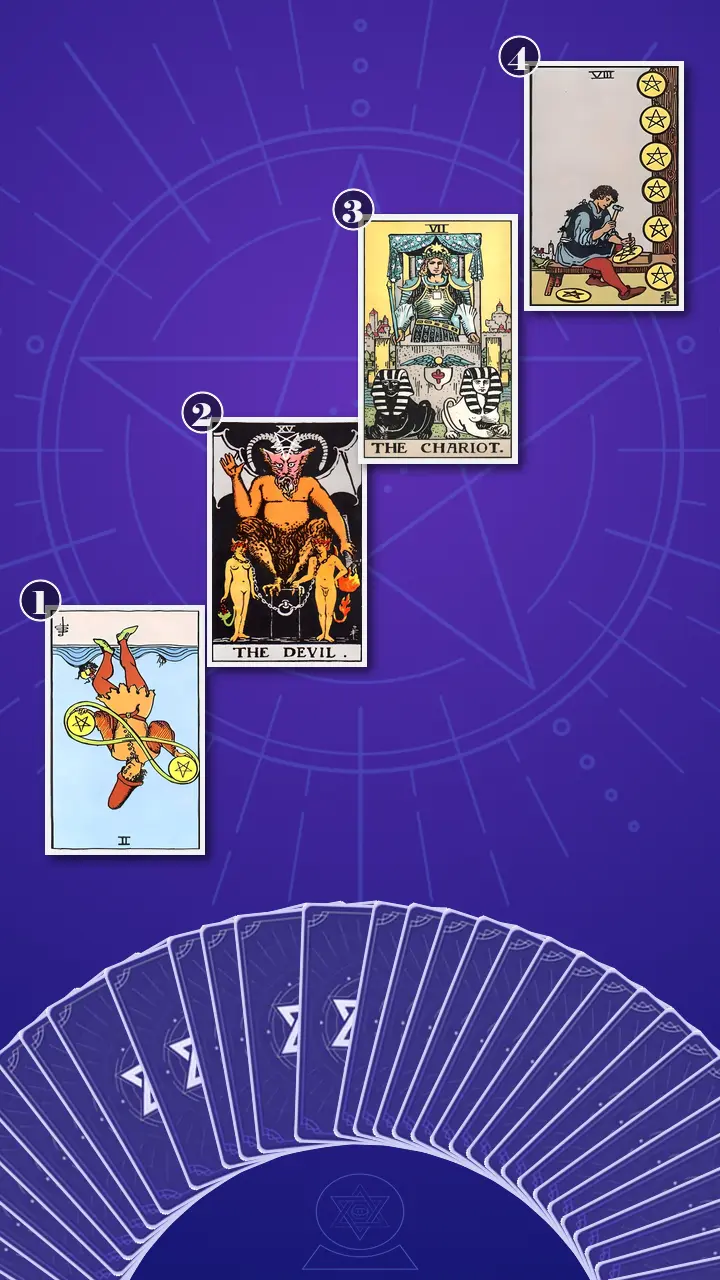
I told Jordan that the first position would show the visible form of Opportunity Pile-On, where her calendar and attention were already being directed. The second would reveal the reward or fear beneath the Workaholic Tendency. The third would be the turning point, the choice of career lane that could close the Manifestation Gap. The fourth would translate that insight into focused practice and visible career evidence.
Reading the Calendar's Hidden Pattern
The Reversed Juggle: Where Opportunity Overload Shows
Now I turn over the card for The visible form of Opportunity Pile-On: how Jordan accepts, stacks, and switches among commitments while the real career goal loses protected time.
The card is the Two of Pentacles, in reversed position.
In real life, this is Jordan opening a one-hour portfolio block at a coworking desk near Old Street, seeing three new messages, and accepting two small requests before opening Google Calendar. The original task slides into a late-night gap, where she toggles between Slack, Google Drive, and a freelance brief. The week looks full and responsive, but the work that would clarify her career direction has no reliable place to happen.
The reversed juggling shows practical Earth energy in excess, stretched beyond a workable rhythm. It is not a sign that Jordan lacks discipline. It shows a system where managing everything has become the reason the main goal remains unfinished. The infinity-shaped loop becomes a repeating cycle: accept, reshuffle, catch up, feel briefly useful, then accept again. The rough water behind the figure mirrors the changing conditions around every new request.
“When a request lands,” I said, “what do you accept, postpone, or move first? Which piece of career-building work gets pushed out of the calendar?” I wanted the card meanings in context, not as an abstract label.
Jordan's thumb stopped above her notebook and her breath caught. Her eyes moved from the card to the phone, as though replaying the last week in reverse. Then she gave a small, humourless laugh, and her shoulders dropped by a fraction. “That is uncomfortably accurate,” she said. “Being busy can prove I am wanted without proving I am moving.”
“Exactly,” I replied. “The issue is not that any single request is bad. The issue is that every request gets to become the organising principle. A 24-hour pause would interrupt the loop before your calendar has to absorb the consequences.”
The Loose Chain of Being Needed
Now I turn over the card for The Workaholic Tendency beneath the Manifestation Gap: the reward, fear, or attachment that makes saying yes feel safer than choosing a direction.
The card is The Devil, in upright position.
A LinkedIn message offers Jordan a short project with “great exposure.” She feels an immediate lift, replies that she is interested, and only later notices that the scope is vague and the deadline competes with her portfolio block. She tells herself it is temporary, but the same promise returns through workplace messages, freelance contacts, and the always-on Slack status that keeps offering a quick hit of relevance.
The Devil's upright energy is an active attachment, a blockage created by a bargain. The loose chains do not mean doom, and they do not define Jordan's character. They show how being available, praised, productive, or visibly useful can feel like security while quietly reducing the freedom to choose a career lane.
I asked her to complete the sentence privately: “If I say no, I lose ____. If I keep saying yes, I lose time for ____.” The first blank held visibility and future choice. The second held the case study, the focused skill practice, and the coherent professional identity she kept saying she wanted.
Because I have travelled across cultures, I have learned to listen for the bargain beneath a polished phrase. In that moment, “great exposure” sounded less like a destination than a passport stamp someone wanted Jordan to collect: attractive, portable, and not necessarily taking her toward home.
Jordan went still. Her chest tightened, her gaze lost focus on the edge of the card, and one hand closed around the other before slowly releasing it. “Being needed feels safer than choosing,” she said. I let the silence hold that recognition without turning it into a moral judgment. An open door is not automatically her direction.
When the Charioteer Took the Driver's Seat
The Lane That Closes the Manifestation Gap
The room became quieter before I turned the next card. I was opening the reading's visual centre of gravity, the card for The clarity move that can close the Manifestation Gap: the shift from reactive availability to a chosen career lane and selective commitment.
The card is The Chariot, in upright position.
The Chariot does not ask Jordan to know her entire future. It shows directed will, self-command, and movement toward a chosen destination while opposing pulls remain present. The black and white sphinxes become visibility versus focused practice, income versus capacity, and keeping every option open versus building one clear body of work.
In practical terms, Jordan chooses one communications direction to test for two weeks and gives it a recurring place in Google Calendar. When a new contact messages during that block, she does not need to decide her whole career. She can check one written criterion, ask for the scope, and let the request wait for a considered reply. The calendar becomes a route plan, not a record of whoever reached her first.
At this point I used my signature lens, Imposter Syndrome Auditing. I separated the objective evidence from the subconscious fear of exposure. Jordan was being trusted with client work, her manager was asking for her help, and professional contacts were seeking her skills. Those facts supported real competence. The fear said that declining one request would expose her as replaceable. The audit did not tell her to accept or refuse. It showed which voice was driving.
At 8:47 PM on the Northern line, Jordan is moving a portfolio block to midnight while replying to two freelance requests. The phone is warm in her hand, the carriage lights buzz overhead, and the full calendar looks like progress even though the work tied to her real career goal remains untouched.
You do not need to keep every opportunity open to prove your value; choose one lane, take the charioteer's seat, and let focused practice make your real career goal visible.
I let the sentence remain between us, then gave it a practical translation.
More opportunities are not proof that your career is moving forward. A chosen direction, protected time, and repeated practice create the evidence that scattered availability cannot.
For a second, Jordan's breath stopped and her thumb hovered above the phone, as if the next notification might decide whether the sentence was true. Her eyes fixed on the black-and-white sphinxes; I could see her replaying the LinkedIn message, the moved portfolio block, and the familiar promise that she could do the important thing later. Then her shoulders lowered by a fraction. She read the line again, this time with one hand flat on the table. A small, unsteady breath left her chest. “But if I choose a lane,” she said, “I might find out I am not good enough for it.” I told her that this was the new vulnerability: the old system gave her endless tasks to hide inside, while a chosen block would produce evidence she could actually inspect. The fear could be present without taking the wheel. I asked, “Now, use this new perspective to think back to last week: was there a moment when it could have made you feel differently?” She looked toward the rain-streaked window, then reached for her notebook.
This was the bridge in the reading. Jordan had taken one step from fear-driven availability and scattered task-switching toward self-directed career focus and visible progress through repeatable practice. She could value an opportunity without giving it the driver's seat. She could also choose a temporary lane without treating that choice as a permanent rejection of every other possibility.
The Workbench That Builds Evidence
Now I turn over the card for The smallest practical integration of the new direction: the repeatable focused work that creates visible career evidence without adding another unnecessary opportunity.
The card is the Eight of Pentacles, in upright position.
The artisan at the workbench gave Jordan a grounded answer. One portfolio piece, case-study section, campaign sample, or focused skill exercise could be completed, reviewed, and improved. The row of finished pentacles was not a collection of unrelated proof that she could handle anything. It was a visible trail built one unit of craft at a time.
The upright Earth energy brings balance back to the spread. The reversed Two of Pentacles showed effort without a stable channel; the Eight of Pentacles gives that effort a bounded station. It receives the Chariot's direction and turns it into a weekly rhythm. Career identity becomes evidence, not another item waiting on a list.
“What small piece of visible evidence could you make in one protected block this week?” I asked. Jordan looked at the blank page in her notebook, then wrote, “One case-study section, not the whole portfolio.” Her fingers were still restless, but they had stopped reaching for the phone.
From the Manifestation Gap to a Chosen Lane
I read the four cards as one story. The reversed Two of Pentacles showed the visible pile-on: every new request entering the calendar before the real goal could claim protected time. The Devil showed why the pattern repeated: being needed offered short-term relief from the fear of falling behind, while constant availability postponed the harder question of direction. The Chariot supplied selective commitment, and the Eight of Pentacles showed how that commitment could become tangible through focused practice.
The cognitive blind spot was treating external demand as career evidence. A crowded professional calendar could look like momentum while producing no finished sample, skill milestone, or coherent body of work. The transformation direction was therefore not from ambition to passivity. It was from reactive availability to directed agency, from collecting opportunities to building a career identity that could be seen.
I told Jordan that the cards had not selected her future or predicted what any particular project would become. They had helped us deconstruct a recurring psychological loop. She was still the person deciding what to accept, what to delay, and what to decline. The practical question was no longer, “Which open door guarantees that I will not fall behind?” It became, “Which next step creates evidence for the direction I have chosen to test?”
The Small Filter and the Protected Workbench
I gave Jordan three small next steps. They were designed for a crowded week, not an imaginary life with unlimited time, energy, or certainty.
- Use the 24-Hour Career-Lane FilterBefore replying to one nonessential work, freelance, or networking request this week, wait 24 hours. Write one sentence in a phone note, such as ‘Builds evidence for focused communications strategy work,’ then compare the request with that criterion and with the calendar, including commute time, recovery time, and the protected block. Use this saved reply: “Thanks for thinking of me. I need to check timing and scope before I can confirm. I will come back to you by Friday.”A pause is not falling behind; it is where the filter gets a say. If the request is urgent, ask which deadline is genuinely fixed. One sentence is enough; do not turn the filter into another elaborate dashboard.
- Book the Protected Proof BlockChoose one communications direction to test for the next two weeks. Put a recurring 25-minute appointment in Google Calendar at a realistic time, such as Wednesday at 7:00 PM. During that block, make one bounded item: an outline, a case-study section, a portfolio edit, or a focused skill exercise. Before beginning, use my Competence Anchoring Exercise in a separate two-line note: record two verifiable achievements, so self-worth stays connected to evidence rather than external validation.Put the phone on Do Not Disturb and stop when the timer ends, even if the work is unfinished. The repeatable appointment matters more than a heroic late-night session, and you do not have to trade sleep for progress.
- Send a scope-check before saying yesChoose one low-stakes opportunity and ask one concrete question about the deliverable, deadline, decision-maker, or actual relevance to your chosen career lane. Then accept the defined scope, propose a smaller version, or decline with a brief thank-you. After sending the message, close the tab and return to the task linked to your direction for at least 10 minutes.A boundary can be specific without being defensive. Start with a small request, give a clear response time, and do not add an apology essay. You can value an opportunity without giving it the driver's seat.

The First Quiet Proof
Five days later, Jordan texted me from a cafe near King's Cross: she had protected Wednesday, drafted a rough case-study outline, and delayed a vague project until Friday. The next morning she slept through the night, then wondered, “What if I choose wrong?” She smiled and kept the block.
That was the first evidence, not a solved life. The shift had begun as a pause, a written career-goal criterion, and one small piece of work that could be inspected. I watched Jordan move from fear-driven availability toward grounded momentum, carrying the uncertainty with her instead of letting it choose the route.
When a new opportunity lights up your phone, your shoulders may tense before you decide. That reaction does not make you unambitious; it tells me that part of you wants to build one real career direction while another part has learned to treat every open door as proof that you are still valuable and in control.
If you let one written career criterion quietly choose the lane for your next small piece of work, what might feel a little more yours before you know where the whole road leads?