Styling the Study Space Instead of Studying: Choosing One Timed Task

The 8:47 p.m. Desk Reset: Finding Clarity When Styling Replaces Studying
“You keep promising, I can start as soon as the desk feels right, while your phone fills with saved study setups, your apartment gets quieter, and the real fear remains that beginning will reveal work you cannot fully control.” I said that gently, watching Riley (name changed for privacy) decide whether to laugh or disappear into the chair.
At 8:47 p.m. on a Tuesday in their compact Toronto apartment, Riley had wiped the desk with a citrus-scented cloth, lined three notebooks against the laptop, and angled the lamp until its reflection left the screen. The lamp hummed. Their phone felt warm from scrolling through #StudyTok desk-setup videos. Their shoulders stayed tight, their hands kept finding one more object to straighten, and the assigned chapter in Canvas remained unopened.
When I asked what brought them in, Riley looked at the carefully centred laptop and said, “Why do I keep styling my study space instead of studying? I can spend twenty minutes cleaning, reorganizing, or searching for a better setup, then the reading still feels impossible.” They wanted real academic progress, but starting the actual work felt more exposing than perfecting everything around it.
I did not call the pattern laziness. I saw anxiety moving through the room like a browser with every tab pinned, grouped, and renamed while the one containing the assignment stayed unopened. There was a quick lift whenever the desk looked better, followed by a heavy drop when the material remained untouched. This was productive procrastination, and it was protecting something. “A polished desk can be proof of effort without being proof of learning,” I told Riley. “We do not have to shame the effort. We can find out what it is trying to protect. Today, I want to help us draw a map through the fog and return the next move to you.”

Choosing the Ladder: A Four-Layer Map for Study-Space Avoidance
I invited Riley to take one ordinary breath and notice the question without trying to solve it. I shuffled slowly, treating the motion as a change of attention rather than a supernatural performance. The cards gave us a visual structure for looking at a behaviour Riley could already observe.
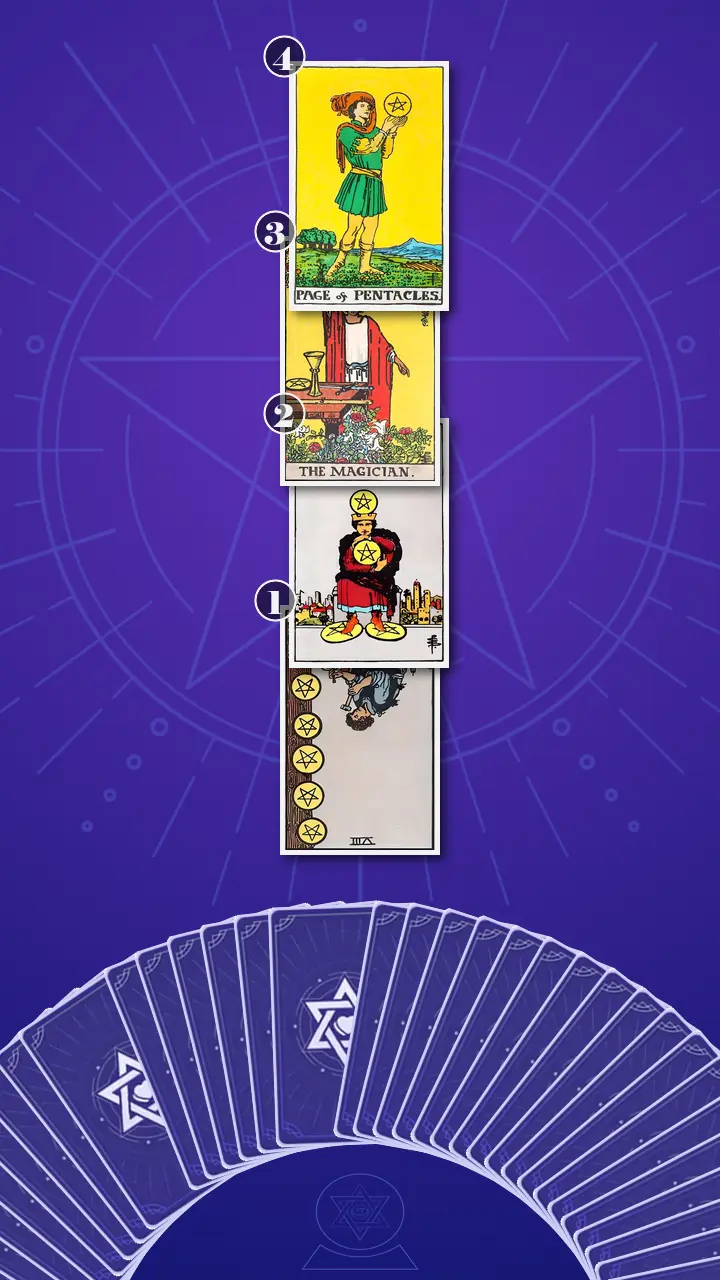
I chose the Four-Layer Insight Ladder · Context Edition. This is how tarot works in this consultation: the images do not deliver a fixed academic future; they organize attention, make a hidden pattern easier to name, and give a person something concrete to test. For a narrow inner-excavation question like this one, the spread is more useful than a Celtic Cross because it does not add broad external or outcome-oriented layers. It is also more substantial than a simple Past-Present-Future reading because it separates the visible substitution from the fear beneath it, the perspective that can interrupt it, and the action that can make the change observable.
I explained the rising line to Riley and to anyone reading along. The first card would show the presenting symptom, the visible substitution that keeps study from beginning. The second would reveal the underlying mechanism, the fear and control strategy beneath styling the space. The third would act as the bridge, showing the quality that redirects preparation into intentional use. The fourth would bring everything down to earth as the smallest practical study behaviour that makes the new perspective real.
We would read upward from the blocked lower pair toward the hinge and then the grounded landing. The point was not to discover what Riley must do. The point was to see where choice had become obscured by preparation.
Reading the Map Without Moving the Furniture
Position 1: The Workbench Turned Sideways
Now I turned over the card representing Presenting symptom: the visible substitution that keeps study from beginning. It was the Eight of Pentacles, in reversed position.
In the Rider-Waite-Smith image, the artisan keeps working over one pentacle while eight finished pentacles line the wall behind him. The workbench is isolated, repetitive, and intensely focused. In Riley’s life, I could see that same effort becoming a craft project aimed at the container: the first twenty or thirty minutes of a planned study block went into aligning notebooks, adjusting the lamp, cleaning the surface, comparing stationery, or opening another setup video. The work was real, but it was pointed sideways. The reading, problem set, or draft that would build academic skill remained untouched.
Reversed, the earth energy was not absent. It was misdirected and beginning to harden into a loop. Diligence had become over-fussy preparation, and repeated small changes created the temporary relief of feeling ready without requiring the vulnerable first attempt. A polished surface could accumulate visible evidence of effort while the actual repetitions of learning had not yet begun.
“That is too accurate,” Riley said after a short, bitter laugh. “Almost rude.” I let the humour stay in the room. “Let’s keep it as information, not a verdict,” I replied. “The card is not saying your effort is fake. It is asking which skill is receiving the effort. For one study block, three minutes of preparation can be enough. After that, one page, two pages, one problem, or three sentences can become the craft you actually practise.”
Riley’s smile thinned, then their thumb stopped rubbing the edge of the notebook. I watched their gaze move from the aligned stationery to the still-closed chapter. The first defensive explanation had loosened, but the relief of organizing had not yet lost its appeal. That mattered. Change would not require pretending the desk ritual felt pointless; it would require noticing what the ritual made easier to postpone.
Position 2: The Guarded Perimeter
Now I turned over the card representing Underlying mechanism: the fear and control strategy beneath styling the space. It was the Four of Pentacles, in upright position.
The figure in the card holds one pentacle tightly against the chest, places another beneath each foot, and wears one above the head. A grey town sits behind him, distant and contained. I read the image as a guarded perimeter. When an assignment felt vague or open to evaluation, Riley kept every part of the study environment in an approved position: the laptop centred, the pens aligned, the lamp fixed, the tabs controlled, and the plan revised until it looked safe to enter.
Here the earth energy was contracted. Control had become a form of protection from uncertainty, and styling the desk gave that protection a physical border. I asked Riley to listen for the sentence underneath the visible one. The surface thought was, I am only fixing the environment. The quieter sentence was, underneath it, I am trying not to find out how the work will feel. The controlled start promised safety, but it also postponed the moment when an imperfect paragraph might challenge the image Riley had of their own performance.
“If the desk is perfect but the chapter is unopened, what exactly is the perfect desk protecting?” I asked. “Maybe confusion. Maybe a rough first draft. Maybe evidence that I cannot control how good the work is,” Riley answered. “And if the desk is slightly imperfect?” I asked. Riley looked down. “Then I have to find out.”
Riley’s breathing paused first, and their fingers tightened around the pen. Then their eyes lost focus for a few seconds, as if another evening had opened behind the room: the cleaned surface, the revised Notion dashboard, the due date appearing again after the assignment had remained untouched. Finally, a long breath moved through their chest and their shoulders lowered a fraction. I did not rush to fill the silence. The guarded perimeter had become visible, and visibility was already a form of choice.
I reminded Riley that a small amount of disorder was not the same as abandoning the study goal. The question was not whether they should enjoy an untidy desk or force themselves into a rigid schedule. The question was whether the environment could be functional without becoming a test they had to pass before they were allowed to learn.
When the Magician Put the Desk to Work
Position 3: The Open Table
The room seemed to quiet before I touched the third card. Even the lamp’s hum receded beneath the distant sound of traffic, and the crooked top notebook suddenly looked more honest than the carefully aligned row beneath it.
Now I turned over the card representing Transformative insight: the quality that redirects preparation into intentional use. It was The Magician, in upright position. This was the bridge of the spread, carrying focused agency, resourcefulness, conscious choice, and the ability to turn existing tools into purposeful work.
The Magician’s raised hand holds a wand while the other hand directs downward. On the table sit a wand, cup, sword, and pentacle, a complete field of fire, water, air, and earth waiting for direction. The image did not ask Riley to acquire a better lamp, a new stationery set, another Pomodoro app, or a more beautiful Notion dashboard. It asked what the existing laptop, notebook, timer, pen, and assigned reading could do when each received one clear job.
My signature lens is Academic ROI Auditing, and I brought it in carefully. I do not use it to turn a student’s worth into a spreadsheet. I use it to distinguish visible motion from strategic yield. Years on Wall Street taught me that a busy screen can still conceal a weak return; in this room, twenty minutes of lamp adjustments yielded a tidier surface, while ten minutes with one paragraph could yield actual contact with the material. The audit was not a demand to maximize every minute. It was a protective question: what will this next small investment make possible?
I told Riley that the Magician was also an operating-system update. The old question was, Is this ready enough? The new question was, What can I do with what is already here? Riley did not need to become a different kind of student before using the tools already on the table.
Riley was caught between two claims: the setup had to be perfect before they could trust themselves, yet beginning now might let a rough paragraph reveal something they did not want to know. The room felt controlled; the work still felt exposed. The conflict was not a lack of tools. It was the fear of directing them.
Do not wait for a perfectly controlled study space; take the tools already on the Magician's table and direct them into one real study action.
Then I added, “The setup is not the assignment. Agency starts when the tools already on the table receive one clear job, even while the room and the work remain imperfect.”
For two seconds, Riley’s face went blank. Their breath stopped halfway in, their pupils widened, and the hand resting near the notebook hovered with the fingers curved as if waiting for another adjustment. Their eyes moved to the laptop, then the timer, then the crooked edge of the top notebook. I could almost see the memory being replayed: another night of colour-coding, another desk reset, another page left unopened. A quiet resistance arrived next. “But if I already have enough, why have I spent so much time trying to get ready?” Their jaw tightened, and the skin around their eyes warmed. Then their shoulders dropped a fraction. The question did not disappear, but it lost some of its authority. Riley turned the notebook over and let out a breath that sounded almost like surprise. Their grip on the pen softened. Relief arrived beside a small, dizzying vulnerability: there was no perfect setup left to blame or wait for. I watched curiosity take its place, not certainty, just a shorter distance to the work. The body froze, the memory connected, and the breath released.
“Now, use this new perspective to think back to last week,” I said. “Was there a moment when this insight could have made you feel different? Maybe the moment you opened a blank Google Doc, saw a dense reading list, or reached for another desk-setup video.”
Riley looked at the objects already near them. The laptop, notebook, timer, and reading had been present all along. The shift was from needing a better setup to recognizing that there was enough for one defined action. This was the first movement from anxiety-driven control of the study environment to grounded agency through one imperfect study action. The Magician did not promise that discomfort would vanish. The card showed that discomfort could coexist with deliberate use.
Position 4: The Page That Counts as a Beginning
Now I turned over the card representing Action and integration: the smallest practical study behavior that makes the new perspective real. It was the Page of Pentacles, in upright position.
The Page holds one pentacle at eye level and studies it closely. Beneath the figure is a green cultivated field, while distant mountains rise beyond the immediate ground. I read this as patient attention to one tangible opportunity. In Riley’s life, it meant opening the assigned material and treating one paragraph, one worked example, one problem, or one sentence as a legitimate beginning. The Page did not survey the entire semester before moving. The Page looked closely at one thing.
This earth energy was grounded rather than guarded. It gave The Magician’s broad resourcefulness a modest container: one tool, one task, one timer. The study space did not need to become more beautiful. It needed to become usable for a short interval. A small beginning could create actual contact with the material, and that contact could become evidence of readiness instead of waiting for readiness to arrive first.
“One page is a beginning, not a verdict,” I told Riley. “You do not have to ban all preparation or force a brutal schedule. You can let the room be adequate while the work becomes real.” Riley slid the notebook closer without straightening it. Their eyes settled on the first paragraph, and the styling impulse became something they could observe rather than automatically obey.
I also named the overcorrection risk. Riley did not need to prove they had changed by refusing every reasonable desk adjustment or demanding an unrealistic study marathon. The point was a repeatable contact with the work, small enough to be chosen and flexible enough to stop, pause, or reduce if the exercise became too activating. Agency included the right to adjust the experiment.
The Good-Enough Study Container: From Insight to Next Steps
When I stepped back from the four cards, the story was clear. The reversed Eight of Pentacles showed real effort diverted into polishing the container. The Four of Pentacles showed why: a controlled surface offered temporary relief from the uncertainty of an imperfect academic attempt. The Magician opened that closed earth loop by gathering the tools already present and giving them direction. The Page of Pentacles grounded the opening in one patient piece of work.
The cognitive blind spot was treating the discomfort of beginning as proof that the environment was not ready. Riley had been preparing for a safer feeling instead of making a small, observable contact with the assignment. The transformation direction was not from messy to perfect or from anxious to permanently calm. It was from setup control to deliberate use, from looking ready to practising the actual skill, and from anxious preparation to grounded contact with the material.
I brought in my Research Sunk-Cost Audit, a decision framework I normally use when someone is deciding whether to pivot or persevere in a stalled academic research project. I adapted it to one study block: separate the time already spent from the yield the next ten minutes can create. The past twenty minutes of rearranging are not evidence that another twenty will solve the problem. Ask whether the next action changes contact with the reading, draft, or problem. If it does not, place the urge on a parking note instead of opening another shopping tab. This was strategic logic used as support, not pressure and not a scorecard for Riley’s worth.
The Three Small Experiments
- Set a Three-Minute Setup ContractBefore one evening study block this week, set a three-minute timer at the Toronto desk. Clear only the space needed for the existing laptop, notebook, timer, and assigned material. When the timer ends, read two pages, highlight one paragraph, or draft three sentences before making any further environmental change.Write every extra urge, such as changing the lamp, comparing stationery, or cleaning a cable, on one note titled Later. If three minutes feels too demanding, use sixty seconds. The timer is a boundary, not a test.
- Run the Magician Tool AssignmentPlace the existing laptop, notebook, pen, timer, and reading in front of you and give each one job for the next ten to twenty minutes. Write one line before starting: I am using this notebook to capture one useful idea from this reading. Then begin without adding an app, template, purchase, or new productivity system.If the assignment is vague, reduce it to a verb and an object, such as read one paragraph, define one term, or list three claims. If the Research Sunk-Cost Audit shows that another setup change will not alter the next academic action, park it and continue only if the interval still feels workable.
- Make Page-One ProofOpen the assigned material and study one paragraph closely for five to ten minutes, leaving one harmless detail of the desk imperfect. Write one plain-language note beginning with This paragraph is mainly about, without formatting it into a final study guide. Mark the page or problem reached so the next start has a visible landing point.One paragraph can still feel large if it seems like a verdict on intelligence or future performance. Reduce the unit to one sentence, one worked example, or one question in the margin. Pause or stop if your body becomes too tense; the aim is contact, not a perfect performance.
“These are invitations, not commandments,” I said. “The cards can help you see the loop, but you remain the person who chooses whether to test a different response. A good-enough study container is not a compromise you have failed into. It is a space that supports one manageable action while the rest of the room and the assignment remain unresolved.”

A Crooked Notebook and One Real Page
Four days later, Riley texted me from the same apartment: “I left the lamp alone, set ten minutes, and wrote one note about the reading.” The notebook was still slightly crooked. They added, “I still wondered whether it was enough, but I opened the next paragraph instead of fixing the desk.”
I held on to the modesty of that update. Riley had not solved anxiety, guaranteed academic success, or transformed every study block. They had created a small piece of evidence that intention could become action without a perfect room authorizing it. The tarot reading had not done the studying. It had helped Riley distinguish protection from progress, then return the decision to their own hands.
That was the Journey to Clarity: not an escape from uncertainty, but a clearer relationship with it. The movement from anxiety-driven control to grounded agency began with one crooked notebook, one existing set of tools, and one page treated as a beginning rather than a verdict.
When a vague assignment leaves your shoulders tight and your hands busy aligning pens, a perfect desk can feel safer than discovering what your first imperfect page might reveal. If your existing notebook and one open page were already enough, what small piece of the work would you feel curious enough to look at for ten minutes?