Fresh-Start Procrastination, Then Ten Minutes on Pages 42–44

Finding Clarity in the 9:40 p.m. Reset
I met Maya (name changed for privacy), a second-year undergraduate in Toronto who balanced classes with weekend retail shifts, at 9:40 p.m. on the kind of Tuesday when fresh-start procrastination looks almost indistinguishable from being organised. Through our video call, I could hear the fluorescent kitchen light buzzing above her. Her laptop fan hummed against her wrists while she shared a screen with an assigned reading open in one tab and a polished next-term study dashboard in another.
I watched her drag the unread chapter into the following week. Her shoulders seemed weighted toward the desk, yet her fingers kept moving quickly across the trackpad—changing subject colours, adjusting deadlines, building a version of the future that looked beautifully under control.
“I know exactly what I’ll do next term,” she said. “I just can’t seem to start it this week. If I can’t follow the whole routine, one random session feels pointless.”
I heard frustration in her voice, but it was not the loud, explosive kind. It sounded like a song trapped in a permanent count-in: every instrument raised, every breath prepared, but the first note never allowed to land. Underneath it, I could also hear apprehension about slipping again, shame about not resembling the organised students in her StudyTok feed, and a small protected hope that the next semester might finally make everything click.
“You are not waiting for a timetable,” I told her gently. “You are waiting for a beginning that cannot yet prove you wrong.”
Her hand became still on the trackpad.
I clarified that I was not calling her lazy or suggesting that planning had no value. The planning had been giving her a brief sense of relief. It let an imagined, disciplined future Maya remain flawless because that version of her had never needed to study while tired, halfway through a term, commuting on the TTC, or coming home from a retail shift.
“I’m not going to use tarot to predict whether you’ll become a ‘good student,’” I said. “That would hand your authority to the cards and turn a complex pattern into a verdict. I want to use the reading as a structured mirror. Let’s make a map of the loop, find the beat where it breaks, and see what you can choose from there.”

Lowering a Lantern into the Study Loop
I asked Maya to close the semester-template tab but leave the current reading open. I invited her to place both feet on the floor, take one unforced breath, and hold a single question in mind: Why do I keep waiting for a new term to change my study habits? I shuffled slowly, using the rhythm as a transition from rapid planning into focused observation rather than as a piece of theatre.
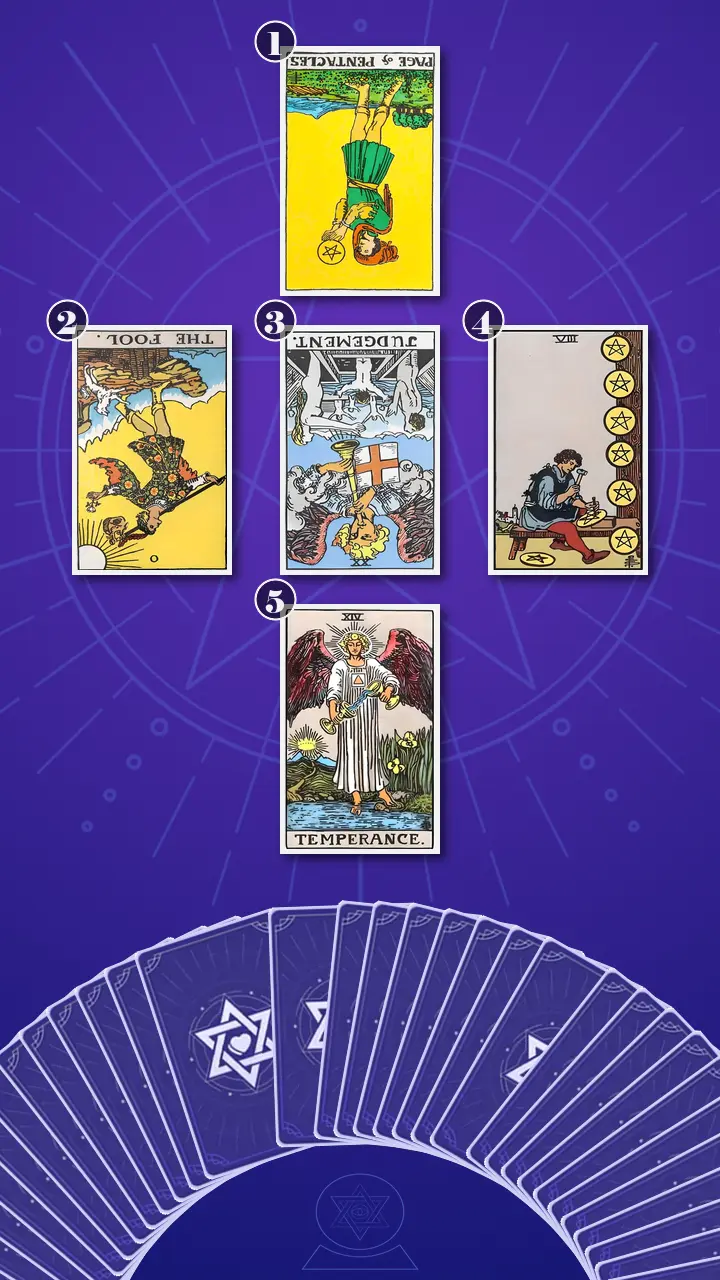
I chose The Shadow Spread, a five-position tarot framework for examining the hidden causes of study procrastination. For anyone wondering how tarot works in my practice, I read card meanings in context rather than treating them as fixed predictions. The cards help separate visible behaviour from the fear and belief beneath it, then identify a resource and translate that resource into actionable next steps.
I chose this compact spread because Maya did not lack planning tools. Google Calendar, Canvas, Notion, and her study tracker were already doing their jobs. The more useful question was why rebuilding those tools felt safer than using them for one ordinary study block. A ten-card Celtic Cross could have added external influences and future possibilities, but it would have made this focused pattern harder to hear. The Shadow Spread gave us the exact sequence we needed: visible delay, hidden fear, root belief, practical resource, and integration.
I arranged the cards like a lantern being lowered into a well. The first position sat above the centre and would show the visible performance of preparation. The second, placed to the left, would reveal what an imperfect beginning threatened to expose. The third rested at the centre as the root belief. The fourth, to the right, would show the capacity concealed inside the struggle. The fifth, below, would ground the insight in Maya’s real schedule, energy, commute, and work.
“This spread won’t tell you what the calendar has decided for you,” I said. “It will help us examine the authority you’ve been giving the calendar—and decide whether you want to take some of it back.”
The Cards That Found the Broken Beat
Position 1: The Dashboard That Looked Like Progress
I turned over the card representing the diagnosis: Maya’s visible pattern of performing preparation by rebuilding future study systems while postponing the current task. It was The Page of Pentacles, in reversed position.
I pointed to the Page holding one pentacle at eye level while standing in a cultivated field. Upright, I often read this Page as the early, practical energy of a student learning through contact with the material. Reversed, I saw that Earth energy as a Blockage: curiosity and academic potential were present, but application had been displaced by preparation.
“This is you at 9:40 p.m.,” I said, “with the reading in one browser tab and the next-term dashboard in another. The single pentacle is the polished system receiving all your attention. The field under the Page is the desk, the open chapter, and the twenty minutes already available tonight.”
I explained that StudyTok semester-reset videos and elaborate Notion templates were not inherently the problem. The problem appeared when curating the image of readiness became easier than touching the coursework. Maya was arranging every tool on the workbench while leaving the first piece of work untouched.
She did not nod in easy agreement. Instead, she let out one brief, bitter laugh.
“That is so accurate it feels a little cruel,” she said.
“Then I want to slow down,” I replied. “Recognition should not become another weapon. This card is describing where your attention goes under pressure; it is not defining your character. The field is still there. Nothing on this card says you have missed your chance to work it.”
I asked her which exact task she was postponing and which future date she had assigned to it. She looked back at the shared screen.
“Pages forty-two to fifty-eight,” she said. “I moved them to next Monday because I already missed the session yesterday.”
The Page gave us our first clear distinction: Maya did not need another system before she began. She needed one experience of using the imperfect system already in front of her.
Position 2: The Wednesday That Was Not Allowed to Count
I turned over the card representing the hidden fear: that an imperfect mid-term attempt might test Maya’s disciplined future identity and expose another lapse. It was The Fool, in reversed position.
I centred the image on the traveller’s lifted foot. Upright, The Fool can carry the open fire of beginning. Reversed, I read that threshold energy as another Blockage: the step remained suspended until the beginning could feel pure, symbolic, and safe enough to guarantee a different ending.
In Maya’s life, this was the moment she decided that a Wednesday halfway through a crowded term was too compromised to count. Her hand hovered near the current reading, then opened a planning app instead. She gave next Monday, next month, or next term the authority to declare when change was legitimate.
“What if the new term feels powerful partly because it has not yet had the chance to disappoint you?” I asked.
Maya pressed her lips together. Her thumb tapped twice against the side of her phone, then stopped.
“If I start now and quit again,” she said, “I won’t be able to tell myself the timing was the problem. It’ll just be me.”
There it was: not a lack of desire, but an identity risk. Waiting protected her from finding out whether the routine could survive an imperfect week. The protection also kept her from gathering any evidence that it could.
“An ordinary Wednesday can be a real beginning,” I said. “It does not have to become a contract promising what every future Wednesday will look like. It only has to be the day on which you made one present-tense choice.”
I saw her glance toward the open reading. The future had not disappeared from her mind, but the present had begun to regain a little visual weight.
Position 3: When the Habit Tracker Became a Court Docket
I turned over the centre card, representing the mechanism’s root belief: each lapse was being treated as a verdict on Maya’s worth rather than as information about the study system. It was Judgement, in reversed position.
I asked Maya about the last time she had reviewed a missed session. She told me about opening an old habit tracker at 11:53 p.m. on a Thursday. The laptop fan had been the only sound in her bedroom. Several unfinished streaks sat on the screen, and the phone felt warm under her palm as she scrolled backward through earlier attempts.
I described the tracker as a court docket. The first entry read: one session missed. The next internal sentence became: this proves I am inconsistent. The final conclusion followed quickly: another attempt will expose the same flaw. Maya had wanted an honest review, but the review had become a prosecution.
On Judgement, the angel’s trumpet usually calls the figures to rise, reassess, and respond. Reversed, I saw the energy of review becoming distorted: an Excess of condemnation and a Deficiency of usable observation. Instead of asking about time, task size, hunger, noise, fatigue, or clarity, Maya’s internal reviewer kept issuing a global ruling about who she was.
My mind flashed to a waveform from my years of sound-energy research. When one section of a signal distorts under pressure, I do not accuse the whole recording of being defective. I locate the overload, reduce the demand, and listen again. Maya’s tracker could have served the same function, but she had been using each clipped beat to condemn the entire song.
“One missed study session is a data point, not a final grade on your character,” I told her.
Her reaction came in three small movements. First, her breath stopped and her fingers froze around the phone. Then her eyes slipped out of focus as if she were replaying every night she had reopened an old planner to confirm what she already feared. Finally, a low “Oh” left her chest, and her shoulders dropped by barely an inch.
“I use ‘inconsistent’ all the time,” she said. “I never write that I started after a nine-hour day, or that I didn’t understand what the chapter question was asking.”
“That omission is part of the shadow,” I said. “If the conditions disappear from the record, your identity becomes the only available explanation. Judgement reversed is asking you to review what happened without sentencing the person who lived through it.”
When the Eight of Pentacles Changed the Tempo
As I reached for the fourth card, the refrigerator motor in Maya’s apartment clicked off. The fluorescent buzz remained, but the room around her became noticeably quieter. I slowed my hand. We had reached the position I considered the reading’s pivot—the point where understanding had to cross into practice or remain another elegant plan.
Position 4: One Coin, One Repetition, One Piece of Evidence
I turned over the card representing Maya’s transformation resource: the capacity to build self-trust through small repetitions completed under present conditions. It was The Eight of Pentacles, upright.
I focused on the craftsperson engraving the pentacle currently in hand. Other completed coins hung nearby, but the figure was not posing beside them or staring at a distant image of mastery. The attention remained on one workable piece. I read this as Earth energy returning to Balance: practical effort, patient craftsmanship, and evidence accumulated through repetition.
In Maya’s life, the image became very literal. She would keep the current apps, sit at the same desk, set a visible timer, read one small section, and note what helped her begin. The completed pentacles would not represent a dramatic personality transformation. They would represent several ordinary sessions that had actually happened.
“Consistency is something you practise before you feel like a consistent person,” I said.
I then used the lens I call Cognitive Tempo Calibration. I placed the tempo demanded by Maya’s ideal plan beside the rhythm her real life could currently sustain. Her plan expected early mornings, long blocks, stable attention, and no disruption. Her actual week contained lectures, TTC travel, vague assignments, weekend retail shifts, hunger, and evenings when her focus arrived in short intervals. She had been writing every day at the tempo of her best hypothetical day, then blaming the musician whenever her nervous system could not keep up.
The Eight of Pentacles did not ask her to lower her worth or abandon ambition. It asked her to choose a beat she could enter. Twenty minutes on a normal evening, ten after work, or one paragraph on a crowded day could all produce contact with the material. That contact would teach her more than another complete system designed in advance.
Maya was still caught in the old calculation: a twenty-minute block looked too small to prove discipline, but another lapse looked large enough to prove failure. Her plan demanded a finished identity before she was willing to practise the first repeatable move.
You do not need a clean academic slate; make one workable repetition today, as the Eight of Pentacles builds mastery one coin at a time.
I let the sentence remain between us without rushing to soften it.
For one beat, Maya stopped breathing. Her fingers hovered above the trackpad as though the next click had been interrupted mid-command. Her pupils widened, then her gaze drifted past the card and toward the open reading, replaying the Tuesday nights, Sunday resets, and half-built dashboards that had preserved hope without testing it. Her eyebrows pulled together. The first emotion to surface was not relief but a flash of anger. “But doesn’t that mean I’ve been doing it wrong this whole time?” she asked, her voice suddenly sharper and thinner. I watched her shoulders tighten again before her fist slowly opened against the desk. “No,” I said. “It means planning protected something important—your hope that change was still possible. We do not need to shame the protection. We only need to notice that it now keeps you from collecting the evidence you actually want.” Her eyes reddened slightly. She exhaled through parted lips, almost unsteady, as if putting down the burden had left her briefly unsure what to do with both hands.
“Now, with this new perspective, can you think of a moment last week when this insight might have made you feel differently?” I asked.
Maya looked toward the ceiling and recalled Wednesday afternoon at Robarts Library. She had opened Canvas, seen the reading she meant to begin on Monday, and moved it into a new calendar block while the printer clicked nearby.
“I could have answered the first discussion question,” she said slowly. “Not all of it. Just written what I didn’t understand. I think that would have counted.”
“Yes,” I replied. “Not because one question would prove that you had permanently changed, but because it would give you information from contact with the work.”
I made the reinforcement concrete. After the reading, she could keep the current setup, choose one paragraph or one question, and work for ten minutes. She could stop when the timer ended. If ten minutes felt too charged, she could highlight one paragraph or write one question for a tutor. Afterward, she would record one factual note about what helped her begin. The exercise was an experiment, not a promise and not a test of worth.
I named the deeper movement I had seen. This was not a shift from an unmotivated student to a perfect one. It was the first step from frustrated stagnation and identity-based self-judgement toward cautious experimentation, grounded self-trust, and flexible study consistency. The cards had not given Maya certainty. They had shown her where she could generate evidence for herself.
Position 5: Temperance and the Routine That Could Change Size
I turned over the final card, representing the practical integration step: blending study with Maya’s real energy, workload, and time instead of waiting for a total reset. It was Temperance, upright.
I drew her attention to the water flowing continuously between two cups, with one foot on land and one in water. I read the card as Balance, but not as a frozen midpoint. Temperance offered balance through ongoing adjustment. Structure and responsiveness could remain in conversation without either one erasing the other.
For Maya, that meant keeping one starting cue while changing the dose around the day she actually had. After a normal class, the cue might lead into twenty minutes. After a retail shift, the same cue might lead into ten. On a packed evening, it might mean opening the course tab and reading two pages. The form could change without breaking the relationship with the work.
“That still feels a little like cheating,” she admitted. “Like I’m saying I have a routine when sometimes it’s only two pages.”
“A routine that changes size but keeps its cue has not failed; it has learned the shape of your day,” I said. “Temperance is not asking you to fake consistency. It is asking you to stop confusing consistency with sameness.”
I saw the distinction register physically. Maya’s jaw loosened first. Her thumb stopped tapping the phone. Then she nodded—not with the bright intensity of someone launching another life overhaul, but with the quieter recognition that ten minutes after a shift might be more honest than scheduling three imaginary hours.
I could now see the energetic arc of the whole spread. The Page of Pentacles reversed had shown blocked practical learning. The Fool reversed had shown a beginning held in suspension. Judgement reversed had revealed reflection distorted into self-condemnation. The Eight of Pentacles restored grounded practice, and Temperance added enough movement for that practice to survive reality.
The Syncopated Study Session: Evidence Before Overhaul
I gathered the cards into one coherent story. Maya’s earlier attempts had taught her to interpret a missed session as evidence about her identity. In the present, the Page showed her polishing the appearance of academic readiness. Beneath that, The Fool revealed why the delay felt protective: an untested future self could still be perfect. At the root, Judgement showed the painful rule keeping the loop alive—if the next attempt failed, the failure would become personal. The Eight of Pentacles offered the unused resource of repeatable practice, while Temperance ensured that practice would not harden into another punishing overhaul.
I described the clean-start rule as a faulty personal algorithm: valid change equals symbolic date plus complete system. Any ordinary Wednesday, tired evening, or partial session was automatically filtered out as invalid. The algorithm kept producing the same result—planning instead of studying—while convincing Maya that the answer was a more elaborate version of the same input.
Her cognitive blind spot was not a lack of discipline. It was the belief that consistency had to arrive as an identity before it could exist as a behaviour. She was also treating adjustment as evidence of failure, even though a study routine with university classes and a part-time job had to be responsive in order to remain usable. The transformation direction was therefore clear: move from calendar permission to present-tense choice, from character verdicts to observable data, and from a next-term overhaul to one adjustable repetition.
When I proposed a twenty-minute block, Maya immediately raised a real obstacle.
“Some nights I genuinely don’t have twenty minutes,” she said. “By the time I leave campus, get home, eat, and deal with work messages, I’m done.”
“Then twenty minutes is not the law,” I replied. “A protocol should serve your actual rhythm, not become another authority you can fail. Five minutes can be the minimum, and continuing can remain optional.”
I offered two experiments and asked Maya to choose rather than promise both. I framed them through my Syncopated Study Session: instead of demanding one long, flawless performance, we would divide the task into small beats with clear entry and exit points.
- The Syncopated Study SessionTonight, at the desk where the current reading is already open, leave Notion, Canvas, the timetable, and every subject colour unchanged. Write one visible action on paper—such as read pages 42 to 44 or answer question 1—then set a phone timer for twenty minutes. If twenty feels inaccessible, set it for five. Work only on that action, and allow yourself to stop when the timer ends.Treat the timer as an exit boundary, not a demand to continue. If a redesign idea appears, place it in a note titled Later Experiments and return to the current task for the remainder of the timer.
- The Same-Cue, Flexible-Dose LoopFor three attempts before Sunday, keep one cue stable: open the same course tab after dinner or sit at the same Robarts desk after Tuesday class. Adjust the dose to the day—twenty minutes after a normal class, ten after a retail shift, or two pages during a crowded evening. After each attempt, record the start time, task size, energy level, and interruption. At the end of the week, change only one variable.I call the review Focus Disruption Auditing: identify one dissonant chord instead of condemning the whole song. If Instagram, hunger, noise, or an unclear task broke the flow, adjust that single condition. A backup cue is an option, never a punishment.
I reminded Maya that she could stop, shorten, revise, or skip either experiment without turning the choice into a moral score. Actionable advice only remains empowering when the person using it retains the right to adapt it.
She chose the first experiment. Not for next Monday. Not for next term. For the chapter that had remained open beside us throughout the reading.
“Ten minutes,” she said. “Pages forty-two to forty-four. And I’m not changing the dashboard first.”
“That is enough information for the next beat,” I replied.

Four Days Later: One Ordinary Coin
Four days later, I received a message from Maya. She had completed ten minutes on Tuesday, stopped when the timer ended, and written two factual notes: showering before the session helped her settle, and keeping the phone beside the laptop broke her focus. On Thursday, she put the phone across the room and read for fifteen minutes without rebuilding her calendar.
Her message ended with: “It was weirdly unimpressive, but I actually did it. I think that’s the point.”
That night, she slept through. Her first morning thought was, “What if this still doesn’t stick?” She sent me a laughing emoji, then opened the same course tab. The doubt had not vanished; it had simply lost admin access.
I did not take that small change as proof that Maya had solved her study habits forever. I took it as something more honest: the first lived evidence that an imperfect repetition could survive without becoming a verdict. This Shadow Spread tarot reading for study procrastination had made the pattern visible, but the cards did not complete the chapter, move the phone, or start the timer. Maya did.
I had watched her move from staring at an imagined future identity to shaping one small piece of work in the present. That was her Journey to Clarity—not certainty about every semester ahead, but enough grounded self-trust to meet the next available page.
If tonight one missed study block locks your shoulders while your hand opens a fresh semester template, I want you to remember why that move can feel safer: it protects the future version of you from being tested. Simply hearing that protective rhythm means you are no longer standing at its silent beginning.
If an ordinary Wednesday were allowed to count as your first pentacle, what current page, paragraph, or question would you meet for five minutes without redesigning the rest?