Rushing Intimacy When Someone Shows Interest: Letting Reciprocity Lead

When Rushing Intimacy Turns a Warm Text into a Deadline
I recognized the scene before Casey (name changed for privacy) had finished describing it. I had met her as a 29-year-old Toronto communications specialist who could answer a client Slack message in ten minutes, yet after one warm exchange with a new Hinge match, she kept the chat pinned and reread the same good-morning text until every pause seemed to carry a message.
She told me about 8:47 p.m. on the northbound TTC Line 1. The fluorescent lights buzzed above her, the phone felt hot in her palm, and her stomach pulled tight as she drafted a deeply personal reply to a voice note. She wanted to enjoy the spark, but she was already trying to secure it before the next pause.
When I asked what usually happened next, she looked down at the cards still inside the box and said, “When someone shows interest, I immediately do more. I text all day, share things I would usually save, and start imagining what exclusivity might feel like before we have even booked the second date. If I do not keep the momentum going, they will lose interest.”
I heard the real question beneath the question, Why do I keep rushing intimacy when someone shows interest? Casey was torn between rushing intimacy the moment interest appeared and letting that interest unfold before treating it as intimacy. A warm signal became a promise, and a promise became something she felt responsible for preserving.
The urgency had become a browser tab with an alarm trapped inside it. A warm reply lowered the volume for a few minutes, while a slower one sent her hand back to the phone. Longing, jealousy, fear, and excitement wore the same jacket, and the impulse to reach across the gap felt physical in her chest and stomach.
I did not call that neediness, and I did not turn it into a warning about Casey’s future. I said, “You are trying to find safety with the tools that are available to you in the moment. We can look at the pattern without shaming the desire underneath it. Our Journey to Clarity is to make a map of the fog, so you can decide what to do with the next spark.”

Choosing a Compass for a Repeating Loop
I invited Casey to put both feet on the floor, take three unforced breaths, and name the question in one sentence. I shuffled slowly while she focused on the difference between what had actually happened and what she feared might happen next. The preparation was a transition into attention, not a mysterious test or a way to summon a fixed outcome.
For anyone wondering how tarot works in a reading like this, I use the cards as a structured cognitive tool. The images give an internal experience a visible form, while the positions force us to separate the trigger, the protective behaviour, the underlying loop, and the choices still available. The cards cannot make another person consistent, guarantee a relationship, or decide what Casey should want. They can help bring card meanings in context, including the parts of a pattern that are easy to miss when every notification feels urgent.
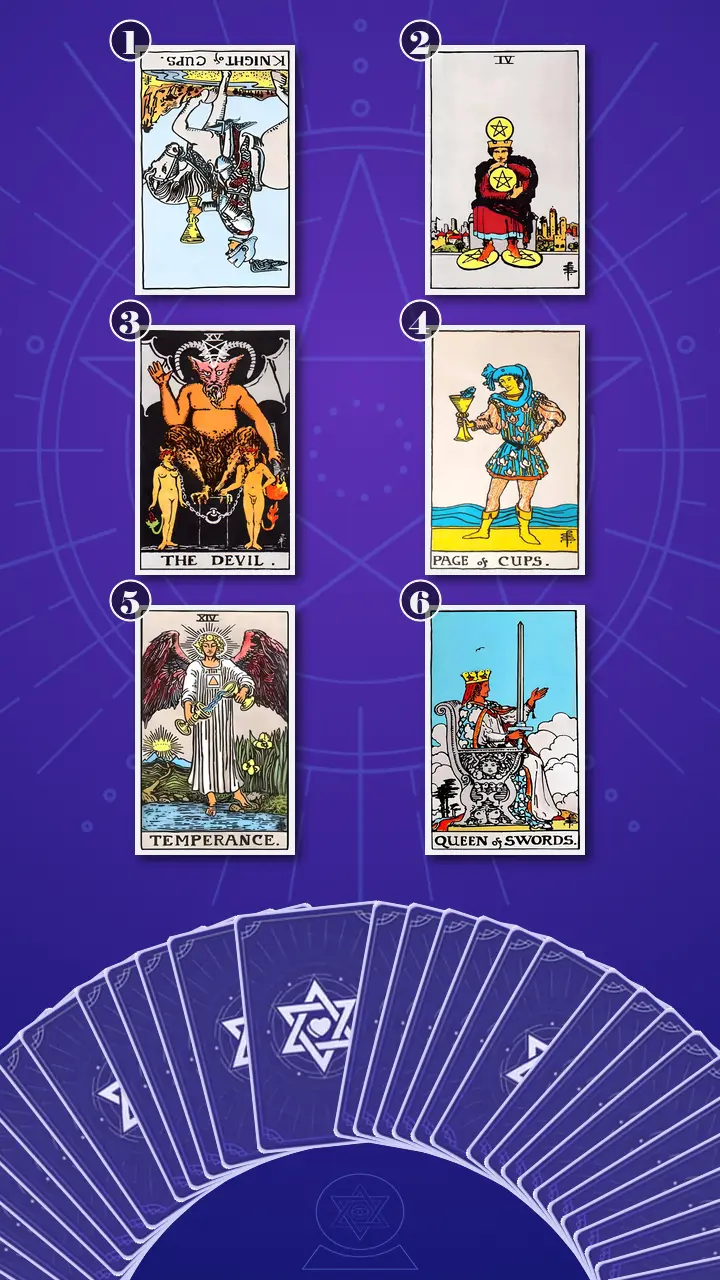
“Today I am using the Transformation Path Grid (6) · Context Edition,” I told her. “This is a six-card tarot spread for a repeating relational system, not a choice between two external paths. It follows how a promising signal becomes an urgent attachment, traces the pattern back to its root, and then shows a practical way to move toward paced intimacy.”
I pointed to the imagined two-column grid. “The first card shows the presenting symptom. The second shows the protective blockage that turns interest into something to hold. The middle row looks at the repetition root and the emotional trigger. The bottom row gives us the transformation lever, then the clarity and integration stance. We are following a staircase from the first spark to a steadier form of intimacy.”
The Cup That Arrived Before the Second Date
The Reversed Knight of Cups: Emotion Ahead of Evidence
“Now I am turning over the card for the presenting symptom: the moment someone shows interest and you accelerate texting, disclosure, fantasy, or exclusivity.”
The full card was the Knight of Cups, in reversed position.
On the Rider-Waite-Smith image, the white horse carries the rider forward while the cup is already held out in front of him. I connected it directly to Casey’s experience after a promising Hinge date: an affectionate voice note arrived during her TTC ride, and she treated the sudden warmth as proof that the connection was already emotionally secure. Before a second date had been scheduled, she had replied with private history, future-oriented questions, and an imagined version of exclusivity.
In this position, the reversed energy was an Excess of romantic momentum and an insufficient supply of grounded evidence. Feeling was travelling ahead of shared reality. The cup was not fake, and neither was Casey’s excitement, but the meaning she attached to it had reached a destination the relationship had not yet visited.
“The practical question is simple,” I said. “What did this person actually offer, separate from what the intensity made you picture? A voice note can be lovely information. It is not yet a completed relationship plan.”
Casey did not nod. She gave a short laugh with no lift in it and rubbed her thumb along the edge of her phone. “That is too accurate,” she said. “The voice note was just a voice note, but my whole evening started acting like an engagement party.”
I let the humour stay in the room. “You do not need to become detached to slow down. You only need to let the next emotional step match the amount of shared reality already available.”
The Pinned Chat and the Hand That Would Not Let Go
The Four of Pentacles: Protecting the First Warmth
“Now I am turning over the card for the protective blockage: how Possessive Attachment turns early interest into something to hold, monitor, or secure.”
The card was the Four of Pentacles, in upright position.
The figure in the image presses a pentacle against the chest, stands on two more, and keeps another above the head. I saw the pinned conversation immediately. At 11:26 p.m. in her apartment, Casey would check whether the person was online, reopen the same chat, compare the length of tonight’s reply with yesterday’s, and refresh the screen while the blue light made the room feel colder.
This was a Blockage created by an Excess of holding and a Deficiency of spacious exchange. The warm connection had become something Casey felt responsible for preserving. She was not only asking, Do I like this person? She was also trying to keep their attention at exactly the temperature of the first few days, as if pressure could stop a living connection from changing.
I placed my finger near the pentacle on the card. “This is the pinned chat, the repeated status check, the follow-up message designed to restore a feeling. The inner line sounds like this: ‘If I can keep the contact exactly this warm, maybe I will not have to find out whether it can survive ordinary space.’ Wanting closeness is one thing. Trying to hold another person’s attention still is another.”
Casey’s hand moved toward her phone, stopped halfway, and returned to her lap. Her breath shortened. She stared at the pentacle for several seconds, then said, “I hate that the checking gives me relief. It does not even make me feel good. It just makes the panic less loud.”
“That distinction matters,” I said. “Short-term relief can teach a behaviour to repeat without proving that the behaviour is helping you build intimacy. The card is showing the cost of gripping, not condemning you for reaching.”
The Chain That Mistook Familiarity for Love
The Devil: The Root Beneath the Rush
“Now I am turning over the card for the repetition root: the familiar emotional script that makes intensity feel compelling and slowing down feel dangerous.”
The card was The Devil, in upright position.
I did not use the image as a bad omen. In the root position, The Devil gives a picture to a loop that feels powerful because it is familiar, not because it is inevitable. The two figures are linked by loose chains. That detail mattered more to me than the central figure: the pattern can feel automatic while still containing visible places to choose differently.
I described the sequence I could hear in Casey’s story. Someone shows interest. Attention is interpreted as a bond that must be secured. Contact, disclosure, and future talk intensify. The immediate closeness quiets uncertainty for a moment. Then the pace outruns mutual knowledge, boundaries blur, and any ambiguity feels like confirmation that closeness is unreliable. The next promising connection receives the same urgent treatment.
“The question is not, What is wrong with me for wanting this?” I said. “The better question is, Which part of this pattern feels familiar enough to be mistaken for love? Being intensely wanted can feel like being securely held, but those are not the same experience.”
As I looked at the loose chains, I remembered an afternoon from my sound-energy research when I watched two metronomes begin in rhythm and gradually drift apart. The sound was not ruined by one dramatic mistake. A tiny timing difference repeated until the whole room felt unsettled. I had learned to listen for tempo, not just volume, and I heard the same mismatch in Casey’s pattern: the other person’s signal might be warm, but her inner tempo was already racing toward permanence.
Casey’s jaw tightened. She looked angry for a moment, then tired. “I have promised myself I would be detached next time,” she said. “Then someone likes me and I am right back in it. I do not want to stop caring. I just do not want caring to turn into this whole performance.”
“You do not have to shame the desire or swing into performative indifference,” I said. “Awareness is the part of the chain you can already touch.”
The Fish in the Good-Morning Text
The Page of Cups: A Signal, Not a Whole Story
“Now I am turning over the card for the triggering invitation: what the first rush of attention, flirtation, or love-bombing pace awakens before mutual trust is established.”
The card was the Page of Cups, in upright position.
A fish appeared unexpectedly from the Page’s cup. I connected it to the good-morning text, the playful compliment, or the message saying the chemistry felt rare. Those moments can be genuinely sweet. They can move a person and still remain small pieces of information rather than evidence that an entire future has arrived.
“The fish deserves attention,” I said. “It does not deserve the weight of a full relationship narrative. A first message is more like a notification that opens a conversation than a completed calendar invite. You can receive the surprise, answer honestly, and watch what happens in ordinary life.”
I asked Casey to try a sentence quietly: “This moved me, but it has not told me everything yet.” The words seemed to create a little air around her. Her shoulders lowered by a fraction, and the fingers that had been curled against her palm opened slowly.
The Page carried a Balance of receptivity and wonder, with an unused capacity for curiosity. The risk was not the feeling itself. The risk was forcing a small emotional event to explain the whole connection before Casey had observed how the other person handled pauses, plans, boundaries, and follow-through.
When Temperance Let the First Spark Breathe
Temperance: The Bridge Between Chemistry and Consistency
“Now I am turning over the card for the transformation lever: the smallest way to practice paced intimacy, reciprocity, and boundaries without shutting down desire.”
The card was Temperance, in upright position.
The room seemed to quiet around it. Temperance’s angel pours water between two cups, with one foot on land and one in water, while a path winds toward distant mountains. I saw the missing movement immediately. This was not emotional suppression. It was an ongoing exchange, adjusted carefully enough that attraction and observation could exist in the same frame.
“This is Balance,” I said. “You can enjoy a promising date, keep your existing plans, answer warmly without manufacturing an all-night conversation, and observe whether interest continues across several ordinary interactions. Pacing is not playing hard to get. It is how you learn what is mutual.”
My signature lens is the Communication Dissonance Audit. I developed it to diagnose arguments not by the words spoken, but by the mismatch between emotional tempo and frequency. I use the same lens at the edge of intimacy. Someone might say, “I had such a good time,” while Casey’s inner tempo converts that sentence into, “We must secure this now.” Or a person might send an intense message at 180 beats per minute while their actual pattern has consisted of one date and a handful of texts. The audit separates the spoken signal, the observable behaviour, and the story rushing in to fill the silence.
At 8:47 p.m. on the TTC, Casey’s phone had been warm in her palm as she reread a new match’s voice note and drafted the deeper reply. The train lights buzzed, her stomach tightened, and her mind was already trying to prevent the spark from disappearing before it had become a pattern.
You do not have to turn early intensity into a secured bond; like Temperance blending two cups, let closeness grow through time, reciprocity, and clear boundaries.
First, Casey froze: her breath stopped, her thumb hovered above her phone, and her mouth opened without sound. Then the insight travelled past her defenses. Her gaze lost focus and settled on the table as though she were replaying the cancelled Saturday plan, the online-status check, and the private story she had sent to keep a new connection warm. Her fingers tightened around the chair, released, then tightened once more. Finally, her shoulders dropped. Moisture gathered at the corners of her eyes, and a small, startled “Ah” left her chest. The relief did not arrive alone; a thin dizziness followed it, the blank space that appears when an old instruction has gone quiet and no new one has taken over. She swallowed and said, “But does that mean I was wrong every time?” I kept my voice steady. “It means your response was trying to create safety quickly. Now you can let time show you what is mutual.”
I asked, “Now, using this new view, can you revisit last week and find one moment when it might have made you feel differently?”
I did not give her a new rule to obey. I offered a ten-minute experiment. I asked her to open a Notes page with three headings: What they have actually done, What I am imagining, and What pace would feel honest for me. Any deeper disclosure or exclusivity question could remain in drafts during those ten minutes. If the exercise became too charged, she could return to an ordinary task and decide later whether to revisit it.
That was the bridge from urgency-driven attachment, possessive reassurance-seeking, and rapid future projection toward grounded curiosity. Casey did not need to stop wanting intimacy. She needed to stop making the first spark carry the whole relationship. The first small crossing was learning that a little space could be observation, not abandonment.
The Open Hand Beside the Upright Sword
The Queen of Swords: Clarity That Still Lets Love In
“Now I am turning over the card for clarity and integration: the relational stance that lets you enjoy interest while judging intimacy by consistent, mutual behaviour.”
The card was the Queen of Swords, in upright position.
The Queen held an upright sword in one hand and extended the other with an open palm. I connected that image to the sentence Casey could use when a connection began moving quickly: “I am enjoying this, and I like getting to know each other gradually, so I am not trying to define everything today.” The sentence did not ask the other person to promise a future. It named the pace Casey could genuinely participate in.
The Queen’s energy was a Balance of receptivity and discernment. The sword did not cut off feeling, and the open hand did not surrender judgment. This was the opposite of treating attention as a verdict on worth. It was the ability to let clear words, personal boundaries, and repeated mutual actions carry more weight than fear of losing access to someone’s attention.
“You do not have to become cold,” I said. “You can be warm and still read the terms. You can say what works for you, then notice whether the connection makes room for that truth over the next few ordinary interactions. One reassuring reply is information. Consistency is a pattern.”
I also named the high note I could hear in the cycle through my Reactive De-escalation Mapping. I use it to identify the precise moment when defensive anger or panic shatters emotional safety. For Casey, the high note was not necessarily an argument with another person. It was the instant a slower reply became a verdict, and the urge to send more contact rose to correct it. Naming that moment would give her a choice before the emotional volume became the only thing she could hear.
The Page Between Spark and Steady Fire
The Pattern, Without the Verdict
When I placed all six cards together, the story became coherent. The reversed Knight of Cups showed feeling and imagined meaning moving ahead of evidence. The Four of Pentacles showed the protective grip that tried to preserve the first warmth. The Devil revealed how short-term relief could reinforce a repeating loop, without defining Casey or predicting an outcome. The Page of Cups returned the first message to its proper scale: tender, surprising, and worth noticing. Temperance supplied the pace, and the Queen of Swords gave that pace honest language.
The wider context mattered too. Casey had learned in her work that fast replies signalled competence and reliability. Dating apps kept a promising person available all day, so responsiveness began to feel like a performance of desirability. Friends could see the chemistry, but chemistry versus consistency required a slower kind of attention. The blind spot was not caring too much. It was assuming that more contact could protect her from uncertainty, when more contact often prevented her from observing whether the connection could hold ordinary space.
The transformation direction was clear: move from trying to secure closeness before it can change to observing whether closeness is mutual, consistent, and spacious enough to survive a slower pace. A warm signal is information, not a contract. The person who chooses what happens next is not the card, the algorithm, or the other person’s typing bubble. It is Casey, deciding what she wants to share, what she can participate in, and what evidence she is willing to wait for.
Small Experiments for Finding Clarity
I kept the actionable advice small because a grand promise would only recreate the pressure we were trying to release. Anyone exploring the Transformation Path Grid (6) · Context Edition can revisit the same six positions as practical questions: What is happening? What am I holding? What familiar script is active? What sparked it? What is one paced response? What would clear, mutual intimacy look like here?
- Use the 24-hour deeper-disclosure pauseFor one week, after a promising date or warm message from a new person, reply to ordinary warmth naturally, then place any deeper personal disclosure or exclusivity question in your phone’s Notes app for 24 hours. Before sending it, check whether you still want to share it, whether the other person has shown reciprocal interest, and whether it matches the pace you can honestly join.Start with a ten-minute timer if 24 hours feels too large. Use the pause for escalation, not for basic kindness. This is an experiment, not a guarantee that anyone will stay.
- Keep a three-action reciprocity logAfter each date or significant conversation, write three observable actions the other person took, such as making a plan, following through, asking about your experience, or respecting a stated boundary. Beside each fact, write the story your mind attached to it, then choose one next step that matches the evidence: answer normally, suggest another date, or let the existing plan unfold.Keep it to three lines so it does not become another monitoring ritual. Write observed actions and predictions separately; the purpose is to choose your next level of disclosure, not to prove that someone is good or bad.
- Name your pace and lower the emotional BPMWhen a new connection starts moving quickly, say, “I am enjoying this, and I like getting to know each other gradually, so I am not trying to define everything today.” If a slower reply turns into an emergency or a charged text exchange begins, use my Reactive De-escalation Mapping to name the high note: the gap became a verdict.Then use the Syncopation Pause: lower the phone, notice one sound in the room, feel both feet, and wait for three quiet seconds before replying. It interrupts escalation without turning silence into a test or trying to control the other person’s interest.

A Week Later, the Quiet Proof
Six days later, Casey messaged me from a café near Queen Street: she had kept one ordinary plan, left a deeper disclosure in Notes overnight, and sent it only when it still felt true. The next morning, “What if I’m wrong?” returned; she made coffee before replying.
I read that as a first piece of evidence, not a perfect transformation. Casey had not solved dating, eliminated jealousy, or secured a future. She had allowed a new connection to remain part of her day without making it the centre of the day. She had answered from choice instead of from the need to silence a gap.
That is what Journey to Clarity looked like in her hands: not certainty, but a steadier rhythm. Temperance had not promised that the connection would work. It had shown Casey how to stay open while time, reciprocity, and boundaries revealed what the connection could hold.
When a warm message makes your chest buzz and your hand reach for the phone, turning the spark into a promise can feel safer than finding out whether you are worth choosing once the pace slows. But noticing that reach is already a change. You can hold the cup without gripping the person.
If you let the next warm signal be information rather than a contract, what small amount of space might still let you stay curious about how this person actually shows up?