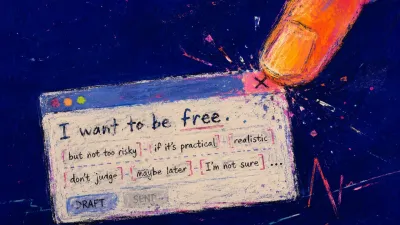
When Easy Chores Feel Existential: One Choice, One Visible Result

The Mug That Never Reached the Sink
I have learned that if someone can close customer-support tickets all day but keeps opening a reset checklist instead of washing five dishes, the problem may be less about knowing how and more about what the quiet brings up.
Alex joined our video consultation from a compact one-bedroom apartment in Toronto at 8:15 on a Tuesday evening. Before sitting down, they carried a coffee mug toward the kitchenette, noticed the laundry basket beside the sofa, and set the mug on the coffee table. The phone in their palm was still warm from a home-reset video. Stale coffee hung in the air, and the refrigerator hummed behind the clip's bright music.
“It isn't hard,” Alex said. “So why does starting feel so loaded? I keep planning a reset instead of doing one.”
The feeling showed up in their body before they found words for it: shoulders hanging like a wet winter coat, momentum thick as slush, and a drawstring tightening under the ribs whenever their eyes travelled around the room. They noticed the task. They bargained with the task. Then the task became a question about their whole life.
Alex wanted a functional, cared-for home. But concrete care removed the stimulation that kept a more difficult thought at a distance: if they washed the dishes and cleared the table, they would still have to face how little direction they felt in their stable but unfulfilling routine.
“I don't hear laziness in that,” I told them. “I hear a small task carrying far more meaning than it was built to hold. Let's make a map of the moment when the room stops being a room and starts feeling like a verdict.”
Choosing a Map for the Question Beneath the Chore
I asked Alex to put both feet on the floor, take three unforced breaths, and hold one question in mind: “What am I avoiding when I keep putting off basic home care?” I shuffled slowly. The pause was not a mystical performance; it gave their attention time to move from the glowing screen back into their body and the actual question.
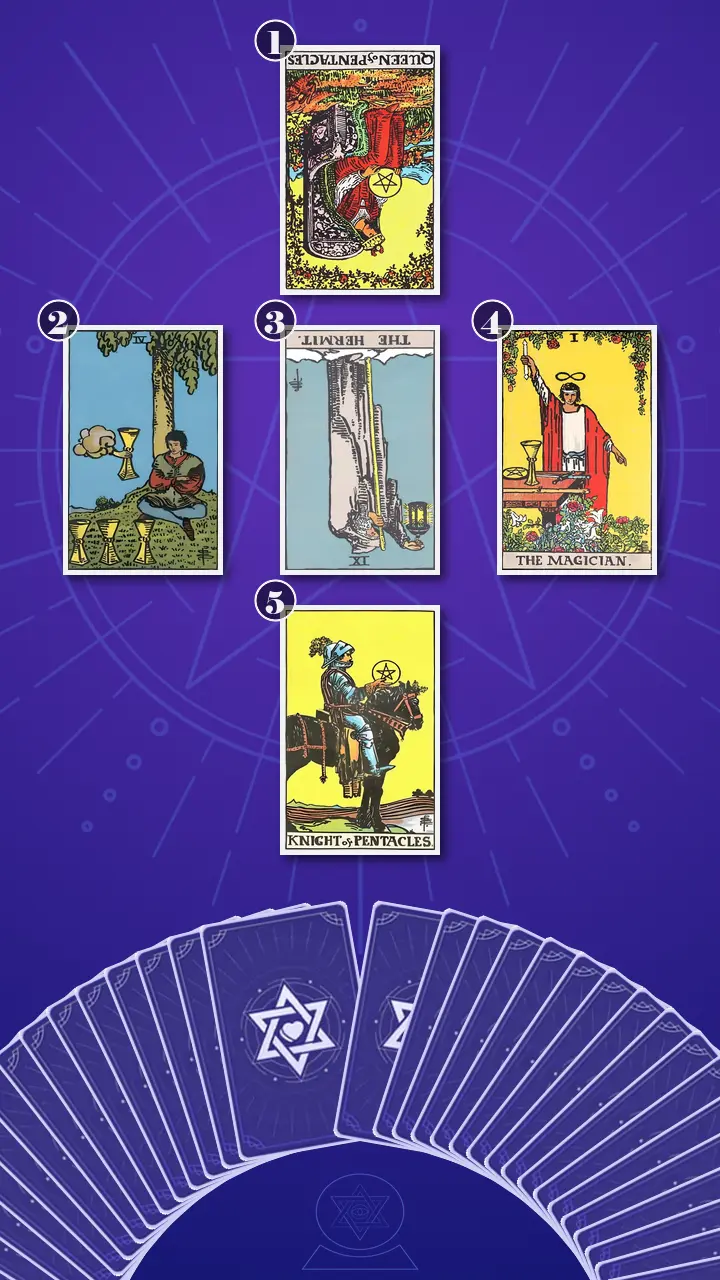
I chose a five-card Shadow Spread. In my practice, this spread works well when a visible habit appears to be protecting something less visible. It is focused enough to examine one procrastination loop without turning every dish, towel, and coffee cup into a sweeping psychological diagnosis.
This is how tarot works for me: the cards do not announce an unavoidable future or expose a secret that the querent must accept. They offer structured images and hypotheses. I explain the card meanings in context, and the person across from me decides what is accurate, what needs adjusting, and what does not belong to them.
At the top of the cross, the first position would show the visible home-care pattern. The left-hand card would identify the trigger, while the central card would explore what the delay was protecting. The right-hand card would reveal a conscious resource, and the final card below would bring that resource into an ordinary, repeatable practice.
Reading the Room as a Map
Position 1: Care Held Inside the Checklist
I began with the card representing the visible expression of the problem: dishes, laundry, and surface care being planned, shifted, or postponed instead of completed. I turned over the Queen of Pentacles, reversed.
Upright, the Queen holds the pentacle with grounded attention inside a fertile garden. Reversed, that practical Earth energy can become blocked. Alex knew exactly what would make the apartment more supportive, but the care remained held inside saved videos, organization systems, and weekend plans instead of reaching the nearest object.
I described the sequence already visible at 8:15: carry the mug toward the sink, spot the laundry, set the mug down, open a reset video, then edit a cleaning checklist while every original task stays unfinished. It was the domestic version of rerouting the same customer-support ticket between queues. There was activity, but nobody took ownership of the next resolvable action.
Alex's fingers stopped against the mug handle. Their eyes moved from the card to the coffee table, as though replaying the last twenty minutes. Then they gave a brief, bitter laugh.
“That's so accurate it feels a little cruel.”
“Then let's remove the cruelty,” I said. “The reversed Queen is describing a blockage, not your character. An unfinished room is a backlog, not a biography.”
Position 2: The First Quiet Minute
I moved to the card representing the trigger: the unstimulated moment when an ordinary chore begins to feel emotionally pointless. The card was the Four of Cups, upright.
The seated figure overlooks a fourth cup already offered within reach. For Alex, that cup was one plate, one mug, or one armful of laundry. The remote shift ended, the laptop fan wound down, and five dishes waited in a kitchen that had suddenly become quiet enough for the refrigerator to be heard.
“The thought may sound like, ‘I could do this, but what would it actually change?’” I said.
The card showed Water pooling into withdrawal. The problem was not a deficiency of feeling but an excess of dissatisfaction attached to a task too small to answer it. Because washing the dishes could not solve Alex's career uncertainty, the action was dismissed as emotionally irrelevant, and a short-form video supplied immediate novelty instead.
I asked what they usually opened during that first quiet minute. Their jaw tightened before they answered.
“Usually TikTok. Sometimes a podcast. Anything that keeps the room from going fully silent.”
“Sometimes the five dishes are not the threat,” I said. “The quiet after them is.”
Position 3: The Hermit's Lantern in a Toronto Kitchen
I turned to the central card, representing the protected inner material: the fear that quiet home care would expose existential drift and appear to confirm a lack of control. The Hermit appeared reversed.
The Hermit's lantern illuminates only a small section of the path. Reversed, that limited guidance can be rejected because it cannot reveal the whole destination. It was like seeing only the next TTC stop and refusing to board until every future transfer was certain.
I placed Alex back at the sink in a familiar scene. A podcast episode ends halfway through one plate. Only water, cutlery, and the refrigerator remain audible. Then the thought arrives: “If I finish this and still feel directionless, what excuse do I have left?” The stomach contracts, the audio restarts, and the plate remains unfinished.
This was blocked Hermit energy: solitude interrupted before it could produce even one useful sentence. Alex was demanding a complete destination before trusting the small lantern already available.
Watching their shoulders lock, I flashed back to waveform traces from my years in sound-energy research. The strain often appeared at a change of tempo, not during the loudest section. Through Somatic Rhythm Mapping, I saw a similar shift here: externally paced support tickets supplied a steady beat all day, but after logout, the first self-directed action had no count-in. Alex's heaviness was not evidence of incapacity. It marked the exact place where their daily rhythm lost its structure.
“If the apartment became quiet tonight,” I asked, “what unfinished question do you suspect would become audible? You do not have to answer it. Just name it.”
Alex drew a hand across their stomach, looked past the camera, and stayed still long enough for the refrigerator motor to cycle off.
“I think the question is whether I've confused stability with having a direction.”
When the Magician Put the Tools Back in Reach
Position 4: One Choice, One Visible Result
The room seemed to sharpen as I reached for the card representing the conscious transformative resource: reclaiming agency by converting one intention into a bounded physical result. I turned over The Magician, upright.
The Magician stands before a table already supplied with tools, one hand raised toward intention and the other pointing toward the earth. For Alex, the table was not symbolic abstraction. It was a phone timer, a cloth, a bin bag, an empty laundry basket, and the coffee table already in front of them.
This was balanced energy: thought, emotion, initiative, and the physical environment working on the same clearly scoped action. Alex did not need another app or a more elegant cleaning system. They needed to place the tools beside one surface, press start before opening another feed, and let one deliberate choice change one square metre.
In my Execution Block Dismantling work, I listen for the dissonant chord that makes a minimalist plan hard to enter. Alex's chord was the hidden condition attached to beginning: “This task must prove I can direct my entire life.” No ten-minute chore could resolve that demand, so every start felt false. I separated the notes: the career question could remain open while the coffee table became usable.
At 8:15 p.m., Alex carried a mug toward the sink, noticed the laundry basket, opened a reset video, and ended up editing Saturday's checklist while the mug stayed exactly where it was. They had been trying to feel completely sorted before permitting one incomplete, ordinary act.
You do not need a complete life plan before you begin; use the tools already on the Magician's table to turn one intention into one visible result.
I let the sentence sit between us. Outside Alex's window, a streetcar bell cut cleanly through the sudden quiet.
For a beat, Alex did not move. Their breath stopped high in the chest, and two fingers hovered above the mug as if the next motion required new instructions. Then their pupils widened and their gaze slipped away from the card. I could almost see the Tuesday sequence replaying: sink, laundry basket, phone, checklist, untouched mug. Their lower eyelids reddened.
“But doesn't that mean I've been doing this wrong for months?” they asked, with a flash of anger that sounded sharper than their earlier guilt.
“It means the pattern gave you brief protection from a question that felt too large,” I said. “That is different from being wrong. We are simply checking whether you still need that protection every time you meet a coffee cup.”
Their clenched hand opened first. Their shoulders descended a moment later, followed by a long breath that trembled at the end. Relief crossed their face, but so did a small, unsteady blankness: if clarity meant choosing rather than waiting, then the next move belonged to them. I did not rush to fill that space.
“Now, with this new perspective, think back to last week,” I invited. “Was there a moment when this insight could have made the situation feel different?”
“When my friend asked to come over,” Alex said. “I treated clearing the table like I had to defend my whole life. Maybe it could have been just clearing the table.”
That was the first shift from numb, guilt-laden resistance toward present-tense agency. It did not resolve Alex's uncertainty. It separated uncertainty from the right to care for the place where they were living now. Direction did not have to arrive before care; it could be practiced through care.
The Knight's Ten-Minute Agreement
Position 5: Consistency Without the Dramatic Reset
I finished with the card representing practical integration: a modest home-care commitment that builds trust through consistency rather than intensity. I turned over the Knight of Pentacles, upright.
The Knight studies one pentacle while the powerful horse remains still. Cultivated fields stretch behind them. This was balanced, dependable Earth energy: no makeover montage, no all-day purge, and no requirement to feel inspired.
I asked Alex to picture the same reminder appearing at 8:10 p.m. on three evenings. Each time, they would complete only the agreed task and stop at the alarm. The Knight's progress would be visible between sessions: a usable sink, a clear section of table, or a sofa no longer holding clean laundry.
“I don't have to feel transformed,” Alex said slowly. “I only have to know whether I kept this one agreement.”
Their shoulders softened again. Self-trust was not a weekend reset; it was a ten-minute agreement they could return to. The Knight did not predict that Alex would never miss a session. It showed a form of care sturdy enough to survive an ordinary evening and flexible enough to resume after interruption.
Turning Tarot Insight Into a Rhythm That Can Hold
Seen together, the spread told a coherent story. After demanding weeks, practical care had become trapped in plans and polished videos. The first quiet minute after externally structured work triggered dissatisfaction, which protected Alex from the deeper question of direction. The Hermit's blocked lantern showed why waiting for total certainty kept both reflection and action stalled. The Magician restored a focused beginning, and the Knight gave that beginning a rhythm it could inhabit.
The cognitive blind spot was simple but costly: Alex had mistaken purpose as a prerequisite for care. That belief turned every household task into an annual performance review of their life. The transformation was not from messy to perfectly organized. It was from waiting to feel purposeful toward completing one bounded ten-minute home-care task with available tools and treating the visible result as evidence of present agency.
I shaped the next steps as a Frictionless Tempo Calibration experiment. The purpose was to reduce entry friction for three days, observe the rhythm, and preserve Alex's right to stop before care turned into another punishing system.
- The Tools-on-the-Table Reset On Tuesday at 8:15 p.m., place a ten-minute timer, cloth, and empty basket beside the coffee table. Clear only the area inside its visible edges. Leave audio off for the first sixty seconds, notice the first thought that pulls away, and write one sentence afterward without solving it. Stop at the alarm even if more remains. A two-minute version counts, and audio can return immediately if silence feels too exposed.
- The Three-Evening Closing Rhythm Schedule the same ten-minute closing task for Monday, Wednesday, and Friday at 8:10 p.m. Keep the task unchanged, such as emptying the sink or returning objects from the coffee table. Afterward, mark one check and record only the visible result: “sink usable” or “table clear.” Each session stands alone. Missing one does not create debt, require a make-up clean, or turn the experiment into a failed streak.
I reminded Alex that The Magician's proof is small: a choice changed something they could see. No optimism was required. No complete reset was required. The larger question about work and direction could remain open without confiscating the present.

Three Evenings Later, a Quiet Proof
Four days later, Alex sent me a message: “Coffee table clear. The thought was, ‘What if stable has become stuck?’ I didn't solve it. I did keep Wednesday's sink appointment.” They had slept through the night, though their first morning thought was still, “What if nothing changes?” This time, they smiled before making coffee.
I did not read that message as proof that tarot had fixed Alex's home or answered their future. The five-card Shadow Spread had helped us distinguish a chore from the fear attached to it. Alex supplied the agency: their hand started the timer, their choice changed the room, and their boundaries kept the experiment humane.
When a five-minute chore makes the shoulders go heavy, it may be because the comfort of a cared-for home sits beside a fear that quiet will expose how little control anyone feels over what comes next. Simply recognizing those two truths at once can loosen the demand that a room must prove its occupant has life figured out.
If your home did not have to deliver a verdict about your direction, which visible-edged surface would you be curious to change tonight using one tool already waiting on your own Magician's table?