A Warm Phone at 11:40 Led to a Later List and Five Repetitions

The 11:40 p.m. Advice Loop
If your habit tracker has been redesigned three times this week, and one polished morning-routine reel can make your current plan feel suddenly incomplete, I recognise the particular exhaustion hiding inside that glow of possibility.
At 11:40 p.m. on a rainy Tuesday, Maya (name changed for privacy) joined my video call from the small bedroom of her shared London flat. Her habit-tracking app was open beside three saved videos about consistency. Rain ticked against the window, the radiator clicked through the quiet, and she shifted a phone that had grown warm in her restless hand.
“I was meant to do a five-minute planning routine after brushing my teeth,” she told me. “Instead, I found a better template. Now I’m rebuilding the whole thing in Notion, and I’ll probably tell myself I’m starting properly on Monday.”
Her jaw tightened as she said it. I could almost see the feeling moving through her like a cursor trapped between seven open tabs, unable to settle anywhere without fearing that the unseen tab might contain the answer. She wanted to stick with one meaningful change, but stopping the search felt dangerous. What if the next podcast, newsletter, or productivity video contained the advice that would finally make consistency work?
“I keep preparing to become consistent instead of being consistent,” she said. “Every method sounds right until I actually have to repeat it.”
I watched her thumb hover over the screen, ready to check something even while she was describing the cost of checking. The pattern was not a shortage of intelligence or motivation. Maya worked as a junior product designer, spending her days comparing options, absorbing feedback, and refining digital experiences. Research was one of her real strengths. But by night, that same strength had become a room with too many mirrors.
She described the Northern line commute filled with habit podcasts, lunch breaks spent comparing focus systems, and Sunday evenings watching friends post completed challenges and career pivots. Each new framework gave her a bright lift. Then the first ordinary week arrived, the routine stopped feeling transformative, and her fingers went looking for another beginning.
Research can feel like progress because it gives you a fresh start without making you face the middle. I said that gently, because I did not want to turn her curiosity into another flaw she had to optimise.
“You’re not here because you’ve failed to find enough advice,” I told her. “You’re here because you haven’t had enough uninterrupted contact with one choice to learn from it. Let’s use the cards to draw a map through that fog. Not a prediction, and not a verdict. A map that helps you decide what gets your next minute.”

Choosing the Four-Layer Insight Ladder
I asked Maya to place both feet on the floor and take one unforced breath. I shuffled slowly while she held one question in mind: “Why do I keep consuming advice instead of sticking with one change?” The breath and shuffle were not mystical requirements. I used them as a clean transition from scrolling and comparing into focused observation.
I chose the Four-Layer Insight Ladder, arranging four cards as a vertical path. This is how tarot works in my practice: the cards provide an external structure through which I can separate behaviours, beliefs, capacities, and choices that have become tangled together. The symbols do not control the outcome. They help me ask more precise questions, while the querent remains the person who chooses what to do with the answers.
I chose this spread because Maya was not really deciding between two productivity systems. A decision spread would have kept the spotlight on which method was best. A larger predictive spread would have introduced future possibilities she did not need. The Four-Layer Insight Ladder was more exact: it could trace one repeating pattern from visible behaviour to its root mechanism, then identify the inner capacity and grounded practice that might interrupt it.
I explained the route I would follow. The first position would show the visible advice loop. The second would reveal the fear and belief keeping that loop active. The third, the centre of the reading, would identify the capacity that could change what happened in the decisive ten minutes after a new recommendation appeared. The fourth would translate insight into a minimum repeatable action and a deliberate review point.
For anyone wondering how to use tarot for productivity paralysis or a repeating habit pattern, this distinction matters. Card meanings in context are not labels pasted onto a person. Each position gives the image a specific job. I would read upward, from a crowded field of possibilities toward one clear workbench.
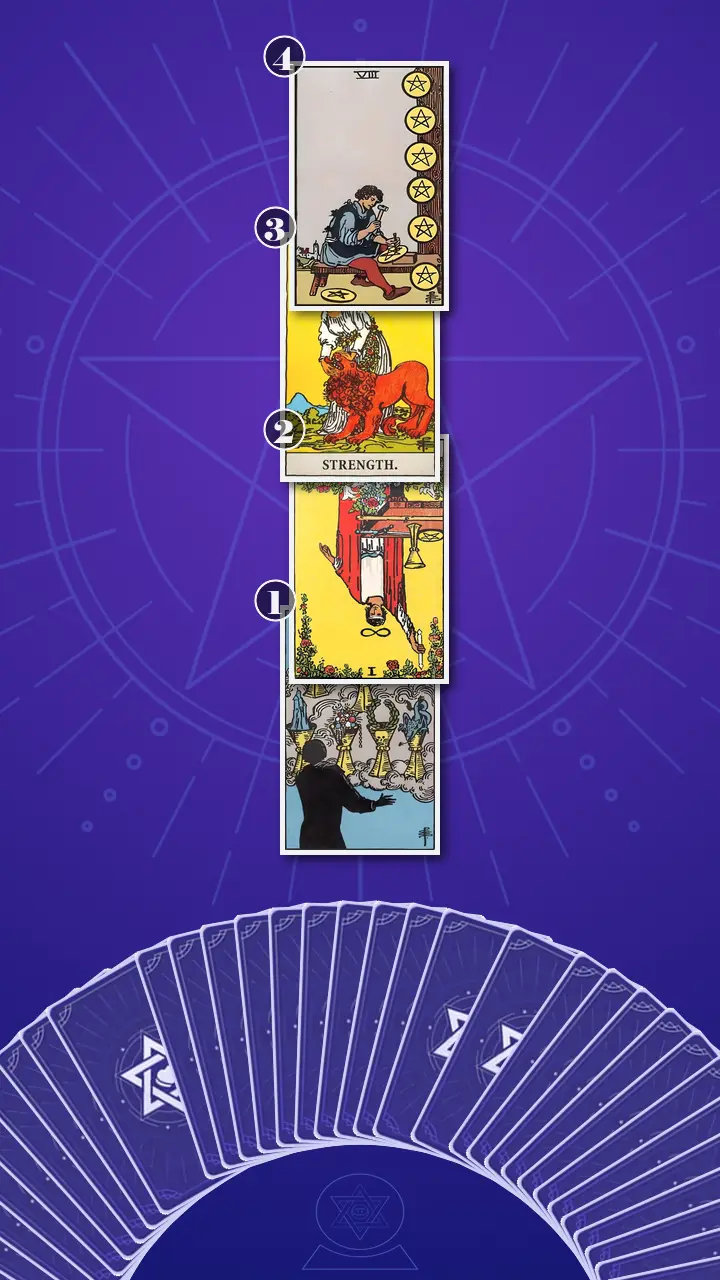
Seven Glowing Promises, One Untouched Plan
Position 1: The Advice Loop in Plain Sight
I turned over the card representing the visible pattern of saving advice, starting systems, and replacing them before enough repetitions had been completed to evaluate the chosen change.
It was the Seven of Cups, upright.
On the card, a dark figure stands before seven cups floating in clouds. Some hold beautiful promises; others contain unsettling shapes. The figure can see every possibility but has not touched or tested any of them. I placed the card beside Maya’s phone, and the symbolism became almost literal.
“In your current life, these are seven glowing promises on a screen,” I said. “A new morning routine, a habit-stacking video, an aesthetic Notion dashboard, a focus podcast, a 30-day challenge, a career newsletter, and a recommended book. Each one offers a possible breakthrough before the previous choice has had time to produce evidence.”
The Seven of Cups carried an excess of emotionally charged possibility. The problem was not that every option was bad. The problem was that each remained vivid, urgent, and idealised because none had entered the less glamorous conditions of repeated use. An algorithmic feed could present seven possible new selves in seven minutes, while the five-minute routine in front of Maya stayed untouched.
“A method cannot become evidence while it is still only a possibility on your screen,” I said. “Which saved item supports the experiment you already chose, and which one is mainly offering the feeling of a fresh start?”
Maya let out a short laugh, but there was no amusement in it. She looked away from the card and pressed her tongue against the inside of her cheek.
“That’s so accurate it feels a bit brutal,” she said. “I literally have all seven of those saved.”
I did not rush to soften the card into meaninglessness. I softened the judgment instead.
“The card is not accusing you of being gullible or lazy,” I said. “It is showing why the options retain so much emotional power. They have not failed because they have not been tested. That means you do not need to condemn your curiosity. You need a better sequence for it.”
Position 2: The Fully Stocked Table
I turned over the card representing the root mechanism beneath the loop: the belief that another expert method was safer than generating imperfect personal evidence with the tools Maya already had.
It was The Magician, reversed.
Even upside down, the Magician’s table was fully supplied. The four suit tools were present. The potential was present. What had become blocked was the direction of will through those resources. I saw this as a blockage of agency, not a deficiency of ability.
“You already have the table,” I told Maya. “You have a calendar block, a habit tracker, a phone timer, a workable five-minute action, and enough knowledge to start. The reversed Magician appears when you search for another expert’s arrangement of those tools because using them in your own way would expose the result to uncertainty.”
I brought her back to a familiar workday. At 8:55 a.m., she could have the Figma file open, a clear adjustment ready, and a calendar block protecting the work. Then a creator’s workflow would appear, the coffee would go cold, and the dashboard would become easier to refine than the design itself.
“Complete this sentence without trying to make it sound reasonable,” I said. “If I use what I already have and the result still feels ordinary, then...”
Her fingers stopped rubbing the phone case. For several seconds, she stared at the Magician’s overturned wand.
“Then there’s no system to blame,” she said. “It’s just me. And maybe I’m the person who can’t follow through.”
That was the exposed place beneath the optimisation loop. Slow results had stopped being neutral information. They had become evidence in a private case against her worth. Another expert framework did more than promise efficiency; it postponed the moment when the outcome might feel personally attributable.
My artist’s mind flashed to an editing timeline crowded with beautiful unused takes. I knew the temptation to keep collecting footage because choosing one imperfect frame would make the film real. But no tutorial could authorise the final cut. Eventually, the hand at the keyboard had to decide what belonged in the scene.
“The missing resource may not be another idea,” I said. “It may be contact with the tool already in your hand.”
Maya’s shoulders lowered, then rose again. I could see recognition arriving alongside the fear of losing a familiar protection.
“So I should delete all the apps?” she asked.
“No,” I said. “That would turn independence into another extreme system. Advice is useful when it enters at a deliberate review point. The issue is not whether you listen to experts. It is whether every expert gets permission to interrupt an experiment before your own experience has a chance to speak.”
When Strength Put a Hand on the Lion
Position 3: The Ten Minutes That Change the Plot
The rain outside Maya’s window thinned until I could hear individual drops rather than a constant wash. Even the radiator seemed to pause. I turned over the card representing the inner capacity that could interrupt the search-and-switch cycle by helping her tolerate uncertainty, novelty cravings, and the ordinary middle of practice.
It was Strength, upright, the key card and bridge of the reading.
I pointed to the woman’s gentle hands resting at the lion’s jaws. She was not wrestling the animal to the ground. The lion remained vivid, powerful, and present. Her strength came from meeting that energy without either obeying it or declaring war on it.
“This is the lunch-break moment when a new productivity video appears,” I said. “Your hand reaches for it. Your jaw tightens, your chest becomes keyed up, and your mind says the recommendation might contain the answer you cannot afford to miss. Strength does not demand that you stop feeling that pull. It asks whether the urge can be here, and you can still complete five minutes of the routine already chosen.”
Strength showed the novelty impulse in balance. The appetite for new information was neither shamed nor allowed to direct the next minute automatically. Its contained fire could become curiosity at the review point rather than disruption in the middle of practice.
At this point, I used what I call Narrative Fork Analysis. I asked Maya to imagine that her next ten minutes could be filmed as two competing plotlines.
In the first plotline, the careful researcher opens the reel, compares its method, redesigns the tracker, and receives another bright but temporary beginning. It looks sensible because it is full of information. Yet I recognised the deeper pattern as Safe-Choice Sabotage: the logical-looking option is protecting the protagonist from the inciting incident she actually needs, which is completing an ordinary repetition and allowing the result to be imperfect.
In the second plotline, the practitioner saves the link, lets the restless hand and tight jaw remain, and gives the chosen routine five minutes. That plotline feels less impressive because no dramatic transformation occurs. It serves her growth more honestly because it creates something the first plotline cannot provide: lived evidence.
“Which scene moves your character forward?” I asked. “Not which one makes her look informed. Which one gives her new information about what she can actually do?”
I reflected the original scene back to her. At 11:40 p.m., her habit app and three saved videos were open, and her thumb was already building a new template. Motivation was present. What she was avoiding was the exposed, ordinary middle where evidence is made.
“The urge for more advice does not need to disappear before you repeat the change you already chose,” I said. “You can let the next repetition be information, not a verdict on your worth.”
You do not need to overpower your restless search for certainty; meet it with a steady hand, as the woman meets the lion, and complete the next small repetition.
For one full beat, I saw Maya’s breath stop. Her fingers, halfway to turning her phone face down, hung above the duvet. Then her gaze slipped past the card towards the rain-dark window, and I watched recognition move through her in three stages: first the physical stillness, then the unfocused look of someone replaying Thursday’s lunch break, then a sudden crease between her brows as the emotional meaning landed.
“But doesn’t that mean I’ve been doing this wrong for years?” she said, her voice sharper than before. “Like I’ve wasted all that time?”
I let the question have room. “It means the strategy protected you from results that felt exposing,” I said. “It also means you can thank it for trying and choose a different strategy now. A protection becoming unnecessary does not make your earlier self foolish.”
Her hand closed once and slowly opened. Her shoulders sank; her eyes grew wet without spilling over. Then she released a low breath that sounded almost like a laugh.
“Oh,” she said. “I don’t have to trust one routine forever. I only have to stay long enough to learn.”
The relief was visible, but it came with a slight disorientation. Once the search was no longer responsible for saving her, the next choice belonged to her. I could see how freedom and responsibility had arrived in the same breath.
“Now, using this new perspective, think back to last week,” I invited her. “Was there a moment when this insight could have changed how you felt?”
She recalled a Wednesday evening at the kitchen table. A video had promised a more efficient creative routine just as her portfolio work became awkward. She watched it while reheating dinner, felt better for twenty minutes, and then realised the evening had gone.
“I thought the relief meant I’d found something useful,” she said. “Maybe it only meant I’d escaped the uncomfortable bit.”
“That distinction is your first piece of evidence,” I replied.
I gave Strength a practical container. The next time a recommendation appeared, Maya could put it on a Later list, set a ten-minute timer, notice one signal in her jaw, hand, shoulders, or chest, and complete only the minimum version of her chosen change. Afterward, she could record one observable fact. If the pause became too activating, she could stop, return to a neutral task, and decide later whether to revisit it. The exercise remained hers to adjust or end.
This was the reading’s central emotional shift: from restless comparison and outsourced agency towards cautious, evidence-based self-trust. Not total confidence. Not permanent certainty. Just the first grounded experience of letting an urge exist without handing it the director’s chair.
Position 4: Eight Repetitions Make Evidence
I turned over the card representing the action and integration layer: a minimum repeatable behaviour, a defined experiment period, and a review process based on what Maya had actually done rather than what a new recommendation promised.
It was the Eight of Pentacles, upright.
A craftsperson sits at a workbench engraving one pentacle. Completed pieces remain visible in an ordered row. The distant town is still there, but it does not control the work taking place under the craftsperson’s hands.
“This is not a transformation montage,” I said. “It is the same small action completed and recorded often enough to reveal what it actually does. Each pentacle can be one dated repetition in a plain Apple Note, Google Sheet, or paper log.”
The Eight of Pentacles brought the reading into balanced, practical earth. Progress would no longer be measured by how inspired, informed, or optimised Maya felt. It would be measured by observable facts: completed five minutes, used the two-minute fallback, noticed resistance and began anyway, or missed the day and recorded it without rebuilding the system.
“Seven options can create hope; eight repetitions can create information,” I said. “You do not need a perfect ninth option. You need enough contact with one ordinary practice to discover what is true for you.”
I asked her to imagine a fourteen-day evidence window. The routine would stay small, new advice would wait on the Later list, and the review date would be booked in advance. At that point, she could open the saved material, examine her repetition log, and freely continue, adjust, pause, or stop.
Maya traced the row of pentacles with her eyes. “A review date makes it feel less like I’m closing every other door,” she said.
“Exactly. You are giving one open door enough time to show you what is behind it.”
The Fourteen-Day Evidence Window
I drew the four cards into one continuous storyline. The Seven of Cups showed Maya surrounded by emotionally convincing possibilities. The reversed Magician showed that she already had enough tools, but fear of unimpressive results kept returning authority to outside systems. Strength showed the capacity to hold the novelty impulse without attacking or obeying it. The Eight of Pentacles turned that capacity into a body of personal evidence.
In the film language that comes naturally to me, Maya had spent a long time watching trailers for possible lives. Each trailer was polished, fast, and full of promise. The blind spot was believing that choosing the right trailer was the central problem. Her actual growth arc required filming the quiet middle of one scene, even when the first takes looked ordinary.
The transformation direction was therefore clear: she did not need to move from advice to isolation, or from curiosity to rigid discipline. She needed to move from expert-dependent certainty to deliberate experimentation. Advice could remain an input, but her own repeated observations would become the primary evidence.
When I proposed a five-minute routine, Maya’s mouth tightened again.
“But some evenings I genuinely don’t have even five protected minutes,” she said. “My flatmate is cooking, work has run late, and by the time I brush my teeth I’m done.”
I adjusted the plan immediately. An experiment that ignored her real schedule would only manufacture another failure story. We gave the routine a two-minute fallback and anchored it after brushing her teeth, when no ideal workspace was required. A missed day would become data, not grounds for restarting on Monday.
I called the first move the Protagonist Pivot Action: one authentic micro-action taken within twenty-four hours, specifically in the plotline that felt more exposing than continued preparation. It was not a dramatic leap. It was the smallest piece of footage proving that the story had begun to move.
- Make the 24-hour Protagonist Pivot.Before the same time tomorrow, create one plain note that says: “For the next 14 days, I am testing one five-minute planning routine after I brush my teeth.” Define the minimum as opening tomorrow’s calendar, choosing the first task, and writing one sentence about when it will happen. On crowded shared-flat evenings, use the two-minute version.Do not decorate the note or build a dashboard. The pivot is completing the first repetition, not designing the perfect production system.
- Use the Ten-Minute Strength Pause.When a podcast, reel, newsletter, book, or template promises a better method, save its title and link to a Later list without opening it. Set a ten-minute timer, name one body signal and one feeling, then complete the minimum version of the current routine before deciding what deserves attention.Use the sentence: “The urge can be here, and I can still give the next minute to my experiment.” Stop the pause if it becomes too activating; you remain free to revisit the recommendation later.
- Review evidence before revising the plot.Book a calendar review exactly fourteen days from the first attempt. Keep a two-column log with the date and one observable fact after each repetition. At the review, ask: What did I repeat? What did I notice? What would I adjust? Open the Later list only after answering those questions.No redesign before the review unless the action is unsafe, impossible, or clearly incompatible with your schedule. One missed day is a data point, not a verdict or a command to start over.
I reminded Maya that tarot had not ordered her to keep an unsuitable routine for fourteen days. The evidence window was a voluntary boundary around one experiment. She could shorten it, adapt it for access needs, or end it. The purpose was to make her experience visible enough that her next decision belonged to her rather than to the loudest recommendation in her feed.

A Week Later, the Quiet Proof
Seven days later, I received a message from Maya. She had completed the routine five times, including two nights when she used the two-minute fallback. Eleven recommendations were sitting unopened on her Later list. Her log was not aesthetic. It contained lines such as “felt resistant but started” and “chose tomorrow’s task, then stopped.”
She had also noticed something the cards could never have dictated for her. On evenings when she chose the first work task in advance, she opened Figma with less circling the next morning. That result was modest, specific, and hers.
She told me she had slept through the sixth night, then woke with the thought, “What if this is still the wrong method?” The doubt remained, but she smiled, logged the thought, and waited for the review date.
That was the quiet proof of our Journey to Clarity. The cards did not make Maya consistent, and I did not hand her certainty. Maya changed what happened in the small space between a compelling promise and her next action. By doing so, she began moving from comparison-driven hope towards evidence-based self-trust and grounded confidence.
When a new method promises to finally make you consistent, your thumb may keep moving while your jaw tightens around the quieter fear that one imperfect path will expose you as not enough. If you can notice that moment without shaming it, you are no longer standing at the beginning of the same scene.
Before your next review date, what one small repetition could you treat as a frame of evidence rather than a verdict on the whole film, and what might you become curious enough to notice?