A Pinned Chat, Busy-Week Silence, and the One Clear Check-In

Finding Clarity in the 8:47 p.m. Scroll
If your phone is both your work device and your reassurance device, you already know how one quiet thread can hijack an entire commute home. When Maya (name changed for privacy) sat across from me, she did not begin with a grand love story. She began with a Tuesday night on Line 1 in Toronto.
It was 8:47 p.m., heading north. The train hummed under her feet, the fluorescent light kept flashing against the window, and her screen sat warm in her palm as she opened the same pinned chat between stops. Her shoulders were creeping toward her ears. Her thumb hovered over the send button as if one more breezy text might either save the rhythm or expose her completely.
‘I know they’re busy,’ she told me, looking almost annoyed at herself, ‘but why does it feel personal?’ Then the real dilemma came out. She wanted reassurance. She wanted steady contact. But she was afraid that if she pushed during their busy weeks, she would create pressure, look needy, or turn something natural into something strained. ‘I don’t want to be the person who pushes,’ she said. ‘But I also don’t want to disappear.’
I could feel the shape of the problem immediately. This was not just overthinking delayed replies in dating. This was that specific split-screen state modern city daters know so well: half of you trying to be reasonable, half of you standing over the phone like it is a lie detector for your worth. The anxiety had a body in it. She described a tight chest, a buzzing stomach, and the strange little ache of keeping herself from checking again while mentally checking anyway. It sounded like trying to breathe while someone had tucked a wool scarf just inside the ribs.
I nodded and let the room stay gentle. ‘That makes sense to me,’ I said. ‘You’re not silly, and you’re not too much. Your system is trying to solve uncertainty by getting closer to the screen. Let’s not shame that. Let’s just map it. Today, our journey is simply this: finding clarity without turning panic into your communication style.’

Choosing the Compass: A Decision Cross Tarot Spread for Texting Ambiguity
I asked Maya to put both hands around her mug for a moment and take one slower breath than felt natural. Then I shuffled the cards slowly. Not for theatre. Not for mystery. Just to give the nervous system a clean threshold between spiraling and noticing.
For this question, I chose a Decision Cross tarot spread for texting ambiguity and busy-week relationship pacing. I like this spread when someone is caught between two responses—should I send a follow-up text or give it space—because it keeps the reading practical. It does not waste time pretending tarot should predict the other person’s next move. Instead, it shows the symptom, compares the two available paths, reveals the hidden driver underneath both, and then grounds everything in the healthiest next step.
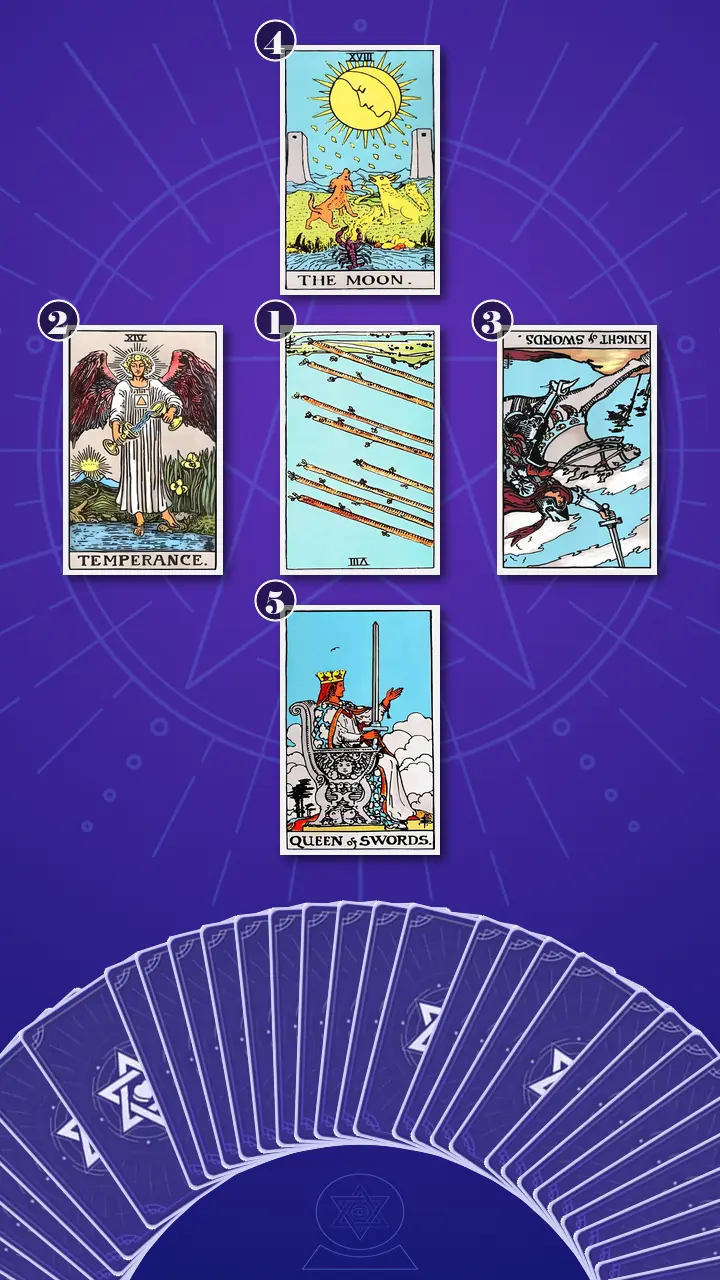
I explained the structure plainly. The center card would show the current communication slowdown and the behavioral loop it triggered. The left card would show what ‘give it space’ actually meant in a grounded sense. The right card would show what the ‘push’ impulse tended to activate. The top card would expose the unseen emotional factor making slow replies feel so loaded. And the bottom card—the bridge card, the one I was most interested in—would offer an integrated, self-respecting response.
For anyone who has ever wondered how tarot works with texting anxiety and relationship overthinking, this is one of its clearest gifts: it turns a foggy, fast-moving feeling into a structure you can actually look at.
Reading the Junction Where Busy Weeks Start to Feel Personal
The Thread That Lost Its Rhythm
I turned the first card and placed my finger lightly on the center of the cross. ‘Now we’re looking at the position that presents the current communication slowdown and the specific loop it creates—checking, rereading, second-guessing, trying to get the thread moving again.’
The card was the Eight of Wands, reversed.
I told Maya this was almost painfully literal. A thread that used to move easily during the weekend suddenly loses rhythm once the workweek hits, and she starts reopening the chat on the hour, checking between TTC stops, rereading the last exchange, and feeling she has to restart momentum before it dies. In tarot, the upright Eight of Wands is fast movement, quick messages, clear forward motion. Reversed, that fire is blocked. The motion is still there, but it has nowhere clean to land. So it turns inward as agitation.
‘This is the moment,’ I said, ‘when the gap starts feeling louder than the connection itself.’ I described the whole loop back to her: the pinned chat, the reread punctuation, the quick glance at Instagram Stories active status, the body jolt when there is no typing bubble. Maybe they’re slammed, she thinks. But what if this is the fade? That is the exact place where reassurance and self-protection start wrestling each other.
She let out a tight, involuntary laugh and shook her head. ‘That’s literally me,’ she said. ‘Like… annoyingly exactly me.’ Her mouth smiled, but there was a wince in it too. That little bitter laugh told me the card had landed where it needed to. The phone had become, as I put it to her, like staring at a stock ticker for your worth. And the problem with that is simple: it never gives a final answer.
Space Is a Pace, Not a Disappearance
I moved to the card on the left. ‘This position shows what the give-it-space path actually asks of you here. Not silent testing. Not self-erasure. Real pacing.’
The card was Temperance, upright.
Temperance was exactly the medicine I hoped to see in this place. One foot in water, one on land, cups pouring steadily between the hands—emotion and reality in conversation with each other. I translated it into her life immediately: Sunday brunch energy and Monday workday energy are not the same ecosystem. A warm weekend of easy contact does not mean Tuesday must behave the same way. Giving space, here, is not pretending not to care. It is letting the connection breathe without forcing the week to perform like the weekend.
This is where one of my own old lenses rose naturally to the surface: what I call Seasonal Energy Diagnostics. I told Maya that a great deal of modern dating panic comes from trying to force a spring harvest during a winter phase. Busy weeks often are winterish. Slower. Less visibly lush. That does not mean the field is dead. It means the pace has changed. Seeing Temperance, I had one of those quick inward flashes I still get from my Highland roots: a February field can look empty to an impatient eye, and still be doing exactly what life requires beneath the frost.
‘Space is a pace, not a disappearance,’ I said. ‘The real question is whether your pause is grounded in self-trust, or whether it’s secretly a test designed to make them prove something.’
Her whole face softened at that. ‘Oh,’ she said quietly. ‘That’s different.’ I watched her shoulders drop a fraction. Relief, in readings like this, often arrives not as joy but as less internal bracing.
When Urgency Puts on a Casual Outfit
I touched the card on the right. ‘This position shows what the push path tends to activate—especially the part of you that wants certainty before enough information exists.’
The card was the Knight of Swords, reversed.
I smiled a little when I saw it, not because it was funny, but because it was so precise. This is the notes-app draft scene. One follow-up written three ways: warm, cooler, then slightly sharp so you do not sound too invested. It is the message that says, ‘Just checking in,’ while carrying the full weight of an activated nervous system inside it. Upright, this knight has clarity and momentum. Reversed, the air element tips into excess. Thought outruns attunement. Speed dresses itself up as honesty.
‘This is the part,’ I told her, ‘that says: I just need to clear the air. But what it often means is: I need this feeling to stop.’ That is not shameful. It is human. But it does matter. Because a fast follow-up sent at peak adrenaline can turn a normal busy stretch into a pressure test. Urgency starts performing as logic. And then the message is no longer just contact; it becomes emotional crowd-control.
I asked her the simplest version of the question: ‘What exact truth are you hoping one more text can realistically give you?’
She gave me the kind of smile that arrives with a cringe inside it. ‘I have sent that exact text,’ she admitted. ‘More than once.’
‘Of course,’ I said. ‘Many people have. But do not let panic write the follow-up. Adrenaline is not the same thing as directness.’
The Low-Information Maze
I lifted my hand to the top card. ‘Now we come to the unseen factor—the hidden driver behind both options. This is the card that shows what slower replies start to say about your worth or your place in the connection, even when you do not yet have the full story.’
The card was The Moon, upright.
The room changed a little when this one appeared. The kettle had gone silent. Even the light from the window looked softer, as though the card had brought its own weather with it. I told Maya that The Moon rules low-information territory: partial signals, projection, instinct waking up before discernment has had a chance to sit down. In her daily life, this is seeing they were active online but not replying, and feeling her mind fill the empty space with meanings faster than reality can.
‘This,’ I said, ‘is what happens when your brain auto-fills the missing messages the way a search bar auto-fills a phrase. You do not actually know, but your mind is acting like it knows.’
I described it the way it often feels in modern life: walking home after dark with one AirPod in, when every shadow begins to look more meaningful than it is. The Moon is not fake intuition. It is the moment fear starts writing the story before the facts arrive. A slow reply is not a full story. But if an old belonging fear is already awake, the silence can start feeling like evidence that you matter less than you hoped.
Maya went very still. First her breath paused. Then her eyes lost focus for a beat, as if she were replaying a workday afternoon where the whole spiral had started. When she spoke, her voice was slower. ‘So it’s not just that I hate uncertainty,’ she said. ‘It’s that I make uncertainty mean something about me.’
‘Exactly,’ I said. ‘That is the turning point. The stressful part is not only the delay. It is the meaning your mind is forcing into it.’
When the Queen of Swords Broke the Spell
One Clean Sentence Over a Spiral of Guesses
I turned to the bottom card, the grounding answer beneath the whole cross, and I could feel the reading gather itself. This was the bridge card—the one that would decide whether Maya left with a theory or with a practice.
The card was the Queen of Swords, upright.
I looked at Maya for a moment before I spoke. I wanted the pacing right. She was sitting in that familiar weekday moment already: the chat pinned, the thumb hovering, the mind running its two-beat loop—if I say nothing, I vanish; if I say too much, I ruin it.
Stop treating the unread thread like a verdict, and lift the Queen's sword by choosing one clean sentence over a spiral of guesses.
You do not need to choose between disappearing and chasing; one clear sentence tells the truth faster than a hundred private theories.
Her first reaction was not relief. It was resistance. Her jaw tightened and she looked down at the edge of her phone case. ‘But if I do that,’ she said, ‘doesn’t that mean I’ve been reading all of this wrong? Doesn’t it make me the one who cares more?’
‘No,’ I said, gently and very clearly. ‘It means you stop letting artificial timing decide your worth.’ This is another of my old tools, and I named it for her: Social Clock Decoupling. Read receipts, active status, weekday reply speed, the strange social mythology that says the calmer person is the more valuable person—none of that is a sacred clock. It is just a clock. The Queen of Swords cuts self-respect free from those timelines. Clarity is not the same thing as chasing. Silence is not dignity by default.
Then I watched the insight move through her in layers. First came the physiological freeze: her breath caught and her thumb stopped rubbing the phone case. Then came the cognitive seep-in: her gaze drifted past me to the rain threading down the window, like she was replaying a dozen TTC rides and office lunch breaks with new subtitles. Then came the release: her shoulders lowered, her lips parted, and a long exhale left her body with almost a tremor in it. She gave a tiny nod, then blinked twice, as if clarity itself had a little weight to it. ‘So I don’t have to be chill or chaotic,’ she said softly. ‘I can just be clear.’
‘Exactly,’ I said. ‘Now, with that lens, think back to last week. Was there a moment when this would have changed how you felt?’
She closed her eyes for a second. ‘Monday night,’ she said. ‘If I’d thought of the silence as incomplete data instead of proof, I wouldn’t have spent two hours drafting a cute text and asking my friends what the period meant.’
That was the crossing point of the whole reading: from panic-driven decoding of delayed texts to calm, self-respecting clarity about what a slower reply does and does not mean. Not certainty. Something better. Discernment.
The One-Sentence Reset: Actionable Next Steps
I drew the cards together for her in one simple story. The center of the spread showed blocked momentum: once the texting rhythm dipped, Maya’s attention got pulled into monitoring rather than relating. The hidden driver above it was The Moon: reduced availability was being interpreted as reduced care, and ambiguity was getting translated into rejection before the facts were clear. On the left, Temperance showed that healthy space is regulated pacing, not self-abandonment. On the right, the reversed Knight of Swords showed how urgent follow-up texting creates a flash of relief but rarely creates real clarity. And at the base, the Queen of Swords offered the integrated answer: one direct, boundary-respecting message, then enough space to let the pattern speak for itself.
I told Maya that her blind spot was not neediness. It was using speed as proof. She had been treating message tempo like an emotional algorithm: fast means safe, slow means danger. But people are not apps, and belonging cannot be measured by weekday cadence alone. The transformation direction was beautifully plain—stop treating delayed texts as proof of disinterest, treat them as incomplete data, and respond from self-respect rather than from panic.
- Facts / Story / Need PauseBefore sending any follow-up during a busy-week gap, open a note titled ‘Facts / Story / Need.’ Under Facts, write only what happened: for example, ‘last reply was Monday at 2:14 p.m.’ Under Story, write the fear version: ‘they’re losing interest.’ Under Need, write the actual next step: ‘I want to know whether we’re still on for Friday.’ Do it on the TTC platform, in the lift, or at your kitchen counter before you unlock the chat.If the Story line makes your body rev up, stop after one sentence. The point is not to become perfectly calm. The point is to stop imagination presenting itself as evidence.
- The One-Sentence ResetIf you genuinely need information, draft one warm, direct check-in about plans or availability: ‘Hey, no rush if your week is packed, but would you still want to grab a drink this weekend?’ Send one sentence. Not a paragraph. Not strategic coolness. Not a disguised protest.Write it in your Notes app first, wait 30 minutes, then send it only if it still feels clear rather than urgent. After sending, mute the chat for 30 minutes and do one off-screen task before checking again.
- A Mini Winter Dormancy RitualFor one evening—or one full workweek if you’re ready—do not send a second message unless it contains a concrete question, plan, or update. Move the chat out of your pinned section and place your phone face down for 20 minutes. Let your nervous system learn that not acting is not the same as losing.This is not silent treatment and not a dating game. It is a grounded reset: enough winter to tell panic from information, and enough space to let organic momentum show itself.

A Week Later, the Thread Was Still Not a Verdict
Four days later, Maya sent me a message of her own. She had done exactly what the Queen asked of her. She wrote the check-in in her Notes app first, waited half an hour, and then sent: ‘Hey, no rush if your week is packed, but would you still want to grab a drink this weekend?’ Afterward, she muted the chat and walked through the grocery store without checking her phone every aisle.
She told me something even more important than whether a reply arrived. ‘I still woke up the next morning with that first thought—what if I got it wrong?’ she wrote. ‘But this time I made coffee before I checked my phone.’ That is the kind of proof I trust. Clear, small, real. She had not solved her whole attachment history by Thursday. She had simply stepped out of the spiral long enough to hear herself again.
That is what tarot is at its best. Not a machine for predictions. A mirror. A way of seeing the pattern clearly enough that you can put your own hands back on the wheel. The cards did not make Maya more worthy, more lovable, or more chosen. They helped her stop outsourcing those questions to a typing bubble.
When a chat goes quiet, a lot of us are not just waiting for a text; we are sitting with that tight-chested moment where wanting closeness and fearing we asked for too much hit at the exact same time.
If the next unread thread felt less like a verdict and more like incomplete data, what one clear, low-pressure Queen-of-Swords sentence might you want to ask for next?