The Insight-Action Gap: Three Rough Sentences Instead of Another Tab

The 8:47 p.m. Insight-Action Gap
I know the familiar insight-action gap: someone finishes a podcast, book, or journaling session with the exact explanation for a pattern, then opens another research tab before touching the application, message, or draft already waiting.
Jordan (name changed for privacy), a 28-year-old UX writer in Toronto, brought me one precise snapshot. At 8:47 on a Tuesday night, they were riding Line 1 north from work, scrolling through an Apple Note titled Things I Finally Understand. Fluorescent lights buzzed above them, the phone felt warm in their palm, and the train brakes shrieked at each station as they opened a saved article about taking action instead of opening the portfolio draft waiting at home.
“I understand the pattern,” Jordan told me when we met by video. Their shoulders were nearly level with their ears, and two fingers pressed against the centre of their chest. “So why am I still standing outside it? If I already know what to do, what does it say about me that I’m still not doing it?”
What Jordan called frustration had the texture of pushing on a door marked pull while everyone else seemed to be walking through. Their chest tightened whenever an idea became a concrete task; their hands, quick enough to build a twelve-step Notion checklist, became strangely heavy over the first blank line.
I told them, “Nothing about this makes you lazy or defective. Understanding the pattern can feel like progress while quietly becoming a substitute for practice. That is a loop we can examine without turning it into your identity.”
After a decade of reading cycles, I have learned not to mistake a recurring orbit for a permanent fate. Sometimes a person is not missing intelligence, discipline, or one final piece of advice. Sometimes I simply need to help them locate the exact point where their momentum is being redirected.
“Let’s make a map of that point,” I said. “Not a prediction, and not a verdict. Our Journey to Clarity is to understand why the pause protects you, then find one movement small enough to remain yours.”
Choosing a Map for the Closed Orbit
I asked Jordan to put both feet on the floor, let one breath leave without forcing the next one deeper, and hold the question in plain language: Why do I keep repeating the gap between insight and action? I shuffled slowly, using the pause as a transition from explaining the problem to observing it.
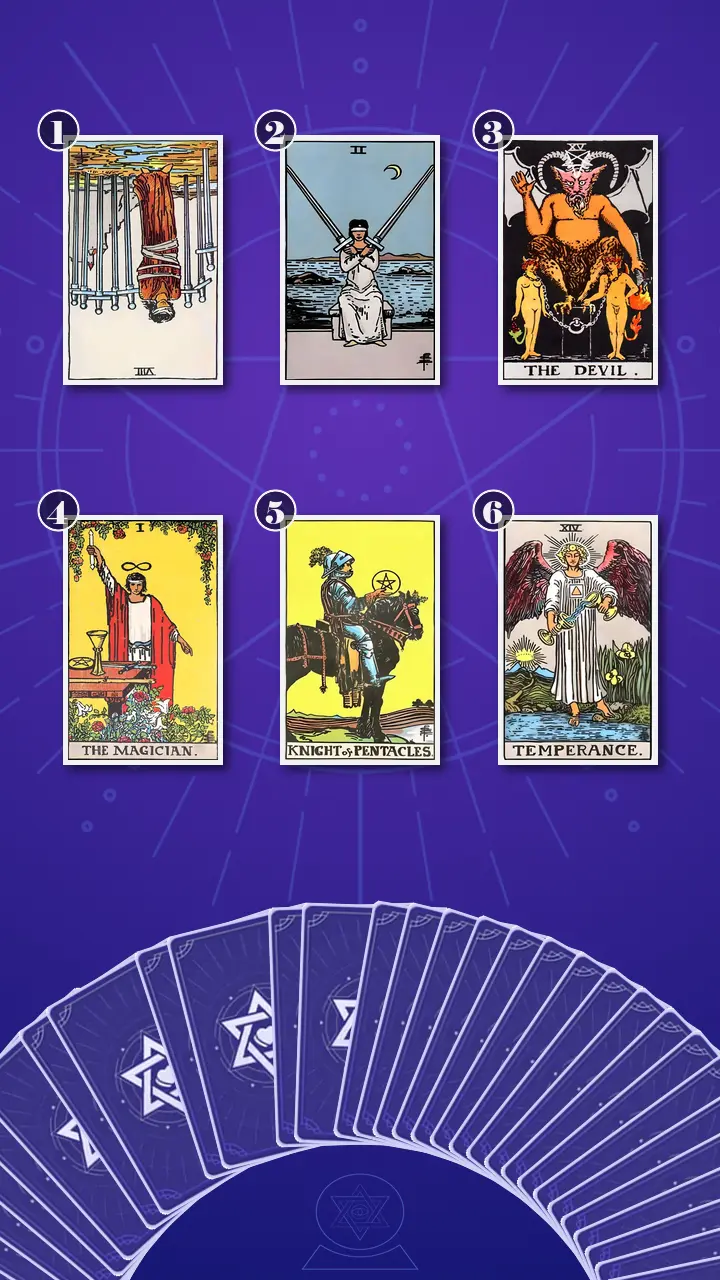
I chose the Transformation Path Grid · Context Edition, an original six-card tarot spread arranged in a two-by-three grid. This is how I use tarot: not as an authority that announces what must happen, but as a structured visual language that places an internal system on the table where we can inspect it together.
A broad Celtic Cross would have produced more context than Jordan’s question needed. A decision spread would have assumed they were stuck between two external choices. I needed a tighter structure for a self-reinforcing loop: present symptom, immediate blockage, underlying fear, transformative trigger, practical action, and integration.
I laid the first three cards across the upper row as the diagnostic sequence. The first would show the recurring symptom; the second, the threshold where insight became delay; the third, the hidden payoff that kept the delay attractive. Beneath them, the fourth card would act as the hinge, followed by a repeatable action and a form of self-trust built through practice rather than prediction.
Visually, the spread resembled a staircase leaving a compressed mental room and arriving at a workbench. I wanted Jordan to see from the beginning that the cards were not asking for a personality transplant. They were helping us find where one available hand could reach one available tool.
Reading the Closed Orbit
Position 1: The Notes App That Became a Waiting Room
I turned over the card representing Jordan’s present state and recurring symptom: the observable loop of finding an insight, planning the first step, and then postponing or abandoning the action. It was the Eight of Swords, reversed.
I pointed to the blindfolded figure, the bound hands, and the surrounding swords. In Jordan’s modern life, those swords looked less like dramatic imprisonment and more like beautifully phrased explanations. The blindfold was the research tab opened before the task. The bound hands were the heaviness over the keyboard. The enclosure was a notes archive that could describe the exit without requiring anyone to walk through it.
“Reversed, this card tells me the restriction is becoming visible,” I said. “You can identify the pattern, name the smallest step, and notice that the boundary is not absolute. But the energy of release is still blocked at the threshold. Awareness has loosened the knot; it has not yet moved your hands.”
I connected it directly to Jordan’s Monday mornings near King West: the UX copy document open, the cursor blinking beside an empty heading, Slack flickering in the corner. Instead of drafting three imperfect lines, they renamed the task from Draft onboarding empty state to Define the perfect onboarding voice framework and searched for another team’s process.
“The unfinished step is not evidence that you need a better identity,” I told them. “It is information you have not gathered yet. If more insight stopped being a prerequisite, what ten-minute action would become possible?”
Jordan did not nod. They gave one short laugh, dry enough to catch in their throat. “That’s so accurate it’s almost rude.”
I smiled, but I did not rush to soften the recognition. “Accuracy is not an accusation. The card is showing a sequence you learned, not a sentence you have to serve. We can respect what the sequence has been protecting before we ask you to change it.”
Position 2: Two Reasonable Tabs and No First Sentence
I turned over the card representing the immediate blockage: the moment when insight becomes a reason to wait because action seems to require more preparation or complete readiness. It was the Two of Swords, upright.
The figure held two crossed swords over their chest while still water sat behind them. I translated the image into the scene Jordan knew: two browser tabs open, one for drafting a rough portfolio case study and one for researching stronger case-study structures. Both options were reasonable. Keeping both open meant neither had to produce an imperfect result.
“This is suspended air,” I explained. “Thought is not deficient here; it is over-employed. Comparison keeps the decision protected from contact with reality. The still water preserves short-term equilibrium, but it also shows the cost: an entire Sunday evening can disappear without anything technically going wrong.”
I offered the sentence I heard underneath the crossed blades: “I’m not avoiding it. I’m making sure I choose correctly.”
Jordan’s inhale stopped halfway. Their shoulders lifted another fraction, their eyes moved away from the cards as if replaying the kettle clicking off beside two competing Notion plans, and then their jaw released with a quiet, unwilling “Yeah.”
“So let’s not demand certainty,” I said. “What decision could become smaller? Not Should I draft or research? Try Can I write three rough sentences before deciding whether research is necessary? A smaller choice is still a real choice.”
Position 3: The Subscription to One More Explanation
I turned over the card representing the underlying root: the fear that action might reveal insight was not enough and that control was never guaranteed. It was The Devil, upright.
I always handle this card without theatre. I do not read it as evil, doom, or an outside force taking command. I read attachment, repetition, and the bargains people keep because those bargains offer something useful in the short term.
The loose chains around the figures mattered most. Jordan’s version was saving another podcast about procrastination while the real document remained closed. For five minutes, the pressure dropped. As long as the task stayed theoretical, no rough draft could expose the limits of the plan, and control could remain one explanation away.
“The pattern persists because it pays you immediately,” I said. “Not in progress, but in relief. The preparation gives you less exposure now. By the end of the week, it charges you with the same unfinished task, plus shame about meeting it again.”
This was where I used my Gravity Well Identification lens. I told Jordan that the gravity well was not research itself, Apple Notes, Notion, or thoughtful reflection. Those were neutral tools. The obsolete habit was the automatic sequence in which meaningful exposure triggered more input. Like an algorithm trained on the wrong engagement signal, it kept serving another explanation because every click briefly reduced discomfort.
“Your system has learned that relief means safety,” I said. “But relief is not always direction. The gravity well begins at the instant the task becomes testable and your hand moves toward a new tab.”
Jordan looked down for several seconds and rubbed their thumb over the seam of their mug. “If I keep explaining it,” they said quietly, “I can keep believing control is just one insight away. And no one gets to tell me the draft is mediocre.”
“Exactly,” I said. “That is not weakness. It is a protective bargain with a recurring fee. What does the pause give you in the next five minutes, and what does it cost by Friday?”
Jordan answered without looking up. “Five minutes where I still get to be potentially good. Then four days where I feel like I can’t trust myself.”
When the Magician Put Hands on the Map
Position 4: The Deliberate Burn That Changes the Orbit
The room seemed to become quieter as I reached the card representing the transformative trigger: the smallest shift capable of turning one existing insight into one concrete experiment. Through Jordan’s open window, I heard a distant streetcar bell, a clean note of movement against the radiator’s dull ticking. I turned the card over. It was The Magician, upright.
I brought the card closer to the camera. One hand pointed upward, one downward. On the table waited a wand, cup, sword, and pentacle—not imaginary resources promised for later, but tools already present. I read the energy as coordinated agency: initiation, emotional willingness, a clear decision, and material contact working together instead of waiting for one another to become perfect.
For Jordan, the modern scene was deliberately ordinary. One old journal insight went onto a sticky note. One verb-led action went beside it. The existing Google Doc opened. A ten-minute timer started before Slack, email, social media, or another productivity article. The first rough line appeared while their hands were still tense.
I used my Cognitive Spiral Mapping framework to show Jordan why returning to the same insight did not have to mean they had learned nothing. I marked each pass around the loop and located the exact point where momentum changed direction: not during the realization, but in the two seconds after the task became visible and personally testable. Feeling stuck can sometimes be the long arc of an orbital slingshot, gathering enough awareness for a precise change of direction—but awareness only changes the orbit when it is paired with a deliberate burn. The Magician was that burn.
Insight is not a finish line. It is a starting instruction.
I watched Jordan glance toward the phone that still held the Apple Note from the train. The old equation was visible in the pause: if the attempt went badly, every careful realization might feel counterfeit; if they kept preparing, control could remain theoretically intact.
You do not need more insight to earn movement; place the insight beside the Magician's four tools and make one deliberate move.
I let the sentence remain between us.
Jordan’s breath stopped first. Their right hand, which had been rubbing the mug’s edge, froze with the index finger suspended. Their pupils widened slightly, then their gaze slipped past the screen as if the Line 1 ride, the blank Figma frame, and every task moved to next Monday were replaying in fast cuts. A flush rose across their cheeks. “But doesn’t that mean I’ve been doing it wrong this whole time?” they asked, sharper than before. I heard anger protecting a sudden tenderness. “No,” I said. “It means explanation protected you until its cost became greater than its usefulness. We are not putting your past on trial.” Their eyes reddened at the rims. The fingers around the mug loosened one by one; their shoulders dropped, followed by a long breath that seemed to leave from somewhere below the ribs. Relief arrived, but so did the slight dizziness of responsibility: if readiness was not the gate, they could choose a small move—and choice felt more vulnerable than another theory.
“Now, with this new perspective, think back: was there a moment last week when this insight might have made you feel different?” I asked.
Jordan was quiet before answering. “Monday, at the blank onboarding file. I thought the first line would prove whether I was actually good at this. I could have treated it as a test of the copy instead of a test of me. I could have written one bad line.”
“That is the bridge,” I said. “A small action does not judge the insight. It gives the insight new information.”
To make the shift physical, I asked Jordan to take one existing insight out of their phone and write it on paper. Beneath it, I asked for one verb and one object: draft three lines. I asked them to use the existing document, set a ten-minute timer before opening any new input, stop when the timer ended, and record one sentence about what doing had clarified. If ten minutes felt too exposing, two minutes and the correct file would count. Continuing would remain their choice.
This was the first meaningful crossing in the reading: from frustrated hyper-analysis and shame about delayed action toward agency built through one small, time-bound experiment. It was not certainty. It was contact.
Position 5: The Knight Who Refused the Productivity Montage
I turned over the card representing the practical action: the low-stakes behaviour Jordan could attempt within one week. It was the Knight of Pentacles, upright.
The horse stood still. The Knight held one pentacle carefully in front of a cultivated field. I told Jordan this was not the kind of progress that makes a dramatic LinkedIn post or a three-minute productivity montage. The card’s earth energy was steady and balanced: one defined piece of work, at a realistic time, repeated without evaluating an entire career first.
In Jordan’s life, it looked like putting the phone away, opening the same visible task, setting a modest time boundary, and completing one piece before expanding the plan. The pentacle was not a future system for becoming consistent. It was the three sentences actually written.
“The Magician starts,” I said. “The Knight returns. If you turn this into a heroic daily routine, you may recreate the same loop at a larger scale. Keep it small enough to survive a normal Toronto workday, a late train, a Slack-heavy morning, and an average amount of motivation.”
Jordan gave me a wary half-smile. “What if I don’t even have ten clean minutes before Slack starts?”
“Then we remove the fantasy of clean time,” I replied. “Two minutes. Open the correct file and write one sentence before checking the first message. Success means making contact with the task, not completing the portfolio or proving you have become a different person.”
Their hand moved toward a pen, not the phone. It was a tiny change in sequence, but that was precisely the point.
Position 6: Two Cups, One Feedback Loop
I turned over the final card, representing integration: the capacity available when repeated action reshapes Jordan’s relationship with insight without predicting an external outcome. It was Temperance, upright.
The angel poured between two cups, with one foot on land and one in water. I read this as balanced exchange rather than compromise for its own sake. Reflection did not need to disappear. It needed to happen after contact with reality as well as before it.
In a modern work session, the two cups became one small attempt and one brief review. Jordan would write three imperfect lines, then answer only two questions: What happened when I began? and What is the next small adjustment? The review would end there, before it grew into another dashboard, template, or complete theory of personal change.
“Your reflection is not the enemy,” I said. “The blockage appears when reflection demands certainty before action. Temperance restores the flow: act, notice, adjust, and choose again. One foot remains in thought and feeling; the other stays on the material ground of what you actually tried.”
I pointed to the path leading toward the distant mountains. “This card gives direction, not a guaranteed destination. Self-trust is built from evidence gathered after imperfect beginnings. You do not have to feel fully ready to collect the first honest piece of evidence.”
Jordan looked across the whole grid, from the covered eyes and crossed swords to the open table, steady pentacle, and moving water. Their face was softer, but not transformed into effortless confidence. “I think I’ve been trying to reflect my way into trust,” they said. “Maybe trust needs something to reflect on.”
“Yes,” I answered. “That is Temperance in context.”
The Ten-Minute Escape Velocity
I gathered the six cards into one causal story. The Eight of Swords showed that Jordan could already see the mental enclosure. The Two of Swords revealed the precise freeze: two reasonable options held open so neither had to become visible. The Devil exposed the short-term reward of that suspension—less exposure and a temporary feeling of control. The Magician introduced the missing hinge: one existing insight placed beside one deliberate action. The Knight grounded that action in a modest repetition, and Temperance turned the result into feedback rather than self-punishment.
The spread answered why this kept happening. Jordan had been treating insight like a TTC route planned down to every transfer while remaining on the platform until certainty arrived. Every new explanation made the map more detailed, but only boarding could reveal what the journey was actually like.
The cognitive blind spot was not simply “too much planning.” Planning was often useful in Jordan’s work. The blind spot was mistaking the relief produced by preparation for evidence that more preparation was necessary. When the chest tightened, Jordan interpreted exposure as missing information. The transformation direction was therefore specific: move from seeking a complete insight that guarantees action to translating one existing insight into one small, time-bound experiment.
I framed the next week through my Orbit Expansion Strategy. I drew three small rings on paper. At the centre was one insight Jordan had already earned. At the burn point was one verb-led move made with an available tool. The outer ring held one piece of evidence gathered after the attempt. Escape velocity, in this context, did not mean intensity. It meant enough directed momentum at the right point in the loop.
“Make the move visible before you make it impressive,” I told them.
- The Before-Input Ten.On Monday morning, before opening email, Slack, social media, or a research tab, choose one realization already saved in Apple Notes. Rewrite it as one verb-led action—such as draft three lines, open the application, or send one question—then use the existing Google Doc, Figma file, Messages thread, or calendar slot for ten minutes. Stop when the timer ends.Tip: Define success as contact, not completion. If the action feels too exposed, use a two-minute timer or keep it as a private draft; continuing is optional.
- The Action-Then-Review Loop.On Friday afternoon, complete one modest version of a meaningful task: three case-study sentences, one cover-letter paragraph, one draft message, or one calendar booking. Spend two minutes answering only: What happened when I began? and What is the next small adjustment? Repeat the same type of action once more at a realistic time within seven days.Tip: Do not increase the scope because the first attempt felt manageable. If it feels flat, awkward, or disappointing, record that as information rather than a verdict; repetition should be chosen, not forced.
I reminded Jordan that the purpose was not to act on every insight, optimize every hour, or turn ordinary life into a performance of discipline. They were choosing one area where they freely wanted an experiment. Tarot had supplied a cognitive map; the movement, boundary, and interpretation of the evidence would remain theirs.

A Week Later, Three Imperfect Sentences
Six days later, I received a message from Jordan. At 8:55 on Wednesday morning, they had placed a sticky note beside their laptop: I want clearer evidence of my writing process. Beneath it, they had written: Draft three case-study sentences.
They opened the existing document before Slack, set the timer, and wrote the sentences. “The first two were bad,” they messaged. “The third showed me what the section was actually about. I stopped at ten minutes and wrote that down instead of redesigning the portfolio.”
That night, they slept through until morning. Their first thought was, “What if the draft is still bad?” Then, they told me, they smiled—not because the risk had vanished, but because the file was no longer empty.
I did not take that message as proof that the whole pattern had disappeared. Jordan had not solved their life, escaped every gravity well, or become immune to the lure of another useful article. They had created one honest interruption in the sequence and one piece of evidence they could return to.
That was the quiet proof of our Journey to Clarity. The cards did not move Jordan’s hands, and I did not hand them a guaranteed outcome. Jordan used the Transformation Path Grid · Context Edition to see the loop, then chose where to place a small action inside it. Grounded self-trust had begun not as a feeling granted in advance, but as something practice could gradually support.
If your hand still hovers over the first imperfect step even after you can explain the pattern perfectly, the tightness in your chest is not proof that you lack control. It may be the fear that action will test whether your insight was ever enough—and noticing that fear means you are already looking at the real threshold.
If one existing insight could become a small experiment rather than a verdict on your control, which note would you place beside the Magician’s tools, and what ten-minute move would you be curious to make before adding another tab?