Stuck Before You Start?

A grounded look at stalled planning loops, related tarot cards, and reading insights for tangled timelines and competing options.

Planning Paralysis
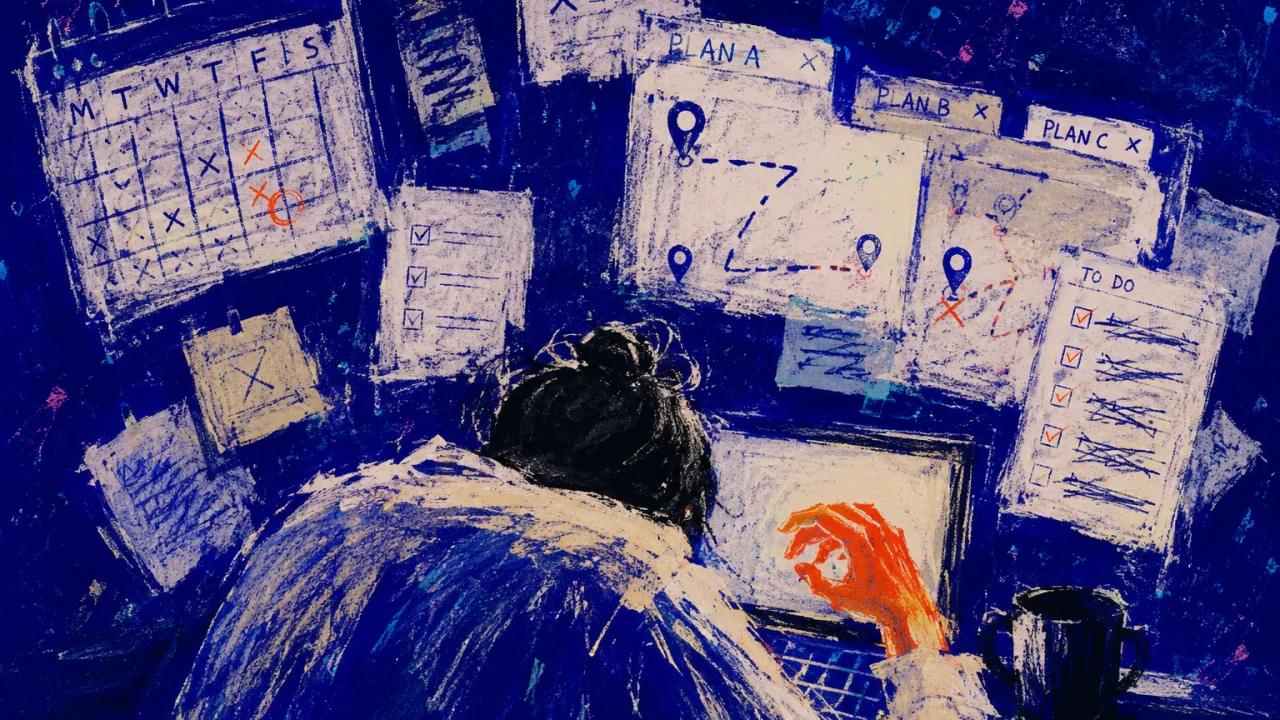
A seated figure with locked shoulders, surrounded by calendars, tabs, and paper routes pressing inward from every side

What is this situation?

Planning Paralysis — you sit down to make a plan, and the plan immediately turns into another place where everything is asking for proof before you have even started. There is the blank document, the calendar grid, the open notes app, the half-built budget, the unread advice threads, the saved videos, the group chat asking what your next move is, and the deadline that keeps getting closer while every option seems to need three more decisions attached to it. You try to choose a course, a job move, a trip, a move-out date, a creative launch, or even a simple weekly schedule, but each route comes with hidden admin: costs to compare, messages to send, people to update, risks to explain, and backup plans to build in case the first plan falls apart. The world around you keeps rewarding certainty, clean timelines, and polished answers, so your planning space becomes crowded with other people's expectations, platform checklists, productivity templates, and the quiet pressure to make the right move on the first try. Your body stays at the desk long after the useful part is over: shoulders locked, chest tight, eyes moving between tabs, hand hovering over the keyboard without committing to the first sentence. By the end, you have not done nothing; you have spent hours carrying the weight of every possible path before any path has been allowed to become real, much like the figure on the Seven of Cups, standing before a cloud of glittering choices that look vivid from a distance but refuse to become solid ground.

Why it's not you?

The issue is not that you are lazy, vague, or bad at making decisions; the situation is built to make every next step look overexposed and high-stakes. Too many options, too many comparison points, and too much pressure to produce a flawless plan can turn ordinary planning into a room with no clear exit. That pressure belongs to the setup around you, not to a personal defect.

Planning Paralysis in Tarot Cards

That tightness in your chest when the calendar, tabs, and notes keep asking for one perfect next step is part of Planning Paralysis, not a private failure. The environmental pressure comes from too many moving parts, the structural demand to optimize every choice, and the dynamic of being held accountable before anything has even begun. The cards below do not decide for you; they reflect the shape of being surrounded by options, deadlines, and half-built routes. Here are the Tarot Cards that tend to mirror this kind of situation.

The Fool
Reversed
The traveller's raised foot hangs at the cliff edge while a small bundle carries only what can realistically be known at departure. Under reversed pressure, that threshold stops representing open exploration and becomes a checkpoint where every risk, cost, and contingency is expected to be resolved before the first move. You can then spend the entire action window trying to make an uncertain life transition look pre-approved. The paralysis is not a shortage of ambition; it is the structural demand to prove that an untested path is safe before the path has generated any evidence.
The Magician
Reversed
The wand, cup, sword, and pentacle are all present on the Magician's table, yet under reversed pressure they read as a crowded inventory rather than a coordinated working system. Each tool can become another template, app, framework, or standard that must be mastered before your actual plan is considered credible. You may therefore appear fully resourced while remaining unable to convert resources into a first test. The blockage sits in the planning architecture: attention is distributed across proving readiness with every tool instead of allowing one tool to produce incomplete but usable evidence.
The Chariot
Reversed
The black and white sphinxes face the road as opposing forces, while the armoured driver holds no visible reins. Reversed, the vehicle's strong presentation cannot compensate for the absence of a practical mechanism that would align conflicting deadlines, values, costs, and expectations. You can look highly intentional while remaining stationary because each part of the plan is trying to optimise for a different future. The paralysis becomes legible as a direction-setting bottleneck: movement is blocked until the plan stops pretending that every competing priority can lead at once.
The Hanged Man
Reversed
The figure remains suspended by one ankle beneath a halo that would ordinarily suggest a perspective gained through pause. Under reversed pressure, the fixed position stops opening a new view and instead becomes a waiting loop in which another review, comparison, or contingency check merely extends the same uncertainty. You can stay at the desk beyond the useful planning period because postponement still looks intellectually responsible. The cost becomes visible in time rather than effort: the deadline keeps moving closer while the suspension prevents real-world feedback from entering the plan.
Seven of Cups
Upright
The solitary figure faces seven containers of radically different possibilities, each vivid enough to become a potential future self. Because the cups remain in a cloud, vision is abundant while the ordinary repetitions required to develop any one identity are absent from view. You can accumulate goals, systems, and reinvention plans without being allowed an unfinished version of growth. The upright card locates the blockage between imagination and embodiment: the future remains rich in symbolic options, but practice cannot stabilise while every identity stays equally open.
Seven of Pentacles
Reversed
The worker leans on a tool and studies seven pentacles growing on a vine, holding labour and evaluation inside the same field. Reversed, the pause no longer functions as a useful progress check; it becomes repeated appraisal of returns that cannot yet exist because the plan has not received a full cycle of action. You may keep recalculating whether the project, course, routine, or move is worth beginning as the available window contracts. The timing bottleneck is circular: the plan must prove its value to earn investment, but only investment could create the evidence being requested.
Eight of Pentacles
Reversed
The artisan sits at a bench carving one pentacle while a series of completed pieces is displayed beside him and the town remains in the distance. Reversed, the workshop becomes a closed proof loop in which another revision, credential, portfolio edit, or planning document is always required before the work can meet the outside world. You can spend substantial labour on a career move without gaining the feedback that an application, pitch, or conversation would provide. The paralysis is embedded in the production standard: preparation remains measurable and private, while release is treated as an unjustifiable risk until the professional narrative looks complete.
Knight of Pentacles
Reversed
The Knight sits on a motionless horse, holding one pentacle with concentrated care above methodically worked fields. Under reversed pressure, steadiness hardens into immobility: the schedule, budget, or routine must account for every disruption before the horse is permitted to take an ordinary step. You can keep improving the operating system of your life while daily life remains paused outside it. The resource is present and the terrain is prepared, but the path is blocked by an overcontrolled standard of consistency that leaves no room for a messy first week or a revisable routine.
Two of Swords
Upright
The blindfolded figure holds two swords crossed at equal height, with a rocky sea and crescent moon behind her. The posture physically preserves a deadlock: neither option is permitted to move, while the unstable environment confirms that complete visibility is unavailable. You can keep both plans alive to avoid choosing under imperfect conditions, especially when other people expect a defensible answer. The upright balance offers temporary protection, but it also reveals the cost of treating neutrality as a permanent plan: time and external circumstances continue moving even while the choice architecture stays fixed.
Eight of Swords
Upright
The eight upright swords create a threatening perimeter around a figure whose vision and movement are restricted, while open space still exists between the blades. That arrangement mirrors a growth plan built from so many rules, warnings, and optimisation criteria that every next step appears to violate something important. You can mistake restricted visibility for the absence of a route when the planning system asks cognition to eliminate all risk before experience begins. The card locates the bottleneck in the enclosure itself: protective knowledge has accumulated past usefulness and now blocks the feedback required for further learning.
Page of Swords
Reversed
The Page holds a raised sword in a windswept landscape, surrounded by moving clouds and airborne signals. Under reversed pressure, that alert posture becomes scattered information management: each new course review, study method, advice thread, or notification redirects attention before a learning plan can stabilise. You can look intensely engaged with education while remaining outside the sustained work of one course or assignment. The blockage is not lack of curiosity; it is an input system with no stopping rule, where researching how to study repeatedly replaces the bounded act of studying.
Two of Wands
Reversed
The figure holds a globe from behind a battlement, with one wand fixed to the wall and a broad landscape visible beyond it. Reversed, the high vantage point becomes a containment system: you can inspect the whole field while remaining physically separated from the conditions that would make one route real. You may keep enlarging the plan because strategic distance feels safer than partial commitment. The blocked direction is produced by a structural contradiction: the planning space demands complete visibility, but the missing information exists only beyond the wall, inside the move that has not been made.
Ten of Wands
Upright
The ten wands are bundled against the figure's body, blocking the view of the nearby town and forcing every responsibility into the same carry. The image directly mirrors a planning session in which calendars, costs, messages, errands, and contingency plans arrive as one undifferentiated workload. You have not done nothing; you have been carrying the coordination cost of every possible route before any route receives a sequence. The upright path remains technically open, but access depends on recognising that total responsibility has obscured the next visible step.

Planning Paralysis in Tarot Card Reading Insights

Planning Paralysis often shows up when people bring tangled timelines, competing options, and unfinished decisions into readings. The focus shifts from the cards themselves to what appears when someone sits with this kind of stalled planning loop. Tarot Reading Insights from sessions with this situation are gathered below.
Psychological Contexts Related to Planning Paralysis