An Hour at Collage Night Turns Productive Delay Into Lived Evidence

The 9:47 p.m. Deferred-Life Loop
You can be a competent mid-level designer, answer every Slack message, and still get the Sunday Scaries from seeing a perfectly organized week with nothing personally meaningful to look forward to. I have learned that a full calendar can still be evidence of an unlived week.
Maya (name changed for privacy) joined my video session from her small Toronto apartment at 9:47 on a Tuesday night. Three pottery studio tabs glowed beside the call window. Her radiator clicked through the microphone, her laptop fan kept up a thin mechanical hum, and blue screen light sharpened the tired half-moons beneath her eyes. When the registration page asked her to choose a date and pay a deposit, I watched her shoulders rise toward her ears.
She picked up her phone, then placed it face down. “I just need to get through this month,” she said. “Then I’ll feel like myself again. Except I said that last month. And the month before that.”
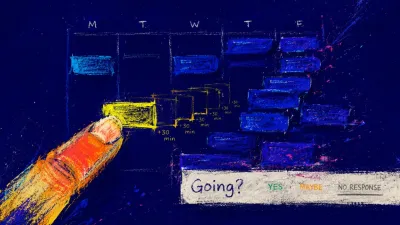
Her Google Calendar was already open. Agency deadlines, grocery shopping, laundry, dentist, and a Sunday meal-prep block all had their own colors. The pottery class was nowhere on it. Neither were the dinners, personal projects, or Toronto places carefully preserved in her Notes app. She kept saying she wanted a more creative, socially inhabited life, but whenever that life asked for a date, a deposit, or 30 real minutes, she reorganized practical tasks so she could begin properly later.
“I keep preparing for a life I’m not actually scheduling,” she said. “Nothing is seriously wrong, so I feel guilty even saying I’m unfulfilled. But I don’t want to waste time, and waiting is becoming the biggest waste.”
The longing in her voice sounded to me like a favorite song playing through the wall of the apartment next door: close enough to recognize, but muffled by a barrier she could not quite locate. Her mind was moving fast while her limbs looked weighted to the chair, and she pressed two fingers against the center of her chest when she imagined clicking “Register.”
“I don’t hear laziness or ingratitude in any of this,” I told her. “I hear a protective strategy that has stayed on duty longer than it was meant to. Let’s use the cards to map how that strategy works, what it protects, and where you still have room to choose. We’re looking for clarity, not a verdict.”

Choosing the Compass: A Five-Card Shadow Spread
I asked Maya to close the comparison tabs for the duration of the reading, place both feet on the floor, and take one slower breath while holding a single question: “Why do I keep putting fulfillment off while my life feels on hold?” I shuffled as a focusing transition, not as a performance of mystery. The point was to help her attention leave the browser maze and arrive in the room.
I chose the five-card Shadow Spread. For anyone curious about how tarot works in a practical reading, I use a spread like this as a structured cognitive map. The cards do not remove agency or predict an unavoidable future. Their images help me separate a visible behavior from the hidden belief, protective need, available resource, and practical response beneath it. Card meanings in context matter more than dramatic declarations.
This spread suited Maya because she did not lack options. A three-card timeline might have described movement without explaining why the same delay kept surviving supposedly temporary busy periods. A full Celtic Cross would have introduced more context than this focused inner question needed. The Shadow Spread was precise enough to ask why postponement persisted without reducing the answer to poor time management.
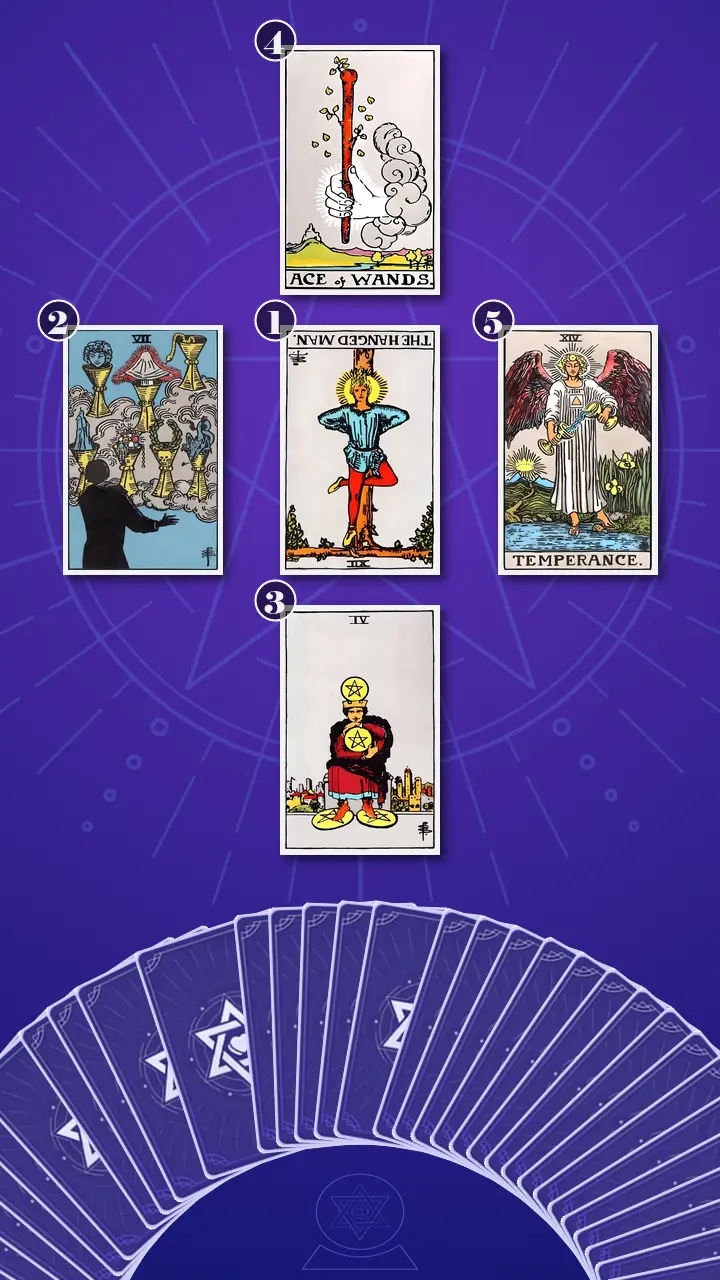
I placed the first card at the center for the visible holding pattern. The second went to the left for the hidden rule that made ideal timing feel necessary. The third sat below for the fear and protective function anchoring the pattern. Above the center, the fourth card would reveal the energy Maya could reclaim. The fifth waited on the right for integration: a repeatable way to let fulfillment and responsibility occupy the same real week.
From where I sat, the cross looked like a pause button opening into a compass. That was the professional rationale for the layout: I wanted to examine the central suspension from four directions, then follow the cards toward behavior Maya could adjust herself.
Reading the Pause from Four Directions
Position One: The Halo Above an Empty Calendar
I turned over the card representing the diagnosis-level behavior through which fulfillment was repeatedly postponed and the present had become a prolonged holding pattern. It was The Hanged Man, reversed.
I pointed to the suspended figure and the halo still shining around his head. Reversed, this was not a lack of self-awareness. Maya could already explain her behavior with impressive accuracy. The problem was that a once-useful pause had become a blockage: reflection was no longer producing a new perspective, yet the suspension continued because it still looked calm, careful, and responsible.
“This is you at 9:47 p.m. with the pottery page open,” I said. “You know exactly why you want the class, and you can explain every reason for postponing it. Then you move it to next month, open your task app, and spend the remaining hour maintaining a system that was already organized. The pause looks productive. The calendar evidence says another week contains preparation without participation.”
I gave voice to the refrain beneath the behavior: “I’m not avoiding it; I’m just waiting until this deadline is over, until work settles, until I can choose the best studio, until I can give it the energy it deserves.” Each reason could be individually sensible. The pattern became visible only when I placed them beside the repeated outcome.
Maya gave a short laugh, but there was no amusement in it. “That’s so accurate it’s kind of brutal.” Her fingers stopped moving over the trackpad.
“Accurate doesn’t have to mean condemning,” I replied. “The pause may once have protected your workload, money, or energy. I’m only asking whether it is still serving that job. The Hanged Man’s halo tells me you are not short of insight; you are short of lived evidence.”
I asked what she had done with the last evening she protected from a meaningful plan. She looked toward the open calendar. “I reorganized my Figma files, watched half an episode of something, and checked Slack even though no one needed me.” The card had not accused her. It had made the cost measurable.
Position Two: Seven Tabs, Seven Future Selves
I turned over the card representing the hidden belief that an ideal possibility or future condition had to be identified before meaningful participation could begin. It was Seven of Cups, upright.
The silhouetted figure faced seven cups floating in clouds, each containing a different promise or threat. I read this as an excess of imaginative Water: possibility had become so emotionally loaded that one ordinary test expanded into a referendum on Maya’s identity. Pottery was no longer just one evening with clay. It carried a possible creative self, future friends, cost, aesthetic taste, disappointment, and all the other interests she might lose by choosing it.
“Your browser has become the modern version of these cups,” I said. “There’s a pottery tab, an improv tab, a climbing tab, a Substack guide, a Montréal weekend plan, and a video called ‘Best Hobby for Your Personality.’ Before you touch one option, you imagine the complete life attached to each one.”
She smiled ruefully. “Exactly. If I pick pottery, I start wondering whether I’m actually a pottery person. Then I think maybe writing would fit me better. Then I’ve somehow turned Thursday night into a five-year strategy decision.”
I told her it reminded me of browsing a streaming service for an hour because choosing one imperfect film feels worse than watching nothing. The behavior can feel like freedom because every option remains available, but it produces no direct experience. Keeping every option open can become its own closed door.
The card did not tell Maya which hobby was secretly destined for her. It revealed that demanding the ideal future choice was producing the choice paralysis. The useful question was smaller: Which possibility deserved one test before being asked to represent an entire life?
Her gaze moved from the card to the three closed studio tabs. Her jaw loosened slightly. “So not knowing whether it’s ‘really me’ isn’t a reason I can’t try it,” she said. I nodded. “It’s a reason to gather evidence.”
Position Three: The Evening Held Too Tightly
I turned over the card representing the protective function of postponement and the fear that an imperfect beginning would reduce Maya’s control. It was Four of Pentacles, upright.
I centered the interpretation on the pentacle pressed against the figure’s chest and the two coins pinning his feet in place. The Earth energy had moved into excess. Conservation had become immobility. What looked like sensible protection of time, energy, money, and optionality was also preventing those resources from circulating toward an experience.
I asked Maya about the last manageable invitation she had declined. She told me about a friend’s Friday text: an $18 collage night near Ossington, starting in less than an hour. She had checked the commute, Monday’s workload, the cancellation policy, and the slush outside. Then she had pressed the phone to her chest while the risk clauses arrived one after another: “What if I’m tired? What if it isn’t worth the money? What if I need the evening later?”
She had protected the $18 and kept the evening open. Work Slack and half-attentive Netflix had quietly spent the time instead.
As I named that tradeoff, her breathing paused. Her fingertips tightened around the edge of her sleeve, and her eyes lost focus for a moment as though she were watching the Friday evening again. Then she released the fabric and exhaled through her nose.
“It wasn’t really the money,” she said. “It was the idea of being tired, paying for something mediocre, and realizing I’d chosen badly.”
“That makes sense,” I said. “The Four of Pentacles is not calling your boundaries a flaw. Toronto costs are real. Work capacity is real. This card asks us to distinguish a real limit from automatic resource guarding. One protects your wellbeing. The other preserves control so completely that your time cannot become anything you value.”
I asked her to finish a sentence: “Keeping that evening open protected me from...”
“Being disappointed,” she answered. After a pause, she added, “And from finding out that doing something I want might still feel ordinary.”
That was the root. If fulfillment stayed imagined, it could remain perfect. If she entered it, it might be awkward, overpriced, merely pleasant, or not for her. Postponement protected the fantasy and her sense of control, but it also kept ordinary life at a distance.
Position Four: The One Living Spark
I turned over the card representing the desire and capacity Maya could reclaim to convert longing into one small lived experiment. It was Ace of Wands, upright.
A hand emerged from a cloud holding one sprouting wand. Unlike the inaccessible cups and the clutched coin, this was a single available offer. I read its concentrated Fire as the energy that had been deficient in Maya’s pattern: not more ambition, but direct contact. The Ace did not demand a reinvention. It asked for one beginning small enough to survive reality.
“This is one clean calendar square,” I said. “Wednesday, 7:00 to 7:30. You attend, make, write, walk, or explore with what is already available. You do not need to know whether the activity will become part of your identity. You only need to notice whether there is enough spark to try it once.”
I was careful not to translate Fire into pressure. Maya already knew how to force herself through work. The reclaimed resource was curiosity without a performance contract. The point of a small beginning is information, not proof.
Her posture changed before she spoke. She moved back from the screen, lowered both shoulders, and glanced toward a shelf outside the camera frame. “I have a sketchbook I bought last year,” she said. “I could use that for half an hour. No supplies. No registration. I can’t turn it into a research project.”
“You probably can,” I said, and she laughed properly this time. “But you can notice the impulse and close the tabs. The Ace is balanced when the spark enters a bounded action. It becomes excess if you suddenly design a five-day creative routine, and it becomes blocked if you make the first attempt wait for perfect equipment.”
When Temperance Found the Missing Beat
Position Five: Two Cups in the Same Week
The radiator behind Maya gave one final metallic knock and fell quiet. In the sudden stillness, I turned over the card representing the repeatable way fulfillment could enter ordinary life rather than waiting beyond the next milestone. It was the key card: Temperance, upright.
I drew her attention to the water moving continuously between two cups, and to the angel standing with one foot on land and one in water. I read the energy as Balance: practical limits and felt meaning were not opponents taking turns. They were two parts of a mixture that could be adjusted while it was being lived.
In Maya’s week, one cup held agency deadlines, errands, money, health, and rest. The other held the Wednesday pottery session, a creative half-hour, dinner with a friend, or anything that made her feel present rather than merely maintained. Temperance did not ask her to empty the first cup. It asked why the second one had been kept dry.
I brought her back to the exact loop. It was 9:47 p.m.; the class page was open; three studio tabs waited beside it; and one hand was already moving the plan into next month. Her body was bracing as if a single Wednesday choice could destabilize the entire month.
This was where I used what I call a Tempo Misalignment Audit. After ten years of sound energy research, I have learned to listen for the difference between desire and pacing. Maya’s vision of fulfillment was playing at album-release tempo: the right hobby, the right studio, a lasting routine, and a transformed future self. Her actual Tuesday-night capacity could support one quiet beat. Because those tempos did not match, every start felt like pushing against a wall.
I thought of the mixing desks I had studied, where a track can disappear not because the sound is absent, but because one channel has been muted while another is driven too hard. Maya had kept the responsibility channel high and told herself meaning could come in after the mix was finished. Temperance offered a different calibration: bring one meaningful channel up to an audible level now, then adjust it using real feedback.
Your life does not begin after every condition is solved; blend one source of meaning into the week you already have, as Temperance keeps water moving between both cups.
For one beat, Maya did not relax. Her inhale stopped halfway, her thumb hovering above the trackpad. Then her eyes moved off-screen and held there, as if she were replaying every “next month” she had said for a year. Her mouth tightened. “But doesn’t that mean I’ve been doing this wrong the whole time?” she asked, with a quick flash of anger that sounded almost protective. I kept my voice level. “No. It means waiting helped you manage uncertainty until the help became too expensive. We’re updating the strategy, not prosecuting the person who needed it.” Her fingers curled once, then opened. The anger thinned into grief; her eyes brightened, and her shoulders dropped so suddenly that she looked briefly unsteady without the tension holding them up. She let out a long, trembling breath. “Oh,” she said. “I wasn’t waiting to find the right life. I was trying not to find out that a real one might be only... ordinary.” A second later she gave a small laugh. “And now I actually have to choose a Wednesday.”
I asked, “Now, with that new perspective, think back to last week. Was there a moment when this insight might have made you feel differently?”
She returned to the collage invitation. “I could have gone for the first hour,” she said. “I was treating it like I had to endorse the whole night in advance. I didn’t think I was allowed to adjust the amount.”
“That is Temperance in daily life,” I told her. “You can adjust the amount without erasing the thing.” Fulfillment was not the prize for finally getting life under control. It was one of the ingredients that could make her present life feel inhabited.
I asked her to open the saved plan that still had a genuine spark. Within ten minutes, she placed a 30-minute block on Wednesday evening and labeled it “experiment, not commitment.” She did not order supplies, compare providers, or design a permanent routine. If her capacity changed, she could shorten, move, or consciously cancel it. Choice remained hers.
I named the crossing carefully: this was one step from restless stagnation and conditional permission to lived experimentation, growing self-trust, and sustainable fulfillment within ordinary life. It was not a total transformation, and I did not present it as one. It was the first piece of evidence that responsibility and meaning could appear in the same frame.
The Two-Cup Weekly Blend
Once all five cards were visible, I traced the story through their hands. The Hanged Man’s hands were hidden while insight remained suspended. The Seven of Cups displayed possibilities that could not be touched. The Four of Pentacles clamped both hands around security. The Ace of Wands offered one living thing that could be accepted. Temperance finally used both hands to keep meaning moving.
Although this was not a timeline spread, its causal logic was clear. A useful pause had hardened into productive procrastination. Idealized future selves multiplied the pressure around every choice. Protecting time, money, energy, and optionality reduced immediate exposure to disappointment, but it also immobilized the resources Maya wanted to feel more alive. The Ace restored one direct impulse, and Temperance gave that impulse a sustainable rhythm.
I told Maya that her cognitive blind spot was treating nonparticipation as neutral. She believed she was keeping time available until she could use it well. In practice, low-priority admin, work spillover, and scrolling were already making the allocation. The absence of Swords reinforced the point: more analysis was not the missing resource. One clear criterion and one clearly scheduled commitment would add enough constructive Air.
She had been living in a departure lounge while waiting for a boarding announcement that never came. The cards did not tell her to board every flight or ignore the price of the ticket. They showed her that she could choose one local departure, learn from it, and revise the next one. Her life did not need to become completely settled before meaning entered it.
For actionable next steps, I used my Execution Rhythm Calibration approach. I looked for the exact points where her ambition exceeded her daily capacity, then reduced the first beat until it could coexist with an ordinary agency week.
Two Small Experiments, No Reinvention Required
- The One-Criterion Single-Spark TestBy Wednesday evening, open one item already saved in Notes. Apply one self-chosen criterion, such as “under $25 and reachable within 30 minutes” or “can begin at home with what I own.” Put the surviving option into one 30-minute block this week labeled “experiment, not commitment.” If another person is involved, send one concise message confirming only the time you can offer.Use one available option, one short test, and no upgrade. If 30 minutes is unrealistic, try the free five-minute version. Stopping after the test still counts as useful information.
- The Three-Day Syncopation ResetRun a three-day tempo adjustment instead of promising a new lifestyle. On day one, schedule the smallest workable beat beside your existing responsibilities. On day two, begin with tools already available and stop at the planned time. On day three, add three plain notes to the event: “energy before,” “what I actually did,” and “energy after.” Use those notes to keep, shorten, move, or discontinue the next two weekly blocks.Treat duration and frequency as adjustable settings, not moral promises. Protect genuine work, health, access, financial, and relationship limits. A conscious resize or boundary-based no is part of calibration, not failure.
I did not ask Maya to become more disciplined. She already had discipline in abundance. I asked her to stop assigning every source of meaning an entrance so large that her current life could not accommodate it. The key shift was modest and exact: move one meaningful activity from “when life settles” into a fixed 30-minute place, then let the experience supply information that another comparison tab could not.
A Week Later: Thirty Minutes of Evidence
Six days later, I received a message from Maya. She had used her under-$25 and 30-minute-transit criterion to choose the next collage night her friend suggested. She closed the other tabs, booked it, and told her friend she would stay for the first hour.
“It wasn’t life-changing,” she wrote. “The first collage was honestly ugly, and I felt awkward for about twenty minutes. Then I got absorbed in cutting out these ridiculous magazine flowers. I came home tired, but it was a different kind of tired. I was actually there.”
She had recorded her three notes. Energy before: guarded and tempted to cancel. What she actually did: attended for one hour and spoke to two people. Energy after: physically tired, mentally lighter. She moved the next meaning slot rather than deleting it because of an agency deadline.
She also told me that she slept through that night without checking work Slack. Her first morning thought was, “What if I picked the wrong thing?” Then she noticed dried glue on her sleeve and laughed. The doubt had not vanished; it had simply stopped running the calendar.
I considered that the quiet proof of our Journey to Clarity. Tarot had not selected a hobby, guaranteed fulfillment, or rescued Maya from uncertainty. It had made her rhythm visible. Maya made the booking, honored her limits, gathered the evidence, and chose the next beat. The agency was hers.
When I see hands staying busy to protect the very time, money, and energy they wish felt more alive, I remember the water between Temperance’s cups. Meaning does not have to wait beyond a completed life. It can enter the mixture in a small amount, be felt honestly, and be adjusted without shame.
If one imperfect half-hour could sit between your own two cups this week, asking for curiosity rather than proof, what saved possibility are you willing to give one real date?