One Missed Workout, a Rolled Mat—And the Shift to Tiny Reps

Finding Clarity in the 10:30 p.m. Notion Spiral
I knew exactly what kind of session this would be. If one skipped day turns into new labels, new streak rules, and a full routine reset before you have even unrolled the yoga mat, you are probably dealing with habit tracker perfectionism, not a lack of ambition.
Taylor (name changed for privacy) came onto my screen from her condo in Toronto at 10:30 p.m., still in work clothes, a rolled yoga mat leaning against the wall behind her like a quiet witness. Her MacBook threw that flat blue light across the room that every late-night dashboard seems to produce. I could hear the laptop fan, the soft fridge hum from the kitchen, the little clink of a spoon against a mug of tea that had already gone lukewarm. Her hands kept hovering over the trackpad even while she talked, restless, ready to rename something.
“I know this sounds ridiculous,” she said. “But if the tracker feels wrong, I can’t start. So I keep fixing the setup instead of doing the habit. Then I miss another day, and now it feels even worse.”
She worked in UX, which meant she spent all day inside systems, frames, flows, and friction points. By night, that same intelligence had turned inward. The whole problem sat right there between us: doing the habit versus perfecting the habit tracker first. Not laziness. Not a lack of desire. A control loop dressed up as self-improvement. Her frustration had the texture of trying to run five heavy apps on a phone that was already at 3%—heat, lag, and that oddly private panic that makes you tap faster instead of wiser.
I leaned in a little. “You’re not ridiculous. You’re doing something that looks like effort, which is exactly why this pattern is so hard to admit. We’re not going to turn this into a character flaw. We’re going to turn it into a map, and see where your energy is actually going.”

The Map I Use When the Tracker Becomes the Gatekeeper
I asked her to put both feet on the floor, close the settings tab for a moment, and say the habit out loud before I shuffled. It was a simple ritual, not for drama, but for focus. In my practice, tarot works less like fortune-telling and more like an honest interface audit of the psyche: it shows me the visible pattern, the hidden pressure, the medicine, and the next step.
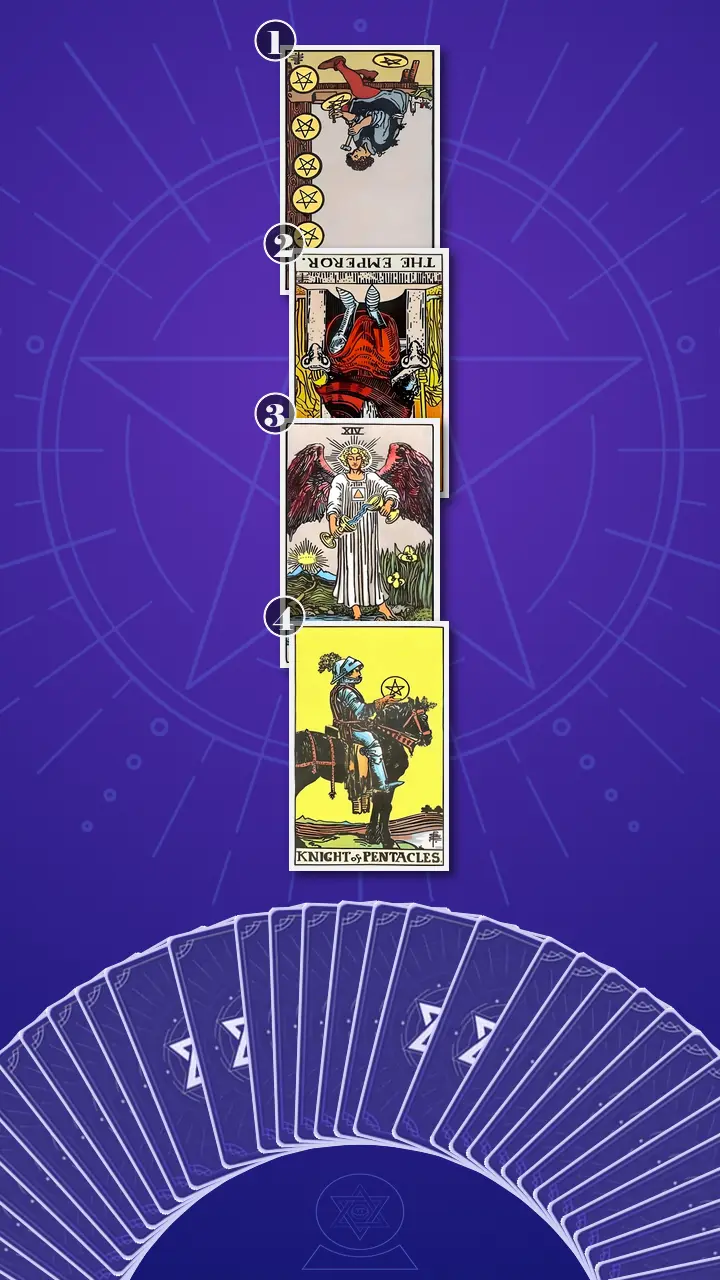
For a question like “Why do I keep tweaking my habit tracker instead of doing the habit?”, I chose The Shadow Spread. When the issue is a compact, sticky loop of productive procrastination, I do not want ten cards and five side roads. A bigger spread can accidentally imitate the same over-engineering that is already exhausting the person in front of me. This four-card structure is cleaner. It moves from symptom, to shadow, to medicine, to embodiment.
I told Taylor exactly how I would read it. The first card would show where her effort was visibly being diverted. The second would reveal the hidden rulebook underneath it. The third would name the reframe that could loosen the control pattern. The fourth would tell us what this insight looked like in a real week, not an ideal one.
Reading the Closed Loop of Productive Procrastination
The Worker Bent Over the Wrong Bench
The first card I turned over represented the conscious pattern currently visible in everyday life: how effort gets spent on tracker design, rule edits, and optimization instead of the habit itself.
It was the Eight of Pentacles, reversed.
I had to smile, because the image was almost painfully literal. In the Rider-Waite-Smith deck, a craftsperson bends over a bench, working pentacle after pentacle. Reversed, that devoted craft energy had slipped sideways. “This,” I told her, “is the late-night Notion spiral. The effort is real. The intention is real. But it’s going into the interface around the habit, not the habit itself.” It was like building a beautiful dashboard for data that did not exist yet. Or wireframing the habit over and over without ever shipping version one.
The inner monologue of this card is sincere at first: I’m just trying to get back on track. And then, almost invisibly, it turns into avoidance: once I fix this, then I’ll start. That’s why this kind of productive procrastination is so convincing. It can look like self-awareness. It can look like responsibility. It can even look like care.
Here I used one of the lenses I’ve developed in my work, something I call Compensatory Routine Decoding. When I see someone spend forty minutes renaming categories, changing icons, and rewriting streak rules after missing a five-minute task, I do not read it as a discipline failure. I read it as a coping mechanism. Reorganizing the tool creates visible progress and a quick burst of hope, which temporarily covers the sting of “what if I try again and prove I still can’t stay consistent?” A better tracker can organize your intention. It cannot do the habit for you.
The energy here was blocked Earth: practical effort, but misdirected. The hands were busy. The practice was absent. This was the exact trap where a ten-minute template tour, a Sunday reset video, or a cleaner app layout quietly takes more time than the two sun salutations waiting three feet away.
Taylor gave a short laugh that landed with more ache than humor. “That’s… kind of brutal,” she said. Then she rubbed her thumb against the side of her index finger, like she could sand down the truth of it.
The Inner Manager on the Stone Throne
The next card represented the hidden driver beneath the loop: the control-based fear and rigid self-management style that kept action frozen.
The Emperor, reversed.
I felt the room narrow in the useful way it sometimes does when a reading stops circling the symptom and touches the mechanism underneath. “This isn’t a motivation problem,” I said. “It’s an inner authority problem.” The stone throne, the armor, the barren mountains—everything in the card pointed to a rulebook so severe that ordinary human effort could barely get through airport security.
In real life, this is the voice that says: the workout only counts if it’s the full version. The reading only counts if it happens in the ideal morning block. The journal entry only counts if you have the right prompt, the right pen, the right uninterrupted stretch of time. Anything partial gets dismissed before it begins. If partial effort never counts, consistency never gets a place to grow.
From a Jungian lens, this was her inner ruler turned punitive—less supportive structure, more impossible performance review. I have heard versions of this in apartments, cafés, and late-night calls across different cities, and the language changes less than people think. The shame still lands in the same places. The jaw locks. The shoulders lift. The hands hover over the tool instead of touching the actual life in front of them.
“So what, I just lower the bar forever?” Taylor asked, and there it was—the first flash of resistance, sharp and practical. “Because that sounds like how I end up doing nothing serious.”
“No,” I said. “You replace a harsh rulebook with one humane minimum. The problem isn’t that you care. The problem is that your standards are acting like surveillance. Your tracker has become a judge instead of a witness.”
She went very still, then let out a slow breath through her nose. Her eyes dropped to the desk. I watched the muscles at the corners of her mouth loosen just a fraction—the kind of softening that isn’t agreement yet, but recognition.
When Temperance Poured Between Two Cups
The Card That Shifted the Entire Reading
The room changed when I turned the third card. This was the position that names the transformation lever—the medicine, the balancing truth, the antidote. In this spread, it was the hinge where the energy stops collapsing inward and starts moving again.
Temperance, upright.
Before I said anything else, I took in the whole scene one more time: the blue laptop light, the rolled mat, the dry-screen blink, the shoulders still half-lifted from a day inside Figma, Slack, client calls, and self-monitoring. She had been treating consistency like a design problem because design was the language in which control felt safest.
Stop worshipping the perfect template; start pouring one small action into the next, like Temperance teaching rhythm over control.
I let that sit between us for a beat.
Then I gave her the plain-language version. “Your consistency isn’t hiding inside a better template. It starts the moment you let an imperfect rep count.”
She didn’t soften right away. First came the freeze: her breath paused mid-inhale, and her fingers stopped over the trackpad as if someone had cut power to the whole loop. Then came the cognitive hit: her focus blurred, not dramatically, just enough that I could tell she was replaying a dozen ordinary evenings—the missed workout, the rewritten rule, the clean-restart fantasy. Then the feeling arrived, more complicated than relief. Her jaw unclenched. Her shoulders dropped an inch. And with that release came a flicker of anger. “But doesn’t that mean I’ve been making this so much harder than it had to be?”
“It means you were trying to feel safe,” I said. “That is not the same thing as being foolish.”
This was the moment I brought in another framework from my own practice: a Psychological Bandwidth Audit. Before I ask whether someone has enough discipline, I want to know how much usable energy has already been burned off by subconscious anxiety, comparison, self-monitoring, and tiny control negotiations. By 10:30 p.m., Taylor’s bandwidth was already leaking through icon edits, streak math, dry-screen fatigue, and the fear of letting one plain missed day stay visible. Of course the full workout felt impossible. The system had drained the very reserves it claimed to organize. Temperance was not asking her for more force. It was asking her to stop bleeding energy into control.
I pointed to the card: one foot on land, one in water; cups pouring continuously between them; a path running quietly toward sunrise. “This is not an on-off switch,” I told her. “It’s a dimmer switch. It’s the difference between wireframing your consistency forever and shipping a tiny, usable version into real life on a tired Tuesday. Structure and flexibility do not have to fight each other.”
Her eyes brightened then, but in that fragile way clarity often arrives—less like fireworks, more like a room finally being ventilated. She pressed the heel of her hand once against her sternum and exhaled. “Okay,” she said. “So the goal isn’t to feel perfectly ready. The goal is to let the small version be real.”
“Exactly,” I said. “That is the first move from frustrated self-surveillance and control-seeking toward steadier self-trust and a workable rhythm.”
Self-trust is built by reps, not redesigns.
I asked her, “Now, with this new lens, think back to last week. Was there a moment when this would have changed the whole night?”
She nodded almost immediately. “Wednesday. Late client call. I had eight minutes. I could’ve stretched for two and been done. Instead I opened the app.”
Boring Tuesday, Real Evidence
The fourth and final card represented the practical expression of the insight: the kind of grounded next step that interrupts the loop through embodied repetition this week.
The Knight of Pentacles, upright.
After Temperance, this card felt wonderfully unglamorous. A still horse. One pentacle held steadily. A worked field. Not a Sunday reset montage. Not a personality makeover. Just dependable follow-through. “This,” I told her, “is the version of you who does the five-minute habit on an ordinary Tuesday without redesigning anything first, logs one simple mark, and moves on. Not glamorous, not optimized, still done.”
The energy had returned to Earth, but in balance this time: grounded, slow, embodied. No frantic optimization. No swinging to the other extreme and deleting every tool in rebellion. Just boring consistency. Boring is not failure here. Boring is the win.
She smiled for the first full time that night. It wasn’t huge. It was quieter than that, the kind of smile that says the solution might actually fit inside a real week.
The Tracker Freeze Week
By then, the whole story of the spread had become clean. The Eight of Pentacles reversed showed effort scattered into management instead of practice. The Emperor reversed showed why: a rigid inner manager kept moving the spec and calling it discipline. Temperance interrupted that control loop by teaching rhythm over perfection. And the Knight of Pentacles translated that insight into behavior—small, grounded, repeatable action under ordinary conditions.
The blind spot was not that Taylor lacked ambition. It was that she had been confusing the emotional relief of looking organized with real progress, and outsourcing self-trust to the tool. That is what makes habit tracker perfectionism so sticky after missed days: the tracker starts to feel like a gatekeeper, and the actual habit becomes theoretical. The shift we were after was simple, but not shallow—stop treating consistency as a design problem to be solved by better setup, and start treating it as a repetition problem solved by small, imperfect reps. The tracker should witness the habit, not audition it.
I gave her a short set of next steps. Clear. Actionable. Small enough to survive a real week.
- Tracker Freeze WeekPick one tracker for the next seven days exactly as it looks tonight. Take a screenshot, freeze the layout, and make no edits midweek—not on your phone, not in Notion, not in the app. If the urge to tweak hits on the streetcar home, after a missed day, or during a Sunday reset spiral, drop the idea into one note called “Next Sunday” and leave it there.If seven days feels too edgy, start with three. The discomfort is part of the experiment; it is not proof that the experiment is wrong.
- Minimum Viable RepWrite one humane rule in Apple Notes or on a sticky note: “This habit counts if I do the tiny version.” Define that version so it fits inside a tired weekday—two sun salutations, five pages, one Duolingo lesson, a five-minute walk, one dish load. Attach it to one transition you already have this week, like right after shutting your laptop, after brushing your teeth, or while the kettle boils. Then do that version before you open any settings.If your brain calls this cheating, let it complain in the back seat. You are testing a floor, not choosing a ceiling for life.
- The Ego Unplugging ProtocolRight before logging, pause for ten seconds and say: “Tonight’s checkbox is data, not a verdict.” Then use one neutral binary mark only—a check, a dot, or the word “done”—after the habit, not before. This mental boundary detaches your self-worth from the dashboard and stops the delayed-return anxiety that makes every miss feel like character evidence.If the app still feels charged, log on paper for the week. Light-touch tracking counts too.
I told her to think of the week ahead less like a cinematic restart and more like a low-fi prototype. No over-polishing. Real use. Real feedback. That is how self-trust becomes earned instead of theorized.

A Week Later, the Quiet Proof
Six days later, Taylor sent me a voice note while waiting for the kettle to boil. She sounded almost amused. “I left the missed day there,” she said. “No edits. I did two sun salutations before I could talk myself into settings, and then I logged one check. It was weirdly boring.”
That was the proof. Not that her life had become frictionless. Not that she would never feel the pull of a cleaner template again. The proof was smaller and better: she had stopped asking the tracker to make her trustworthy and started letting repetition do that work.
The next morning still brought a flicker of the old thought—what if I drop it again?—but this time she smiled at it, put the phone face down, and did the tiny version anyway. In a Shadow Spread tarot reading for habit tracker perfectionism and productive procrastination, that is what finding clarity often looks like: not a perfect answer, but an ordinary act that finally lines up with reality.
Sometimes the most exhausting part is not the five-minute habit itself, but the moment your jaw tightens and one missed day starts to feel like evidence against your ability to trust yourself at all. If tonight is one of those nights for you, I hope you remember the image Temperance gave us: one small pour into the next, one plain check after, no ceremony required.
If one imperfect rep were allowed to count this week, what tiny version of the habit would feel honest enough to try before you touch the settings?
Every reading at AceTarot is a Journey to connect with inner wisdom and empower next step.
Learn more about our Journey to Clarity.